Key takeaways
- Non-Muslim expats can use a DIFC will or an Abu Dhabi non-Muslim will, and each has its own scope and rules.
- Indian immovable property is generally governed by Indian law, so a separate Indian will is usually advised.
- Never put private keys in a will; use a separate secure access plan referred to in the will.
- Get UAE-licensed and Indian advice together so that the documents do not conflict.
Crypto inheritance planning UAE residents need often fails at a simple point: the family cannot find the assets or cannot get access to them. A will helps only if it is valid where it will be used, names the assets in a way an executor can act on and fits with the law of the country where each asset sits. Indian expats in Dubai also have property back home, so one document may not be enough.
This guide compares two routes for non-Muslim expats, a DIFC will and an Abu Dhabi non-Muslim will, and explains how each interacts with crypto, UAE assets and Indian property. Courts, rules and fees have evolved quickly, so treat the description as a map, not a plan. Take advice from a UAE-licensed lawyer for UAE law and an Indian lawyer for Indian assets. Crypto inheritance planning UAE families rely on should be reviewed whenever assets, wallets or residence change.
Why a will matters for expats
Without a will, the default rules of succession apply, and for an expat those rules may be the law of the UAE, the law of the home country or a mix, depending on nationality, religion and the location of the asset. Non-Muslim expats were historically exposed to Sharia-based default rules unless they had a registered will or could apply their home law. A properly registered will lets you choose who inherits and who manages the estate.
The UAE has created routes for non-Muslim expats. The DIFC Wills Service Centre has registered wills for non-Muslims for several years, and Abu Dhabi introduced a non-Muslim civil family law and court that includes wills. Dubai Courts also offers will registration for non-Muslims. Details differ on who can use each, what assets are covered and how guardianship is handled.
Choosing the route is therefore a practical decision, not a status symbol. Ask where your assets are, where your family lives, which court would deal with the estate and whether the document will be recognised in India or elsewhere. Think about a separate will for each country if that is simpler. Good crypto inheritance planning UAE lawyers recommend starts with a list of assets and the law that governs each.
DIFC will and Abu Dhabi will compared
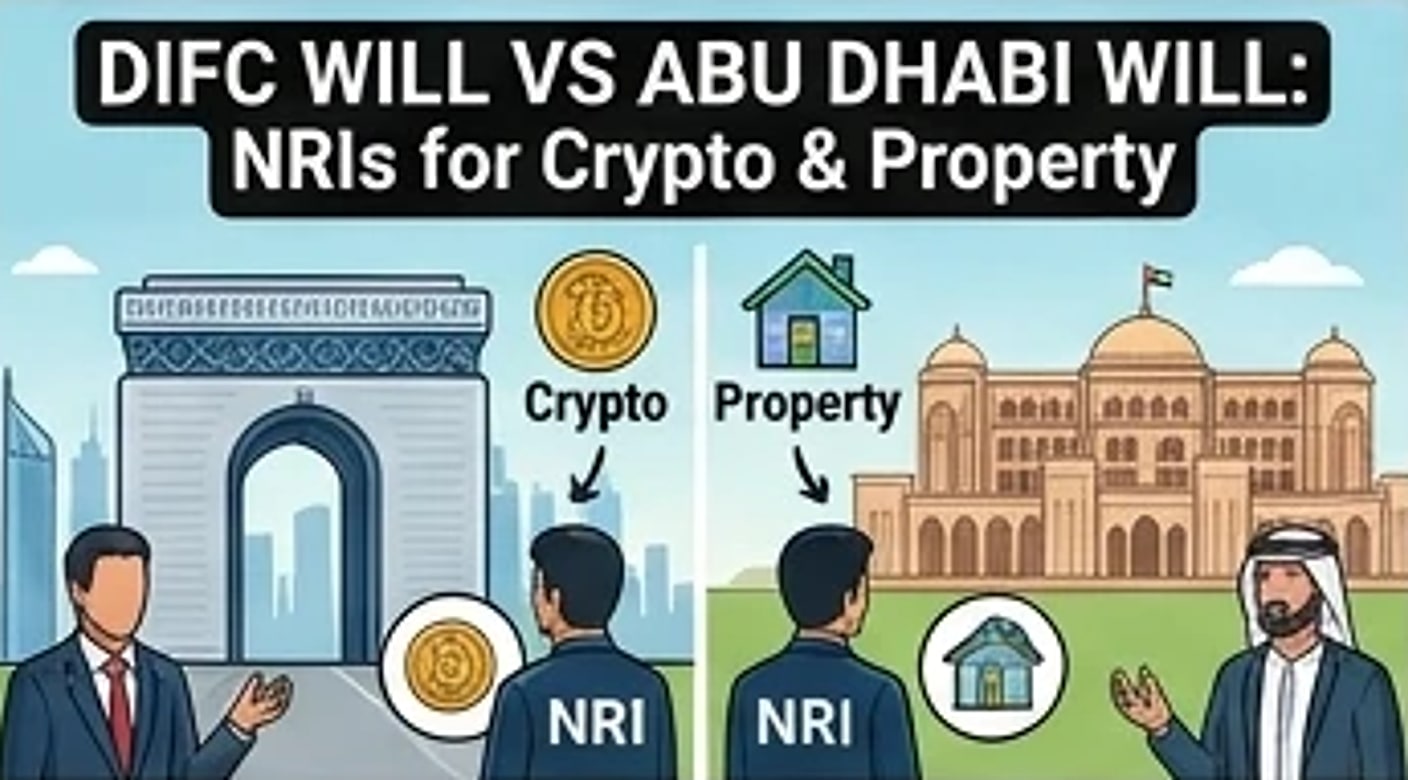
A DIFC will is made under the DIFC Wills and Probate regime and registered with the DIFC Courts. It is drafted under common law principles in English, and the DIFC Wills Service Centre has been a popular route for expats with UAE assets such as property and bank accounts. Commentary says the DIFC regime can cover assets in the UAE and, in some cases, assets elsewhere if the will is drafted to do so. Registration and fees should be checked with the Centre.
| Point | DIFC will | Abu Dhabi non-Muslim will |
|---|---|---|
| Regime | DIFC wills and probate | Abu Dhabi civil family law for non-Muslims |
| Registered with | DIFC Courts | Abu Dhabi Judicial Department |
| Language and style | Common law, English | Local statutory form |
| Typical use | UAE assets and property | Residents and property in Abu Dhabi |
| Indian property | Needs a separate Indian will | Needs a separate Indian will |
An Abu Dhabi non-Muslim will is made under Abu Dhabi’s civil family law for non-Muslims and registered through the Abu Dhabi Judicial Department’s family court. It is designed for residents of the emirate and for people with property there. Its approach to inheritance, guardianship and recognition can differ from the DIFC will, which is why you should not assume that one is a substitute for the other.
Some people hold more than one will, which creates a risk of conflicts unless each will is carefully limited to specific assets and expressly preserves the others. Overlap can cause disputes and delay. If you hold both a DIFC and an Abu Dhabi will, take advice on scope, revocation and priority. Do not rely on online summaries for this point.
Crypto: the practical problem
Digital assets in a will UAE lawyers draft need precision. Name the types of assets, the platforms or wallets, who can access them and how. Do not put private keys or seed phrases into the will itself, because a will becomes a public or semi-public document in probate and the keys would be exposed. Use a separate, secure instruction that the executor can find, such as a sealed letter or a custodian arrangement.
Private keys inheritance crypto planning is a security problem and a legal problem. If the keys are lost, no court can restore the assets. If an exchange holds the assets, the exchange will follow its own process and demand documents such as a grant of probate or a court order. Self-custody needs a documented plan for access, with a trusted person and a backup method that avoids a single point of failure.
Also consider tax and reporting. Keep a record of what you hold, acquisition costs and where assets are held, because beneficiaries in India may face reporting duties and tax questions on receipt or sale. Review the plan whenever you change wallets, exchanges or family circumstances. Regulation of virtual assets is evolving, and so is treatment of them in succession. In short, crypto inheritance planning UAE courts can respect needs both a valid will and a workable access plan.
Indian property and cross-border issues
A will for Indian property made in UAE can be valid in India if it meets Indian requirements for execution, such as signature and witnesses, but succession to immovable property is generally governed by the law of the place where the property is located. Indian property therefore needs a will that works under Indian law, and many advisers recommend a separate Indian will. A will that is valid in the UAE but ignored by an Indian authority is not helpful.
Probate may be required in India in some cases, for example for wills of Hindus made in certain cities or concerning property there, and the process can be slow. Mutation of property records, bank claims and shares transmission each have their own procedures. Gather title documents, nominee details and account information now and keep them with your estate file.
Coordinate the documents. Make sure the UAE will, the Indian will and any trust or nomination do not contradict each other. Check nominations on bank accounts, insurance and mutual funds, which can pass assets outside the will. Review beneficiaries’ residence and tax position. This is complex enough that a joint review by UAE and Indian counsel is usually better than separate, uncoordinated advice. Crypto inheritance planning UAE and India both recognise works best when the documents are reviewed together.
Next steps and quick answers
List your assets by country, decide on separate wills, choose between registration routes with UAE counsel, set up a secure crypto access plan and review nominations. This is general information, not legal advice, and UAE law points need UAE-licensed counsel. Start crypto inheritance planning UAE residents can finish quickly by listing assets, then choosing the will route.
Related reading: crypto inheritance for NRIs in Dubai: wills and wallets, crypto inheritance in India: will and private keys, NRI property in India from Dubai, power of attorney from Dubai for Indian property, whether NRIs in Dubai can buy crypto and the UAE tax residency certificate for Indians.
Quick answers
What is the difference between a DIFC will and an Abu Dhabi non-Muslim will?
They are made under different regimes and registered with different bodies. Scope, fees, recognition and treatment of guardianship vary, so choose with UAE counsel based on where your assets and family are.
Can I put my crypto private keys in my will?
It is not advisable, because a will can become accessible. Use a separate secure access arrangement and refer to it in the will.
Does a UAE will cover my property in India?
Not reliably. Indian immovable property is generally governed by Indian law, so many advisers suggest a separate Indian will and coordination with the UAE will.
Can I hold both a DIFC will and an Abu Dhabi will?
It is possible but risks conflict unless each is limited to specific assets. Take advice on scope and priority.
Final word
Halverton & Co. is an Indian law firm advising NRIs, founders, investors and businesses in Dubai and across the UAE on Indian law, including cross-border estate planning for Indian expats, Indian wills, probate and succession, and digital asset holdings. We practise in Jharkhand, Maharashtra and before the Supreme Court of India, and work alongside UAE-licensed counsel, who advise on UAE law. Halverton & Co.: Where tech needs law! If you have a question about Indian law, write to us at office@halvertonandco.com, or get in touch.
This article reflects developments reported up to 31 October 2026. It is for general information only, is not legal advice, and does not create an advocate-client relationship. Halverton & Co. is an Indian law firm and does not advise on UAE law; UAE-law points should be confirmed with UAE-licensed counsel.
Sources
Related practice area
Crypto, Web3 & Digital Assets
Advice for virtual digital asset businesses on registration, reporting and structure.
View the practice areaComments
No account needed. Comments are reviewed before they appear, so yours will show here once approved. Please do not share confidential details or describe your own legal matter: replies are general discussion, not legal advice, and do not create an advocate-client relationship. For your own situation, write to office@halvertonandco.com.