Key takeaways
- In Bartz v. Anthropic, the court held that training on lawfully purchased books was fair use, while building a library from pirated copies was a separate problem that ended in a settlement.
- Final approval of the $1.5 billion settlement was reported on 20 July 2026, and it sets no binding precedent.
- Investors, customers and rights holders now ask where training data came from, so a provenance register is a commercial need as well as a legal one.
- An AI training data provenance audit inventories each dataset, records how it was acquired and on what terms, and classifies risk.
When the Bartz v. Anthropic class settlement received final approval in July 2026, one number defined the headlines: $1.5 billion. For US AI startups, the more useful lesson is about records. The case turned on how training data was obtained, and a company that cannot show where its data came from has little to say when a rights holder asks. An AI training data provenance audit is how you find out before someone else does.
This guide explains what Bartz decided and what it did not, why provenance now matters to investors, customers and courts, what an AI training data provenance audit should cover, how to run one in practice and what to do with what you find. It is written by an Indian law firm for US startups with global data: US copyright points must be confirmed with US counsel.
What Bartz decided and what it settled
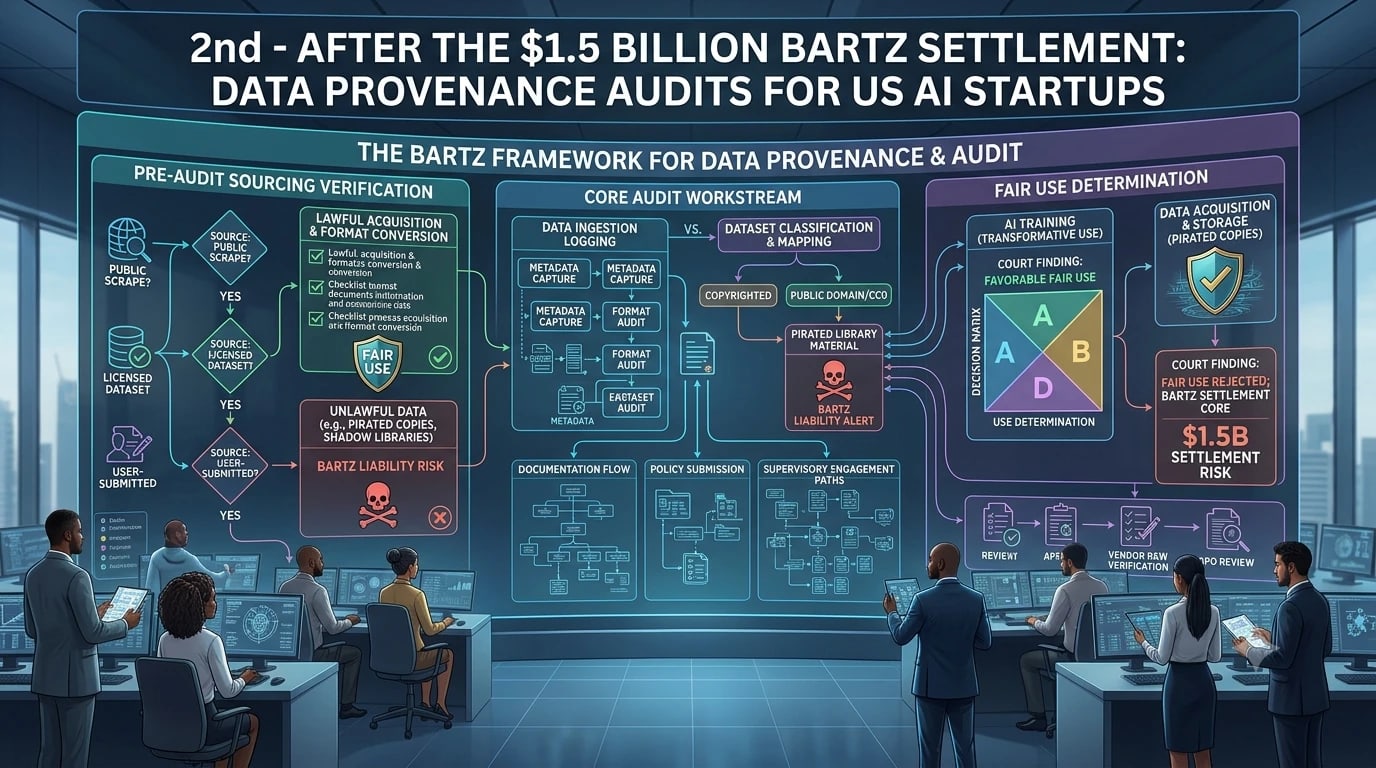
In Bartz v. Anthropic, authors alleged that their books were copied to train AI models. Before the class was certified, Judge Alsup held that training on lawfully purchased books was fair use, but that building a permanent central library from pirated copies was not covered by fair use and could proceed as a claim. The parties then settled. The settlement fund is $1.5 billion plus interest, and reports put the works list at 482,460 works, which works out to roughly $3,100 per work.
Final approval was granted on 20 July 2026 by Judge Martínez-Olguín, who inherited the case after Judge Alsup retired. She overruled all 53 objections, and reports say the release covers past conduct up to 25 August 2025 and does not extend to AI outputs or future conduct. Anthropic must also destroy the original files downloaded from the two pirate libraries and copies derived from them, subject to legal preservation duties. Reports differ on the amount of attorneys’ fees, so check the final order. This article takes no view on the merits of the claims.
Because the case ended in a settlement, it sets no binding precedent. The fair use ruling on purchased books was a district court decision, and other courts have reached different results on different facts. What the case does show is that the method of acquisition was the pressure point, which is the question an AI training data provenance audit is built to answer.
Investors now put data questions into their standard diligence lists: which datasets trained which model, whether any were scraped, whether opt-out signals were honoured, what licences exist and whether there is any claim or demand. A startup that has run an AI training data provenance audit can answer in a data room folder. One that has not usually answers by email over several weeks, and the delay itself tells the investor something.
Why provenance matters now
Three audiences now ask where training data came from. Rights holders use the answer to decide whether to send a letter or file a claim. Investors and acquirers ask for it in diligence, often with a specific warranty about data sources. Enterprise customers ask for it in security and procurement reviews, and sometimes for an IP indemnity that depends on it. A startup with a clear provenance file answers these questions in a day. One without it faces delay, price pressure or a failed deal.
The legal risk is also uneven across data sources. Material that was bought, licensed or openly licensed has a different risk profile from material scraped from behind a paywall, copied from a shadow library or taken in breach of terms. After Ross, a US court has also treated a developing market for licensing AI training data as relevant to the fair use analysis. Training data provenance is therefore both a legal and a commercial question.
A third driver is regulation outside the US. The EU AI Act asks providers of general-purpose models to publish a summary of training content and respect opt-outs, and India’s DPDP Act, 2023 will govern the processing of personal data of people in India from 13 May 2027. A startup with global users needs one provenance record that can answer all of them.
What an AI training data provenance audit covers
Start with an inventory. List every dataset used to train, fine-tune, evaluate or ground a model: name, owner, version, size, location and the models that used it. Include data bought, scraped, licensed, user-generated, synthetic and inherited from a previous team or open-source project. A common finding in a first AI training data provenance audit is that nobody can say where an older dataset originated.
For each source, record how it was acquired and on what terms. Capture the licence or terms of service, the date accessed, whether access involved a login, API or paywall, whether robots.txt or other opt-out signals were honoured, and who approved the use. Flag sources obtained from known shadow libraries or through circumventing access controls, since those raise the sharpest legal exposure.
Then classify risk. A simple scheme works: licensed or owned, public domain or openly licensed with checked terms, lawfully purchased, scraped public web data and unknown or problematic. Add notes on personal data, sensitive content and children’s data, which raise separate privacy duties. The result should be a register that legal, engineering and finance can all read.
| Field | What to record | Why |
|---|---|---|
| Source and owner | Name, owner, version and where it came from | Lets you answer who supplied the data |
| Acquisition method | Purchase, licence, API, scrape, user-generated or synthetic, and whether a login or paywall was involved | Method of acquisition was the pressure point in Bartz |
| Terms | Licence or terms of service snapshot and date accessed | Shows what use was permitted |
| Opt-outs | Robots.txt or other opt-out signals and whether they were honoured | Responds to rights-holder and regulator questions |
| Risk class and approval | Licensed, public domain, purchased, scraped or problematic, and who signed off | Supports diligence and gate controls for new data |
How to run the audit
Assign an owner and a small team: a lawyer, an ML engineer who knows the pipelines and someone from product. Interview the people who built the datasets, because documentation is often thin. Pull logs and repositories to confirm what was actually ingested, not just what was planned. Run the audit under legal privilege where possible, with US counsel directing it, so candid findings are protected.
Test the technical controls. Check whether the pipeline can trace a training example back to its source, whether deduplication and filtering work, whether opt-out lists are applied and whether deletion requests can be honoured. Where a model has already been trained, decide what can be shown about its training set and what cannot. A good AI training data provenance audit ends with a data lineage file that is updated each time a dataset is added.
Write up findings in two parts: a short summary for the board and investors, and a detailed register for the legal team. Rank issues by severity and cost to fix. Set a cycle for repeating the audit, for example before each major model release and each financing round, and build a gate so that new datasets cannot enter the pipeline without a provenance entry.
Keep the evidence that makes the audit credible: purchase receipts, licence agreements, terms of service snapshots taken on the date of access, crawl logs, opt-out lists, approvals and the names of the people who signed off each source. For synthetic data, record the generating model and its own licence terms, because outputs from another provider’s model can carry usage restrictions. An AI training data provenance audit is only as good as the evidence behind each line of the register.
Fixing gaps, remedies and quick answers
Gaps are common and fixable. For problematic sources, options include removing the data and retraining, replacing it with licensed or synthetic data, negotiating a retrospective licence, or documenting a fair use analysis prepared by US counsel. Prefer going forward with licences: a documented licence is more valuable than an argument about fair use. For personal data, address notice, consent and retention, and check whether Indian, EU or UK rules apply to the people in the dataset. If you receive a demand letter, preserve documents, pause use of the disputed data if feasible and respond through counsel. Update customer contracts so that your promises about training data match what your audit shows, because overstating provenance in marketing or contracts creates its own risk. A completed AI training data provenance audit also helps when a customer or investor asks for a warranty, since you can give one you have checked. The cost of the audit is small compared with a settlement fund counted in billions, or a lost financing round.
Related reading: after Ross: how US AI companies should structure data deals, Thomson Reuters v. Ross and legal tech startups, the October 2026 AI music copyright suits, AI copyright in India vs the US, AI training data licensing with Indian publishers, the DPDP Act for US SaaS companies and due diligence for Indian startups by US investors; also Getty v. Stability AI at the Court of Appeal and AI watermarks and trade mark infringement.
Quick answers
What is an AI training data provenance audit?
It is a structured review of every dataset used to train or ground a model, recording its source, how it was acquired, the terms that applied and the legal and privacy risks, so the company can answer questions from rights holders, investors and customers.
Does the Bartz settlement mean training on books is unlawful?
No. The court held that training on lawfully purchased books was fair use, while the pirated library was a separate problem, and the case then settled without creating binding precedent. The case shows that how data was obtained matters.
Who should run a data provenance audit?
A lawyer, an ML engineer and a product lead, directed by US counsel where possible so the work is privileged. Repeat it before major model releases and financing rounds.
How often should we repeat the audit?
Before each major model release and each financing round, and whenever a new dataset source is added. A gate that requires a provenance entry before data enters the pipeline keeps the register current.
Should the audit be privileged?
Where possible, have US counsel direct it so that candid findings are protected. Confirm the approach with US counsel, as privilege rules are a US-law point.
Final word
Halverton & Co. is an Indian law firm advising US companies, founders, investors and law firms on Indian law, including cross-border AI and technology contracts, DPDP Act compliance and Indian-law aspects of AI training data. We practise in Jharkhand, Maharashtra and before the Supreme Court of India, and work alongside US counsel, who advise on US law. Halverton & Co.: Where tech needs law! If you have a question about Indian law, write to us at office@halvertonandco.com, or get in touch.
This article reflects developments reported up to late October 2026. It is for general information only, is not legal advice, and does not create an attorney-client relationship. Halverton & Co. is an Indian law firm and does not advise on US law; US-law points should be confirmed with US counsel.
Sources
Related practice area
Technology & AI Law
Contracts, data protection and AI policies for products that handle other people’s data.
View the practice areaComments
No account needed. Comments are reviewed before they appear, so yours will show here once approved. Please do not share confidential details or describe your own legal matter: replies are general discussion, not legal advice, and do not create an advocate-client relationship. For your own situation, write to office@halvertonandco.com.