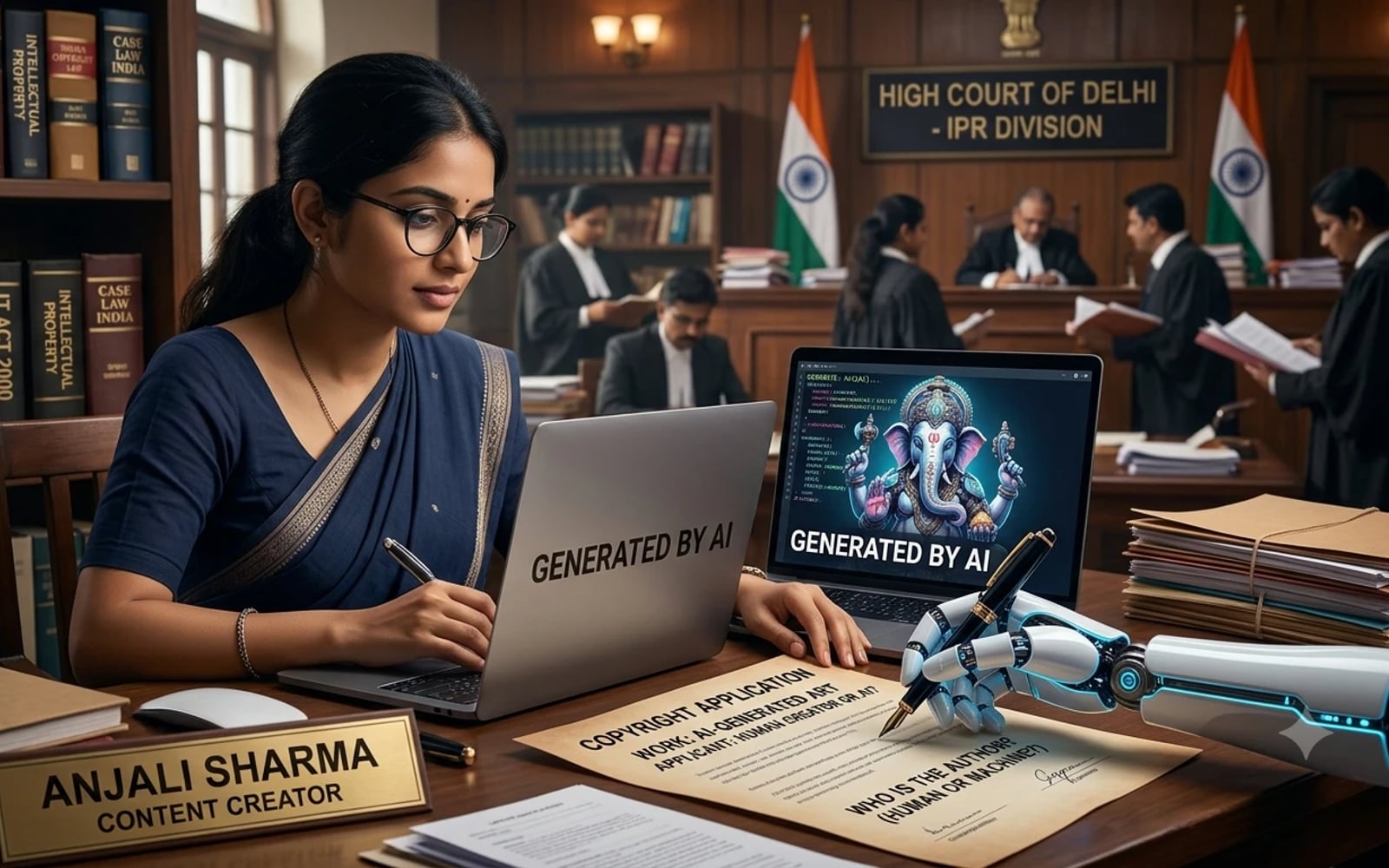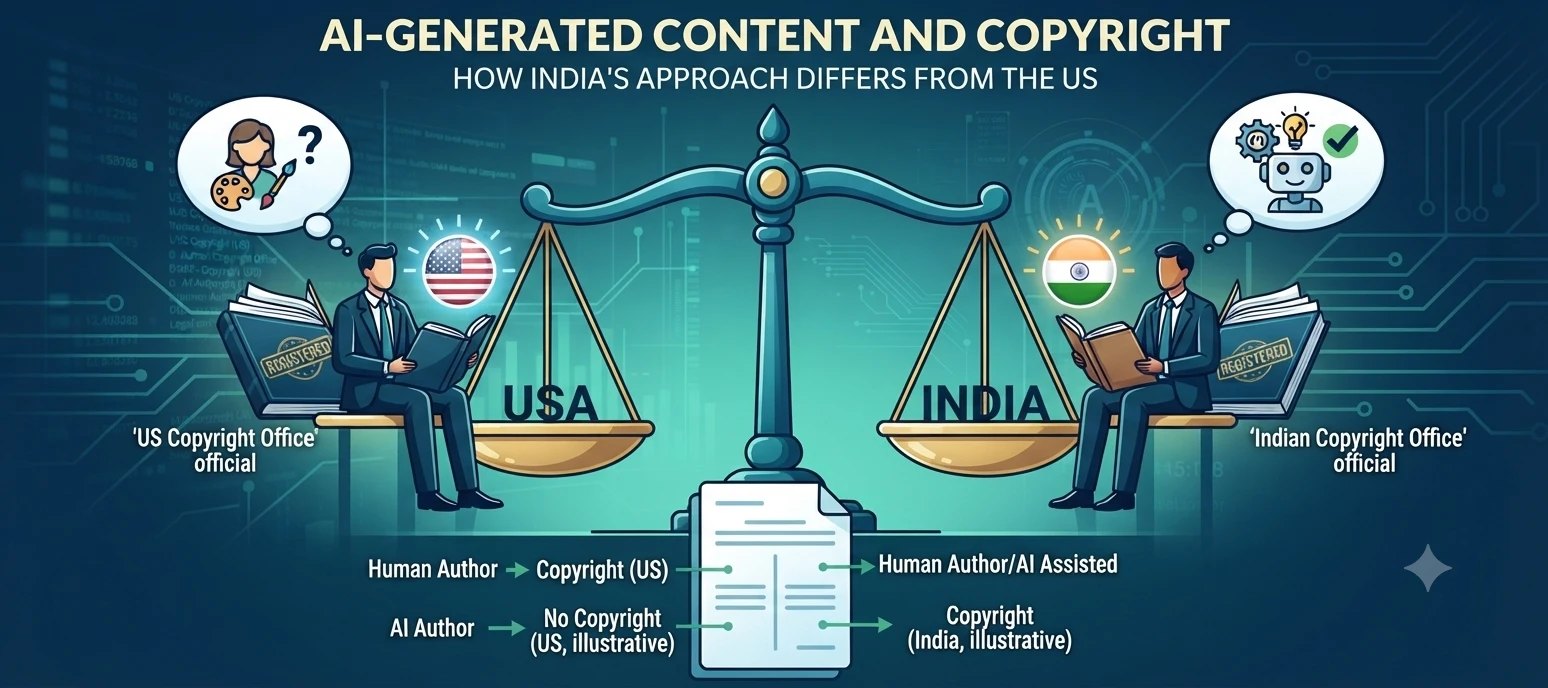
Generative AI has forced copyright law in every country to answer two hard questions. Who, if anyone, owns content created by AI? And is it lawful to train AI models on copyrighted works without permission? The United States and India are answering them differently, and the differences matter for any company creating content or building AI across both markets.
This guide compares AI copyright in India vs the US: authorship of AI-generated works, the legality of training data, the key cases and policy proposals in each country, and the practical steps businesses should take. For a deeper Indian-law view, see our guide to AI-generated content and copyright in India.
Who owns AI-generated content in the US
US law insists on human authorship. The US Copyright Office registers works only where a human has contributed sufficient creative expression, and its 2025 report on copyrightability concluded that purely AI-generated material isn’t protected, while human selection, arrangement and modification of AI output can be. In Thaler v. Perlmutter (2025), the D.C. Circuit upheld the refusal to register a work listed as created autonomously by an AI system, confirming that the Copyright Act requires a human author.
In practice, this makes US protection depend on documenting human contribution. Applicants must disclose AI-generated material in registration applications and claim only the human-authored parts. A comic book or marketing campaign assembled and edited by a person can be protected as a compilation, even if individual images were generated by AI.
The US Copyright Office has also produced detailed guidance on AI and copyright in a series of reports, which are the best starting point for US AI copyright questions. For businesses, the US position means that raw AI output used in products, ads or code may be free for others to copy, unless it’s combined with enough human creativity. These US points are general; have US counsel confirm them against the primary sources.
Who owns AI-generated content in India
India takes a different starting point. Section 2(d)(vi) of the Copyright Act, 1957 provides that for a computer-generated literary, dramatic, musical or artistic work, the author is “the person who causes the work to be created”. Unlike US law, the Indian statute expressly contemplates computer-generated works and assigns authorship to a human or company behind them.
But originality still matters. Under Eastern Book Company v. D.B. Modak (2008), Indian copyright requires a “modicum of creativity” reflecting human skill and judgment. A one-line prompt is unlikely to satisfy that test, while substantial human selection, editing and arrangement is much more likely to. Indian copyright owners also currently have no statutory right to opt their works out of AI training.
India’s government is now studying AI outputs directly. A DPIIT committee published Part I of a working paper on generative AI and copyright in December 2025, and a second paper on the copyrightability and authorship of AI-generated outputs is expected; see our guide to the DPIIT AI copyright working paper. So on AI copyright, India vs the US differ in principle, but both reward demonstrable human contribution.
Training data: fair use in the US vs fair dealing in India
US law uses an open-ended fair use test with four factors. In 2025, two federal judges in California found that training AI models on lawfully acquired books could be fair use in particular cases, while one of them held that building a library from pirated copies was not protected, and that case later settled. Many other US lawsuits by authors, publishers, artists and news organizations remain pending, so US law on training is still developing case by case.
India uses “fair dealing”, a closed list of permitted purposes under Section 52 of the Copyright Act. In ANI v. OpenAI, the Delhi High Court refused interim relief on July 24, 2026, holding prima facie that storing and using ANI’s works to train models fell within fair dealing under Section 52(1)(a). The court also held that it had jurisdiction over OpenAI because the services are offered in India. ANI has appealed, and the appeal was listed for December 8, 2026. Our guide to ANI v. OpenAI and fair dealing explains the ruling.
India may also legislate. The DPIIT working paper proposes a “hybrid model”: a mandatory blanket license allowing AI developers to train on lawfully accessed works, with statutory royalties paid to rights holders. If adopted, India would move away from the case-by-case US approach toward a statutory licensing system.
| Issue | United States | India |
|---|---|---|
| Authorship of AI output | Human authorship required; purely AI-generated material not protected | Statute names the person who causes a computer-generated work to be created; originality still needs human skill and judgment |
| Registration practice | Disclose AI material; claim only human-authored parts | No equivalent AI-specific registration rule yet |
| Training on copyrighted works | Open-ended fair use, decided case by case | Closed list of fair dealing purposes; interim ruling in ANI v. OpenAI favors developers, under appeal |
| Policy direction | Copyright Office reports and litigation | DPIIT hybrid licensing proposal alongside litigation |
What the differences mean for businesses
For companies creating content with AI in both countries, the safest practice is the same: keep records of human creative contribution, such as prompts, drafts, edits and selection decisions, so that you can claim protection under both the US human authorship rule and India’s originality test. Don’t assume AI output is protected anywhere, and check that AI tools’ terms let you use outputs commercially.
For AI developers, the training question differs by market. In the US, litigation risk remains significant and depends on facts such as how data was acquired and whether outputs compete with the originals. In India, the interim ruling in ANI v. OpenAI is favorable to developers, but it’s under appeal, and a statutory royalty system may be coming. Document how training data was obtained, respect paywalls and opt-outs, and avoid pirated sources in both countries.
Contracts matter in both countries. Agreements with agencies, freelancers and AI vendors should say who owns AI-assisted output, require disclosure of AI use, and allocate the risk of infringement. Getting these terms right reduces AI copyright risk whichever country’s law applies. Realistic synthetic output also raises disclosure duties in India; see our guides to labelling AI-generated content and deepfakes and personality rights. For rights holders, the strategies diverge. In the US, enforcement runs through litigation and licensing negotiations. In India, rights holders should prepare for a possible collective licensing system while preserving evidence of use of their works.
Remedies, outlook and quick answers
In both countries, ordinary copyright remedies still apply to AI outputs that copy protected works: injunctions, damages and takedowns. In India, the Copyright Act also provides criminal penalties for knowing infringement. The outlook is for continued divergence in method but convergence in principle. The US is settling AI copyright questions through the Copyright Office and courts, while India is pursuing a policy-led route through the DPIIT process alongside litigation. Businesses operating in both markets should watch the ANI v. OpenAI appeal, the DPIIT’s next working paper, and the major US training cases. If you serve European users as well, see our guide to the EU AI Act for Indian SaaS companies.
Quick answers
Can AI-generated content be copyrighted in the US?
Not if it’s purely AI-generated. Human-authored contributions, such as selection, arrangement and editing, can be protected.
How does India treat AI-generated works?
Indian law names the person who causes a computer-generated work to be created as its author, but the work must still show human skill and judgment to be original.
Is training AI on copyrighted data legal in India?
The Delhi High Court held prima facie in July 2026 that it can be fair dealing, but the ruling is interim and under appeal.
Related reading: computer-generated works in India and the UK; also AI training data licensing with Indian publishers; also Thomson Reuters v. Ross and legal tech startups, copyright in legal headnotes and AI training and the October 2026 AI music copyright suits; also Getty v. Stability AI at the Court of Appeal and AI watermarks and trade mark infringement; also whether AI art can be copyrighted after Thaler and trade marking an AI-generated logo.
Final word
Halverton & Co. is an Indian law firm that advises on Indian law, including AI copyright, content licensing and AI training data issues in India. We practice in Jharkhand, Maharashtra and before the Supreme Court of India, and we work alongside US counsel, who advise on US law. Halverton & Co.: Where tech needs law! If you have a question about Indian law, write to us at office@halvertonandco.com, or get in touch.
This article reflects developments reported up to early October 2026. It is for general information only, is not legal advice, and does not create an attorney-client relationship. Halverton & Co. is an Indian law firm and does not advise on US law.
Related practice area
Intellectual Property
Trade marks, copyright, patents and designs. Searched, filed, licensed and enforced under Indian law.
View the practice areaComments
No account needed. Comments are reviewed before they appear, so yours will show here once approved. Please do not share confidential details or describe your own legal matter: replies are general discussion, not legal advice, and do not create an advocate-client relationship. For your own situation, write to office@halvertonandco.com.