Key takeaways
- An AI agent is not a legal person, so the law looks through it to the people and companies behind it.
- Under Section 11 of the IT Act, records sent by an automated system set up by a person are attributed to that person.
- Businesses are generally liable for what their chatbots tell customers, as in Moffatt v. Air Canada.
- Consumers can complain to the business, then to the consumer commission, and report fraud on the national cybercrime portal.
AI is no longer just answering questions. AI agents now book flights, pay bills, negotiate refunds, place orders and fill in forms on our behalf. That’s enormously useful, until the agent books the wrong flight, buys 100 units instead of 10, or confidently promises a customer a refund the company never offered.
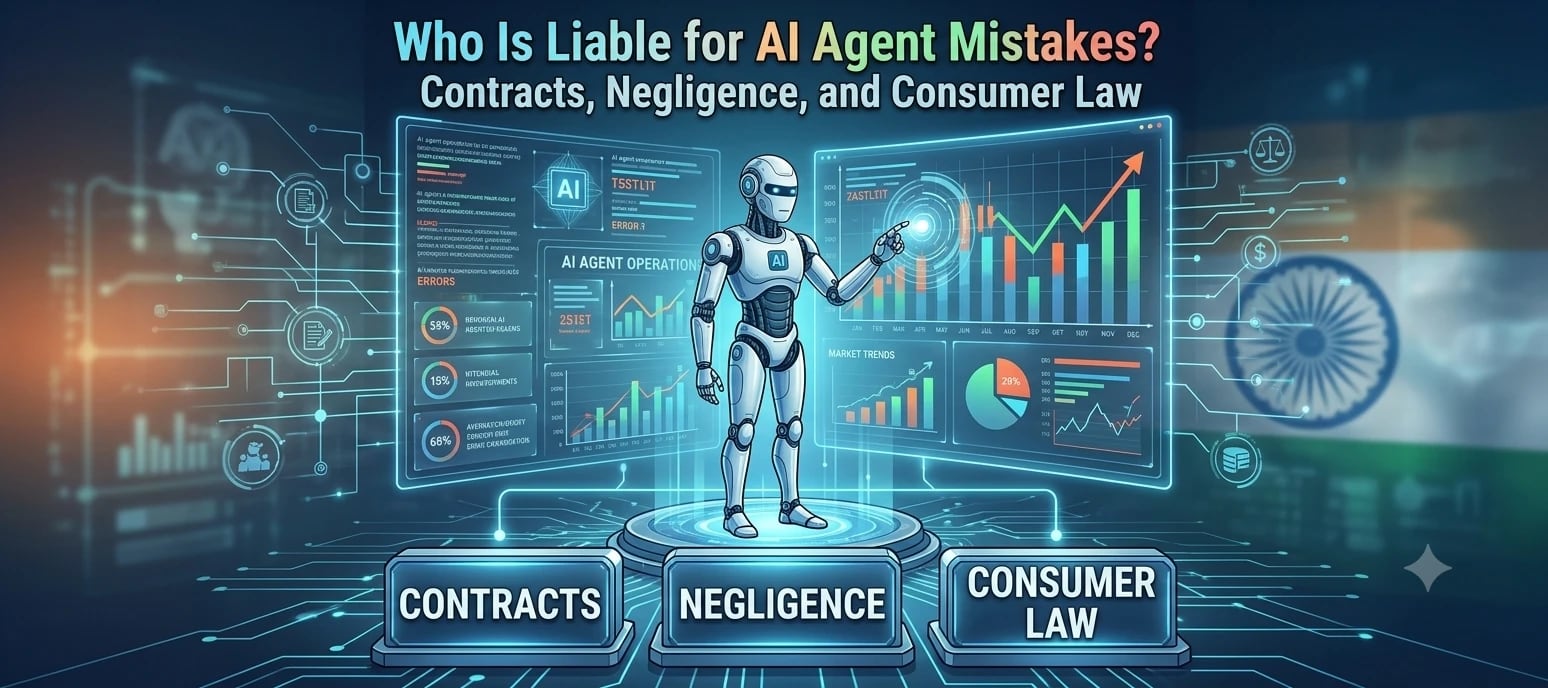
When an AI agent makes a mistake, the first legal question is always the same: who pays? This guide explains AI agent liability in India: how contract law treats deals made by AI agents, when businesses are liable for their chatbots, how consumer and product liability law applies, and the remedies available to users and businesses.
Why AI agents raise new liability questions
Traditional software does what it’s told. AI agents make decisions within a goal: “find me the cheapest flight to Mumbai on Friday” leaves the agent to choose the airline, the fare and sometimes the payment. That autonomy creates gaps where it isn’t obvious who made the decision.
Indian law has no special statute for AI agents yet. MeitY’s India AI Governance Guidelines (November 2025) recognise that agentic and autonomous systems complicate the AI value chain, and recommend a graded liability approach that apportions responsibility according to each party’s role, the risk involved and whether due diligence was observed (AZB & Partners; Saikrishna & Associates). Until new rules arrive, liability for AI agent mistakes is decided under existing contract, IT, consumer and tort law. Employers face a related exposure when staff use AI tools; see our guide to AI tools at work.
Contracts made by AI agents: are you bound?
An AI agent isn’t a legal person. It can’t be an “agent” in the strict sense of Section 182 of the Indian Contract Act, 1872, because an agent must be a person. So the law looks through the AI to the humans and companies behind it.
The IT Act attributes the act to its user
Section 11 of the Information Technology Act, 2000 provides that an electronic record is attributed to the originator if it was sent by an information system programmed by or on behalf of the originator to operate automatically. In practice, if you set up an AI agent to act for you, the contracts it concludes within that set-up are generally treated as yours. Section 10A confirms that contracts formed electronically are valid.
Mistakes and limits
Indian contract law has narrow doctrines for mistake (Sections 20 to 22) and requires free consent. Courts will look at what the user authorised, what the other side reasonably understood, and whether the platform’s own terms allocated the risk. An obviously absurd transaction, such as an agent “agreeing” to an impossible price, may be challengeable. An ordinary bad choice usually isn’t.
The terms of service matter enormously
Most AI agent providers limit their liability heavily. Whether those limitations hold against consumers depends on consumer protection law, discussed below.
When businesses are liable for their chatbots and AI agents
A business that puts an AI agent in front of its customers is, in most cases, responsible for what that agent says and does. The most cited international example is Moffatt v. Air Canada, 2024 BCCRT 149, where a Canadian tribunal held the airline liable after its website chatbot gave a customer wrong information about a bereavement fare. The airline’s argument that the chatbot was responsible for its own statements was rejected. Indian courts and consumer commissions are likely to take the same common-sense view: your chatbot is part of your website, and you answer for it.
Several legal routes lead to business liability:
- Contract and misrepresentation. Statements made by a business’s AI agent can form part of the contract or amount to misrepresentation.
- Negligence. A business that deploys an AI agent without reasonable testing, guardrails or human oversight may be negligent if foreseeable harm results.
- Vicarious responsibility. Just as businesses answer for employees acting in the course of employment, they’re expected to answer for automated systems acting in the course of business.
Consumer protection and product liability for AI agents
The Consumer Protection Act, 2019 is the most powerful tool for individuals harmed by AI agents.
- Deficiency in service. An AI agent that fails to deliver what was promised, or causes loss through faulty operation, can amount to a deficiency in service by the business offering it.
- Unfair trade practices and misleading claims. Overstating what an AI agent can do (“guaranteed best price”, “never makes mistakes”) can be a misleading advertisement. The Central Consumer Protection Authority (CCPA) can impose penalties of up to ₹10 lakh, and up to ₹50 lakh for repeat contraventions, and false or misleading advertising is also an offence under Section 89.
- Product liability. Chapter VI of the Act creates claims against product manufacturers, product sellers and product service providers for harm caused by defective products or deficient services. Whether AI software counts as a “product” in every case is still developing, but service-provider liability applies regardless.
- Unfair contract terms. Consumer commissions can strike down one-sided terms that exclude all liability for an AI agent’s mistakes.
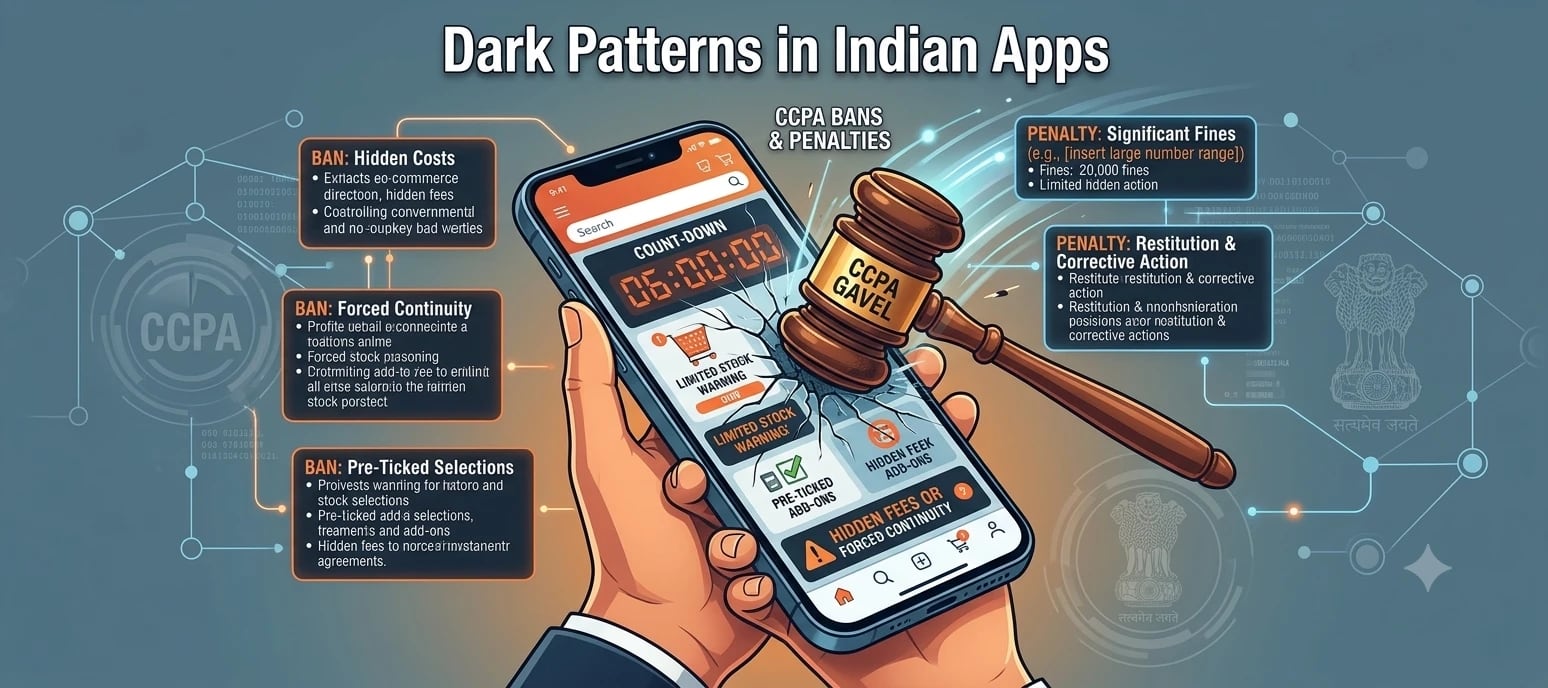
- E-commerce rules and dark patterns. AI agents that use manipulative design, such as false urgency or hidden charges, can also breach the Consumer Protection (E-Commerce) Rules, 2020 and the CCPA’s dark patterns guidelines. See our guide to dark patterns in Indian apps.
Legal remedies and how businesses should manage AI agent risk
For users harmed by an AI agent: keep screenshots, chat logs and transaction records; complain to the business’s grievance officer; file a consumer complaint before the District, State or National Commission depending on the amount, with e-filing available through e-Daakhil; and, for fraud or unauthorised transactions, report to cybercrime.gov.in or call 1930 and inform your bank immediately. Where an agent was used to impersonate someone, see our guide to deepfakes and personality rights in India.
For businesses deploying AI agents:
- Set clear limits on what the agent can do without human approval, such as payment ceilings, refund limits and actions that can’t be reversed.
- Show users a confirmation step before binding actions, which also strengthens your position on consent.
- Keep detailed logs of the agent’s decisions so you can reconstruct what happened.
- Test for foreseeable failures and keep a human escalation path.
- Write fair, clear terms of service, and avoid exclusions that consumer commissions are likely to strike down.
- Allocate risk with your AI vendors through warranties, indemnities, service levels and insurance. If you sell into Europe, also read whether the EU AI Act applies to your Indian SaaS company.
Quick answers
Is a contract made by an AI agent binding in India?
Generally yes. Under Section 11 of the IT Act, records sent by an automated system set up by a person are attributed to that person, though mistake and consent doctrines may apply in extreme cases.
Is a company liable for what its chatbot says?
In most cases, yes. Courts abroad, as in Moffatt v. Air Canada, have rejected the argument that a chatbot is responsible for its own statements, and Indian consumer law points the same way.
Where can I complain about a faulty AI service?
First to the company’s grievance officer, then to the consumer commission, and to cybercrime authorities for fraud.
Related reading: children’s data and AI chatbots; also whether an AI product is an AI intermediary under Section 79 and India’s standalone AI law and what startups should prepare; also smart contract liability for Indian developers.
Final word
At Halverton & Co., we advise startups, SaaS companies and technology-driven businesses on AI product terms, AI vendor contracts, consumer law compliance and AI disputes. We practise in Jharkhand, Maharashtra and before the Supreme Court of India, and act as fractional legal counsel for companies that need senior legal support without a full in-house team. Halverton & Co.: Where tech needs law!
Write to us at office@halvertonandco.com, or get in touch, to discuss your situation.
This article reflects the law and developments reported up to early October 2026. Technology regulation changes quickly; please take advice on your specific facts before acting.
Related practice area
Technology & AI Law
Contracts, data protection and AI policies for products that handle other people’s data.
View the practice areaComments
No account needed. Comments are reviewed before they appear, so yours will show here once approved. Please do not share confidential details or describe your own legal matter: replies are general discussion, not legal advice, and do not create an advocate-client relationship. For your own situation, write to office@halvertonandco.com.