India is one of the fastest-growing software markets in the world, and many UK SaaS companies already have Indian customers who found them online. Selling SaaS in India from the UK, without a local entity, is entirely possible. But it brings Indian tax, payment, contract and data protection rules into play, and they differ from what UK founders are used to.
This guide explains the legal and tax essentials for UK companies selling SaaS in India: GST on digital services, withholding tax and the India-UK tax treaty, data protection under the DPDP Act, customer contracts, payments, and when a local entity makes sense. The GST and withholding points should be reviewed by an Indian indirect tax adviser, and UK tax points by a UK adviser.
GST on SaaS sold into India
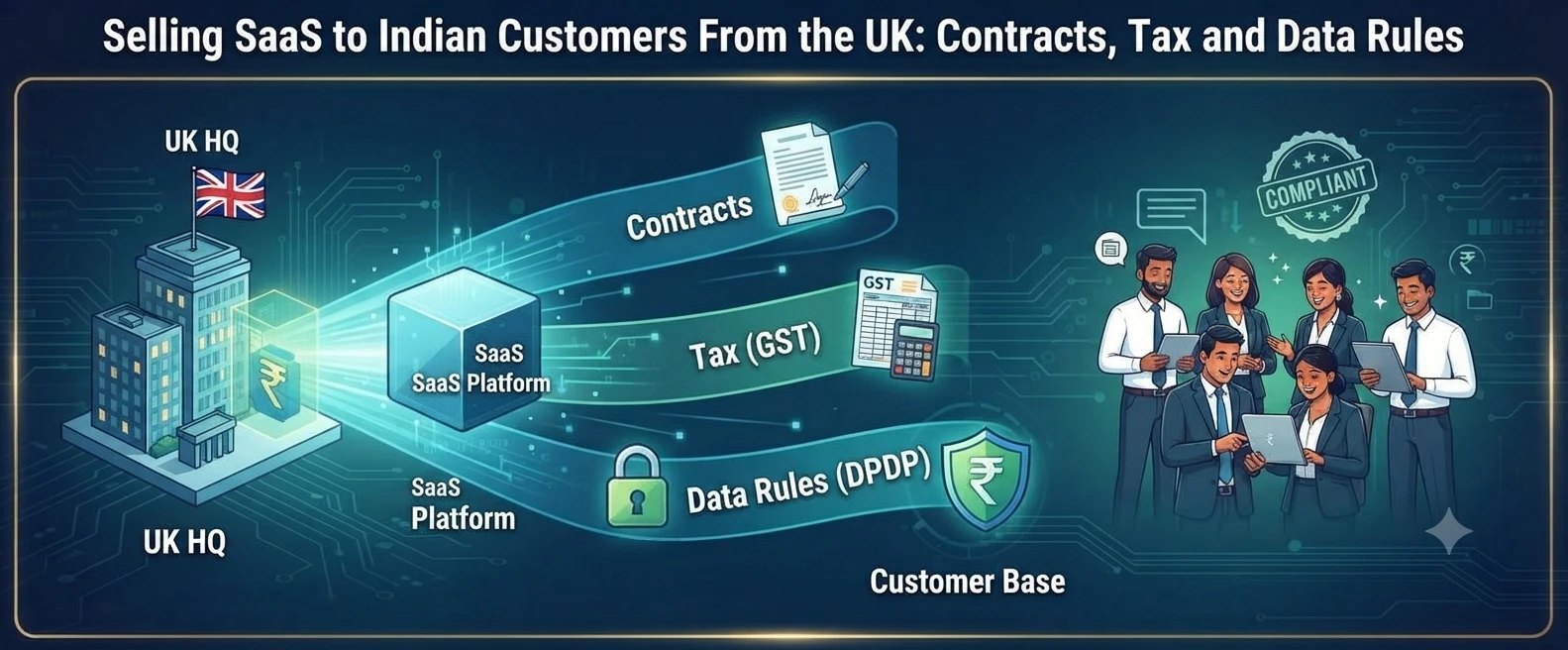
India charges goods and services tax (GST) on digital services supplied to customers in India, including SaaS supplied from abroad. The position depends on who the customer is. For business customers registered for GST, the Indian customer generally accounts for GST under the reverse charge mechanism, so the UK supplier doesn’t usually need to register for that reason alone.
For consumers and other non-business customers, India treats many cross-border digital services as “online information database access and retrieval” (OIDAR) services, and the foreign supplier must register for GST in India under a simplified scheme and charge GST, generally at 18%. Changes in recent years broadened the OIDAR definition, so UK SaaS companies with Indian consumer users should check their position carefully.
Pricing and invoicing need care too. If you price in pounds or US dollars, make clear who bears currency risk and bank charges, and make sure your invoices contain the details Indian customers need for their own GST and tax records. In practice, selling SaaS in India to businesses is simpler than selling to consumers. Collect your Indian customers’ GST registration details at sign-up, so you can show which supplies are business-to-business.
Withholding tax and the India-UK tax treaty
Indian business customers paying a UK SaaS provider may ask whether they need to withhold tax on the payment. For years, Indian tax authorities argued that software payments were “royalties”, taxable in India. In Engineering Analysis Centre of Excellence v. Commissioner of Income Tax (2021), the Supreme Court of India held that payments for the use of off-the-shelf software, where no copyright is transferred, aren’t royalties under India’s tax treaties. That has significantly reduced withholding disputes for SaaS providers.
The India-UK double taxation agreement governs the position. To benefit from it, Indian customers typically ask for a tax residency certificate from HMRC and other documentation. Providing these promptly helps avoid unnecessary withholding. India’s equalisation levy, a separate tax that applied to certain digital services, has been abolished for e-commerce supplies and online advertising in recent Budgets, which further simplifies the picture.
Watch for permanent establishment risk if your business grows. Employees or dependent agents in India who habitually conclude contracts for you could create a taxable presence there. Keep contracting authority in the UK until you decide to set up locally; see our guide to setting up a company in India from the UK.
| Question | Usual position |
|---|---|
| GST on sales to registered Indian businesses | Customer accounts for GST under reverse charge |
| GST on sales to consumers | OIDAR rules: UK supplier registers under a simplified scheme and charges GST, generally at 18% |
| Withholding on off-the-shelf SaaS | Generally not royalties after Engineering Analysis (2021); keep treaty documents ready |
| Equalisation levy | Abolished for e-commerce supplies and online advertising in recent Budgets |
| Permanent establishment | Keep contracting authority in the UK; review as the Indian team grows |
Data protection: the DPDP Act and UK GDPR
If you’re selling SaaS in India to individuals, or processing personal data of people in India, India’s Digital Personal Data Protection Act, 2023 applies to you even without an Indian presence, because it covers processing outside India connected with offering goods or services to individuals in India. Most obligations take effect on 13 May 2027; see our guide to India’s DPDP Act for UK businesses.
The main differences from UK GDPR are a narrower set of lawful bases (consent plus limited “legitimate uses”, with no general legitimate interests basis), a definition of children as anyone under 18 with verifiable parental consent required, breach notification without a risk threshold (with a detailed report to the Data Protection Board within 72 hours), and notices in English or Indian languages. Penalties reach up to ₹250 crore for security failures. See our DPDP Act compliance checklist and guide to consent managers.
Indian enterprise procurement can also involve detailed security questionnaires, vendor onboarding forms and, in regulated sectors, audit rights for the customer’s regulator. Preparing standard answers in advance shortens sales cycles when selling SaaS in India. For B2B SaaS, your Indian business customers will usually be the data fiduciaries, and they’ll push DPDP obligations onto you as their processor through contracts. Prepare a data processing addendum that addresses DPDP requirements, so contract negotiations don’t stall.
Customer contracts and payments
Your standard UK terms will mostly work for selling SaaS in India, but a few points need attention. For consumer customers, Indian consumer protection law, including the Consumer Protection (E-Commerce) Rules, 2020 and the regulator’s guidelines on dark patterns, applies, so subscription cancellation must be easy, pricing transparent and auto-renewals clear; see our guide to dark patterns in Indian apps. Onerous terms that exclude all liability can be challenged.
For business customers, consider governing law and dispute resolution. English law with arbitration is common and enforceable: India enforces arbitral awards from New York Convention countries, and the UK is a reciprocating territory for enforcement of certain court judgments. Indian enterprise customers may also request Indian data localisation or specific security commitments, especially in regulated sectors such as banking and insurance.
Payments have their own rules. RBI regulations on recurring card payments require customer registration of e-mandates and additional authentication above certain limits, which affects subscription billing; check the current limits. Work with a payment provider experienced in Indian recurring payments to avoid failed renewals and churn.
When to set up locally, remedies and quick answers
Language and localisation can also matter commercially, even though English is widely used in Indian business. Many UK SaaS companies start by selling into India from the UK and set up an Indian subsidiary once they have a local sales team, significant consumer revenue, or enterprise customers who prefer a local contracting entity.
If disputes arise, your remedies depend on your contract: arbitration or court proceedings in the chosen forum, enforcement in India, and, for unpaid invoices from business customers, commercial courts. Tax disputes over withholding can often be resolved by providing treaty documentation, or through appeals in India. With the UK-India trade deal in force since 15 July 2026, selling SaaS in India from the UK is easier than ever, provided the tax and data details are right; see our UK-India trade deal checklist. The US version of this guide is India’s DPDP Act for US SaaS companies.
Related reading: licensing UK technology to Indian companies; also exclusive and non-exclusive copyright licences between UK and Indian companies; also licensing a UK brand to Indian franchisees; also selling on Amazon India from the UK.
Quick answers
Do UK SaaS companies need to charge GST in India?
For Indian business customers, usually not, as the customer accounts for GST under reverse charge. For consumers, the UK supplier may need to register and charge GST under the OIDAR rules.
Do Indian customers have to withhold tax on SaaS payments?
Generally not for off-the-shelf software, following the Supreme Court’s 2021 Engineering Analysis judgment, subject to treaty documentation.
Does India’s DPDP Act apply to UK SaaS companies?
Yes, where they process personal data of individuals in India in connection with offering services there, from 13 May 2027.
Final word
Halverton & Co. is an Indian law firm that advises on Indian law, including SaaS customer contracts, DPDP compliance, GST and withholding questions, and India market entry. We practise in Jharkhand, Maharashtra and before the Supreme Court of India, and we work alongside your UK solicitors, who advise on English law. Halverton & Co.: Where tech needs law! If you have a question about Indian law, write to us at office@halvertonandco.com, or get in touch.
This article reflects developments reported up to early October 2026. It is for general information only, is not legal advice, and does not create a solicitor-client relationship. Halverton & Co. is an Indian law firm, is not authorised or regulated by the Solicitors Regulation Authority, and does not advise on English law or UK tax.
Related practice area
Technology & AI Law
Contracts, data protection and AI policies for products that handle other people’s data.
View the practice areaComments
No account needed. Comments are reviewed before they appear, so yours will show here once approved. Please do not share confidential details or describe your own legal matter: replies are general discussion, not legal advice, and do not create an advocate-client relationship. For your own situation, write to office@halvertonandco.com.