On 1 October 2026, the Bombay High Court ordered platforms to take down deepfake videos, morphed photos and AI voice clips of actor Samantha Ruth Prabhu (The420.in). In the months before that, Shashi Tharoor, Aman Gupta, Preity Zinta and Ravi Kishan all won similar orders. Indian courts are now issuing personality rights orders against deepfakes almost every month.
What strikes us about these cases isn’t the celebrity names. It’s how easy the harm has become. A few photos and a ten-second voice clip are now enough for anyone to make a convincing fake of you. Celebrities can afford to rush to the High Court. But the same technology is being used against students, small business owners and ordinary women in Ranchi, Pune and everywhere else.
This guide explains how personality rights work in India, what the courts have actually said about deepfakes, what the new IT Rules require from platforms, and, most importantly, the legal remedies available to anyone whose name, face or voice is misused.
What are personality rights, and why have deepfakes made them urgent?
Personality rights protect the things that make you recognisably you: your name, face, voice, signature, image, style of speaking and even a well-known catchphrase. They let you control who may use your identity, especially for commercial purposes, and stop others from using it in ways that damage your dignity or reputation.
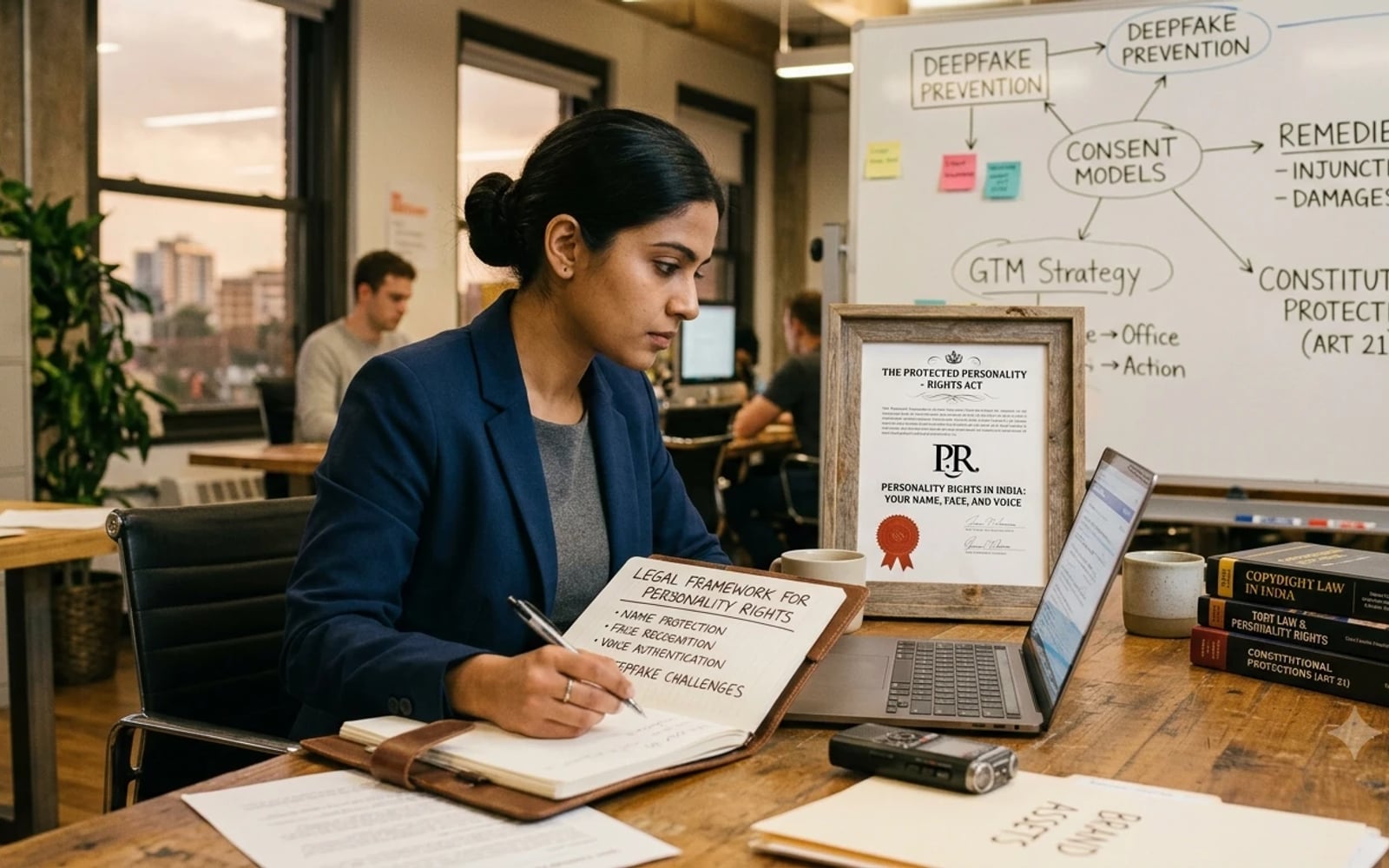
Here’s the surprising part. India has no single “personality rights law”. There’s no statute you can open to section one. Instead, our courts have built personality rights in India from several sources:
- The Constitution. The right to privacy and dignity under Article 21, confirmed by the Supreme Court in K.S. Puttaswamy v. Union of India (2017), is the foundation. In R. Rajagopal v. State of Tamil Nadu (1994), the Supreme Court had earlier recognised a person’s right to control publication of their own life story. Recent orders treat personality rights as protected under Articles 19 and 21 (LiveLaw).
- Passing off and false endorsement. Using a famous person’s identity to suggest they endorse a product misleads the public, which is classic passing off.
- Trademark law. Many public figures register their names as trademarks, which adds a statutory infringement claim.
- Copyright and performers’ rights. Sections 38A and 38B of the Copyright Act, 1957 give performers rights over their performances and moral rights against distortion. These are increasingly relevant when an AI clones a singer’s or actor’s voice.
Deepfakes have turned this slow-moving area of law into an emergency. A deepfake is AI-generated audio or video that makes a person appear to say or do something they never did. The technology now costs almost nothing, and fake content can go viral in hours. That is why personality rights cases now come to court with urgent applications rather than ordinary suits.
There are limits, and they matter. Courts have repeatedly protected parody, satire, news reporting, criticism and artistic work as free speech under Article 19(1)(a). In Digital Collectibles v. Galactus Funware (2023), the Delhi High Court refused to stop the use of cricketers’ names and publicly available information in an online game. In August 2026, while hearing a case involving Aaradhya Bachchan, the same court remarked that personality rights claims were acquiring “amoebic proportions” (MediaNama). Courts are clearly trying to draw a boundary, and not every unflattering use of a famous face will be stopped.
How Indian High Courts are protecting celebrities from deepfakes
The Delhi High Court and the Bombay High Court have done most of the work here. Looking at the orders together, you can see the law of personality rights in India growing almost case by case.
The early landmarks (2022 to 2024)
In late 2022, the Delhi High Court protected Amitabh Bachchan’s name, voice and image after fraudsters used them in fake lottery schemes. In 2023, Anil Kapoor won an order that went further. It covered his catchphrase “jhakaas” and specifically restrained AI tools from morphing his face and cloning his voice, one of the first Indian orders aimed directly at deepfakes. Jackie Shroff followed in 2024. The same year, the Bombay High Court protected singer Arijit Singh against AI platforms that cloned his voice, making it clear that a voice is part of a person’s protected identity.
The AI wave (2025)
Orders started to name AI and deepfake technology expressly. In Ankur Warikoo v. John Doe (2025), the Delhi High Court restrained unknown defendants from misusing the educator’s identity and brand, including through AI and deepfake technology (WIPO). In the Sadhguru case the same year, the court granted a “dynamic+” injunction, which lets the plaintiff get new copies of the infringing content taken down without filing a fresh suit every time (WIPO). A long list of film stars, including Aishwarya Rai Bachchan and Abhishek Bachchan, obtained similar protection.
2026: deepfakes become the main battleground
This year, AI-generated content has been at the centre of almost every personality rights case:
- Shilpa Shetty (Bombay High Court, March 2026): takedown of AI-generated deepfakes (Bar & Bench).
- Shashi Tharoor (Delhi High Court, May 2026): an injunction against unknown persons circulating deepfake videos that falsely put politically sensitive statements in his mouth. The court held that personality rights are protected under Articles 19 and 21 of the Constitution (Bar & Bench).
- Aman Gupta (Delhi High Court, May 2026): protection of his name, image, voice and likeness, including against AI deepfakes (MediaNama).
- Preity Zinta (Bombay High Court, July 2026): removal of deepfake videos and morphed images. The court also looked at how platforms could deal with future complaints without the victim having to keep coming back to court (Outlook).
- Ravi Kishan (Delhi High Court, July 2026): removal of AI-generated obscene and pornographic content.
- Samantha Ruth Prabhu (Bombay High Court, 1 October 2026): an order against deepfakes, AI voice clips and AI chatbots that objectified her. The court linked her personality rights to free speech, life, privacy and dignity (Siasat).
What these orders usually contain
The typical deepfake injunction in India restrains named and unnamed (“John Doe”) defendants, directs platforms to take down listed links within a short period, asks government agencies to block websites where needed, and requires platforms to disclose the details of the people who uploaded the content. One lesson from 2026 is that evidence matters. In cricketer Abhishek Sharma’s case, the Delhi High Court initially put off relief because evidence was missing, and granted protection only later (MediaNama). Come to court with every link, screenshot and date in order.
The IT Rules 2026: India’s new deepfake regulations for platforms
Court orders protect one person at a time. In February 2026, the government moved to regulate deepfakes for everyone. On 10 February 2026, MeitY notified amendments to the IT (Intermediary Guidelines and Digital Media Ethics Code) Rules, 2021, bringing deepfakes and other AI-generated content into the platforms’ due diligence framework (MediaNama). For anyone dealing with a deepfake, these are the provisions that matter most.
A legal definition of deepfakes
The rules use the term “synthetically generated information”. It covers audio, visual or audio-visual content that is artificially or algorithmically created or altered so that it appears real. Text alone is not covered, so an AI-written article is outside it, but a fake video or cloned voice is squarely inside (iPleaders).
Mandatory labels
AI-generated content must carry a prominent label and permanent provenance metadata that cannot be stripped out (iPleaders). Platforms whose tools create or modify such content, such as AI video apps and voice cloning services, face heavier duties, including detection and labelling systems.
Much faster takedowns
This is the change that helps victims most. Platforms must now act on government or court takedown orders within three hours, down from 36 hours. For user complaints about non-consensual intimate images, including morphed or deepfake nudity, the deadline has been cut from 24 hours to two (MediaNama).
Safe harbour puts pressure on platforms
Under Section 79 of the IT Act, 2000, platforms are shielded from liability for user content only if they follow these due diligence rules. A platform that ignores a valid complaint or a court order risks losing that protection and becoming liable itself. That is real pressure, and a well-written complaint uses it.
In practice, the IT Rules 2026 mean that ordinary people no longer always need a High Court order to get a deepfake removed. A properly made complaint to the platform, backed by the rules, can often do the job within hours.
What ordinary people can do: step-by-step legal remedies against deepfakes
You don’t need to be famous to have rights over your own face and voice. Celebrities lean on personality and publicity rights because their identity has commercial value. Everyone else has the same constitutional right to privacy and dignity, plus a range of criminal and civil remedies. If someone has made a deepfake of you, this is the order in which we’d act.
Step 1: Preserve the evidence before it disappears
Take screenshots and screen recordings, copy every URL, and note the account names, dates and times. Don’t forward the content to friends “to show them”, because that spreads it further. If the matter goes to court or the police, electronic evidence will need a certificate under Section 63 of the Bharatiya Sakshya Adhiniyam, 2023, so keep the originals safe.
Step 2: Report it to the platform, and mention the law
Use the platform’s reporting tool and write to its grievance officer as well. Say clearly that the content is a deepfake made without your consent and point to the IT Rules. For intimate or sexual deepfakes, the platform now has only two hours to act on your complaint. If the grievance officer refuses or doesn’t respond, you can appeal to the Grievance Appellate Committee within 30 days.
Step 3: File a cybercrime complaint
Report it on the National Cyber Crime Reporting Portal (cybercrime.gov.in) or call the 1930 helpline, and file an FIR at your local police station or cyber cell. The criminal provisions that commonly apply to deepfakes include:
| Law | What it covers | Punishment |
|---|---|---|
| IT Act, Section 66C | Identity theft, such as fraudulently using someone’s identity features | Up to 3 years and a fine up to ₹1 lakh |
| IT Act, Section 66D | Cheating by personation using a computer resource | Up to 3 years and a fine up to ₹1 lakh |
| IT Act, Section 66E | Capturing or publishing private images without consent | Up to 3 years, or a fine up to ₹2 lakh, or both |
| IT Act, Sections 67 and 67A | Publishing obscene or sexually explicit material online | Up to 3 and 5 years respectively for a first offence, plus heavy fines |
| BNS, Sections 319 and 336 | Cheating by personation; forgery, including of electronic records to harm reputation | Imprisonment and fine |
| BNS, Section 356 | Defamation | Up to 2 years, fine, or community service |
| BNS, Section 308 | Extortion, including sextortion using fake images | Imprisonment and fine |
Step 4: Go to court for an injunction and damages
Where the content keeps spreading, or the platform or police are slow, a civil suit gives you the strongest tools: an urgent injunction (including against unknown “John Doe” uploaders), takedown and blocking directions, disclosure of who uploaded the content, and damages for violation of your privacy and for defamation. The orders that celebrities have won, especially dynamic injunctions, are equally available in principle to anyone who can show a real violation of privacy and dignity.
Step 5: Ask for free legal help if you need it
Women and children are entitled to free legal aid under the Legal Services Authorities Act, 1987, whatever their income. Your District Legal Services Authority can assign a lawyer. Never pay money to anyone threatening to release a fake video. Report them straight away.
Protecting your identity before it’s misused
Legal remedies work best when you have prepared for the day you need them. Whether you’re a creator, a founder, a doctor with a public profile or simply someone with an active Instagram account, a few steps now can make a deepfake far easier to fight later.
Creators, influencers and public figures
Register your name or brand as a trademark (our guide to trademark registration for startups explains how). It gives you a statutory infringement claim on top of personality rights, and courts have taken registered marks into account in cases like Ankur Warikoo’s. Keep your official accounts verified, and when a fake appears, post a public clarification quickly so your audience knows it isn’t you. Most importantly, read your brand and agency contracts. Many now include clauses letting a brand reuse your face or voice with AI. Make sure any such permission is specific, limited in time and paid for, and that AI cloning and model training are expressly prohibited unless you agree otherwise.
Businesses and startups
Deepfake fraud has moved into the office. Scammers clone a CEO’s or director’s voice and ask an employee for an urgent payment. Set a simple rule: no payment request is approved on the strength of a voice note or video call alone, and every such request is verified on a known number. If your company uses AI avatars or synthetic voices in marketing, take written consent from the people involved and label the content as AI-generated, as the IT Rules 2026 require. (On the copyright side of AI content, see who owns AI-generated content in India and our analysis of ANI v. OpenAI. For who is liable when an AI agent acts on your behalf, see AI agent liability in India.)
Families and individuals
Use privacy settings, think twice before posting high-quality close-up videos publicly, and run a reverse image search on yourself now and then. Talk openly with teenagers about sextortion, so they know that a fake image is not their fault and that the right response is to tell someone and report it, never to pay.
Quick answers
Are deepfakes illegal in India?
There is no single deepfake law, but making or sharing a deepfake can break several laws, including the IT Act, 2000, the Bharatiya Nyaya Sanhita, 2023 and the IT Rules 2026, and it can violate your personality rights and right to privacy.
Can I sue someone for using my face or voice in an AI video?
Yes. You can seek an injunction and damages for violation of privacy, defamation and, where your identity has commercial value, personality rights and passing off.
How quickly must platforms remove deepfakes?
Within three hours of a government or court order. For complaints about intimate or sexual deepfakes, within two hours.
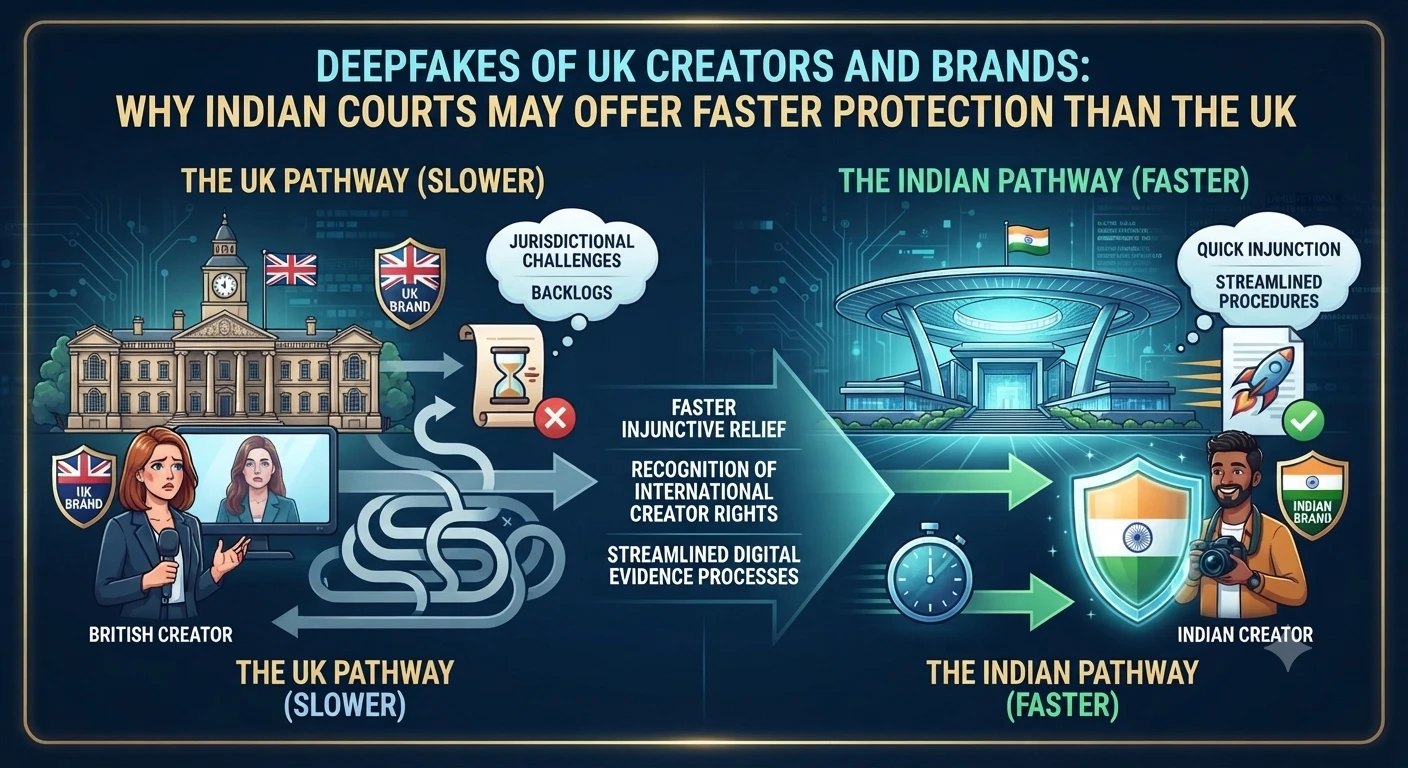
Related reading: labelling AI-generated content under the IT Rules 2026 and the Sahyog portal and content takedowns; also deepfakes of UK creators and brands: Indian courts vs UK law.
Final word
Deepfakes have moved faster than any statute, but Indian law is catching up. The High Courts have built a strong body of personality rights law around celebrities, and the IT Rules 2026 have given everyone else much faster takedowns. Whether you’re famous or not, your name, face and voice belong to you, and the law gives you real tools to protect them, if you act quickly and with the right evidence.
At Halverton & Co., we advise creators, founders, businesses and individuals on personality rights, deepfake takedowns, AI law and online reputation protection. We practise in Jharkhand, Maharashtra and before the Supreme Court of India. Halverton & Co.: Where tech needs law!
If a deepfake of you or your business is circulating, write to us at office@halvertonandco.com or get in touch.
This article reflects developments up to early October 2026. If you are in immediate danger or being threatened, call 112 straight away. To report cybercrime, use cybercrime.gov.in or the 1930 helpline.
Related practice area
Technology & AI Law
Contracts, data protection and AI policies for products that handle other people’s data.
View the practice area