Key takeaways
- Google announced ads in AI Overviews and AI Mode for India in 2025, with ads labelled as sponsored; we found no newer reporting.
- No Indian rule is written specially for AI search ads, so the Consumer Protection Act, CCPA guidelines, Dark Patterns Guidelines and ASCI standards apply.
- An ad that cannot be told apart from the AI’s own answer risks being treated as a disguised advertisement.
- The advertiser remains responsible for its own claims, including text generated by automated tools.
Search used to show ten blue links with a few clearly marked ads. AI search shows a written answer, and now ads can sit inside or beside it. Google announced ads in AI Overviews and AI Mode for India in 2025, and reports describe them as drawn from existing Search, Shopping and Performance Max campaigns and labelled as sponsored. That raises a fresh set of AI search ads India advertising law questions for brands, agencies and platforms.
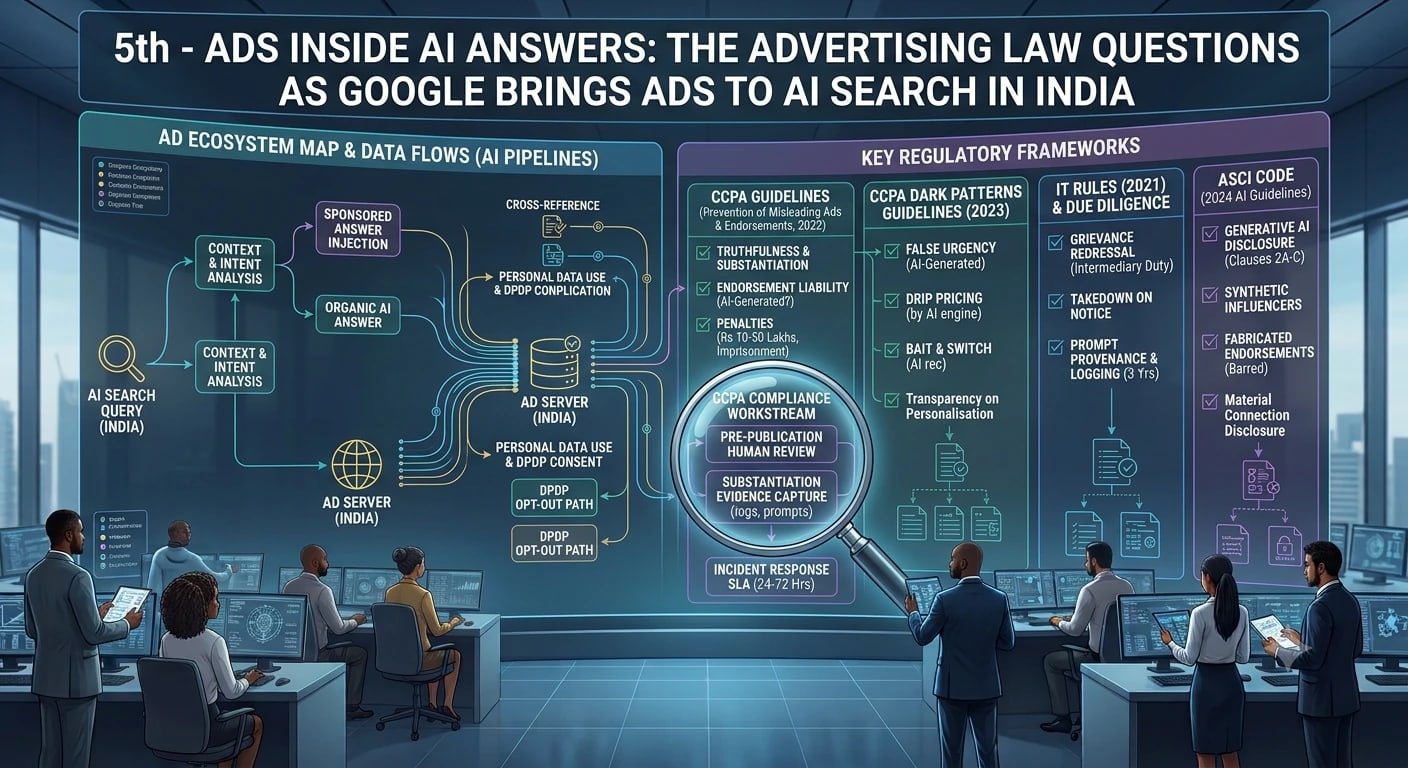
This guide explains how the main Indian rules apply when an advertisement appears inside an AI-generated answer: the Consumer Protection Act, 2019 and the CCPA’s guidelines on misleading advertisements, the Dark Patterns Guidelines, 2023 on disguised advertisements, ASCI standards, the DPDP Act on personalised targeting and the IT Rules. No Indian rule is written specially for AI search ads, so the analysis applies existing law.
What has changed in AI search advertising
AI Mode launched in India in June 2025 as an opt-in feature, and Google confirmed at its Marketing Live India event in July 2025 that AI-powered search ads would reach India through AI Overviews and AI Mode. Reports say advertisers using Search, Shopping, Performance Max and AI Max campaigns can appear, and that Google describes the ads as a helpful next step for users with commercial intent. We did not find newer reporting on the current rollout, so confirm the latest status.
The legal significance is the setting. A classic search ad sits in a recognised ad block. An ad inside an AI answer sits next to text that the user may read as neutral advice. The user may not distinguish between what the model says on its own and what an advertiser paid to place. That is the heart of the AI search ads India advertising law debate.
Brands also face a new form of exposure. AI tools can generate ad headlines and descriptions from a brand’s assets, and AI answers may summarise brand claims. A brand that supplies claims, or lets automated tools generate them, remains responsible for whether those claims are true and substantiated.
Misleading advertising rules for AI answers
Section 2(28) of the Consumer Protection Act, 2019 defines a misleading advertisement, covering false descriptions, false guarantees, deceptive claims and the concealment of important information. The Central Consumer Protection Authority can order discontinuation or modification and impose penalties under Section 21, which the Act sets at up to ₹10 lakh for a first contravention and up to ₹50 lakh for later ones. Endorsers can also be penalised and, in some cases, barred from endorsing.
The Guidelines for Prevention of Misleading Advertisements and Endorsements for Misleading Advertisements, 2022 set conditions for a valid advertisement: it must be truthful, claims must be substantiated, and disclaimers must not contradict or hide material information. They also address bait advertising and surrogate advertising, and say that advertisers, agencies and endorsers have duties. These rules apply whatever technology delivers the message, so an ad placed in an AI answer is tested the same way.
| Rule | Source | What it asks |
|---|---|---|
| Misleading advertisement | Consumer Protection Act, 2019, Section 2(28) | No false, deceptive or concealing claims |
| Valid advertisement conditions | CCPA Guidelines, 2022 | Truthful, substantiated claims and disclaimers that do not hide material information |
| Disguised advertisement | Dark Patterns Guidelines, 2023 | Ads must not be passed off as other content |
| Identification of ads | ASCI Code (self-regulatory) | Advertisements should be identifiable as such |
| Targeting and children | DPDP Act, 2023 | Lawful basis for personal data and no targeted advertising to children |
In practice, AI search ads India advertising law risk is highest in regulated and claim-heavy sectors: health, finance, education and consumer goods with comparative claims. A claim that would need a disclaimer in a print ad needs one in an AI answer too, and a short summary that drops a material condition can make an otherwise acceptable ad misleading.
Examples show how the issues arise. A health supplement brand’s ad appears beside an AI answer that mentions general wellness benefits. A loan app’s sponsored result sits in an answer about personal finance. A coaching institute’s sponsored link appears inside an answer comparing exam courses. In each, the ad’s own claims must be true and substantiated, and the user must be able to tell the ad from the answer. These situations are where AI search ads India advertising law questions are most likely to be tested first.
Disguised ads, dark patterns and labelling
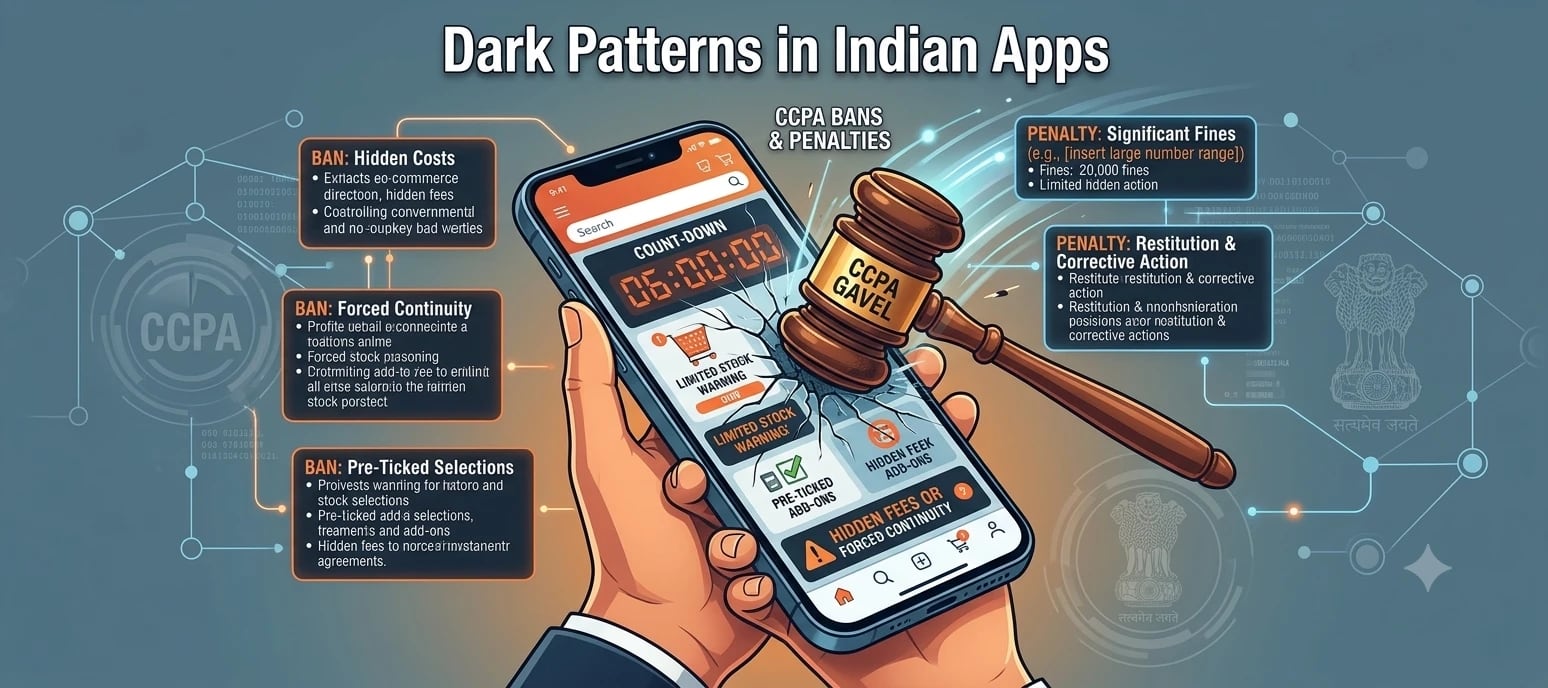
The Guidelines for Prevention and Regulation of Dark Patterns, 2023 list thirteen specified dark patterns, including disguised advertisement, which covers posting advertisements as other types of content so users are tricked into clicking. An ad that is not clearly distinguishable from the AI’s own answer risks falling into this category. The Guidelines apply to platforms that systematically offer goods or services in India, advertisers and sellers.
Clear labelling is the practical answer. Reports say Google labels AI Overview ads as sponsored where relevant, and brands and platforms should check that labels are visible, consistent and not hidden in small text. ASCI’s code, which is self-regulatory, also requires advertisements to be identifiable as such, and its influencer guidelines require clear disclosure of paid relationships. We have not verified how ASCI treats AI-answer placements specifically.
A second question is attribution. If an AI answer recommends a product and the recommendation is influenced by payment, users should know. A blurred line between organic recommendation and paid placement is the main compliance risk for platforms, and a likely focus for regulators looking at AI search ads India advertising law in the coming years.
Data, targeting and platform responsibility
AI search advertising uses signals from the query and sometimes from user data. Once the DPDP Act, 2023 is fully in force from 13 May 2027, processing personal data for personalised ads will need a valid legal basis, usually consent given through a clear notice. The Act also prohibits tracking, behavioural monitoring and targeted advertising directed at children, which matters for conversational products used by teenagers.
Platform responsibility is less settled. Under Section 79 of the IT Act, intermediaries are protected for third-party content if they observe due diligence, but whether an AI answer that includes a paid placement is third-party content is part of the open debate discussed in our guide on AI intermediaries. Platforms also have direct duties under the dark patterns rules and the consumer law.
Advertisers cannot rely on the platform. Even where the platform generates the surrounding answer, the advertiser remains liable for its own claims and for instructing agencies and tools. Contracts with agencies and platforms should say who reviews AI-generated copy, who approves final text and who pays if a regulator orders a change.
Keep an eye on sector regulators as well. Financial promotions and advice are overseen by RBI and SEBI rules and can carry their own advertising requirements, health claims are limited by drugs and medical laws, and educational claims can fall under education regulators. The general consumer rules are only the baseline, so brands in regulated sectors should add sector review to the AI ad approval process.
What brands and platforms should do, quick answers
Brands should treat AI-generated ad copy as their own. Keep a substantiation file for every claim, review AI-generated headlines before they go live and keep the approved text. Check disclaimers survive in shortened formats. Avoid claims you cannot prove in any setting, because an AI summary will compress them. Add AI terms to agency contracts. Platforms should make sponsored labels clear, separate organic and paid content, record how ads are selected and offer a simple complaint route. All parties should monitor how the CCPA and ASCI treat AI placements, because the rules on AI search ads India advertising law are likely to develop through guidance and complaints. If a regulator or competitor challenges an ad, collect the creative, targeting settings and approval trail, respond within the stated time and consider a corrected version rather than a contest. Where personal data is used for targeting, map the data flows and prepare notices ahead of the DPDP Act’s main obligations in 2027.
Related reading: dark patterns and the CCPA guidelines, whether an AI product is an AI intermediary under Section 79, labelling AI-generated content under the IT Rules 2026, MeitY’s October 2026 AI labelling advisory, India’s standalone AI law and what startups should prepare, DPDP Act compliance for startups and who is liable when an AI agent causes harm; also keyword advertising and trade marks in India; also hiring Indian influencers for a US brand.
Quick answers
Do Indian misleading-advertising rules apply to ads inside AI answers?
Yes. The Consumer Protection Act, 2019 and the CCPA guidelines apply to advertisements whatever the medium, so an ad shown inside an AI-generated answer must be truthful, substantiated and not misleading.
Can an ad inside an AI answer be a dark pattern?
Potentially. The 2023 Dark Patterns Guidelines list disguised advertisement, meaning ads presented as other content. An ad that cannot be told apart from the AI’s own answer risks that classification.
Who is liable for an AI-generated ad claim?
The advertiser remains responsible for its own claims, including text generated by automated tools it uses. Platforms and agencies can also face liability under the consumer and dark pattern rules, so contracts should allocate review duties.
Is there an Indian rule specifically for ads in AI answers?
Not that we found. The Consumer Protection Act, the CCPA guidelines, the Dark Patterns Guidelines, ASCI standards, the DPDP Act and the IT Rules apply to such ads as they apply to any other.
What is the current rollout status?
Google announced AI-powered search ads for India in mid-2025 through AI Overviews and AI Mode, and we found no newer reporting. Confirm the latest status before treating it as new.
Final word
Halverton & Co. is an Indian law firm advising founders, startups, technology companies and investors on Indian law, including advertising and consumer law compliance, influencer and endorsement contracts, dark patterns and DPDP Act advice for brands and platforms. We practise in Jharkhand, Maharashtra and before the Supreme Court of India, and act as fractional legal counsel for technology-driven businesses. Halverton & Co.: Where tech needs law! If you have a question about Indian law, write to us at office@halvertonandco.com, or get in touch.
This article reflects developments reported up to late October 2026. It is for general information only, is not legal advice, and does not create an advocate-client relationship. Halverton & Co. is an Indian law firm.
Sources
Related practice area
Technology & AI Law
Contracts, data protection and AI policies for products that handle other people’s data.
View the practice areaComments
No account needed. Comments are reviewed before they appear, so yours will show here once approved. Please do not share confidential details or describe your own legal matter: replies are general discussion, not legal advice, and do not create an advocate-client relationship. For your own situation, write to office@halvertonandco.com.