Key takeaways
- Banks and exchanges check the source of funds when property proceeds move into crypto.
- Prepare the sale documents, proof of receipt, original purchase evidence and a purpose statement.
- Use licensed exchanges and your own accounts, and do not split transfers to avoid checks.
- Resident Indians must report foreign assets and pay Indian tax on gains.
Selling a property in Dubai and moving the money into crypto is lawful in principle, but it is a transaction that compliance teams look at closely. To convert property proceeds crypto Dubai exchanges and banks will ask where the money came from, how the property was bought, who the buyer was and why you want to move into virtual assets. If the paper trail is incomplete, the transfer can be delayed or refused. Many owners ask how to convert property proceeds crypto Dubai exchanges will accept.
This guide explains the checks you can expect, the documents that usually help, how to approach licensed exchanges and what Indian owners should consider on tax and reporting. It is general information, not legal or tax advice. Halverton & Co. is an Indian law firm and does not advise on UAE law, so take UAE-licensed advice for UAE steps.
Why compliance looks closely
Real estate and virtual assets are both sectors that regulators treat as higher risk for money laundering. Under the UAE’s AML framework, banks, exchanges and real estate agents must verify customers, monitor transactions and report suspicious activity to the FIU. A sale of property followed by a large transfer to a crypto exchange fits patterns that systems are designed to flag.
Questions will come at three points: when the buyer’s funds reach you, when you move proceeds to your bank or exchange account, and when you buy crypto. At each point, the institution may ask about the source of funds and the reason. Dubai Land Department sale proceeds AML reviews also look at the original purchase, the buyer and any third-party payments.
Reports also describe scrutiny from Indian authorities of Indian residents who own property abroad, including questions on the source and mode of payment. Indian owners should therefore keep their Indian and UAE records consistent. Plan the sequence of steps so that the paper trail is clear at each stage. Convert property proceeds crypto Dubai plans should be sequenced with the bank first.
Source of funds documents
A source of funds property sale crypto file should show the full chain. Typical documents are the sale agreement or memorandum of understanding, the title deed and the transfer registration, proof of how you bought the property (purchase agreement, payments and financing), proof of receipt of sale proceeds in your own account, the buyer’s details, and any mortgage settlement letter. Add ID documents and proof of address.
Explain the purpose. Prepare a short statement describing why you sold, why you want crypto and how you will hold it. Keep it consistent with your wealth profile and previous activity. Expect questions about your occupation, income, tax residency and other assets. Provide tax returns or other evidence if requested.
Be careful with payments. Funds should come to your account from the buyer’s bank or through the registered process, not through third parties or cash. If an agent or lawyer held funds in escrow, get the statements. Do not split proceeds into smaller amounts to avoid thresholds, because that is a red flag. Convert property proceeds crypto Dubai steps are smoother when documents are ready.
Choosing the channel
Use a regulated channel. In Dubai, VARA-licensed exchanges and brokers must follow rulebooks on onboarding and AML. A VARA licensed exchange onboarding documents checklist usually covers identity, proof of address, source of funds and wealth, purpose and expected activity, tax residency and, for larger sums, enhanced due diligence. Check the licence on VARA’s register before sending funds.
| Document | Purpose | Tip |
|---|---|---|
| Sale agreement and title deed | Show the sale and ownership | Keep certified copies |
| Proof of receipt of proceeds | Link funds to the sale | Use your own account |
| Original purchase evidence | Show how you bought | Include financing |
| Purpose statement | Explain why crypto | Keep it consistent |
| Tax records | Show tax residency and gains | Indian and UAE |
Transfers from your bank to the exchange may be reviewed by both institutions. Tell your bank about the planned transfer in advance and give supporting documents. Some banks restrict transfers to crypto platforms, so ask about their policy. If a bank refuses, do not turn to informal intermediaries or unlicensed over-the-counter desks, which raise legal and fraud risk.
Consider staging and security. Large purchases may be done in phases to manage market impact and compliance review, but not to evade checks. Use secure custody, keep records of every trade and wallet, and consider an estate plan for the digital assets. Understand fees, spreads and settlement times. Convert property proceeds crypto Dubai transfers should go through licensed platforms only.
Indian tax and reporting
If you are tax resident in India, your worldwide income and gains are taxable in India. The Indian tax on property sale abroad is generally computed as capital gains, with holding period and cost rules, and may be affected by the India-UAE tax treaty and by whether the property is held in your name. The UAE does not tax individuals’ capital gains on property in the same way, but Dubai charges transfer fees. Take advice on computation and credit.
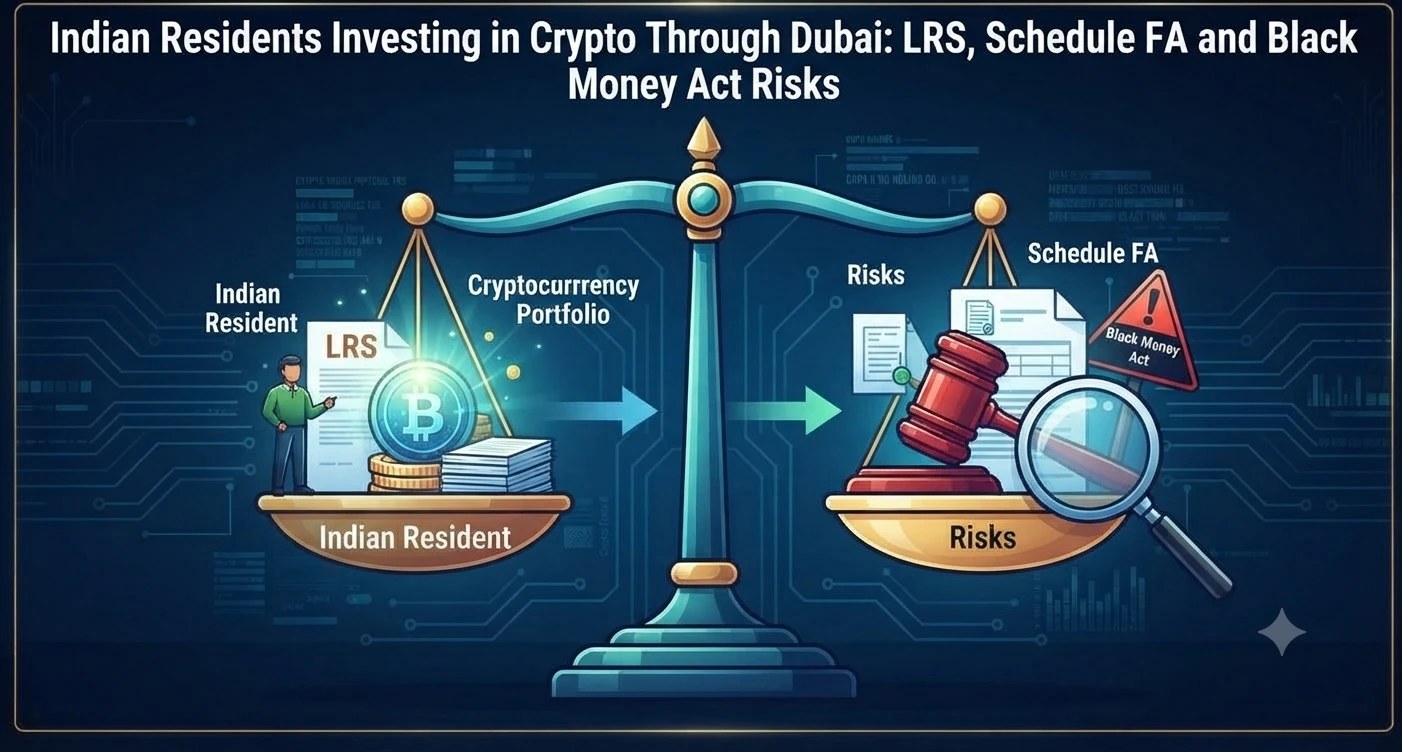
Resident Indians must disclose foreign assets, including foreign property and virtual assets held abroad, in the return. Schedule FA foreign assets crypto holdings are reportable in the schedule for foreign assets for residents, and non-disclosure can attract penalties under the Black Money Act. NRIs have different rules. Check your residential status each year.
Foreign exchange rules also matter. If the property was bought with funds remitted under LRS, the sale proceeds and their use are subject to FEMA rules, including limits and reporting on repatriation and reinvestment. Later gains on crypto are taxed in India at 30% for residents under the VDA rules. Seek an Indian tax and FEMA review before you sell and before you convert.
Next steps and quick answers
Collect documents, talk to your bank, choose a licensed exchange, plan your Indian tax and disclosures and keep records. This is general information, not legal or tax advice, and Halverton & Co. does not advise on UAE law. Before you convert property proceeds crypto Dubai owners should get Indian tax advice.
Related reading: buying property in Dubai with crypto, Indians investing in crypto from Dubai: LRS and Schedule FA, UAE bank accounts for crypto companies, how to check whether a crypto firm is VARA licensed, a crypto OTC desk in Dubai and NRI property in India from Dubai; also claims after a Dubai crypto exchange collapse.
Quick answers
Can I use Dubai property sale proceeds to buy crypto?
In principle yes through licensed channels, after AML checks and source of funds documentation. Take UAE advice on process.
What documents will an exchange ask for?
Identity and address, the sale and purchase documents, proof of receipt of proceeds, tax residency and an explanation of purpose.
Do I report this in India?
Resident Indians must disclose foreign assets and report income and gains. Take Indian tax advice.
Can I use Dubai property proceeds to buy crypto?
In principle yes through licensed channels after AML checks. Take UAE and Indian advice.
Final word
Halverton & Co. is an Indian law firm advising NRIs, founders, investors and businesses in Dubai and across the UAE on Indian law, including Indian tax, FEMA and disclosure questions for NRIs and residents with UAE property and digital assets, working alongside UAE-licensed counsel. We practise in Jharkhand, Maharashtra and before the Supreme Court of India, and work alongside UAE-licensed counsel, who advise on UAE law. Halverton & Co.: Where tech needs law! If you have a question about Indian law, write to us at office@halvertonandco.com, or get in touch.
This article reflects developments reported up to 31 October 2026. It is for general information only, is not legal advice, and does not create an advocate-client relationship. Halverton & Co. is an Indian law firm and does not advise on UAE law; UAE-law points should be confirmed with UAE-licensed counsel.
Sources
Related practice area
Crypto, Web3 & Digital Assets
Advice for virtual digital asset businesses on registration, reporting and structure.
View the practice areaComments
No account needed. Comments are reviewed before they appear, so yours will show here once approved. Please do not share confidential details or describe your own legal matter: replies are general discussion, not legal advice, and do not create an advocate-client relationship. For your own situation, write to office@halvertonandco.com.