Indian investors often look to Dubai for crypto: VARA-licensed exchanges, crypto-friendly banks, Dubai-based brokers, and tokenised investment products. Some open accounts while visiting; others invest through family members living in the UAE. It feels like a simple way to invest in a more developed crypto market.
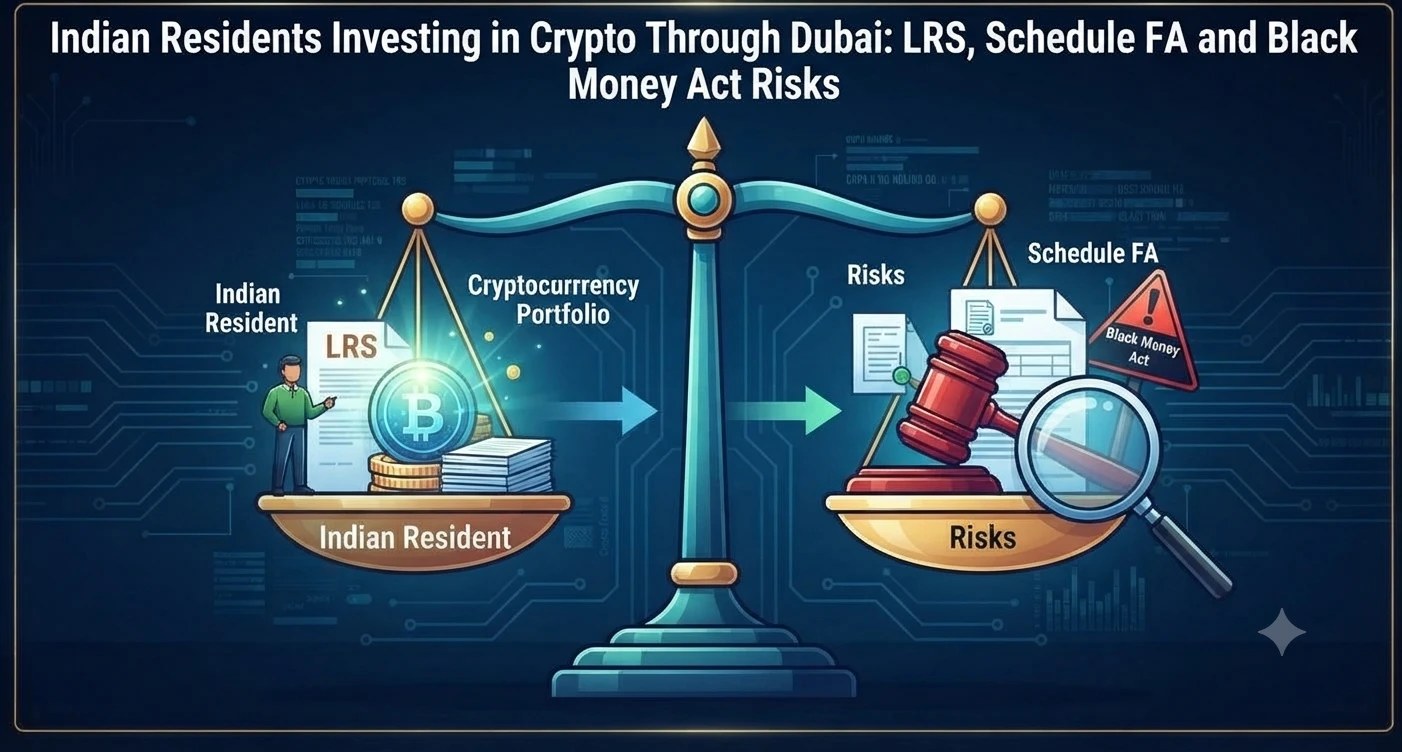
For Indian residents, though, investing in crypto through Dubai raises serious questions under India’s foreign exchange and tax laws. This guide explains what India’s Liberalised Remittance Scheme allows, the tax collected at source on remittances, the duty to disclose foreign crypto in Schedule FA, and the Black Money Act risks that make mistakes so costly.
Can Indian residents send money to Dubai for crypto?
Indian residents can send money abroad under the Liberalised Remittance Scheme (LRS), up to US$250,000 per financial year, for permitted current and capital account transactions. The LRS lists certain prohibited purposes, such as margin trading and lottery-type activities, and it doesn’t expressly provide for the purchase of crypto assets abroad.
In practice, Indian banks have been cautious. Many decline LRS remittances where the stated purpose is buying crypto or funding a crypto exchange account, because the RBI hasn’t expressly approved it and banks must apply their own due diligence under foreign exchange and anti-money laundering rules. Misdescribing the purpose of a remittance to get it through is a serious problem in itself.
NRIs living in Dubai are in a different position. Non-residents can generally invest abroad from their foreign income without LRS limits, but money held in Indian NRO accounts has its own repatriation rules, and income connected with India may still be taxable there. Indian residents who are temporarily in Dubai face the same rules. Using a UAE bank account or card opened during a visit doesn’t change your status: if you’re resident in India, India’s foreign exchange rules apply to your investments abroad.
Tax collected at source and tax on gains
Remittances under the LRS above a threshold attract tax collected at source (TCS). For most investment remittances, TCS applies above ₹10 lakh a year at 20%, under the threshold raised by the Finance Act, 2025. TCS isn’t an extra tax: it can be credited against your income tax liability, but it ties up cash and creates a clear record of the remittance.
Indian residents are taxed on their worldwide income, so gains on crypto bought and sold through Dubai platforms are taxable in India. Under India’s virtual digital asset regime, gains are taxed at 30%, plus cess, with no deductions except the cost of acquisition and no set-off of losses. Holding the crypto on a Dubai exchange doesn’t change that.
There’s also a timing trap. Swapping one crypto for another on a Dubai exchange is a taxable transfer for Indian residents, even if nothing is converted back to rupees or dirhams. Active traders can build up significant Indian tax liabilities without realising it.
Schedule FA: disclosing foreign crypto
Indian residents who are “resident and ordinarily resident” must disclose their foreign assets in Schedule FA of their income tax return. That includes accounts and holdings with foreign exchanges and brokers, foreign bank accounts, and, in practice, crypto held abroad. Schedule FA disclosure is required even if the asset produced no income during the year.
Schedule FA is where many Indian investors in Dubai crypto go wrong. They report gains (or don’t) but forget to disclose the accounts themselves, or assume that small balances don’t need reporting. The rules are strict, and the information increasingly reaches Indian authorities: exchanges in many jurisdictions report under international information-sharing frameworks, and India’s own reporting regime for crypto has expanded since April 2026.
Self-custody wallets deserve a mention. Crypto held in a hardware or software wallet you control, after being bought on a Dubai exchange, is still a foreign asset for practical purposes, and investors should record where and how it is held so they can report it accurately. If you’re not sure whether something belongs in Schedule FA, the safer course is usually to disclose it, with a clear description, rather than leave it out.
The Black Money Act: why mistakes are so expensive
The Black Money (Undisclosed Foreign Income and Assets) and Imposition of Tax Act, 2015 applies to undisclosed foreign income and assets of Indian residents. Where a foreign asset is undisclosed, the Act can tax its value at 30%, impose a penalty of up to three times the tax, and, in serious cases, allow prosecution. Failing to disclose a foreign asset in the return can also attract a separate penalty of ₹10 lakh.
Families should pay particular attention. It’s common for an Indian resident to fund a relative’s Dubai crypto account, or for accounts to be held jointly; both arrangements can create disclosure and tax obligations for the Indian resident, and they should be documented clearly.
There’s some relief for small balances. The Finance (No. 2) Act, 2024 provided that the ₹10 lakh penalty for non-disclosure doesn’t apply where the aggregate value of foreign assets, other than immovable property, doesn’t exceed ₹20 lakh. But that relief doesn’t remove the duty to disclose, and it doesn’t protect undisclosed income.
| Issue | What the rule says | Practical point |
|---|---|---|
| LRS | Up to US$250,000 per financial year for permitted purposes; it does not expressly provide for buying crypto abroad | Banks are often cautious; describe the purpose of the remittance accurately |
| TCS | 20% on most investment remittances above ₹10 lakh a year | Creditable against income tax, but it ties up cash and leaves a clear record |
| Tax on gains | 30% plus cess, with only the cost of acquisition deductible and no set-off of losses | A crypto-to-crypto swap on a Dubai exchange is a taxable transfer |
| Schedule FA | Residents who are ordinarily resident must disclose foreign assets, even if they produced no income | Include exchange accounts, holdings and, in practice, self-custody wallets |
| Black Money Act | Tax at 30% of an undisclosed asset, a penalty of up to three times the tax, and possible prosecution; a separate ₹10 lakh penalty for non-disclosure | The ₹20 lakh relief for small foreign assets does not remove the duty to disclose |
For investors in Dubai crypto, the lesson is clear: the cost of disclosure is low, and the cost of non-disclosure can be enormous.
Staying compliant and remedies
If you’re an Indian resident investing in crypto through Dubai, use only lawful channels for remittances, keep records of every transfer and trade, calculate Indian tax on every transfer, and disclose foreign accounts and holdings in Schedule FA. If you’re an NRI who has moved to Dubai, check your Indian residential status carefully, because Schedule FA and worldwide taxation apply only to residents. If you’ve made mistakes, act before the tax department does: an updated return can correct income within 48 months of the end of the relevant assessment year, and early voluntary correction is treated far more leniently than discovery. If you receive a notice under the Black Money Act or the Income-tax Act, take advice before responding, because the answers you give at that stage shape everything that follows.
Related reading: why India may still tax Indians in Dubai on crypto, setting up a Dubai crypto holding company as an Indian founder, tokenized real estate in Dubai for Indian investors, crypto fraud between Dubai and India, the RBI’s lean towards prohibition, what happens to crypto when you die and crypto tax in India vs the UK; also sending USDT from Dubai to India and returning to India from Dubai with crypto.
Quick answers
Can Indian residents buy crypto on a Dubai exchange?
India’s LRS doesn’t expressly provide for buying crypto abroad, and banks are often cautious about such remittances, so take advice before investing.
Do I need to disclose crypto on a Dubai exchange in my Indian return?
If you’re resident and ordinarily resident in India, foreign accounts and holdings should be disclosed in Schedule FA.
What happens if I don’t disclose foreign crypto?
The Black Money Act can tax the undisclosed asset at 30%, impose penalties of up to three times the tax, and allow prosecution in serious cases.
How much can an Indian resident remit abroad?
Up to US$250,000 per financial year under the LRS for permitted purposes. TCS of 20% applies to most investment remittances above ₹10 lakh a year and can be credited against income tax.
Is swapping one crypto for another on a Dubai exchange taxable?
Yes. For Indian residents it is a taxable transfer, even if nothing is converted back to rupees or dirhams.
Final word
Halverton & Co. is an Indian law firm advising Indian founders, investors, NRIs and crypto businesses in Dubai and across the UAE on Indian law, including LRS and FEMA compliance, Schedule FA disclosure, Black Money Act proceedings and crypto tax corrections. We practise in Jharkhand, Maharashtra and before the Supreme Court of India, and work alongside UAE-licensed counsel, who advise on UAE law. Halverton & Co.: Where tech needs law! If you have a question about Indian law, write to us at office@halvertonandco.com, or get in touch.
This article reflects developments reported up to early October 2026. It is for general information only, is not legal advice, and does not create an advocate-client relationship. Halverton & Co. is an Indian law firm and does not advise on UAE law; UAE-law points should be confirmed with UAE-licensed counsel.
Related practice area
Crypto, Web3 & Digital Assets
Advice for virtual digital asset businesses on registration, reporting and structure.
View the practice area