Key takeaways
- Several UAE regulators license crypto firms: VARA in Dubai outside the DIFC, the DFSA in the DIFC, the FSRA in the ADGM and the federal Capital Market Authority, which succeeded the SCA from 1 January 2026.
- Match three things: the legal entity, the licence and the service you are buying, and type the regulator’s address yourself instead of following links from the firm.
- Read VARA’s investor and marketplace alerts, and treat guaranteed returns, pressure to deposit and payments to personal accounts as red flags.
- Indian investors should also check FIU-IND registration, the 30% tax and 1% TDS rules, remittance limits and Schedule FA reporting.
Many Indian investors are drawn to crypto firms that advertise a Dubai or UAE licence. A licence badge on a website is easy to copy, and it is also easy to misread. A firm may hold a licence for one activity but not the one it sells you, a licence from one regulator but not another, or no licence at all. Knowing how to check VARA licence crypto firm status, and how to look up the other UAE regulators, is the most useful ten minutes you can spend before you send money.
This guide explains the UAE’s regulators, the steps to verify a firm, the red flags to watch for, the issues that arise for Indian residents, and what to do if something goes wrong. It is written by an Indian law firm. UAE regulatory points should be confirmed with UAE-licensed counsel, and this is not investment advice.
Who regulates crypto firms in the UAE
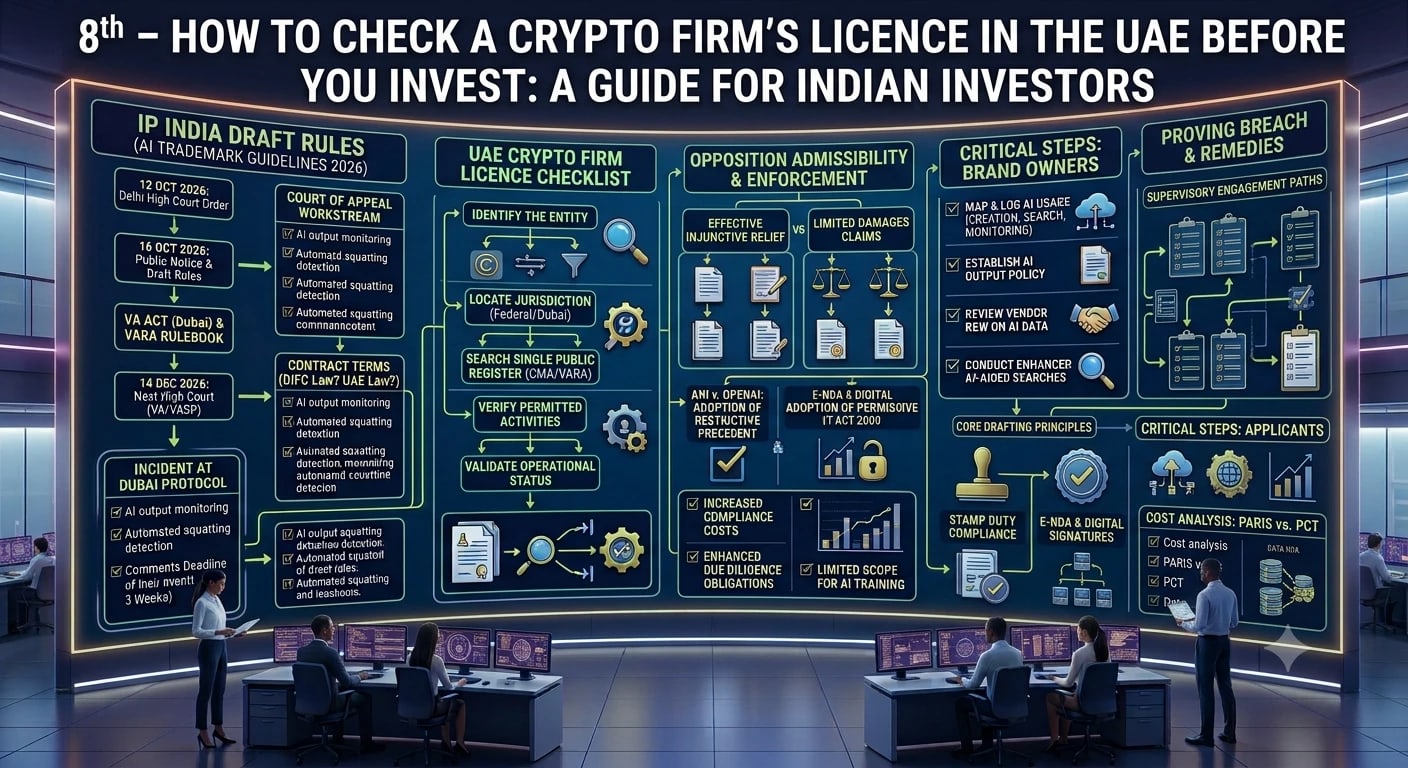
The UAE has several regulators, and which one matters depends on where the firm operates. The Virtual Assets Regulatory Authority (VARA) licenses virtual asset service providers in the emirate of Dubai, excluding the DIFC. The Dubai Financial Services Authority (DFSA) regulates firms inside the DIFC, and the Financial Services Regulatory Authority (FSRA) regulates firms in the ADGM in Abu Dhabi. At federal level, the Securities and Commodities Authority became the Capital Market Authority (CMA) from 1 January 2026, and it oversees federal virtual asset activity.
A firm licensed by one regulator is not automatically licensed by another. A company might hold a VARA licence for custody, but not for exchange or margin trading. It might hold an ADGM licence but market itself in Dubai. VARA and the federal regulator have said they are working towards a single public register of licensed virtual asset firms, which should make checks across the federal and Dubai frameworks easier. Confirm what is actually available when you search, and check each regulator’s own register if a combined one is not shown.
Licensing has stages. VARA has used provisional or minimum viable product approvals before a full licence, and the register can show different statuses. A provisional approval is not the same as a full licence. Read the status carefully, and check which activities the licence covers. The practical aim of the check VARA licence crypto firm process is to match three things: the legal entity, the licence and the service you are buying.
Steps to check a licence
Step one: get the exact legal name of the company, its registration number and the licence number it claims. Ask the firm in writing. A genuine firm will give these quickly. Compare the name on the website and the app with the company name in the terms of use, because a brand name often differs from the licensed entity. Be careful with names that are close to a real licensed firm, which is a common scam.
Step two: search the official register. Use the VARA public register for Dubai firms, and the registers published by the CMA, the DFSA and the FSRA for the others. Do not follow links from the firm’s own site or from social media. Type the regulator’s address yourself. Check that the entity name matches exactly, that the status is current and that the list of permitted activities includes what you want to use. Doing this search yourself is the core of any check VARA licence crypto firm routine.
| Regulator | What it covers | What to check |
|---|---|---|
| VARA | Dubai, outside the DIFC | Entity name, status, permitted activities and warning notices |
| DFSA | The DIFC | Authorised firm, permitted activities and crypto token conditions |
| FSRA (ADGM) | Abu Dhabi Global Market | Authorised firm and regulated activities |
| CMA (formerly SCA) | Federal virtual asset activity | Federal licences and any combined register |
Step three: cross-check. Read the regulator’s warning notices, which list unlicensed firms and imitators. Look at the firm’s terms, risk disclosures and complaints process. Search for the company in the Dubai or UAE company registers and confirm its address and directors. If you are still unsure, email the regulator and ask it to confirm the licence. Keep screenshots with dates. These steps take little time and can prevent a large loss.
Red flags and warning notices
Warning signs include guaranteed returns, pressure to deposit quickly, ’insider’ trading groups, a recent licence claimed without a number, payment to an individual’s wallet or bank account, and requests for remote access to your device. Another sign is a licence logo that does not link to the register entry. Scammers also use fake apps, cloned websites and messages on Telegram and WhatsApp that appear to come from a known exchange.
Regulators publish alerts. VARA, for example, issues investor and marketplace alerts naming firms that advertise without a licence, including offshore exchanges marketing in Dubai. Check these notices before you invest and again before you add funds. A firm’s absence from a warning list does not prove it is safe, but a name on the list is a clear reason to stay away.
Also test the business model. A genuine licensed firm should hold client assets in segregated accounts or custody, publish fees, give statements, offer a complaints route and tell you what happens if it fails. If a firm cannot explain who holds your assets, how withdrawals work and where it is regulated, treat that as a problem even if its licence checks out. Licences reduce risk, but they do not guarantee returns or protect against market loss. A thorough check VARA licence crypto firm review therefore goes beyond the licence number.
Issues for Indian investors
Indian residents face extra points. Virtual digital assets are not legal tender in India, and gains are taxed at a flat 30% with a 1% tax deducted at source on transfers, under provisions that began in the Income-tax Act, 1961 (Sections 115BBH and 194S) and now sit in the Income-tax Act, 2025, with no set-off of most losses. Offshore exchanges that serve Indian users are expected to register with the Financial Intelligence Unit (FIU-IND) as reporting entities, and FIU-IND has issued notices to unregistered offshore platforms. Check whether the firm is registered in India as well.
Moving money abroad raises foreign exchange questions. The Liberalised Remittance Scheme allows resident individuals to remit up to a set annual limit for permitted purposes, but the RBI has not issued clear rules for crypto purchases, and banks apply their own policies. Take advice on what you can remit and how to report foreign assets in your tax return, including Schedule FA. Keep records of every transfer and purchase.
Legal recourse is also different. A UAE licence gives you access to a UAE complaints process and, in some cases, courts, but a dispute with a firm abroad is harder for an Indian investor to pursue. Check the firm’s terms, governing law and dispute forum before you invest. If you invest through a company or fund, structure and documentation will matter even more. Seek professional advice for larger sums. Keep a record of every check VARA licence crypto firm step you take, in case you later need to complain.
Next steps and quick answers
Before you invest, write down the legal name and licence number, search the register yourself, confirm the licensed activities, read the warning notices, test the firm’s custody and complaints terms, and check the Indian tax and FIU position. If you suspect a scam, stop paying, preserve messages and transactions, report it to the regulator and to the National Cyber Crime Reporting Portal or helpline 1930 in India, and contact your bank at once.
Related reading: VARA licence and FIU-IND registration for Dubai exchanges, the UAE FIU and VARA agreement and Indian traders, crypto fraud from Dubai to India and the remedies, Indians investing in crypto in Dubai: LRS and Schedule FA, FIU-IND registration for crypto businesses, DMCC crypto licence versus VARA licence, crypto tax in India: 30% and 1% TDS and the travel rule for UAE and India crypto transfers; also whether crypto is legal in Dubai in 2026 and whether the UAE bans Bitcoin self-custody; also the KuCoin alert from VARA and crypto influencer rules in Dubai; also a crypto OTC desk in Dubai, whether NRIs in Dubai can buy crypto and whether USDT is legal in the UAE; also crypto leverage trading in Dubai and the LRS problem and accepting crypto payments as a Dubai business.
Quick answers
How do I check VARA licence crypto firm status?
Search the VARA public register yourself, match the exact company name and licence status, and check that the licence covers the service you plan to use. Read VARA’s warning notices too.
Does a UAE licence mean my money is safe?
No. A licence shows that a regulator has authorised the firm for stated activities, but it does not remove market, operational or fraud risk. Check custody, fees and complaints terms as well.
Is there one UAE register of licensed crypto firms?
VARA and the federal authority have talked of a unified register, but you should check what is live. Search VARA, the CMA, the DFSA and the FSRA as needed.
Does a VARA licence mean my money is safe?
No. A licence shows authorisation for stated activities, but it does not remove market, operational or fraud risk. Check custody, fees and complaints terms too.
Is there a single UAE register I can search?
VARA and the federal regulator have said they are working towards one, but check what is live and search each regulator’s own register as needed.
Final word
Halverton & Co. is an Indian law firm advising NRIs, founders, investors and businesses in Dubai and across the UAE on Indian law, including virtual digital asset regulation and tax, cross-border investment structuring between India and the UAE, and investor and founder advisory. We practise in Jharkhand, Maharashtra and before the Supreme Court of India, and work alongside UAE-licensed counsel, who advise on UAE law. Halverton & Co.: Where tech needs law! If you have a question about Indian law, write to us at office@halvertonandco.com, or get in touch.
This article reflects developments reported up to late October 2026. It is for general information only, is not legal advice, and does not create an advocate-client relationship. Halverton & Co. is an Indian law firm and does not advise on UAE law; UAE-law points should be confirmed with UAE-licensed counsel.
Sources
Related practice area
Crypto, Web3 & Digital Assets
Advice for virtual digital asset businesses on registration, reporting and structure.
View the practice areaComments
No account needed. Comments are reviewed before they appear, so yours will show here once approved. Please do not share confidential details or describe your own legal matter: replies are general discussion, not legal advice, and do not create an advocate-client relationship. For your own situation, write to office@halvertonandco.com.