Key takeaways
- A draft amendment circulated on 30 March 2026 would make compliance with MeitY advisories and similar instruments part of safe harbour due diligence.
- Civil society groups criticised it as going beyond delegated legislation and as a free speech risk.
- We found no evidence that it has been notified, so it has no legal effect today.
- Platforms should keep an advisory register, a fast legal review process and records of what was done and why.
Advisories from the Ministry of Electronics and Information Technology have, until now, been guidance. Platforms usually follow them, but the law does not say that ignoring an advisory forfeits safe harbour. A draft amendment to the IT Rules, circulated for comment in March 2026, would change that by making compliance with the ministry’s advisories, clarifications and similar instruments part of the due diligence an intermediary must observe.
This guide explains what the draft reportedly says, why civil society groups and digital rights organisations criticised it, the legal argument about delegated legislation, what has and has not happened since, and how platforms and creators should prepare. The status of the draft after mid-2026 could not be confirmed, so anything described here as proposed should be checked before anyone acts on it.
What the draft proposes
The draft Information Technology (Intermediary Guidelines and Digital Media Ethics Code) Second Amendment Rules, 2026 was circulated on 30 March 2026, with public comments due in April. Reports say that it would add to the due diligence duties of intermediaries a requirement to comply with advisories, clarifications, standard operating procedures, guidelines and circulars issued by the ministry.
| Aspect | Today | Under the draft (proposed) |
|---|---|---|
| Legal status of an advisory | Guidance; ignoring it does not itself forfeit safe harbour | Compliance would form part of due diligence |
| Risk of non-compliance | Reputational and political pressure | Possible loss of Section 79 protection |
| Process | Issued quickly, often without public consultation | Same, but with legal consequences |
| Status | In use | Draft circulated 30 March 2026; no notification found |
In practical terms, a ministry advisory would no longer be a request. Under the proposal, failure to follow one could be treated as a failure of due diligence, and an intermediary that does not observe due diligence loses the protection of Section 79 of the IT Act for third-party content.
Reports also say the draft would extend rules on news and current affairs content to individual accounts that post such content above a follower threshold, with 1 lakh followers reported. That would reach independent creators and commentators, not just organised news publishers. The detail of this part of the draft should be read in the original.
Why safe harbour is the pressure point
Section 79 gives intermediaries conditional immunity from liability for what users post. The conditions include observing due diligence as prescribed by the Central Government. The ministry has used this link before: when it warned a large platform over AI-generated images, the warning was that failing to act could cost the platform its Section 79 protection.
For a large platform, losing safe harbour could mean exposure to claims over huge volumes of user content. That makes the threat of withdrawal a strong lever. If advisories become part of due diligence, the ministry would have a faster and less formal way to shape platform behaviour than rule-making, which requires drafting, consultation and notification.
The ministry’s recent advisories, including the October 2026 advisory on unlawful protest content and manipulated media discussed in the previous article, show the kind of subject matter that could fall under such a provision: urgent, fact-specific instructions that change quickly.
The criticism: delegated legislation and free speech
The Internet Freedom Foundation, SFLC.in, the Global Network Initiative and Human Rights Watch are among the groups reported as criticising the draft. Their arguments are that rules made under the IT Act must stay within the powers the Act gives, and that an advisory, which is not made through the process of consultation and publication that rules go through, cannot properly become a condition of statutory immunity.
The legal theme is familiar. Delegated legislation can be struck down if it goes beyond the parent Act, and the Supreme Court read down Section 79’s takedown provision in Shreya Singhal v. Union of India in 2015, holding that platforms need to act on court orders or notified government directions, not on private complaints. Critics argue that binding advisories would bypass that safeguard by turning informal guidance into an enforceable duty.
A free speech concern is also raised: if a platform risks losing immunity for ignoring informal instructions, it will tend to over-comply and remove lawful speech. Supporters of the idea answer that platforms need clear, fast direction on harms such as deepfakes and incitement, and that the ministry should be able to give it. That disagreement is likely to decide whether the draft survives in its current form, and a court challenge is plausible if it is notified.
There is also a procedural argument. Rules made under a statute must usually be published in draft, allow time for comment and be notified in the Gazette so that those affected can know the law. An advisory can be issued quickly and may not be published in the same way. If a duty to follow advisories were built into the rules, companies could be bound by instruments whose existence and content they learned of only when they arrived. Critics say that is hard to reconcile with the rule of law, and supporters would likely answer that urgent harms need fast direction.
Other countries show how this tension is handled. Some regimes give regulators power to issue binding orders on defined grounds with judicial review, instead of treating informal guidance as a condition of immunity. India’s own court-order and blocking-order mechanisms already allow targeted action. The question is whether a further, less formal channel is needed, and if so, what safeguards should accompany it.
Where the draft stands and what else it covers
We found no report that the draft has been notified. Reports from around June 2026 said there was no sign of notification, and we found no later coverage in September or October. A draft that is not notified has no legal effect, so today’s obligations remain those in the existing IT Rules, as amended in February 2026.
That is not the same as the proposal being abandoned. Drafts can be revived, folded into a larger package, or replaced by the broader AI regulation that the IT Minister has said a consultation paper will address. Watch the ministry’s website for notifications and the Gazette for final rules.
In the meantime, the practical reality is that platforms are already treating advisories as strongly persuasive. The risk in the proposal is not that it introduces compliance with advisories as a concept, but that it turns a commercial and political expectation into a legal one.
What platforms and creators should do, quick answers
Platforms should keep a register of all ministry advisories, with the date, the addressee, the action taken and the legal basis relied on. Build a process for reviewing new advisories quickly, with legal sign-off, so that you can both comply and record any concerns. If a draft is notified, review it for scope: which advisories count, whether publication is required, and how disputes are resolved. Consider joining industry submissions to defend the line between guidance and law. Creators who post news or current affairs content should watch the follower threshold in any final rules and consider whether their accounts could fall within a regulated category. Document your sources and corrections policy now, since similar duties apply to publishers of news. If a platform removes your content citing an advisory, ask for the reason through the grievance process, use the Grievance Appellate Committee where the rules allow, and take advice on whether to challenge the action. If you receive a government order directly, do not ignore it, because short deadlines apply, and a High Court petition may be possible where an order is unlawful. This is a developing area, and the safest course is to follow guidance in practice while keeping a clear record of the legal position.
For smaller intermediaries, the proposal would add a monitoring burden. Someone must watch for advisories, interpret them and decide what compliance means in practice, often within hours. Industry bodies and counsel can help by circulating summaries, but the legal responsibility would remain with the intermediary, which is a reason to build the register and review process now.
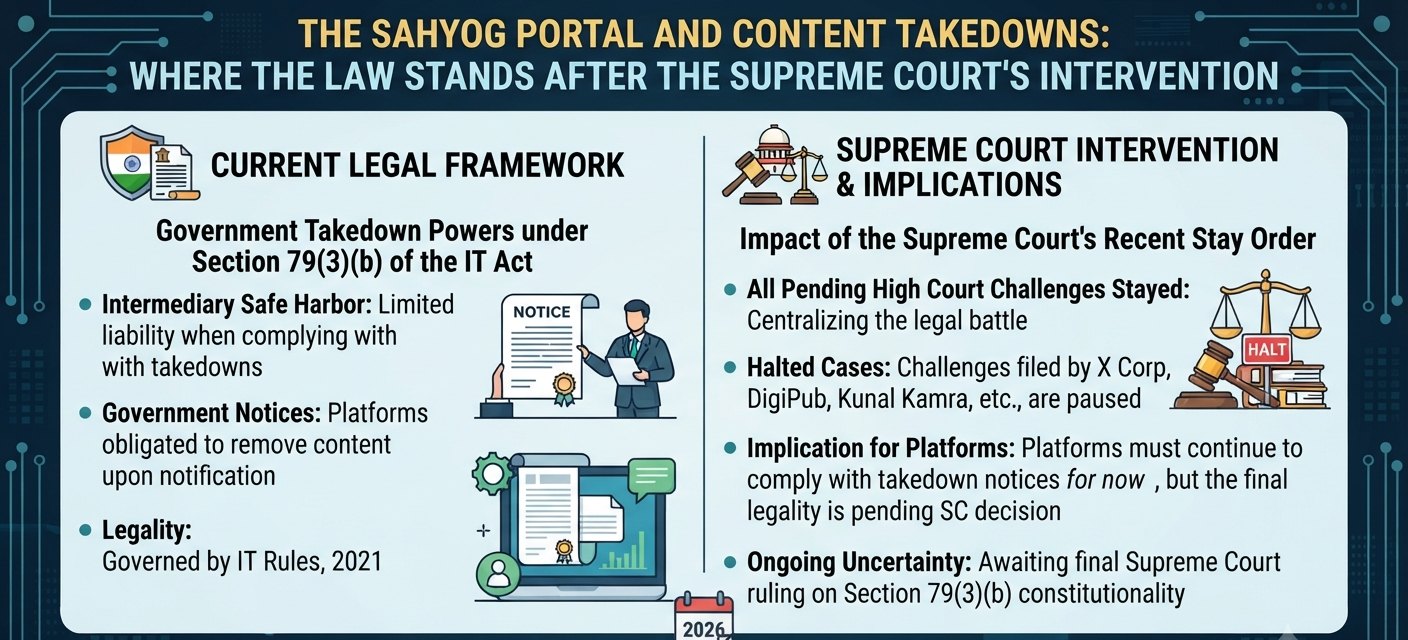
Related reading: MeitY’s October 2026 AI labelling advisory, whether an AI product is an AI intermediary under Section 79, India’s standalone AI law and what startups should prepare, labelling AI-generated content under the IT Rules 2026, the Sahyog portal and content takedowns, dark patterns and the CCPA guidelines and the CERT-In 6-hour rule for startups; also Grok, deepfakes and platform liability for US companies in India.
Quick answers
Are MeitY advisories legally binding today?
Generally no. An advisory is guidance. A March 2026 draft amendment would make compliance with advisories part of due diligence for safe harbour, but we found no confirmation that it has been notified.
What would the draft change for safe harbour?
It would add compliance with ministry advisories, clarifications and similar instruments to the due diligence an intermediary must observe, so ignoring one could risk Section 79 protection.
Why do critics say the draft goes too far?
They argue that rules cannot exceed the powers in the IT Act, that advisories skip the consultation required for rules, and that the threat of losing immunity would push platforms to over-remove lawful speech.
Has the draft Second Amendment been notified?
We found no report of notification and no coverage after about June 2026. A draft has no legal effect until it is notified, so today’s duties remain those in the existing IT Rules.
Why do critics say binding advisories are a problem?
They argue that rules cannot go beyond the IT Act, that advisories skip the consultation and publication that rules need, and that the threat of losing immunity would push platforms to remove lawful speech.
Final word
Halverton & Co. is an Indian law firm advising founders, startups, technology companies and investors on Indian law, including intermediary compliance, government takedown responses and constitutional challenges to technology regulation. We practise in Jharkhand, Maharashtra and before the Supreme Court of India, and act as fractional legal counsel for technology-driven businesses. Halverton & Co.: Where tech needs law! If you have a question about Indian law, write to us at office@halvertonandco.com, or get in touch.
This article reflects developments reported up to late October 2026. It is for general information only, is not legal advice, and does not create an advocate-client relationship. Halverton & Co. is an Indian law firm.
Sources
Related practice area
Technology & AI Law
Contracts, data protection and AI policies for products that handle other people’s data.
View the practice areaComments
No account needed. Comments are reviewed before they appear, so yours will show here once approved. Please do not share confidential details or describe your own legal matter: replies are general discussion, not legal advice, and do not create an advocate-client relationship. For your own situation, write to office@halvertonandco.com.