Most Indians have never heard of the Sahyog portal, but it shapes what they can see online. It is the government’s system for sending content takedown notices to social media platforms, and over the past two years it has become one of India’s most important technology law battles.
In July 2026, the Supreme Court stepped in and stayed every pending High Court challenge to the portal. This guide explains what the Sahyog portal is, why X Corp and others challenged it, what the Karnataka High Court decided, what the Supreme Court’s intervention means, and what platforms, startups and users can do when content is taken down.
What the Sahyog portal is and how it works
The Sahyog portal was developed by the Indian Cyber Crime Coordination Centre (I4C) under the Ministry of Home Affairs to transmit requests to online intermediaries for the removal of content considered unlawful. India launched it in late 2024 to automate content takedowns and let government agencies order platforms directly to remove content they consider unlawful.
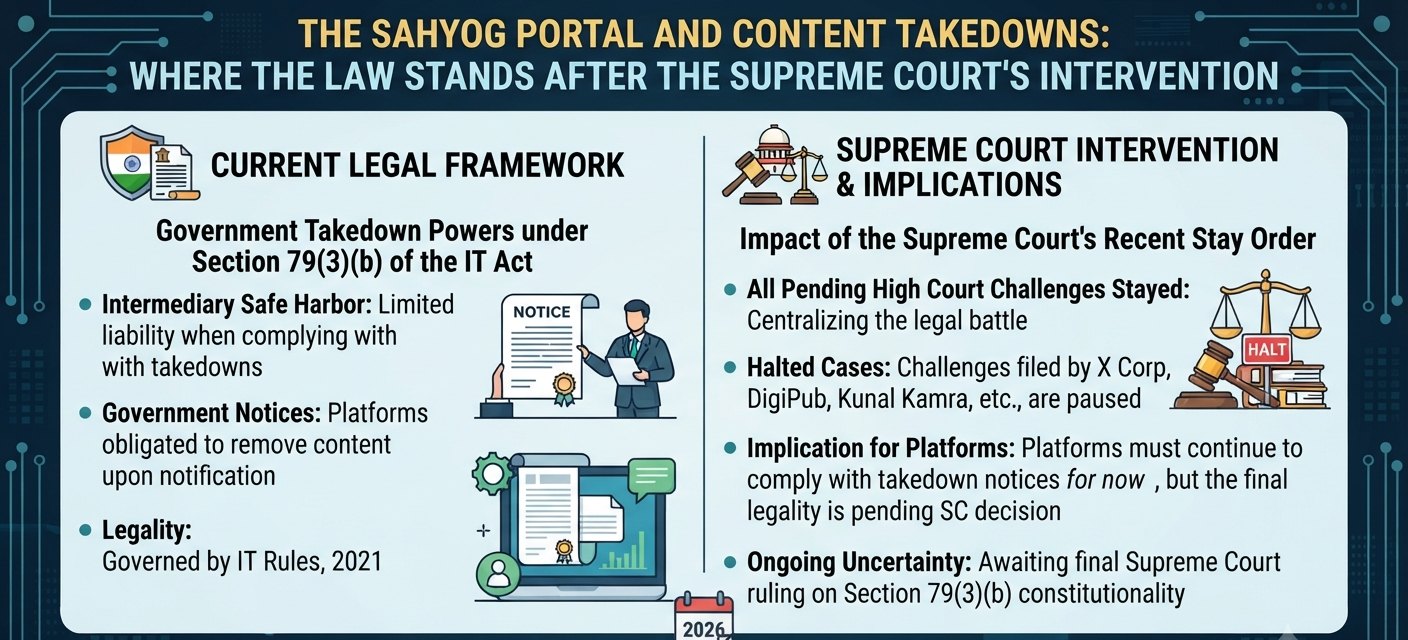
The legal basis the government relies on is Section 79(3)(b) of the IT Act, 2000, read with Rule 3(1)(d) of the IT Rules, 2021. Section 79 gives intermediaries “safe harbour” from liability for user content, and Section 79(3)(b) removes that protection if a platform fails to act expeditiously after receiving actual knowledge, or notice from the government, that content is being used for an unlawful act. Notices on the Sahyog portal are framed as such notices: comply, or risk losing safe harbour.
This differs from the older blocking mechanism under Section 69A of the IT Act, which the Supreme Court upheld in Shreya Singhal v. Union of India (2015) because it contained procedural safeguards, including reasoned orders, a review committee and confidentiality rules. Critics argue that the Sahyog portal creates a parallel takedown route without those safeguards.
| Section 69A blocking | Sahyog notice under Section 79(3)(b) | |
|---|---|---|
| Source of power | Blocking rules with a designated process | Notice that removes safe harbour if ignored |
| Safeguards | Reasoned orders and a review committee | Challenged as lacking equivalent safeguards |
| Consequence of non-compliance | Penalties under the blocking regime | Loss of immunity for the platform |
The X Corp challenge and the Karnataka High Court ruling
X Corp challenged the system in the Karnataka High Court in March 2025, arguing that the portal circumvents Section 69A, violates Supreme Court rulings and infringes citizens’ right to free speech. DigiPub News India Foundation and journalist Abhinandan Sekhri sought to join, arguing that the portal sets up a parallel blocking mechanism with no safeguards, and asked the court to quash the MeitY office memorandum of 31 October 2023 that established it.
On 24 September 2025, the Karnataka High Court dismissed X’s petition. It held that the government acted lawfully in allowing ministries, departments and police agencies to issue takedown orders under Section 79(3)(b) and in creating the Sahyog portal for coordination with social media companies, and that intermediaries must comply or lose their immunity. X said it would appeal to defend free expression, and both X and DigiPub filed appeals before a Division Bench of the Karnataka High Court.
The Supreme Court’s July 2026 intervention
On 22 July 2026, a Supreme Court bench of Chief Justice Surya Kant and Justices Joymalya Bagchi and V. Mohana stayed all pending High Court challenges to the Sahyog portal and to the government’s use of Section 79(3)(b) for takedowns. The order froze four matters: X Corp’s and DigiPub’s appeals in the Karnataka High Court, and petitions by comedian Kunal Kamra and senior advocate Haresh Jagtiani in the Bombay High Court.
The stay came on transfer petitions filed by the Union government, which wants all four cases decided together by the Supreme Court because they raise common questions about the validity of the portal and the scope of Section 79(3)(b). The Centre has also asked the Court to tag these cases with its own pending challenge to the Bombay High Court judgment that struck down the fact-check unit amendment to the IT Rules. The notice was made returnable on 10 August 2026. At the time of writing, we could not find a reported order from that hearing, so check the current status of the transfer petitions before relying on this section.
In practical terms, the Karnataka High Court’s 2025 ruling upholding the Sahyog portal stands for now, and the system continues to operate. The final answer on whether Section 79(3)(b) can be used to order takedowns, and whether the portal is lawful, will come from the Supreme Court, and it will be one of the most important free speech and intermediary liability decisions since Shreya Singhal.
What the Sahyog portal means for platforms and startups
The Sahyog portal isn’t only a Big Tech issue. Any startup that hosts user content (a community app, a marketplace with reviews, a creator platform, a comments section) is an intermediary and may receive notices. The practical lessons are straightforward. Appoint the officers the IT Rules require, set up a process to receive and log government notices, act on them within the required time, and record what was done and why. Incident reporting has its own clock; see our guide to the CERT-In 6-hour rule.
Platforms also have duties to their users. The IT Rules, as amended in February 2026, require platforms to resolve general user grievances within seven days, down from 15. The same amendments introduced India’s first rules on synthetic media; see our guide to labelling AI-generated content. Keeping clear records of takedowns, and telling users why content was removed where the law allows, reduces disputes and builds trust. Takedowns of impersonating or manipulated content also overlap with deepfakes and personality rights, and user data handled in the process is covered by the DPDP Act.
Startups should also remember that Sahyog portal notices can come from many different agencies, including state police units, so a single nominated person who receives, logs and tracks every notice is essential. For startups with limited legal resources, the safest course is to comply promptly with notices that are facially lawful, keep detailed records, and take advice on notices that seem overbroad, especially those affecting news, political speech or journalism, where the constitutional stakes are highest. Interface design and consent flows are a separate compliance area; see our note on dark patterns.
Remedies for users and platforms, and quick answers
A user whose content is removed can first use the platform’s grievance process and, if unsatisfied, appeal to the Grievance Appellate Committee. Where a takedown violates free speech rights, a writ petition before a High Court remains possible, although the Supreme Court’s stay means challenges to the Sahyog portal itself are now effectively centralised before it. Platforms that receive notices they consider unlawful can seek clarification, comply under protest while challenging the notice, or approach the courts, bearing in mind that refusing to comply risks loss of safe harbour while the law is unsettled.
Quick answers
What is the Sahyog portal?
A government portal developed by I4C under the Ministry of Home Affairs to send content takedown notices to online intermediaries under Section 79(3)(b) of the IT Act.
Did the Supreme Court strike down the Sahyog portal?
No. In July 2026 it stayed the High Court challenges on the Union government’s transfer petitions. The Karnataka High Court’s 2025 ruling upholding the portal still stands for now.
What can I do if my post is taken down?
Use the platform’s grievance process, then the Grievance Appellate Committee, and take legal advice if your free speech rights are affected.
Related reading: deepfakes of UK creators and brands: Indian courts vs UK law; also VARA licences and FIU-IND registration for Dubai exchanges; also clone apps copying your crypto brand in India; also the draft IT Rules change on binding MeitY advisories and whether an AI product is an AI intermediary under Section 79; also Grok, deepfakes and platform liability for US companies in India.
Final word
At Halverton & Co., we work with founders, startups and technology-driven businesses on intermediary compliance, content takedowns, IT Rules and free speech disputes. We practise in Jharkhand, Maharashtra and before the Supreme Court of India, and act as fractional legal counsel for companies that need senior legal support without a full in-house legal team. Halverton & Co. is built on a simple idea: Where tech needs law! If this issue affects your business, write to us at office@halvertonandco.com, or get in touch, and we’ll help you work out where you stand.
This article reflects the law and developments reported up to early October 2026. It is for general information only and is not legal advice. Please take advice on your specific facts before acting.
Related practice area
Technology & AI Law
Contracts, data protection and AI policies for products that handle other people’s data.
View the practice areaComments
No account needed. Comments are reviewed before they appear, so yours will show here once approved. Please do not share confidential details or describe your own legal matter: replies are general discussion, not legal advice, and do not create an advocate-client relationship. For your own situation, write to office@halvertonandco.com.