Key takeaways
- VARA’s alert of 5 March 2026 named four entities advertising as KuCoin and said they were not approved to market virtual assets in Dubai and hold no licence.
- On 24 June 2026 VARA published a notice of fines concerning Peken Global Limited for unlicensed services; other entities were not targeted by that action.
- The alert is directed at firms, not users, but using an unlicensed platform removes regulatory protection.
- Check the entity, test withdrawals, keep records, beware phishing and prefer licensed or registered platforms.
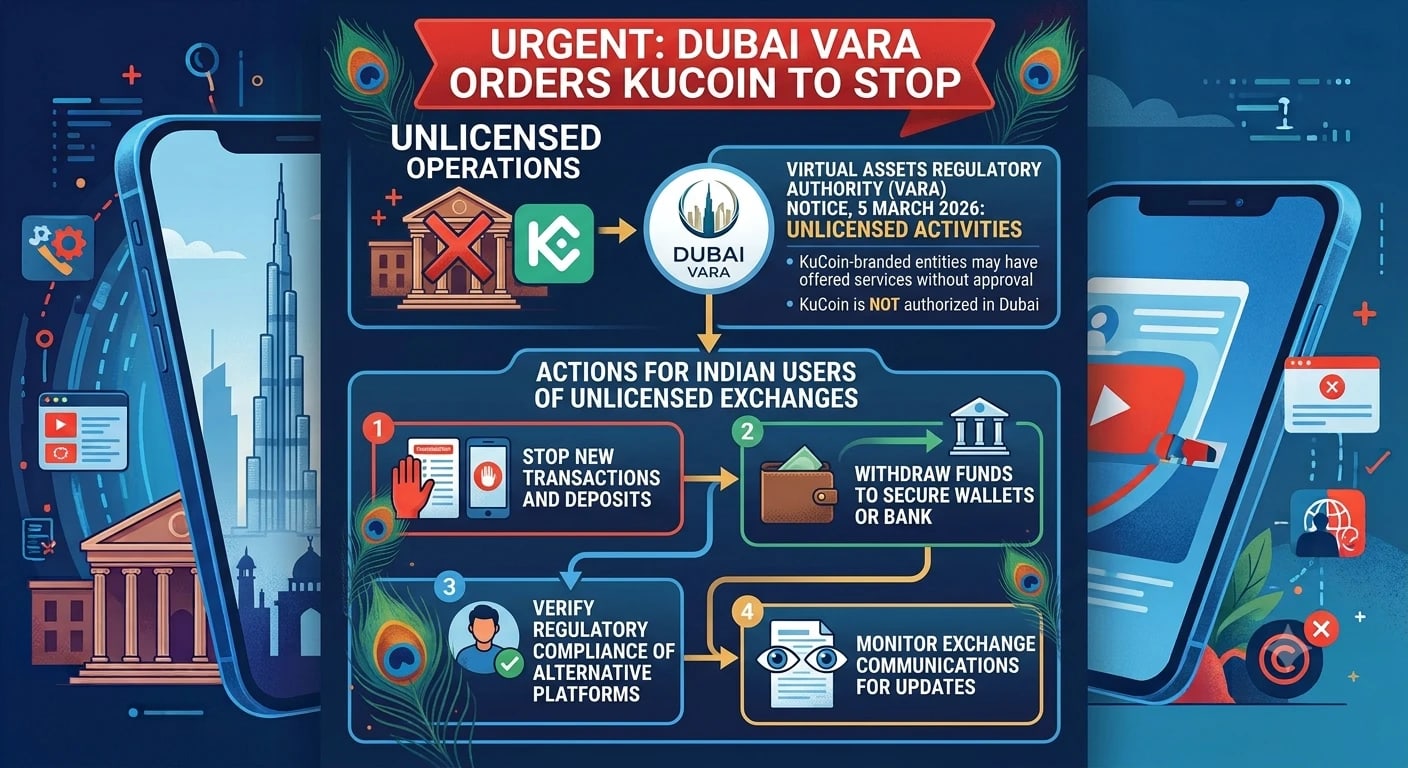
On 5 March 2026, Dubai’s Virtual Assets Regulatory Authority issued an investor and marketplace alert about KuCoin. VARA said that entities commercially advertising as KuCoin had not been approved to market virtual asset products in Dubai or to its residents, that KuCoin does not hold a licence to provide virtual asset services in or from Dubai, and that consumers should avoid engaging with it. The KuCoin Dubai VARA order matters to Indian users because many of them hold accounts on offshore exchanges.
This guide explains what VARA said, what followed in June 2026, what the order does and does not mean for an Indian resident or an Indian in Dubai, and the practical steps to take if you use an unlicensed exchange. It is written by an Indian law firm. UAE regulatory points should be confirmed with UAE-licensed counsel, and this is not investment advice.
What VARA said about KuCoin
VARA’s notice, dated 5 March 2026, named four companies that it said were commercially advertising as KuCoin: Phoenixfin Pte Ltd, MEK Global Limited, Peken Global Limited and Kucoin Exchange EU GmbH. It said that promotions for KuCoin had not been approved, that the platform could not lawfully market virtual assets in Dubai and that it holds no VARA licence. It advised consumers and investors in Dubai to avoid dealing with the platform. The VARA investor alert KuCoin received is public on VARA’s website. This is the core of the KuCoin Dubai VARA order.
Press reports described the notice as an order to halt services. The wording that matters is in the notice itself, which is an alert about unlicensed activity and unapproved marketing. VARA also reportedly said that the exchange may have served Dubai residents while misrepresenting its licensing position. KuCoin responded that it operates through several entities in different jurisdictions. A VARA alert is a public warning, and enforcement is a separate step.
The notice follows VARA’s marketing regulations, which apply to marketing of virtual assets that targets the UAE, and its licensing regime, under which a firm needs VARA’s licence to provide virtual asset services in or from Dubai. For anyone searching the KuCoin Dubai VARA order, the key facts are that the alert exists, that it names specific entities and that it recommends staying away from the platform in Dubai.
What followed: enforcement and fines
On 24 June 2026, VARA published a notice of fines concerning Peken Global Limited. It said that the entity provided broker-dealer and exchange services in Dubai without a licence. The notice states that it targets that entity and not the other legal entities connected with the brand. Another outlet reported fines in the range of AED 100,000 to AED 600,000, but that figure does not come from the notice itself, so check the notice before quoting numbers. The Peken Global Limited VARA fine is the clearest sign of enforcement. It is the second chapter of the KuCoin Dubai VARA order.
VARA’s enforcement powers include fines, orders to stop activity, public notices and, in serious cases, referral to other authorities. The Peken Global Limited fine shows that an alert can be followed by a penalty. It also shows how enforcement is entity-specific: the regulator names the legal entity it considers responsible, so brands with many companies can see action against one and not the others.
Do not read the fines as a verdict on the exchange’s operations outside Dubai. They concern services offered in Dubai without a licence. KuCoin may be regulated or registered in other places, and other regulators may take a different view. But for a user in Dubai, the practical point is stark: an exchange that VARA says is unauthorised can be hard to rely on for complaints, recovery or legal protection in the UAE.
What it means for Indian users
For an Indian living in Dubai, the alert is direct. VARA advises residents to avoid the platform, and using it means dealing with an unlicensed firm. VARA’s rules focus on the firm, not the user, so an individual customer is not the target of the order, but you lose the protections of a licensed provider: segregation rules, complaints routes and a regulator that can act. Each unlicensed crypto exchange Dubai Indian users rely on carries the same risks. Indian users should read the KuCoin Dubai VARA order as a warning about all unlicensed platforms.
For an Indian resident in India, the position is different but not safer. Offshore exchanges that serve Indian users are expected to register with the Financial Intelligence Unit, and FIU-IND has issued notices and blocked access to some unregistered platforms in the past. Indian law does not ban holding crypto, but using an unregistered exchange can lead to account problems, tax issues and difficulty recovering funds.
Tax and reporting duties do not change because an exchange is unlicensed. India taxes gains at 30% for residents and expects a 1% TDS on transfers, and a foreign exchange may not deduct it, leaving you to report and pay. The UAE and India are also moving to share crypto data under CARF from 2027 and 2028. Using an unlicensed platform does not take your activity out of the tax net.
Practical steps if you use an unlicensed exchange
First, check the facts. Look at VARA’s public register and warning notices for the firm’s name, and at the exchange’s legal entity in its terms. Second, decide whether to move assets. Many users withdraw to a wallet they control or to a licensed exchange, but do it carefully: withdrawals can trigger checks, fees and tax events, and sending funds to the wrong address is irreversible. Test with a small transfer first. To check if crypto exchange is VARA licensed, search VARA’s public register by legal name. Before you withdraw funds from unlicensed exchange accounts, plan for fees and tax.
| Step | What to do | Watch point |
|---|---|---|
| Check | Search VARA’s register and warning notices for the legal entity | Brand and entity can differ |
| Test | Withdraw a small amount first | Withdrawals can trigger checks and tax events |
| Record | Download trade history, deposits and tax statements | Before any restriction |
| Beware scams | Never click links or share seed phrases | Phishing follows news like this |
| Switch | Use VARA, DFSA, FSRA or FIU-IND registered platforms | Licensing is not a safety guarantee |
Third, keep records. Download your trade history, deposit and withdrawal records and tax statements before any restriction. Fourth, avoid panic moves. Scammers exploit news like this with fake support messages and phishing links. Use only the official website you typed yourself, never click links in messages and never share your seed phrase or two-factor codes. If you cannot withdraw, keep evidence and take legal advice.
Fifth, review your platform choices. Prefer exchanges licensed by VARA, the DFSA or the FSRA if you are in the UAE, and registered with FIU-IND if you are in India. For Indians who invest from India, check Indian registration and your tax obligations. Licensing does not guarantee safety, but it gives you a regulator, rules on custody and a complaints route that unlicensed platforms cannot offer.
Next steps and quick answers
Check each exchange you use against the VARA register or FIU-IND records, reduce balances on any platform you cannot verify, keep self-custody for long-term holdings and file your tax returns on time. If you are in Dubai, follow VARA’s alerts. This is general information, not investment advice. Keep the KuCoin Dubai VARA order in mind when you review your exchanges.
Related reading: how to check a crypto firm’s licence in the UAE, whether crypto is legal in Dubai in 2026, VARA licence and FIU-IND registration for Dubai exchanges, whether WazirX and CoinDCX are legal, Dubai influencers promoting crypto: VARA rules, lost crypto in a Dubai scam: 5 steps and crypto fraud from Dubai to India; also crypto prop firms in Dubai; also checking the VARA register.
Quick answers
What did VARA say about KuCoin?
On 5 March 2026, VARA said entities commercially advertising as KuCoin were not approved to market virtual assets in Dubai, that KuCoin holds no licence there and that consumers should avoid engaging with it. In June 2026 it fined Peken Global Limited for unlicensed services.
Is it illegal for me to use KuCoin in Dubai or India?
VARA’s action targets the firms, not individual users. But using an unlicensed platform removes regulatory protection, and in India offshore exchanges are expected to register with FIU-IND. Take advice if you are unsure.
Should I withdraw my funds from an unlicensed exchange?
Many users do, but do it carefully with a small test transfer, keep records and beware of scams. Consider tax effects and take advice if the amount is large.
Was KuCoin literally ordered to stop?
Press reports used that wording, but VARA’s notice is an alert that KuCoin-branded entities were not approved to market and hold no Dubai licence, followed by a June 2026 fine on Peken Global Limited. Read the notices.
Is it illegal for me to hold funds on KuCoin?
VARA’s action targets the firms, not individual users. But you lose the protections of a licensed provider, and Indian users should also check FIU-IND registration.
Final word
Halverton & Co. is an Indian law firm advising NRIs, founders, investors and businesses in Dubai and across the UAE on Indian law, including virtual asset regulation, cross-border compliance between India and the UAE, and investor and founder advisory. We practise in Jharkhand, Maharashtra and before the Supreme Court of India, and work alongside UAE-licensed counsel, who advise on UAE law. Halverton & Co.: Where tech needs law! If you have a question about Indian law, write to us at office@halvertonandco.com, or get in touch.
This article reflects developments reported up to 31 October 2026. It is for general information only, is not legal advice, and does not create an advocate-client relationship. Halverton & Co. is an Indian law firm and does not advise on UAE law; UAE-law points should be confirmed with UAE-licensed counsel.
Sources
Related practice area
Crypto, Web3 & Digital Assets
Advice for virtual digital asset businesses on registration, reporting and structure.
View the practice areaComments
No account needed. Comments are reviewed before they appear, so yours will show here once approved. Please do not share confidential details or describe your own legal matter: replies are general discussion, not legal advice, and do not create an advocate-client relationship. For your own situation, write to office@halvertonandco.com.