Key takeaways
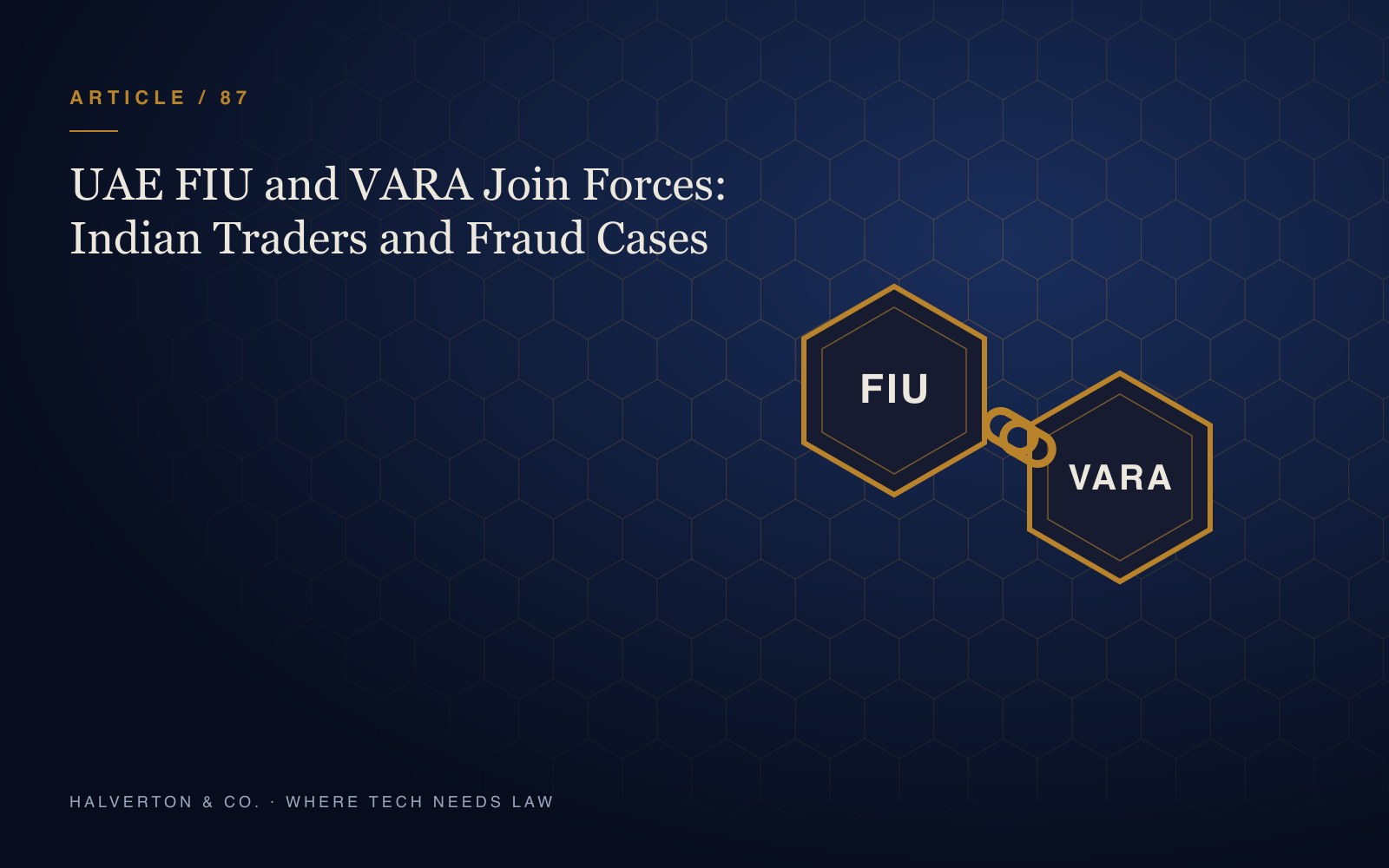
- The UAE FIU and VARA reportedly signed an MoU on 5 October 2026 to share financial intelligence and expertise on crypto-related financial crime.
- An MoU is an agreement between two bodies; it creates no new offences and no new duties for traders.
- Closer scrutiny of platforms’ reporting and controls is the likely effect, so keep clear source-of-funds records.
- Victims still need to report quickly in both countries and pursue the usual criminal and civil routes.
In October 2026, the UAE’s Financial Intelligence Unit and Dubai’s Virtual Assets Regulatory Authority signed a memorandum of understanding to share financial intelligence and expertise on crypto-related financial crime. For the Indian community in Dubai, which includes a large number of traders, founders and users of VARA-licensed exchanges, the agreement raises two questions. Will it make life harder for ordinary traders? And does it help Indians who have been defrauded?
The answer to both is: a little, and indirectly. This guide explains what the memorandum is and what it isn’t, how financial intelligence flows from licensed crypto businesses to the authorities, what it means for Indian traders and businesses, how it fits with India-UAE cooperation on crypto fraud, and what victims and traders should do in practice. UAE-law points should be confirmed with UAE counsel.
What the FIU and VARA agreed
On 5 October 2026, the UAE Financial Intelligence Unit and VARA signed a memorandum of understanding, according to reports by the Emirates News Agency, Zawya and Gulf News. It was signed by Ali Faisal Ba’Alawi, the head of the UAE FIU, and Matthew White, VARA’s chief executive. The memorandum provides for the exchange of relevant financial intelligence and expertise in accordance with applicable legislation and confidentiality requirements, with the aim of strengthening cooperation in combating financial crime and spotting emerging risks involving virtual assets (WAM; Zawya; Gulf News).
It is worth being precise about what it is. A memorandum of understanding is an agreement between two government bodies on how they will work together, not a new law, and it does not create new offences or new duties for businesses or customers. We found no published text of the memorandum and no details on data-handling mechanics, reporting thresholds or enforcement outcomes tied to it, so claims about specific new powers should be treated as speculation.
| Point | Position |
|---|---|
| Parties | The UAE Financial Intelligence Unit and VARA |
| Reported date | 5 October 2026 |
| Purpose | Exchange of financial intelligence and expertise on crypto-related financial crime, in line with applicable law and confidentiality |
| Legal effect | An agreement between two bodies; it creates no new offences or duties for traders |
| Published text | None found, so claims about its mechanics are unconfirmed |
The agreement builds on existing arrangements. The UAE FIU sits within the Central Bank of the UAE, and it is the body that receives suspicious transaction reports from regulated businesses, including virtual asset service providers. VARA licenses and supervises those businesses in Dubai. Formalising a channel between the two makes it easier to move information from the reporting entity to the supervisor and back.
How financial intelligence flows from crypto businesses
A VARA-licensed exchange, broker or custodian must run an anti-money laundering programme: it must identify and verify customers, monitor transactions, apply sanctions screening, keep records and report suspicious activity to the UAE FIU. The FIU analyses those reports, combines them with other sources and, where appropriate, passes intelligence to law enforcement and to supervisors. The memorandum improves the supervisory half of that loop, so that VARA can use intelligence about risks in the sector when it supervises its licensees.
For licensed firms, the practical consequence is closer scrutiny of the quality of their reporting and controls. A platform that files weak or late suspicious transaction reports, or that onboards customers without adequate checks, is more likely to be noticed. VARA has also taken public enforcement action against firms operating or marketing without a licence, so weak reporting by a licensee is unlikely to go unnoticed (confirm current examples).
International information exchange is moving in the same direction. Reports indicate that the UAE has signed the multilateral agreement for exchanging crypto-asset information under the OECD’s Crypto-Asset Reporting Framework, which is designed to give tax authorities visibility of crypto-asset holdings across borders (Unlock Blockchain). The dates and mechanics should be confirmed, but the trend is towards more visibility of crypto flows, in the UAE and elsewhere.
What it means for Indian traders in Dubai
For a typical Indian trader using a VARA-licensed exchange with clean funds, the memorandum changes little. The checks you already face, such as identity verification, source-of-funds questions and transaction monitoring, are the framework through which intelligence reaches the FIU. The agreement does not make ordinary trading unlawful and doesn’t give VARA or the FIU a new power over your assets.
The risk is for people whose activity looks unusual. Rapid movement of funds in and out, structuring of transfers to stay under thresholds, use of multiple accounts or wallets that cannot be explained, payments from third parties, or trades connected with P2P markets in India where fraud proceeds circulate, can all produce suspicious transaction reports. A report is not an accusation, but it can lead to account restrictions, questions and, if funds are linked to a fraud, to freezes.
Practical hygiene helps. Keep records of where your funds came from, including salary, savings and sale of assets. Use licensed platforms and your own accounts. Be careful with P2P trades and third-party payments, because an innocent seller can be caught in a fraud investigation, as many Indian traders have found. And if you are an Indian resident with money in Dubai, remember that Indian tax and foreign exchange rules still apply: disclosure of foreign assets in Schedule FA and the Black Money Act matter more as information flows increase.
Crypto-fraud cases: India-UAE cooperation in practice
India and the UAE already cooperate on financial crime through treaties on mutual legal assistance in criminal matters and on extradition, and through law enforcement and financial intelligence channels. Financial intelligence units around the world, including India’s FIU-IND and the UAE FIU, generally exchange information through their own networks and agreements, and both are generally understood to belong to the Egmont Group of financial intelligence units, although how requests are handled is not public.
The new memorandum is between two UAE bodies, so it does not itself connect Indian and UAE authorities. Its value for a victim is indirect: better supervisory intelligence about how crypto scams use Dubai platforms may help VARA act against licensees whose controls are weak, and may help investigators trace funds that pass through licensed Dubai exchanges. Recovery still depends on speed, evidence and the right complaints in both countries.
For victims, the usual routes still apply. Report immediately to the exchange or bank concerned, asking in writing for records to be preserved and any remaining balance frozen. File complaints with the police where you live, the National Cyber Crime Reporting Portal in India or the 1930 helpline, and the authorities in Dubai. Whether a Dubai court judgment can be enforced against assets in India depends on which court issued it and on Indian rules for foreign judgments, so take advice before relying on that route. Be careful with recovery agents who promise to get money back for a fee, as many are a second fraud.
Practical steps, remedies and quick answers
Traders should do five things. Use VARA-licensed platforms and check the licence on VARA’s register. Keep a simple file of source-of-funds documents. Avoid unexplained third-party payments and P2P counterparties. Respond promptly and accurately when an exchange asks for information, because delay or inconsistency can lead to restrictions. And take advice on Indian disclosure and tax if you are resident in India. Businesses should review their own anti-money laundering programme: staff training, transaction monitoring, quality of suspicious transaction reports and records. If your account is frozen or you receive a notice, collect the documents explaining your funds, ask the platform in writing for the reason and the process for review, and take advice, because the way you respond at the start shapes the outcome. If you are in India and a bank account has been frozen because of a Dubai-linked trade, Indian courts have in some cases read down account-wide freezes, but that depends on the facts, and a documented representation to the investigating officer is a sensible first step. The agreement does not change these remedies, but it is a reminder that information travels faster than it used to.
Business owners should also think about the reverse flow. When a platform holds a customer’s funds and the customer is the subject of a request from the authorities, the platform may have to freeze, report or hand over records. Staff need clear instructions on what they may tell the customer, because disclosing that a report has been made can itself be an offence in many jurisdictions. A written escalation procedure, and a named compliance officer with authority to act, are basic requirements of a licensed business and a sign of maturity for an unlicensed one preparing to apply.
Related reading: crypto fraud between Dubai and India, bank account frozen after a P2P crypto trade, VARA licence, Indian users and FIU-IND registration, DMCC and VARA licences compared, crypto tax in Dubai for Indian residents, investing in crypto from Dubai: LRS and Schedule FA and FIU-IND registration for crypto businesses; also how to check a crypto firm’s licence in the UAE and the crypto travel rule between the UAE and India; also the KuCoin alert from VARA and lost crypto in a Dubai scam: five steps.
Quick answers
What did the UAE FIU and VARA agree?
A memorandum of understanding signed in October 2026 to exchange financial intelligence and expertise on crypto-related financial crime, in line with applicable law and confidentiality requirements. We found no published text.
Does the MoU create new obligations for Indian traders in Dubai?
Not directly. It is an agreement between two UAE bodies, but it may mean closer scrutiny of platforms’ reporting and controls, so traders should keep clear records of their funds.
Does it help victims of crypto fraud between Dubai and India?
Indirectly. It may help UAE authorities act on weak controls at licensed platforms and trace funds, but victims still need to report quickly in both countries and pursue the usual criminal and civil routes.
What should I do if my Dubai exchange account is restricted?
Collect the documents that explain your funds, ask the platform in writing for the reason and the review process, respond promptly and consistently, and take advice. Delay or inconsistent answers can make restrictions last longer.
Where do Indian victims of crypto fraud report?
Report at once to the exchange or bank, to local police, to the National Cyber Crime Reporting Portal or the 1930 helpline in India, and to the authorities in Dubai. Ask in writing for records to be preserved and balances frozen.
Final word
Halverton & Co. is an Indian law firm advising NRIs, founders, investors and businesses in Dubai and across the UAE on Indian law, including crypto fraud complaints, frozen accounts, FIU-IND and FEMA compliance and cross-border enforcement for NRIs and traders. We practise in Jharkhand, Maharashtra and before the Supreme Court of India, and work alongside UAE-licensed counsel, who advise on UAE law. Halverton & Co.: Where tech needs law! If you have a question about Indian law, write to us at office@halvertonandco.com, or get in touch.
This article reflects developments reported up to late October 2026. It is for general information only, is not legal advice, and does not create an advocate-client relationship. Halverton & Co. is an Indian law firm and does not advise on UAE law; UAE-law points should be confirmed with UAE-licensed counsel.
Sources
Related practice area
Crypto, Web3 & Digital Assets
Advice for virtual digital asset businesses on registration, reporting and structure.
View the practice areaComments
No account needed. Comments are reviewed before they appear, so yours will show here once approved. Please do not share confidential details or describe your own legal matter: replies are general discussion, not legal advice, and do not create an advocate-client relationship. For your own situation, write to office@halvertonandco.com.