Key takeaways
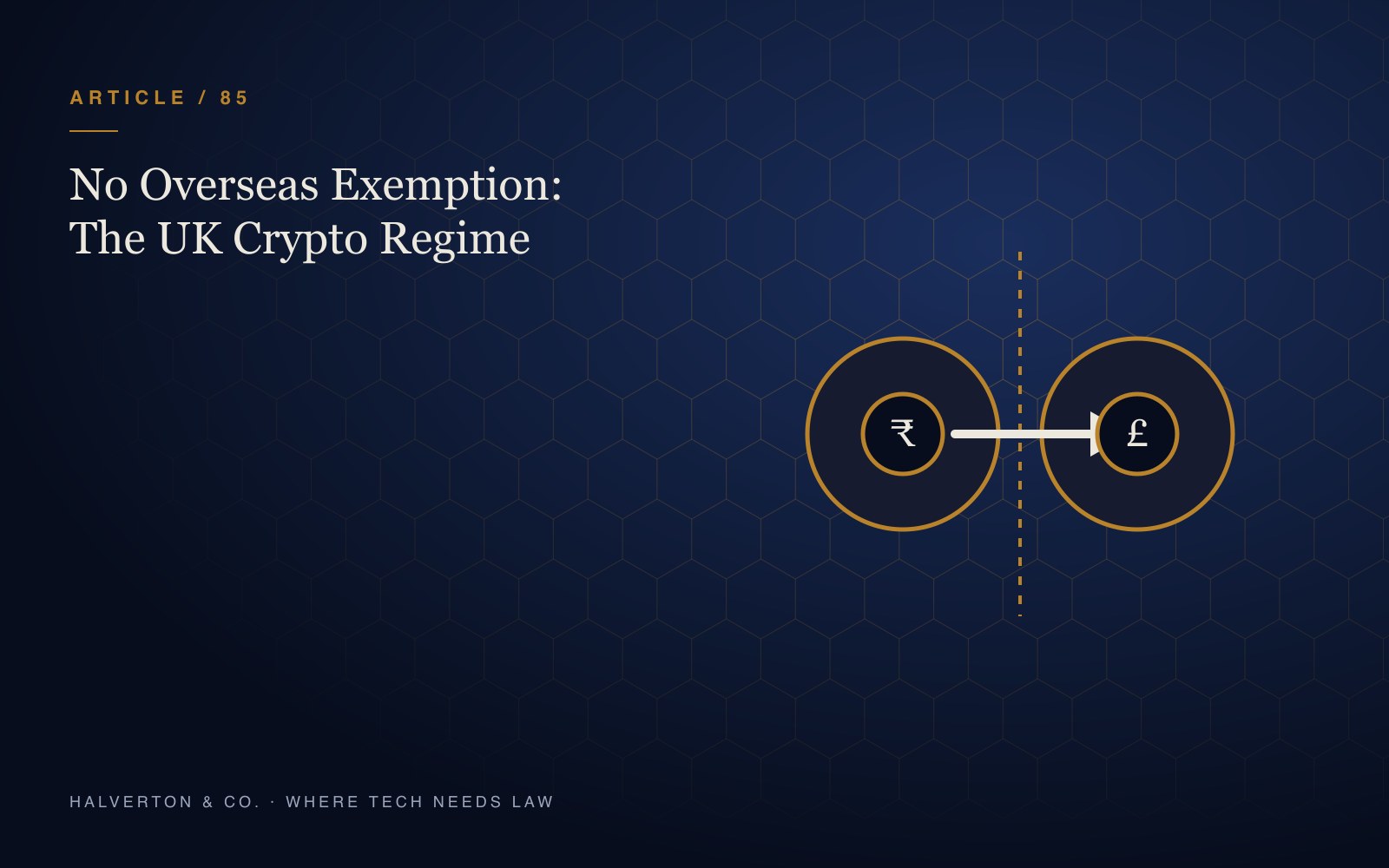
- The government did not extend the overseas persons exclusion to the new regulated crypto activities.
- Deeming provisions can treat activity involving a UK consumer as carried on in the UK, wherever the firm is based.
- There is no planned reverse solicitation exemption, so a UK customer approaching you first does not take you outside the regime.
- Start with a perimeter review for each product, and decide before 28 February 2027 whether to apply, partner or exit.
Many overseas firms assume that a company with no UK office and no UK staff cannot be caught by UK financial regulation. For traditional financial services, there is an overseas persons exclusion in the Regulated Activities Order that supports that assumption in limited circumstances. For crypto, the UK has deliberately not extended it, and instead has written rules that can treat some overseas activity as carried on in the UK.
That matters to Indian Web3 startups: exchanges, wallets, staking services, token platforms and apps with UK users. This guide explains what the overseas persons exclusion is, why it doesn’t apply to the new regime, how the deeming provisions work, which Indian startups should be concerned, and what they should do before the regime starts on 25 October 2027. UK regulatory points should be confirmed with UK advisers, because Halverton & Co. is an Indian law firm and does not advise on UK financial regulation.
What the overseas persons exclusion is
The UK’s Regulated Activities Order, which defines the activities that need FCA authorisation, contains exclusions for overseas persons in certain circumstances. In broad terms, an overseas firm that does not have a UK establishment and that deals with UK customers only through authorised firms, or on a legitimate approach from the customer, can in some cases carry on certain regulated activities without being authorised. The exclusion has long made it possible for overseas banks, brokers and funds to deal with UK institutions and, in limited ways, UK clients without opening a UK office.
It is designed around a simple idea: if you are doing business from abroad and your UK counterparties are protected by the UK firm in the middle, the UK regulator does not need to supervise you directly. The details are technical and differ by activity, and the FCA’s perimeter guidance explains them. The point for crypto is that this idea has not been carried across.
For Indian startups, the practical meaning is that a business model that depends on being outside the UK, such as running a platform from Bengaluru and accepting customers from anywhere, cannot rely on an overseas exclusion once the new rules start. Anyone who has told investors that the UK rules are not a concern because the company is Indian should revisit that statement.
Why it is not available for crypto
The government confirmed that it would not extend the overseas persons exemption to the new regulated cryptoasset activities. Commentary on the legislation says that, in place of an exclusion, it introduces specific deeming provisions that can treat certain overseas cryptoasset activities as being carried on in the UK, and describes the exclusion as simply not available for these activities (Greenberg Traurig via Mondaq; Pinsent Masons; Addleshaw Goddard).
The policy reasoning is easy to follow. The UK wants consumer protection for people in the UK who buy, hold or stake cryptoassets, regardless of where the platform they use is based. Retail crypto customers are often reaching overseas platforms directly, with no authorised UK firm in between, so an exclusion designed around intermediated business would leave them unprotected.
The FCA’s final perimeter guidance and policy statements, PS26/13 and FG26/7, set out how the perimeter works for the new activities, and the guidance tells firms to apply the ordinary territorial analysis first and then check whether a deeming provision applies. Because several sources we reviewed are commentary on drafts, firms should read the final guidance directly.
How the deeming provisions work
The central concept is the UK consumer, which commentary describes as an individual in the UK who is acting outside their trade, business or profession. Under the deeming provisions, a firm can be treated as carrying on certain activities in the UK where a UK consumer is involved, regardless of where the firm is physically located or legally registered. For example, the FCA’s guidance says a person is deemed to be arranging qualifying cryptoasset staking in the UK where the consumer is in the UK, and staking or safeguarding done outside the UK at the direction of a UK consumer can also fall within the perimeter, subject to other exclusions.
Business-to-business firms generally face a lower risk. Pinsent Masons notes that the deeming provisions generally do not apply where no UK consumer is involved, so an overseas firm that serves only institutional clients may often fall outside the perimeter, provided those clients are not acting as intermediaries for UK consumers (Pinsent Masons; Greenberg Traurig). The safeguarding rules also apply to some specified investment cryptoassets, such as those that represent securities.
There is no safe route through reverse solicitation. One firm notes that there is currently no planned exemption for it, so a UK customer approaching you first does not by itself take you outside the regime. And the practical enforcement tools go beyond authorisation: the FCA already regulates the promotion of cryptoassets to UK consumers, and carrying on a regulated activity without authorisation from October 2027 can be an offence.
Which Indian Web3 startups are exposed
The most exposed are consumer-facing businesses with real UK users. A centralised exchange or broker that onboards UK consumers, a custodial wallet that holds assets for them, a staking service that lets UK customers stake, and a platform that issues or arranges access to tokens for UK consumers all raise obvious perimeter questions. The questions are sharper where the startup markets in the UK, accepts UK payment methods or has a UK-language app store listing.
| Business | UK consumers involved? | Likely position |
|---|---|---|
| Centralised exchange or broker onboarding UK retail users | Yes | Likely in scope; authorisation or an authorised partner needed |
| Custodial wallet or staking service for UK consumers | Yes | Likely in scope for custody, safeguarding or arranging staking |
| Non-custodial wallet software or protocol front end | Depends on control and fees | Substance decides; take UK advice |
| Infrastructure or software sold only to businesses | No, if clients do not pass UK consumers through | Generally lower risk |
Less obviously exposed are businesses that think of themselves as software. A non-custodial wallet or a decentralised protocol front end may fall outside some activities, but the FCA looks at the substance: who controls the service, who earns the fees and what the user relies on. Infrastructure and software providers that serve only other businesses are generally in a better position, although they should check whether their business customers pass UK consumers through to them.
Indian startups should also consider their own geography. If the company is registered in India, its founders live in India and its team works there, the UK analysis may be straightforward on territory but difficult on consumer exposure. If the group also has a Dubai or Singapore entity, which entity actually serves UK users, and which markets the service, matters. Map the customer journey and the contracting entity before you decide anything.
What to do now, remedies and quick answers
Start with a perimeter review. For each product, answer three questions: do we have UK consumers, do we perform one of the newly regulated activities for them, and can we rely on an exclusion? If the answers are yes, yes and no, you have three choices: apply for authorisation within the window that closes on 28 February 2027, exit the UK consumer market with real controls, or serve UK customers through an authorised firm on a structure UK advisers have approved. In parallel, run the Indian checks: FIU-IND registration if you serve Indian users, FEMA rules if you plan a UK subsidiary, and tax and disclosure for founders. Record the decision and the reasoning in a board paper. If you decide to exit, plan for customers who are already in the UK, including how they will withdraw assets. If the FCA contacts you, respond accurately and promptly. And be wary of marketing statements that imply you are authorised in the UK when you are not, because that is itself a risk under the financial promotion rules.
A short checklist helps. Which products does the company offer, and which of them would be regulated activities if a UK consumer used them? How many UK users and how much UK revenue exist today? Does any marketing, language, currency or payment method target the UK? Which group entity contracts with the user? Who would sign off a decision to ring-fence or exclude the UK? Answering these in writing, with dates, gives the board a record and gives UK advisers something concrete to work from.
Related reading: FCA crypto authorisation: what Indian firms must do, UK staking regulation for Indian providers, UK stablecoin rules for Indian payment startups, UK crypto exchanges serving Indian users and FIU-IND, FIU-IND registration for crypto businesses, crypto tax in India vs the UK and enforcing a UK judgment or award in India; also the FCA DeFi consultation for Indian protocol developers and UK crypto promotions and Indian influencers.
Quick answers
Does the UK overseas persons exclusion apply to crypto?
No. The government did not extend it to the new regulated cryptoasset activities. The legislation instead uses deeming provisions that can treat some overseas activity involving UK consumers as carried on in the UK.
Can an Indian crypto startup with no UK office be caught by the UK regime?
Yes, potentially. Where a UK consumer is involved, an overseas firm can be treated as carrying on a regulated cryptoasset activity in the UK, wherever it is based, so it should take UK advice.
Does a UK customer contacting us first keep us outside the regime?
Not on current guidance. Commentary notes there is no planned reverse solicitation exemption, so an unsolicited approach does not by itself take you outside the perimeter.
Does a UK customer approaching us first keep us outside the regime?
Not on current guidance. Commentary notes there is no planned reverse solicitation exemption, so an unsolicited approach does not by itself take you outside the perimeter.
Is a business-to-business crypto firm caught?
Generally lower risk, because the deeming provisions are built around UK consumers, but only if the business customers are not passing UK consumers through to you. Check the real flow of customers.
Final word
Halverton & Co. is an Indian law firm advising UK companies, founders, investors and law firms on Indian law, including FIU-IND registration, FEMA structuring and Indian-law compliance for Indian Web3 startups with overseas users. We practise in Jharkhand, Maharashtra and before the Supreme Court of India, and work alongside your UK solicitors, who advise on English law. Halverton & Co.: Where tech needs law! If you have a question about Indian law, write to us at office@halvertonandco.com, or get in touch.
This article reflects developments reported up to late October 2026. It is for general information only, is not legal advice, and does not create a solicitor-client relationship. Halverton & Co. is an Indian law firm, is not authorised or regulated by the Solicitors Regulation Authority, and does not advise on English law; UK-law points should be confirmed with UK advisers.
Sources
Related practice area
Crypto, Web3 & Digital Assets
Advice for virtual digital asset businesses on registration, reporting and structure.
View the practice areaComments
No account needed. Comments are reviewed before they appear, so yours will show here once approved. Please do not share confidential details or describe your own legal matter: replies are general discussion, not legal advice, and do not create an advocate-client relationship. For your own situation, write to office@halvertonandco.com.