Key takeaways
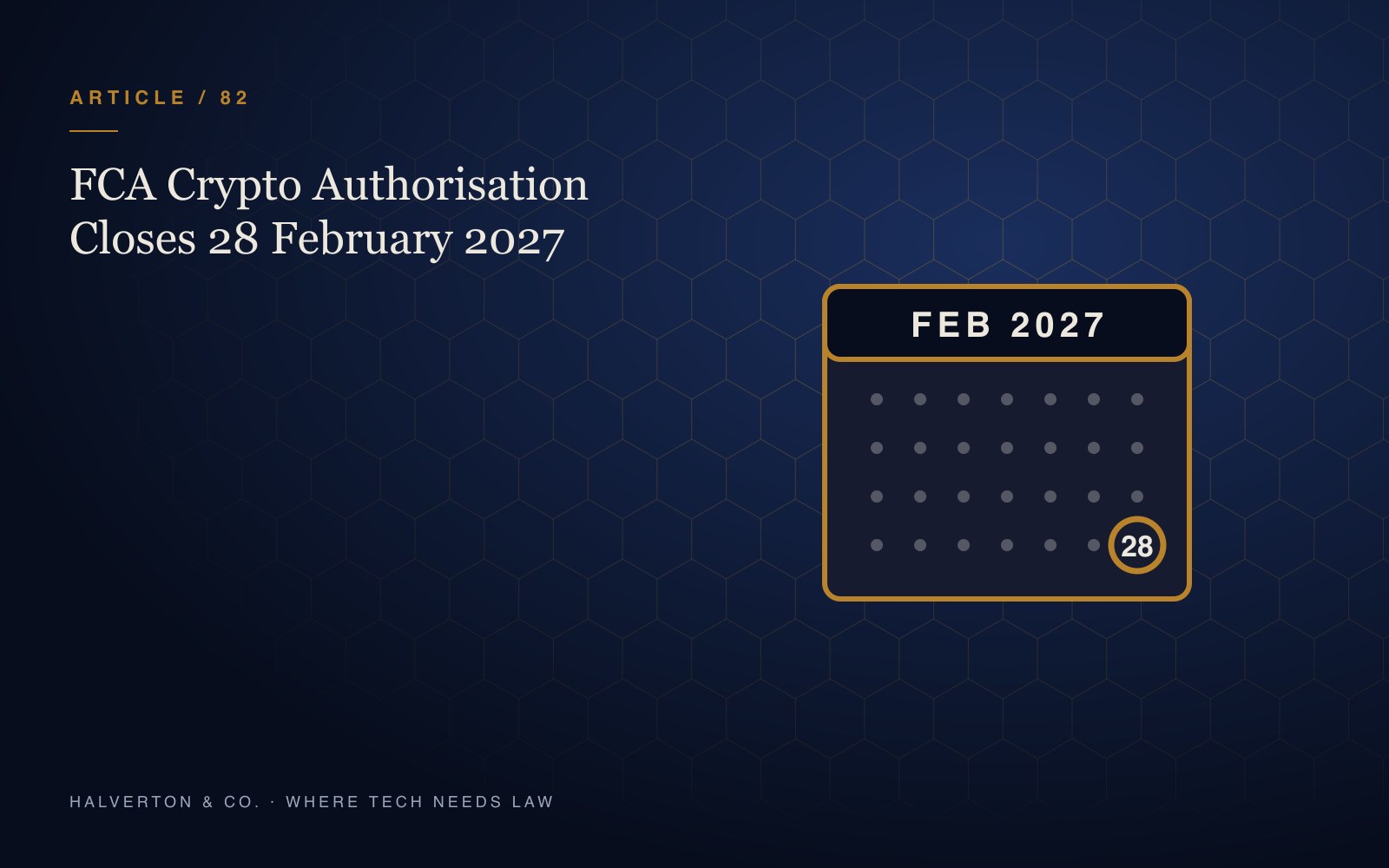
- The FCA’s application window for the new crypto regime runs from 30 September 2026 to 28 February 2027, and the regime starts on 25 October 2027.
- The UK has not extended its overseas persons exclusion to crypto, so an Indian firm with UK consumers can be caught without a UK office.
- The choices are to apply, serve UK users through an authorised firm, or exit the UK consumer market with real controls.
- Indian-law checks run alongside: FIU-IND registration, FEMA for any UK subsidiary and tax disclosure for founders.
The FCA opened its authorisation gateway for the new UK cryptoasset regime on 30 September 2026. Firms that want to keep operating through the changeover are expected to apply by 28 February 2027, ahead of the regime starting on 25 October 2027. For an Indian crypto exchange, wallet provider or Web3 platform that has UK users, that deadline is a business decision with real consequences, whatever the firm’s size and wherever it is incorporated.
This guide explains the timetable, which overseas firms are likely to be caught, the realistic options for an Indian firm, and the Indian-law checks that should run alongside the UK analysis. UK regulatory points should be confirmed with UK advisers, because Halverton & Co. is an Indian law firm and does not advise on UK financial regulation.
The timetable: window, deadline and start date
The FCA published its final rules and guidance for the new cryptoasset regime on 30 June 2026. The authorisation application window runs from 30 September 2026 to 28 February 2027, and the regime itself takes effect on 25 October 2027, when firms carrying on the newly regulated cryptoasset activities will need FCA authorisation (Lewis Silkin; BDO; Price Bailey). The new activities include operating a trading platform, dealing, arranging, safeguarding, staking and issuing qualifying stablecoins.
The 28 February date matters because of what are called savings provisions. Commentary says that a firm that wants to carry on operating after 25 October 2027 while the FCA is still considering its application needs to have applied within the window, and that applying late risks a gap in authorised status (BDO; Price Bailey; DAC Beachcroft). The FCA has also offered a pre-application support service for crypto applicants since mid-2026.
Sources differ on what happens to firms that apply after the window. One commentary says the gateway stays open through 2027 for new firms, and another says the FCA will keep accepting applications but that a decision before the regime starts is unlikely. Treat the position after February as unsettled and check the FCA’s own pages, but plan on the basis that 28 February is the deadline that preserves your options.
Which overseas firms are caught
The new regime is not limited to UK-based firms. The usual overseas persons exclusion in the Regulated Activities Order, which lets some overseas firms deal with UK customers through authorised firms or in certain ways without authorisation, is not being extended to the new cryptoasset activities. Instead, the legislation includes deeming provisions that treat some overseas activity as carried on in the UK (Addleshaw Goddard; Greenberg Traurig; Pinsent Masons).
The key trigger is a UK consumer, which commentary describes as an individual located in the UK who is acting outside their trade, business or profession. If a firm arranges staking or safeguards or otherwise deals for a consumer in the UK, the FCA’s guidance says the firm may be treated as carrying on the activity in the UK, wherever it is located or registered. Staking or safeguarding carried out outside the UK on the direction of a UK consumer can likewise fall inside the perimeter, subject to other exclusions.
Firms that deal only with institutional clients are in a different position. Commentators note that the deeming rules generally do not apply where no UK consumer is involved, so a business-to-business firm may face materially lower risk, provided its institutional clients are not themselves acting for UK consumers. There is also no planned exemption for reverse solicitation, so the fact that a UK customer approached you first will not by itself keep you outside the regime. Take UK advice on the facts of each product.
The options for an Indian firm with UK users
An Indian firm with UK customers has three broad choices. The first is to apply for authorisation, which means meeting the FCA’s requirements on governance, resources, safeguarding, conduct, and anti-money laundering controls, and usually involves a UK presence and UK-based senior individuals. The application is substantial, so firms are advised to begin early and use the FCA’s pre-application support (BDO; Browne Jacobson).
| Route | What it involves | Main risk |
|---|---|---|
| Apply for FCA authorisation | Application inside the window that closes on 28 February 2027, with a UK-ready business plan, governance and controls | Cost, time and the substance the FCA expects |
| Serve UK users through an authorised firm | A contract with a UK-authorised intermediary that carries the regulated activity | Allocation of regulatory responsibility and dependence on the partner |
| Exit the UK consumer market | Geo-blocking, onboarding and marketing controls, and a wind-down for existing UK users | Leakage through app stores, payment methods or marketing aimed at the UK |
The second is to stop serving UK consumers before the regime starts. That means more than blocking sign-ups: you need effective controls, such as location checks at onboarding, restrictions on UK payment methods, app store availability, marketing and referral programmes, and clear terms. UK financial promotion rules already restrict marketing cryptoassets to UK consumers, so a firm that wants to exit should also stop UK-directed promotions. The FCA will look at whether the exclusion is real.
The third is to work through an authorised UK firm. An overseas firm that serves UK consumers only through an FCA-authorised intermediary may not itself need authorisation for some activities, but the arrangement has to be structured with care, with clear allocation of responsibilities, and UK advisers should confirm it. Whichever option you choose, record the decision in a board-approved paper with the reasons, because both the UK and the Indian authorities will want to see that the position was considered.
Indian-law checks alongside the UK application
Indian law runs in parallel. If the firm serves users in India, it needs to consider registration with the Financial Intelligence Unit - India as a virtual digital asset service provider, because FIU-IND treats the obligations as activity-based, and it issued non-compliance notices to a number of offshore platforms in 2025 and 2026. A UK authorisation does not satisfy the Indian regime, and an Indian registration does not satisfy the FCA.
If an Indian company plans to set up or fund a UK subsidiary, foreign exchange rules on overseas investment apply, and the rules restrict overseas direct investment by Indian residents in certain financial services activities, so the structure should be checked before money moves. Founders who are Indian tax residents are also taxed on their worldwide income, must disclose foreign assets and shareholdings in Schedule FA, and may need to consider whether a UK company managed from India raises residence questions under Indian tax law.
Finally, think about data and consumer law. Customer data moving between India and the UK engages the DPDP Act, 2023 and UK data protection law, and your onboarding, complaints and marketing practices in India must meet Indian consumer rules. A single compliance programme with consistent records is cheaper than separate ones.
Before you apply, prepare the documents the FCA will expect from any new applicant: a regulatory business plan that explains each cryptoasset activity and the customers served; governance and senior management arrangements, including who will hold the key accountable functions; financial resources and a wind-down plan; anti-money laundering and sanctions controls; complaints handling; and a financial promotions policy. Applying inside the window is only the first step. A thin or inconsistent application is likely to slow the process and may weaken the case for transitional treatment.
Indian firms often underestimate the people question. The FCA looks at who actually runs the business, where they are based and how decisions are made. A structure in which key decisions sit with founders in India, with a UK entity that has little substance, is likely to draw questions. Consider whether a UK-based compliance lead and a genuine UK management presence are realistic before committing to an application.
Planning, remedies and quick answers
Work back from 28 February 2027. By the end of 2026, finish the perimeter analysis for each product, decide between applying, exiting or partnering, and appoint UK advisers. By January, if you intend to apply, have the business plan, governance, financial resources, compliance framework and key individuals ready, because the FCA reviews all of these. If you intend to exit, build and test the UK exclusion controls well before October 2027, and plan for existing UK customers, including how they will withdraw funds. If you do nothing, you risk carrying on a regulated activity without authorisation after 25 October 2027, which can attract enforcement, and the FCA’s financial promotion powers already apply. If you receive an FCA information request, answer it carefully and take advice before replying. Keep a compliance file that shows your analysis and the decisions you made, because it is the best evidence of good faith if your position is later questioned.
Related reading: how the UK crypto regime reaches Indian Web3 startups, UK staking regulation for Indian providers, UK stablecoin rules for Indian payment startups, UK crypto exchanges serving Indian users and FIU-IND, FIU-IND registration for crypto businesses, crypto tax in India vs the UK and India-UK trade deal: a legal checklist; also the FCA DeFi consultation for Indian protocol developers and UK crypto promotions and Indian influencers.
Quick answers
When does the FCA crypto authorisation window close?
The application window runs from 30 September 2026 to 28 February 2027. Firms that want to keep operating through the changeover should apply within it, ahead of the regime starting on 25 October 2027.
Does an Indian crypto firm need FCA authorisation to serve UK users?
Potentially, yes. The overseas persons exclusion is not extended to the new crypto activities, and deeming provisions can treat activities for UK consumers as carried on in the UK, so firms serving UK consumers should take UK advice.
Can an Indian firm avoid the regime by blocking UK users?
Yes, if the exclusion is real. That means effective location, payment, marketing and app-store controls, not just terms of service, and it should be documented.
When does the UK crypto regime start?
Reports of the FCA’s final rules, published on 30 June 2026, give 25 October 2027 as the start date, with applications accepted from 30 September 2026 to 28 February 2027. One law-firm alert gave 2026 for the start, which we believe is a mistake.
What happens if we miss the window?
The position for firms that apply after 28 February 2027 is unsettled, and transitional protection is expected to depend on applying inside the window. Take UK advice rather than assuming a later route will be available.
Final word
Halverton & Co. is an Indian law firm advising UK companies, founders, investors and law firms on Indian law, including FIU-IND registration, FEMA structuring and Indian-law compliance for Indian crypto firms with overseas users. We practise in Jharkhand, Maharashtra and before the Supreme Court of India, and work alongside your UK solicitors, who advise on English law. Halverton & Co.: Where tech needs law! If you have a question about Indian law, write to us at office@halvertonandco.com, or get in touch.
This article reflects developments reported up to late October 2026. It is for general information only, is not legal advice, and does not create a solicitor-client relationship. Halverton & Co. is an Indian law firm, is not authorised or regulated by the Solicitors Regulation Authority, and does not advise on English law; UK-law points should be confirmed with UK advisers.
Sources
Related practice area
Crypto, Web3 & Digital Assets
Advice for virtual digital asset businesses on registration, reporting and structure.
View the practice areaComments
No account needed. Comments are reviewed before they appear, so yours will show here once approved. Please do not share confidential details or describe your own legal matter: replies are general discussion, not legal advice, and do not create an advocate-client relationship. For your own situation, write to office@halvertonandco.com.