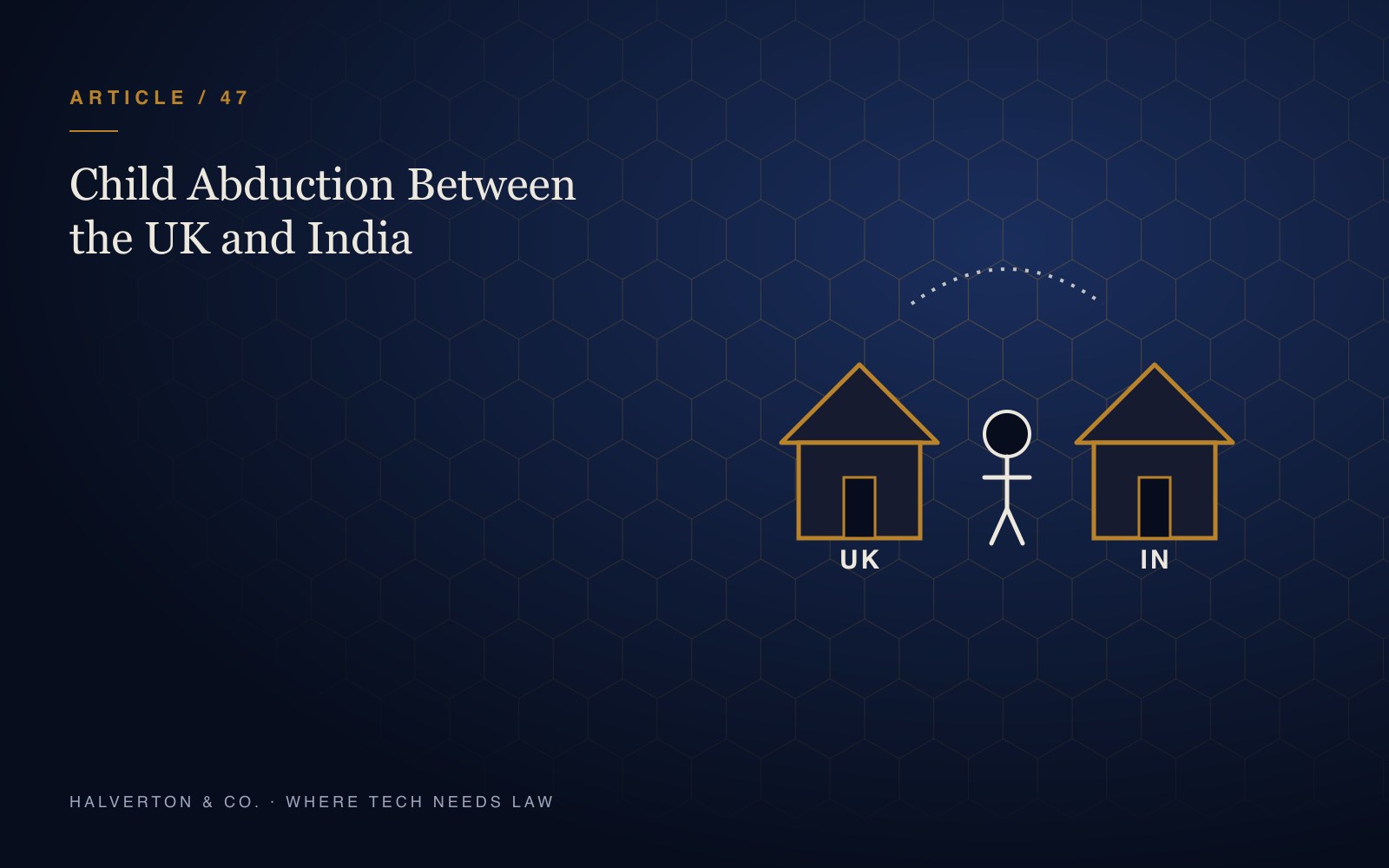
Few situations are as painful as a parent taking a child abroad without the other’s consent. When the destination is India, British parents quickly discover that the usual international machinery doesn’t apply, because India isn’t a party to the Hague Convention on international child abduction.
This guide explains what happens in cases of child abduction from the UK to India: why the Hague Convention doesn’t help, how Indian courts approach UK custody orders, the legal routes available in India, how courts decide whether to return a child, and the practical steps parents should take. It’s written for parents in the UK and their family solicitors. UK-side measures should be checked with a UK family solicitor.
Why the Hague Convention doesn’t apply
The 1980 Hague Convention on the Civil Aspects of International Child Abduction provides a fast, summary procedure for returning children wrongfully removed between member countries. The UK is a member. India isn’t, and it hasn’t enacted domestic legislation implementing the Convention, although the issue has been studied for years.
That means a UK court order for the child’s return can’t simply be registered and enforced in India. Instead, the left-behind parent must start proceedings in the Indian courts, which decide the case under Indian law, with the child’s welfare as the overriding consideration. Indian courts give weight to UK orders, but they’re not bound to follow them.
The reverse situation also arises: a parent in India may seek the return of a child taken to the UK, in which case the UK’s courts apply their own law. This article focuses on removals to India. For parents facing child abduction from the UK to India, the practical consequence is that time is critical. The longer a child lives in India, the more likely an Indian court is to find that the child has settled there, which can weigh against return.
How Indian courts approach return cases
The leading Supreme Court decision is Nithya Anand Raghavan v. State (NCT of Delhi) (2017), in which the Court held that the welfare of the child is the paramount consideration, and that the principle of comity of courts, while relevant, is subordinate to welfare. The Court said Indian courts may decide either to conduct a summary inquiry and return the child to the country from which they were removed, or to hold a detailed inquiry into the child’s welfare before deciding.
Later decisions show that Indian courts do order returns. In Rohith Thammana Gowda v. State of Karnataka (2022), the Supreme Court directed the return of a child to the United States, emphasising the child’s best interests, including continuity in the environment where the child had lived and the existence of foreign court orders. Each case turns on its facts: the child’s age and wishes, how long they’ve been in India, where they went to school, their relationships with each parent and wider family, any allegations of harm, and how promptly the left-behind parent acted. (Add citations for both decisions before relying on them.)
UK orders matter as evidence. An existing UK custody or return order, especially one made with both parents participating, shows the Indian court that a competent court has already considered the child’s welfare, and Indian courts often give it significant weight.
| Hague Convention countries | India | |
|---|---|---|
| Mechanism | Summary return procedure between member states | No Hague mechanism; the parent starts Indian proceedings |
| Test | Wrongful removal and habitual residence | Welfare of the child is paramount; comity is secondary |
| UK order | Directly relevant to return | Given weight as evidence, but not binding |
| Speed | Designed to be fast | Often fast by habeas corpus; slower in a full custody case |
The legal routes in India
The fastest route is usually a habeas corpus petition in the High Court, or in some cases the Supreme Court, under Articles 226 or 32 of the Constitution. Habeas corpus asks the court to order the production of the child and to decide whether the child’s custody with the parent in India is lawful and in the child’s interests. These petitions are often heard quickly, and courts can direct mediation, interim access and the surrender of passports.
The alternative is custody or guardianship proceedings in the family court under the Guardians and Wards Act, 1890, and, for Hindus, the Hindu Minority and Guardianship Act, 1956. These proceedings involve a fuller inquiry into welfare and take longer, but may be appropriate where the facts are disputed or the child has been in India for some time.
Courts also consider the child’s own views, depending on age and maturity, and may speak to older children directly or through a counsellor. Mediation plays a growing role. Indian courts frequently refer parents to court-annexed mediation, and agreements reached there can be made orders of the court. In cross-border cases, carefully drafted mediated agreements, sometimes mirrored by orders in both countries, can provide durable solutions that litigation can’t.
Practical steps for parents
If you fear that a child may be taken from the UK to India, act before it happens. UK family solicitors can advise on prohibited steps orders, port alerts and passport arrangements, which are matters of UK law. Keep copies of the child’s documents, school records and evidence of their life in the UK.
If the child has already been taken, move quickly on both sides. In the UK, consult a family solicitor about orders from the UK court, including orders for return, and contact the relevant UK government and specialist support services. In India, instruct Indian counsel promptly to file a habeas corpus or custody petition, and gather evidence of the child’s habitual residence in the UK, the UK orders, and any risk to the child.
Allegations of domestic abuse are common in these cases and are taken seriously by Indian courts. Evidence of abuse, or of safeguarding concerns in either country, can change the outcome, so it should be documented carefully. Be realistic and child-focused. Indian courts look closely at the conduct of both parents and the child’s welfare in the round. A left-behind parent who acts promptly, shows willingness to facilitate the child’s relationship with the other parent, and offers practical undertakings (such as housing, schooling and financial support on return) presents a much stronger case. For other family matters that cross the UK-India border, see our guide to UK-based NRIs and Indian property, inheritance and disputes.
Remedies, outcomes and quick answers
Outcomes in cases of child abduction from the UK to India vary. Courts may order the child’s return, order the child to stay in India with access arrangements for the other parent, or approve a mediated agreement. Orders can include directions on passports, travel, contact by video, and undertakings to be given in the UK court. Decisions of a High Court can be appealed to the Supreme Court. Contempt proceedings are available if a parent disobeys an Indian court’s order. If you hold a UK order and need to know how it will be treated in India, see our guide to enforcing a UK judgment or arbitration award in India, which explains the limits of Section 44A for non-money orders. Because the law in this area is driven by the facts and by the child’s welfare, early, coordinated advice in both countries is the most important thing a parent can secure.
Related reading: victims of Indian scam call centres.
Quick answers
Is India a member of the Hague Child Abduction Convention?
No. India hasn’t joined the Convention, so UK return orders can’t simply be registered and enforced in India.
Do Indian courts return children to the UK?
They can and sometimes do, but the decision is based on the child’s welfare as the paramount consideration, with UK orders given weight as evidence.
What is the fastest legal route in India?
Usually a habeas corpus petition in the High Court or Supreme Court, alongside or instead of custody proceedings in the family court.
Final word
Halverton & Co. is an Indian law firm that advises on Indian law, including habeas corpus and custody proceedings, mediation and cross-border family disputes involving the UK and India. We practise in Jharkhand, Maharashtra and before the Supreme Court of India, and we work alongside your UK solicitors, who advise on English law. Halverton & Co.: Where tech needs law! If you have a question about Indian law, write to us at office@halvertonandco.com, or get in touch.
This article reflects developments reported up to early October 2026. It is for general information only, is not legal advice, and does not create a solicitor-client relationship. Halverton & Co. is an Indian law firm, is not authorised or regulated by the Solicitors Regulation Authority, and does not advise on English law or UK tax.
Related practice area
Disputes & Litigation
Courts and tribunals in Jharkhand and Maharashtra, and the Supreme Court. IP and technology first.
View the practice areaComments
No account needed. Comments are reviewed before they appear, so yours will show here once approved. Please do not share confidential details or describe your own legal matter: replies are general discussion, not legal advice, and do not create an advocate-client relationship. For your own situation, write to office@halvertonandco.com.