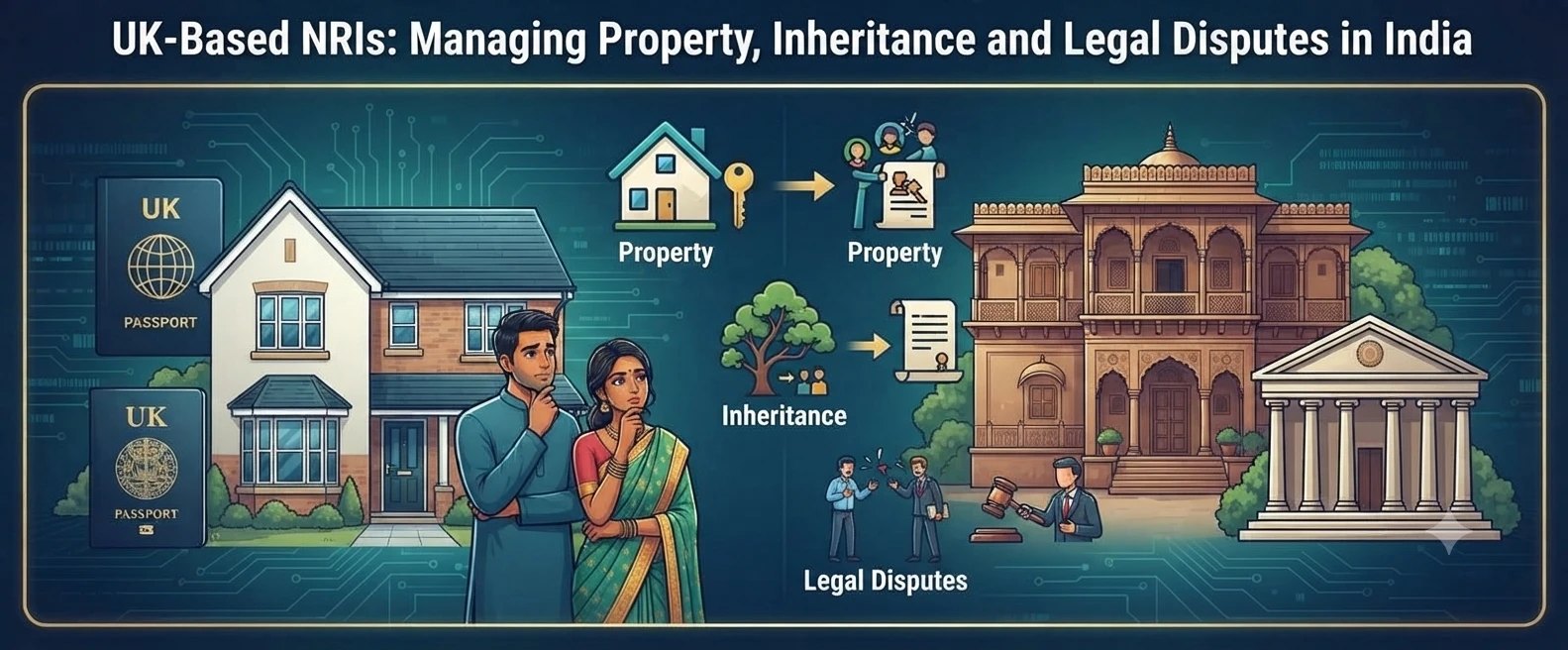
Britain is home to one of the largest Indian diaspora communities in the world. For many British Indians and Indian citizens living in the UK, life in Britain sits alongside a house in Pune, ancestral land in Punjab or Gujarat, a parent’s flat in Chennai, or a family business in Kolkata. Managing those interests from thousands of miles away is one of the most common, and most stressful, legal challenges they face.
This guide is for NRIs in the UK and people of Indian origin who hold or expect to inherit property in India. It explains the rules on buying, selling and repatriating money, how to act through a power of attorney, how inheritance and probate work, and the legal remedies when property disputes arise. UK tax and estate questions should be put to a UK adviser; see also our guide to crypto tax in India vs the UK for the tax side of digital assets.
Owning, buying and selling property in India from the UK
Under India’s foreign exchange rules, non-resident Indians and overseas citizens of India can generally buy residential and commercial property in India, but can’t buy agricultural land, plantation property or farmhouses, except by inheritance or with specific approval. Inherited property of any kind can be held. Payments for purchases must come through normal banking channels, such as NRE or NRO accounts or inward remittances.
When NRIs in the UK sell Indian property, the buyer must deduct tax at source on the sale, and the rate for non-residents is generally higher than for residents. The NRI can apply for a lower deduction certificate where the actual tax due is lower. Capital gains in India are covered by the India-UK double taxation agreement, and UK tax may also apply depending on your residence, which is a question for a UK adviser. Confirm the current NRI TDS rates under the Income-tax Act, 2025.
Repatriating sale proceeds to the UK is possible within limits. Funds in an NRO account, including proceeds from inherited property, can generally be remitted abroad up to a specified annual limit, with documentation and tax clearance; check the current limit with your bank. Planning the sale and remittance together avoids delays and surprises.
Acting from the UK: powers of attorney and documents
Most NRIs in the UK manage Indian property through a trusted person in India, acting under a power of attorney. A power of attorney executed in the UK for use in India generally needs to be notarised and apostilled (both India and the UK are parties to the Hague Apostille Convention), and then stamped in India, usually within three months of its receipt there under state stamp laws. Requirements differ between states, so check the specific state’s rules before signing.
Be precise about the powers you grant. A general power of attorney giving wide powers to sell, mortgage or lease can be misused, and property fraud involving misused powers is a recurring problem. Grant only the powers needed, for a specific property and purpose, consider a time limit, and revoke it formally when it’s no longer needed, giving notice to the attorney and relevant authorities.
Keep your own records: copies of title deeds, sale deeds, mutation records, tax receipts and utility bills, ideally stored securely and digitally. Many property disputes begin because the owner abroad can’t produce documents quickly when a problem arises.
Inheritance, wills and probate
Inheritance of Indian property depends on whether there’s a will and on the deceased’s personal law. Hindus, Sikhs, Jains and Buddhists are generally governed by the Hindu Succession Act, 1956, under which, since 2005, daughters have the same rights as sons in ancestral coparcenary property, as the Supreme Court confirmed in Vineeta Sharma v. Rakesh Sharma (2020). Christians and Parsis are governed largely by the Indian Succession Act, 1925, and Muslims by Muslim personal law.
A will is the best way for NRIs in the UK to control what happens to Indian property. Many British Indians make a separate Indian will for Indian assets alongside an English will for UK assets, drafted carefully so that one doesn’t accidentally revoke the other. In some Indian cities, notably Mumbai, Kolkata and Chennai, probate of a will is required for certain communities and property; elsewhere it’s often not mandatory but may still be practical.
Where there’s no will, heirs usually need documents such as a legal heir certificate, a succession certificate or letters of administration, depending on the asset, before banks, housing societies and land registries will transfer property. Mutation of the land records into the heirs’ names is a separate, essential step. The same principles apply to digital assets; see our guide to crypto inheritance in India.
| Issue | Key point |
|---|---|
| Buying | Residential and commercial property generally; not agricultural land, plantations or farmhouses except by inheritance or approval |
| Selling | Buyer deducts tax at source at a higher non-resident rate; lower deduction certificate possible; proceeds via NRO account within annual limits |
| Power of attorney | Notarised and apostilled in the UK; stamped in India under state law; grant only the powers needed |
| Inheritance | Depends on personal law and any will; daughters equal in coparcenary property since 2005 |
| Wills | Consider a separate Indian will; probate mandatory in some cities for certain communities |
Property disputes and legal remedies in India
The most common disputes for NRIs in the UK include encroachment or illegal occupation of vacant property, tenants who refuse to leave, relatives who claim exclusive ownership or sell without consent, misuse of powers of attorney, and builders who delay or fail to deliver flats.
Indian law provides remedies for each. Civil suits can seek recovery of possession, injunctions against interference or sale, declarations of title, partition of jointly owned property, and cancellation of fraudulent documents. Under the Specific Relief Act, 1963, a person dispossessed without due process can sue to recover possession. Criminal complaints for criminal trespass, cheating, forgery and criminal breach of trust are available under the Bharatiya Nyaya Sanhita, 2023 where the facts support them. Buyers facing delayed or defective housing projects can complain to the state Real Estate Regulatory Authority under the Real Estate (Regulation and Development) Act, 2016, and consumer commissions can also hear complaints.
NRIs can pursue most of these remedies without travelling, through a lawyer and a power of attorney holder, with video hearings increasingly available in Indian courts. Several states also have NRI cells within the police or government to assist with complaints.
Practical steps, remedies and quick answers
Prevention is the best remedy. Visit or arrange inspections of vacant property regularly, keep property tax and utility bills in your name, put written leave and licence or rental agreements in place, register tenancy agreements where required, and keep title documents and mutation records up to date. Make an Indian will, review powers of attorney regularly, and keep family members informed.
When a problem arises, act quickly: delay makes encroachment and possession disputes much harder to resolve, and limitation periods apply to many claims. With the right planning and local legal support, NRIs in the UK can protect their Indian property and inheritance effectively from Britain. If a family business or company is involved, see our guides to setting up a company in India from the UK and shutting down a startup legally.
Quick answers
Can NRIs in the UK buy agricultural land in India?
Generally not, except by inheritance or with specific approval. Residential and commercial property can usually be bought.
Can a UK-signed power of attorney be used in India?
Yes, typically after notarisation and an apostille in the UK, and stamping in India within the time required by the state’s stamp law.
Do daughters inherit equally in India?
Under the Hindu Succession Act as amended in 2005, daughters have the same rights as sons in coparcenary property, as confirmed by the Supreme Court in 2020.
Related reading: child abduction between the UK and India; also buying and selling property in India from Dubai and a power of attorney from Dubai for Indian property.
Final word
Halverton & Co. is an Indian law firm that advises on Indian law, including property management, inheritance, wills and property disputes for NRIs and British Indian families. We practise in Jharkhand, Maharashtra and before the Supreme Court of India, and we work alongside your UK solicitors, who advise on English law. Halverton & Co.: Where tech needs law! If you have a question about Indian law, write to us at office@halvertonandco.com, or get in touch.
This article reflects developments reported up to early October 2026. It is for general information only, is not legal advice, and does not create a solicitor-client relationship. Halverton & Co. is an Indian law firm, is not authorised or regulated by the Solicitors Regulation Authority, and does not advise on English law or UK tax.
Related practice area
Disputes & Litigation
Courts and tribunals in Jharkhand and Maharashtra, and the Supreme Court. IP and technology first.
View the practice areaComments
No account needed. Comments are reviewed before they appear, so yours will show here once approved. Please do not share confidential details or describe your own legal matter: replies are general discussion, not legal advice, and do not create an advocate-client relationship. For your own situation, write to office@halvertonandco.com.