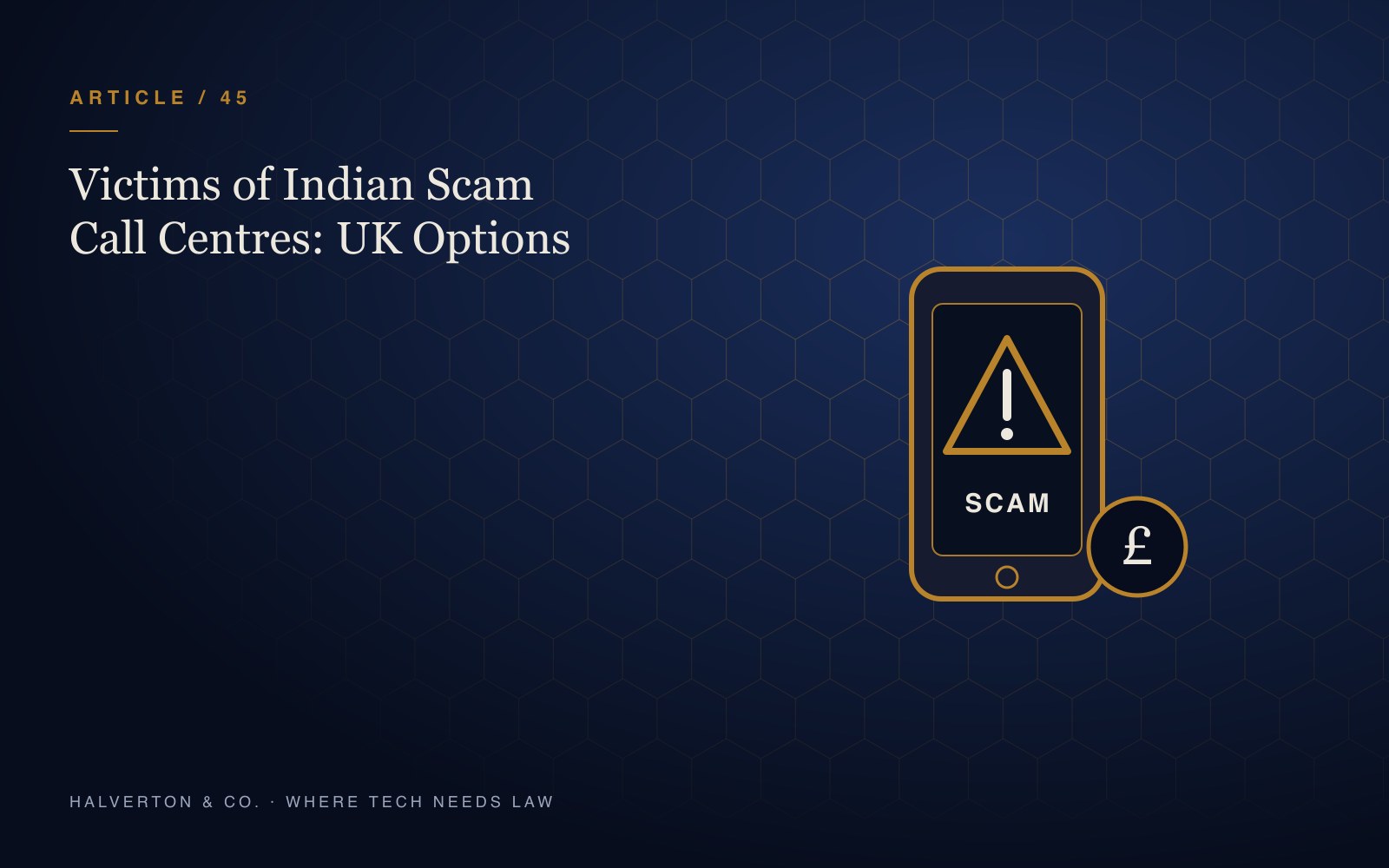
It usually starts with a pop-up warning that your computer is infected, or a call claiming to be from HMRC, your bank or Microsoft. A friendly, urgent voice talks you through “fixing” the problem. By the end of the call, someone has remote access to your computer, your bank details, or a payment you’ll never see again.
Many of these scams are run from call centres in India. This guide explains how scam call centres operate, what Indian and UK authorities are doing about them, and the legal options for UK individuals and businesses who have been defrauded, including reporting, freezing funds and pursuing criminal and civil remedies in India. UK-side steps (police reporting, bank reimbursement) should be confirmed with UK advisers.
How scam call centres operate
Scam call centres are increasingly sophisticated. In one case broken up in 2025, the CBI found that the call centre used advanced calling infrastructure and malicious scripts to achieve cross-border anonymity and target victims at scale, with operations timed to the victims’ time zones, so live scam calls were in progress during the raids. The fraudsters used spoofed numbers and VoIP tools so that calls appeared to come from the UK.
Typical scams include fake tech support (impersonating Microsoft, Apple or internet providers), impersonation of HMRC, banks or police, refund and overpayment scams, fake investment schemes, and romance or sextortion schemes. Money is usually moved quickly through “mule” accounts in the UK and abroad, then converted into cryptocurrency or withdrawn in cash.
Elderly people are particularly targeted by tech support and impersonation scams, and families often only discover the losses later. If a relative may have been scammed, check their bank statements and devices for remote-access software, and act quickly. Businesses are targets too. Invoice fraud, CEO impersonation using cloned voices, and fake supplier calls cost UK companies significant sums, and some of these schemes rely on call centre infrastructure in India; see our guide to deepfakes of UK creators and brands.
What Indian and UK authorities are doing
Enforcement has stepped up. On 7 July 2025, India’s Central Bureau of Investigation searched three locations in Noida as part of Operation Chakra-V, including a fully functional fraudulent call centre operating from the Noida Special Economic Zone. UK citizens alone were reported to have lost at least £390,000 to the operation, with more than 100 UK victims confirmed.
The operation was the result of international cooperation. The CBI worked closely with the FBI, the UK’s National Crime Agency and Microsoft to trace the syndicate’s operations, following an 18-month joint investigation, according to reports. In August 2025, the CBI arrested the alleged kingpin at Delhi airport as he tried to board a flight to Kathmandu.
These cases show that action against scam call centres in India is possible and increasingly common. But criminal prosecution doesn’t automatically return victims’ money, which is why victims and their advisers need to act on several fronts at once.
First steps for UK victims
Speed is everything. Contact your bank immediately to try to stop or recall payments, and change passwords and secure any device the scammers accessed. Report the fraud to the UK police through the national fraud reporting service, and keep the crime reference number. UK victims of authorised push payment fraud may be able to claim reimbursement from their bank under the UK’s reimbursement rules, which is a matter for UK advisers.
Preserve evidence: phone numbers (even if spoofed), call times, emails, text messages, website addresses, remote-access software used, payment details, bank account numbers and any cryptocurrency wallet addresses. This information is what allows investigators in both countries to trace funds and identify suspects.
Scam call centres frequently ask victims to buy gift cards or cryptocurrency, because these are harder to trace. Even then, recording card numbers, wallet addresses and transaction IDs gives investigators a chance to follow the money. Where money has reached Indian bank accounts or Indian payment systems, an Indian complaint can make a real difference. Indian banks can be asked to put a lien on funds traced to fraud, but only if someone acts quickly and identifies the accounts involved; see our guide to frozen bank accounts over crypto or UPI for how Indian freezes work.
| Step | Action |
|---|---|
| Stop the loss | Call your bank immediately; secure devices and change passwords |
| Report in the UK | Report to police through the national fraud reporting service; keep the crime reference number |
| Preserve evidence | Numbers, call times, emails, texts, URLs, payment, bank and wallet details |
| Report in India | National Cyber Crime Reporting Portal or local cyber police, usually through an Indian lawyer |
| Avoid second scams | Ignore “recovery agents” who ask for a fee |
Legal remedies in India
Criminal complaints can be filed in India, including through India’s National Cyber Crime Reporting Portal or with the cyber police in the city where the call centre or receiving accounts are located. Relevant offences include cheating by personation using a computer resource under Section 66D of the Information Technology Act, 2000, identity theft under Section 66C, and cheating, forgery and criminal conspiracy under the Bharatiya Nyaya Sanhita, 2023. For foreign victims, filing through an Indian lawyer or authorised representative is often the most practical route; confirm whether the portal accepts complaints from foreign nationals directly.
Funds traced to Indian accounts can be frozen. Under India’s criminal procedure law, police can seize property connected with an offence, and a Magistrate can order attachment of proceeds of crime and their restoration to victims. Where scams involve large-scale laundering, the Enforcement Directorate may act under the Prevention of Money-laundering Act, 2002, which also provides for restoration of property to victims in appropriate cases.
Victims sometimes receive follow-up calls from “recovery agents” promising to get their money back for a fee. These are almost always a second scam by the same networks. Only deal with recovery through the police, your bank and lawyers you have instructed yourself. Civil action is also possible against identifiable defendants or companies that received money, including suits for recovery and injunctions to freeze assets; see our guide to enforcing a UK judgment or arbitration award in India. International cooperation between India and the UK, including through law enforcement channels and mutual legal assistance arrangements, supports cross-border evidence gathering. Victims should be realistic: recovery is never guaranteed, but early, coordinated action in both countries gives the best chance.
Protecting your business, and quick answers
UK businesses can reduce the risk from scam call centres by training staff to recognise impersonation calls, verifying payment changes through a known phone number, never allowing remote access to systems at the request of an unsolicited caller, and setting payment approval rules that don’t rely on a single voice call or email. Companies that outsource customer service to India should also carry out due diligence on vendors and protect customer data carefully, since some fraudulent operations have previously presented themselves as legitimate service providers; see our guides to UK GDPR transfers to India and offshore data processing in India. If your business is defrauded, report it in the UK, involve your bank and insurers, preserve evidence, and take Indian legal advice quickly if funds or suspects are traced to India. For the Indian incident-reporting duties, see our guide to the CERT-In 6-hour rule.
Related reading: crypto fraud between Dubai and India; also a bank account frozen after a P2P crypto trade; also the Ofcom ruling and Indian apps with UK users.
Quick answers
Can UK victims report a scam to Indian authorities?
Yes. Complaints can be filed with Indian cyber police or through the National Cyber Crime Reporting Portal, often most practically through an Indian lawyer or representative.
Can money sent to Indian scammers be recovered?
Sometimes. Funds traced quickly to Indian accounts can be frozen and, through court processes, restored to victims, but recovery isn’t guaranteed.
Do Indian and UK authorities cooperate on scam call centres?
Yes. Operation Chakra-V involved the CBI, the UK’s National Crime Agency, the FBI and Microsoft, and led to raids and arrests in 2025.
Final word
Halverton & Co. is an Indian law firm that advises on Indian law, including cyber fraud complaints, tracing and freezing funds, and criminal and civil proceedings in India for UK victims. We practise in Jharkhand, Maharashtra and before the Supreme Court of India, and we work alongside your UK solicitors, who advise on English law. Halverton & Co.: Where tech needs law! If you have a question about Indian law, write to us at office@halvertonandco.com, or get in touch.
This article reflects developments reported up to early October 2026. It is for general information only, is not legal advice, and does not create a solicitor-client relationship. Halverton & Co. is an Indian law firm, is not authorised or regulated by the Solicitors Regulation Authority, and does not advise on English law or UK tax.
Related practice area
Disputes & Litigation
Courts and tribunals in Jharkhand and Maharashtra, and the Supreme Court. IP and technology first.
View the practice areaComments
No account needed. Comments are reviewed before they appear, so yours will show here once approved. Please do not share confidential details or describe your own legal matter: replies are general discussion, not legal advice, and do not create an advocate-client relationship. For your own situation, write to office@halvertonandco.com.