Key takeaways
- Under the DPDP Act, marketing needs a lawful basis, usually consent that is specific, informed and easy to withdraw.
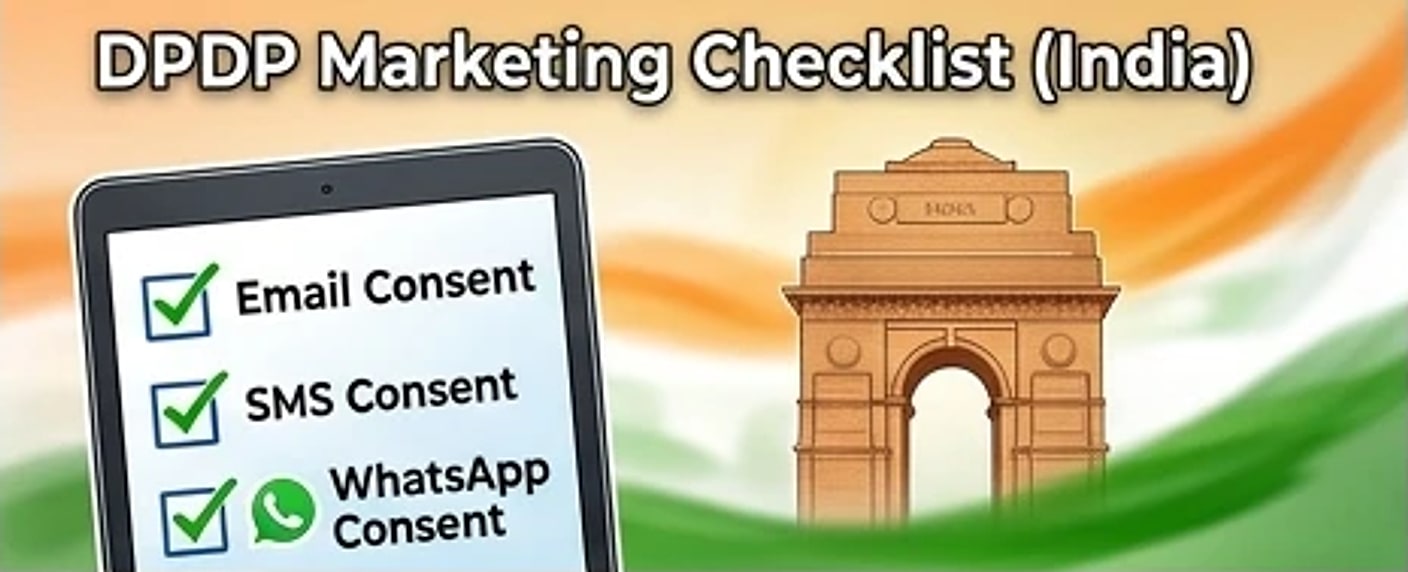
- Email, SMS and WhatsApp each need their own opt-in record, and telecom rules on promotional messages still apply alongside the DPDP Act.
- Agencies and platforms that send campaigns for you are processors, so put written terms in place and keep a consent log.
- Review old lists now: purchased or scraped contacts are the highest-risk part of most marketing databases.
Marketing teams run on contact lists, and every list is personal data. India’s Digital Personal Data Protection Act, 2023 and the DPDP Rules, 2025 turn consent from a good habit into a legal requirement for most promotional messages. A DPDP marketing checklist helps a business check its email, SMS and WhatsApp campaigns before the main obligations start on 13 May 2027, and before regulators or customers ask hard questions.
This guide gives a practical checklist: who counts as a data fiduciary, what a valid notice and consent look like, how withdrawal must work, how the DPDP regime sits beside the telecom rules for SMS and calls, platform rules for WhatsApp, and what to do with an existing list. It is general information, not legal advice. Check the final Rules and any later notifications before you rely on dates or details.
Who must comply and when
The Act applies to digital personal data processed in India and to processing outside India that relates to offering goods or services to people in India. A business that decides why and how to use customer data is a data fiduciary, and a marketing agency or platform that acts on its instructions is a data processor. If you send promotional messages to people in India, you are almost certainly in scope.
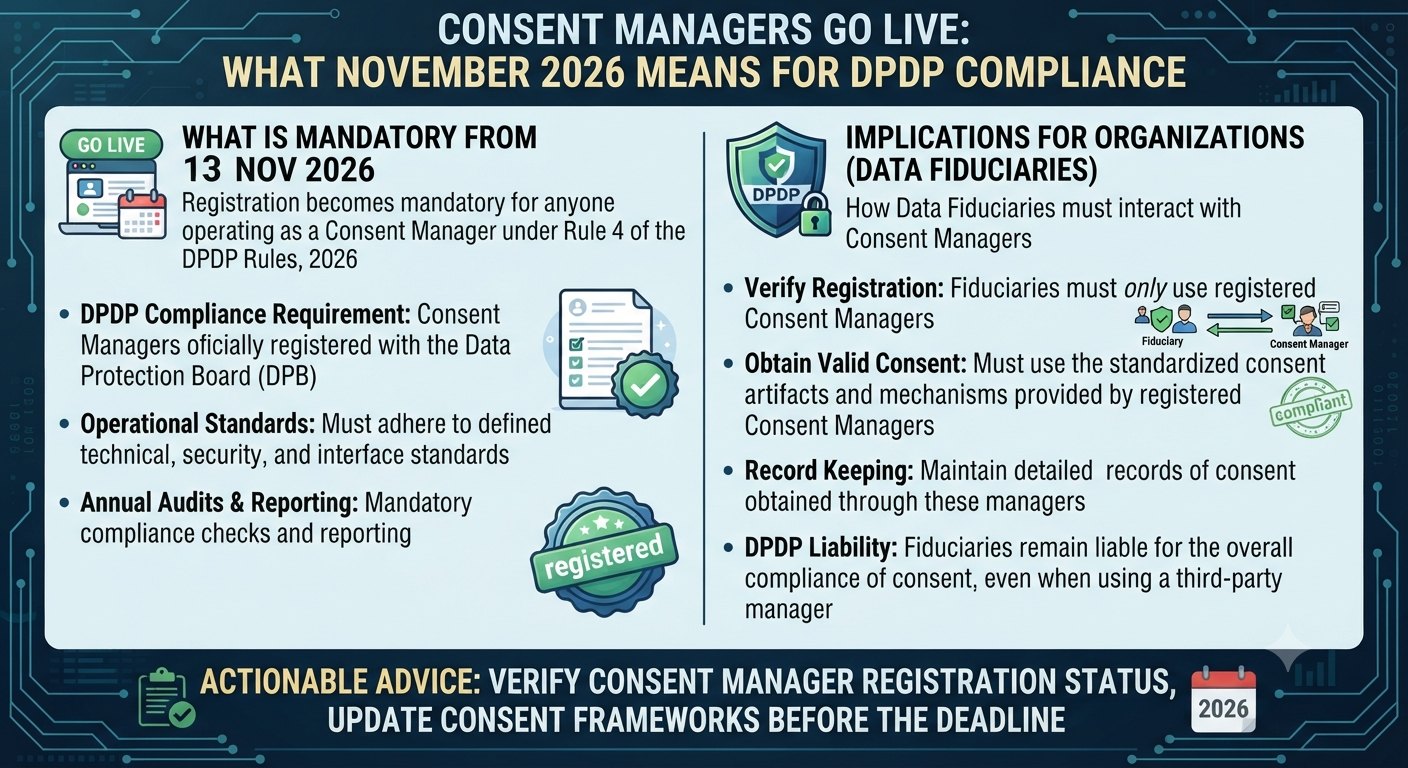
The Rules were notified in November 2025 and come into force in stages. Commentators describe three steps: the Board provisions first, the consent manager framework on 13 November 2026 and the main duties, including notice and consent, on 13 May 2027. Check the Rules for the exact commencement of each rule. Use the time to fix your lists, because consent records are hard to rebuild later.
There is no general exemption for small businesses. Being a small business or an MSME does not by itself take you outside the Act. The Act allows the Central Government to exempt classes of data fiduciaries, such as startups, from some duties, but you should check any notification before you rely on it. Treat the DPDP marketing checklist as applying to you unless an exemption clearly says otherwise. A DPDP marketing checklist should start from this assumption.
Notice and consent for marketing
A data fiduciary must give a notice before or when it asks for consent. The Rules describe a clear, standalone, plain-language notice that lists the data collected, the specific purpose, how to withdraw consent and how to complain to the Board. A standalone consent notice DPDP requires cannot be buried in long terms. For marketing, the purpose must be stated as marketing, not hidden inside a general purpose. Every DPDP marketing checklist item below flows from the notice, so write it first.
| Channel | What to have in place | Common gap |
|---|---|---|
| Clear notice, opt-in record, easy withdrawal | Bought or scraped lists | |
| SMS | Consent plus telecom registration and templates | Promotional texts sent as transactional |
| Opt-in capture, template approval, opt-out handling | Adding people to groups without consent | |
| Vendors | Written processor terms and deletion on request | No contract with the campaign agency |
| Records | Time, source and wording of each consent | Consent stored only in a spreadsheet |
Consent must be free, specific, informed, unambiguous and given by a clear affirmative action. A pre-ticked box, silence or a bundled consent that makes service depend on marketing does not meet the standard. DPDP consent for email marketing therefore means a separate, unticked choice to receive promotional email, with the sender and the type of content stated. Keep a record of who consented, when, to what notice and by what method.
Withdrawal must be as easy as giving consent. If a user subscribed with one click, they should be able to unsubscribe with one click. Once consent is withdrawn, the fiduciary must stop processing for that purpose within a reasonable time and tell processors to do the same. Build the unsubscribe link, the preference centre and the suppression list into the system before 13 May 2027. This is the heart of any withdraw consent as easy as giving rule.
Channel rules: email, SMS and WhatsApp
Email is the simplest channel. Collect marketing consent separately from transactional consent, include a working unsubscribe link in each message, identify the sender and honour opt-outs quickly. Where the processing is purely transactional, for example a receipt for a purchase, the Act’s legitimate use grounds may apply instead of consent, but promotional content in the same email can change the analysis. Keep transactional and promotional messages apart.
SMS and voice marketing are also governed by telecom rules. India’s telecom regulator has rules on commercial communications, including registration of senders and templates and preference registers. The DPDP Act applies in addition, so SMS marketing DPDP and TRAI rules both need to be met: a valid DPDP consent does not remove the telecom registration duties, and a telecom registration does not replace DPDP consent. Check the current regulator rules for your use case.
WhatsApp marketing consent India rules combine the Act with the platform’s own policies. WhatsApp Business policies require a clear opt-in for marketing messages, and the Act requires a notice and consent for the data you use. Record the opt-in, state that messages will come by WhatsApp and give an easy way to stop. Do not add numbers from purchased or scraped lists, because you will not be able to show consent.
Lists, vendors and records
Audit your existing lists. For each segment, ask where the data came from, what the person was told and whether you can show consent. Lists without proof of consent are a risk after the main duties start. Consider a re-permission campaign that asks active contacts to confirm their consent under a compliant notice, and retire contacts who do not respond. Quality lists perform better and carry less risk.
Manage vendors. Agencies, email platforms and messaging providers process data on your behalf, so you need written contracts that bind them to your instructions, require security safeguards, limit sub-processing and require deletion or return of data. Check where they store data and whether any transfer restrictions apply. A processor’s failure is still your responsibility as the data fiduciary.
Keep records and be ready for requests. Maintain a register of notices, consent versions and withdrawals, and a process to answer requests for access, correction and erasure within a reasonable time. Name a contact for grievances. Penalties under the Act can reach very large amounts for serious failures, such as not keeping reasonable security safeguards, so treat the DPDP marketing checklist as part of your wider compliance plan, not as a stand-alone task. Keep this DPDP marketing checklist with your campaign approval process.
Next steps and quick answers
In the next quarter: map your marketing data flows, rewrite your notices and consent screens, build one-click unsubscribe, clean your lists, update vendor contracts and train the team. Revisit the plan when the final dates and any exemptions are confirmed. This is general information, not legal advice.
Related reading: the DPDP compliance checklist for small businesses, consent managers under the DPDP Rules, dark patterns and the CCPA guidelines, DPDP compliance for small businesses, the DPDP Act for US SaaS companies and CCPA and DPDP side by side; also UK cookie consent rules in 2026; also privacy notices under the DPDP rules.
Quick answers
Do I need consent to send marketing email under the DPDP Act?
Generally yes. Promotional email needs free, specific, informed and unambiguous consent with a clear notice, and withdrawal must be as easy as giving it. Transactional messages may rest on a different ground.
Does DPDP replace the telecom rules for SMS marketing?
No. Both apply. DPDP governs the personal data and consent, and the telecom regulator’s rules govern senders, templates and preferences. Meet both.
Are small businesses exempt from the DPDP Act?
Not automatically. The Central Government can exempt classes such as startups from some duties by notification, so check the latest notifications before you rely on an exemption.
Does WhatsApp marketing need separate consent?
Treat each channel as needing its own clear opt-in, and follow the platform’s template and opt-out rules as well as Indian law.
Final word
Halverton & Co. is an Indian law firm advising founders, startups, technology companies and investors on Indian law, including data protection compliance, digital marketing and consumer law, and technology contracts for Indian businesses. We practise in Jharkhand, Maharashtra and before the Supreme Court of India, and act as fractional legal counsel for technology-driven businesses. Halverton & Co.: Where tech needs law! If you have a question about Indian law, write to us at office@halvertonandco.com, or get in touch.
This article reflects developments reported up to 31 October 2026. It is for general information only, is not legal advice, and does not create an advocate-client relationship. Halverton & Co. is an Indian law firm.
Sources
Related practice area
Technology & AI Law
Contracts, data protection and AI policies for products that handle other people’s data.
View the practice areaComments
No account needed. Comments are reviewed before they appear, so yours will show here once approved. Please do not share confidential details or describe your own legal matter: replies are general discussion, not legal advice, and do not create an advocate-client relationship. For your own situation, write to office@halvertonandco.com.