Key takeaways
- The CCPA centres on notice and opt-out rights for California residents, while the DPDP Act centres on consent or a specified legitimate use.
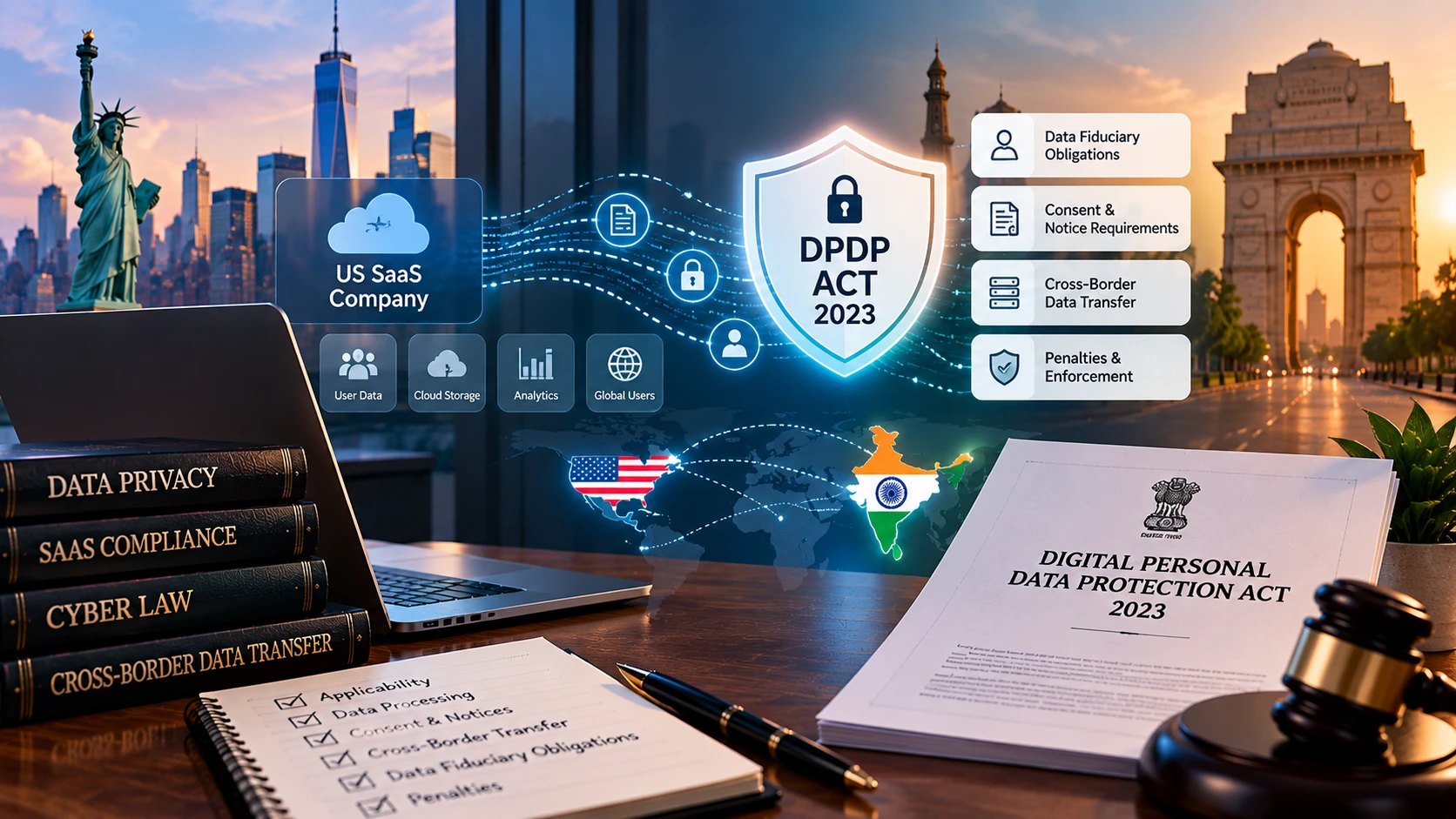
- The DPDP Act can apply to a US company that offers goods or services to people in India.
- Children’s data and breach duties differ sharply, so one policy rarely fits both laws.
- Build one data map and layer the stricter requirement for each topic.
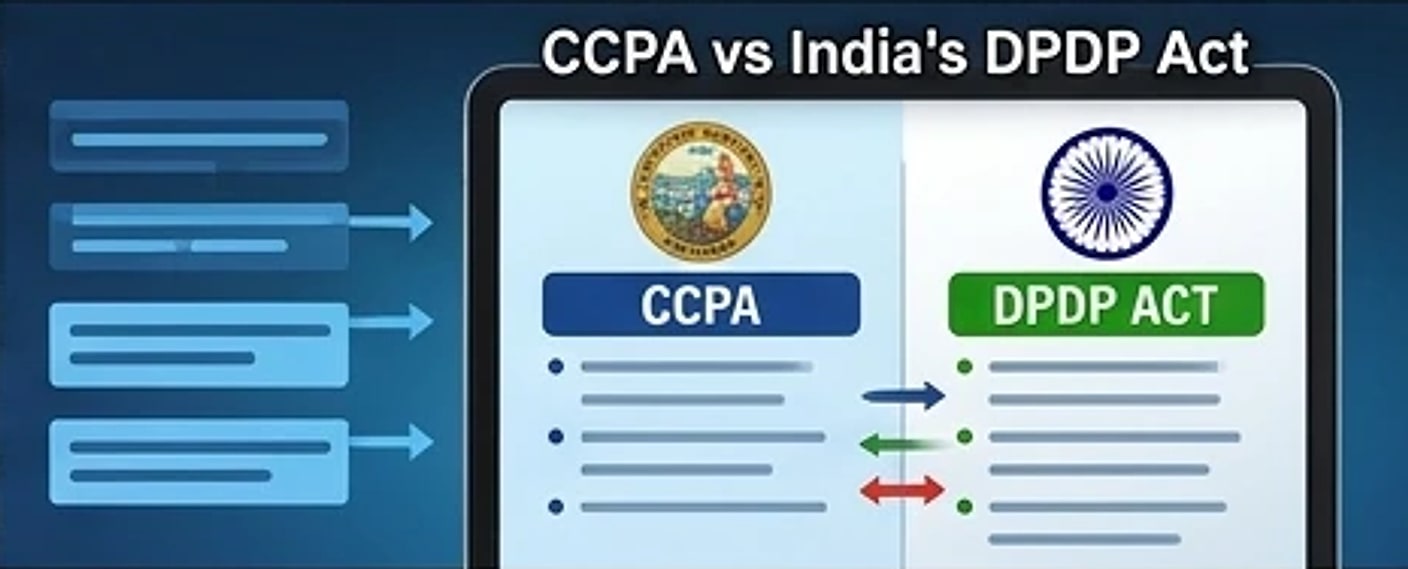
A US company with California customers and Indian users now has two privacy regimes to satisfy, and they work on different principles. The California Consumer Privacy Act, as amended by the CPRA, is largely an opt-out and transparency law. India’s Digital Personal Data Protection Act, 2023 is a consent-based law with a notice at its core. The CCPA vs DPDP comparison helps a compliance team decide what to build once and what to localise. The CCPA vs DPDP question is mostly about design choices.
This guide compares the two on scope, roles, legal bases, rights, children, transfers, security and penalties. It does not replace advice on either law. US privacy points should be confirmed with US counsel. The DPDP Rules, 2025 are being phased in, with the main duties starting on 13 May 2027, so check the latest dates and any new notifications.
Scope and roles
The CCPA applies to for-profit businesses that do business in California and meet a threshold: annual gross revenue above an inflation-adjusted figure of about $26 million, handling the personal information of 100,000 or more consumers or households, or earning half or more of revenue from selling or sharing personal information. The DPDP Act has no revenue threshold. It applies to digital personal data processed in India and to processing outside India that relates to offering goods or services to people in India. Put simply, the DPDP Act vs California privacy law comparison starts with who is covered.
Roles differ in name and in detail. The CCPA speaks of a business, a service provider and a contractor. The DPDP Act uses data fiduciary and data processor. A data fiduciary vs business CCPA comparison shows that both decide the purposes and means of processing, and both must put contracts in place with processors. A US company that serves Indian users through a website or app will usually be a data fiduciary for those users.
Territory also differs. California law protects California residents, and the DPDP Act protects data principals in India and those whose data is processed in connection with services offered to people in India. A US company with global users should map users by location and decide which rules apply to which data. Because the Act has no threshold, even a small US company serving Indian users may be in scope, unless an exemption is notified.
Consent, notice and legal bases
The key philosophical difference is consent. Under the CCPA, a business can collect and use personal information for disclosed purposes without prior consent, and the consumer has a right to opt out of sale and sharing and to limit use of sensitive information. Under the DPDP Act, processing generally needs consent that is free, specific, informed, unambiguous and given by a clear affirmative action, unless a listed legitimate use applies. The consent vs opt-out privacy India US contrast drives product design. The CCPA vs DPDP gap on consent is the biggest for product teams.
| Topic | CCPA | DPDP Act |
|---|---|---|
| Core model | Opt-out of sale and sharing, notice at collection | Consent or legitimate use, notice |
| Who is protected | California residents | Individuals in India, and abroad in some cases |
| Rights | Know, delete, correct, opt out, limit | Access, correction, erasure, grievance, nomination |
| Children | Opt-in for minors in some cases | Parental consent under 18 |
| Breaches | Private right of action in some cases | Notice to the Board and individuals |
Notice duties exist in both. The CCPA requires a privacy policy and notices at collection that describe categories of data and purposes. The DPDP Rules require a standalone, plain-language notice that lists the data, the specific purpose and how to withdraw consent or complain. A US company that publishes one long policy may need a separate Indian notice with consent controls and records.
Withdrawal and marketing also differ. In India, withdrawal must be as easy as giving consent, and processing must stop for that purpose once consent is withdrawn. In California, a consumer can opt out of sale or sharing for cross-context behavioural advertising, and a business must honour opt-out signals such as global privacy control. Design a consent platform that can serve both models.
Rights, children and sensitive data
Both laws give individuals rights. California consumers have rights to know, access, delete, correct, port data, opt out of sale and sharing and limit use of sensitive information. Indian data principals have rights to access information, correct and erase data, grievance redress and nominate another person to exercise rights on death or incapacity. The DPDP Act has no express right to opt out of sale, and no portability right in the same form. In a CCPA vs DPDP review, children’s data is where the gap is widest.
Children are treated differently. Under the DPDP Act, a child is a person under 18, and a data fiduciary must obtain verifiable parental consent and must not track, monitor behaviour or target advertising at children, subject to exemptions. The CCPA applies opt-in consent for sale or sharing of data of consumers under 16, with parental consent for those under 13. The DPDP children under 18 vs CCPA minors difference is large for apps with young users.
Sensitive data categories differ. The CCPA defines sensitive personal information, such as government identifiers, precise geolocation, health and biometric data. The DPDP Act does not define a separate sensitive category, but processing is judged by purpose and risk, and significant data fiduciaries have extra duties. Do not assume that a CCPA sensitive data programme covers India without checking.
Transfers, security and penalties
The DPDP Act allows transfers of personal data outside India except to countries the Central Government restricts by notification, which makes it a negative list approach, while the Rules allow additional conditions to be imposed. The CCPA does not restrict international transfers but requires contracts with service providers and rules on sale and sharing. A US company moving Indian users’ data to the US can do so unless restricted, but should document it. Use the CCPA vs DPDP comparison to plan security and breach processes.
Security is required under both. The DPDP Act requires reasonable security safeguards and breach notification: the Rules describe an intimation to the Board and affected individuals without delay and a detailed report to the Board within 72 hours, with no risk threshold in some readings. The CCPA gives consumers a private right of action for certain data breaches caused by failure to maintain reasonable security.
Penalties differ in shape. The DPDP Act’s schedule sets penalties up to ₹250 crore for failure to take reasonable security safeguards and up to ₹200 crore for failure to notify a breach, according to commentary, though sources vary. The CCPA allows administrative fines per violation, with higher amounts for intentional violations and violations involving minors, plus statutory damages in data breach cases. Check current amounts, and compare the DPDP penalties 250 crore vs CCPA fines in your risk assessment.
Next steps and quick answers
Map where Indian users are, decide whether you are a data fiduciary, build a consent and notice layer for India, check child data flows, update vendor contracts and plan for the 13 May 2027 date. Ask US counsel to confirm CCPA positions. This is general information, not legal advice. Keep a living CCPA vs DPDP matrix for your privacy team.
Related reading: the DPDP Act for US SaaS companies, DPDP compliance for small businesses, the DPDP marketing checklist, AI chatbots, children and the DPDP Act, offshore AI teams and data privacy in India and cross-border data and Indian vendors; also CCPA risk assessments for offshore vendors; also COPPA compliance for Indian apps; also CIPA website wiretap lawsuits, auto-renewal laws for SaaS in the US and BIPA compliance for face recognition.
Quick answers
Does the DPDP Act apply to a US company?
Yes, if it processes digital personal data in connection with offering goods or services to people in India, even from outside India. There is no revenue threshold, unless an exemption is notified.
What is the main difference between the CCPA and the DPDP Act?
The CCPA is largely transparency and opt-out for sale and sharing, while the DPDP Act is consent-based and requires a standalone notice and a legal basis for processing, with withdrawal as easy as consent.
How are children treated under each law?
The DPDP Act treats anyone under 18 as a child and requires verifiable parental consent. The CCPA requires opt-in for sale or sharing of data of consumers under 16 and parental consent for those under 13.
Does the CCPA apply to Indian users?
It protects California residents. Indian users fall under Indian law, and other laws may apply depending on facts.
Final word
Halverton & Co. is an Indian law firm advising US companies, founders, investors and law firms on Indian law, including data protection compliance across India and the United States, technology contracts, and cross-border privacy programmes for US companies. We practise in Jharkhand, Maharashtra and before the Supreme Court of India, and work alongside US counsel, who advise on US law. Halverton & Co.: Where tech needs law! If you have a question about Indian law, write to us at office@halvertonandco.com, or get in touch.
This article reflects developments reported up to 31 October 2026. It is for general information only, is not legal advice, and does not create an attorney-client relationship. Halverton & Co. is an Indian law firm and does not advise on US law; US-law points should be confirmed with US counsel.
Sources
Related practice area
Technology & AI Law
Contracts, data protection and AI policies for products that handle other people’s data.
View the practice areaComments
No account needed. Comments are reviewed before they appear, so yours will show here once approved. Please do not share confidential details or describe your own legal matter: replies are general discussion, not legal advice, and do not create an advocate-client relationship. For your own situation, write to office@halvertonandco.com.