Key takeaways
- Commencement regulations brought the main Data (Use and Access) Act changes into force on 5 February 2026, according to law firm summaries.
- Some analytics cookies used solely for aggregate statistics no longer need prior consent, if users are informed and can object.
- Advertising, retargeting and social media cookies still need valid consent.
- Fines under PECR now align with the UK GDPR, so audit your cookies and update your banner.
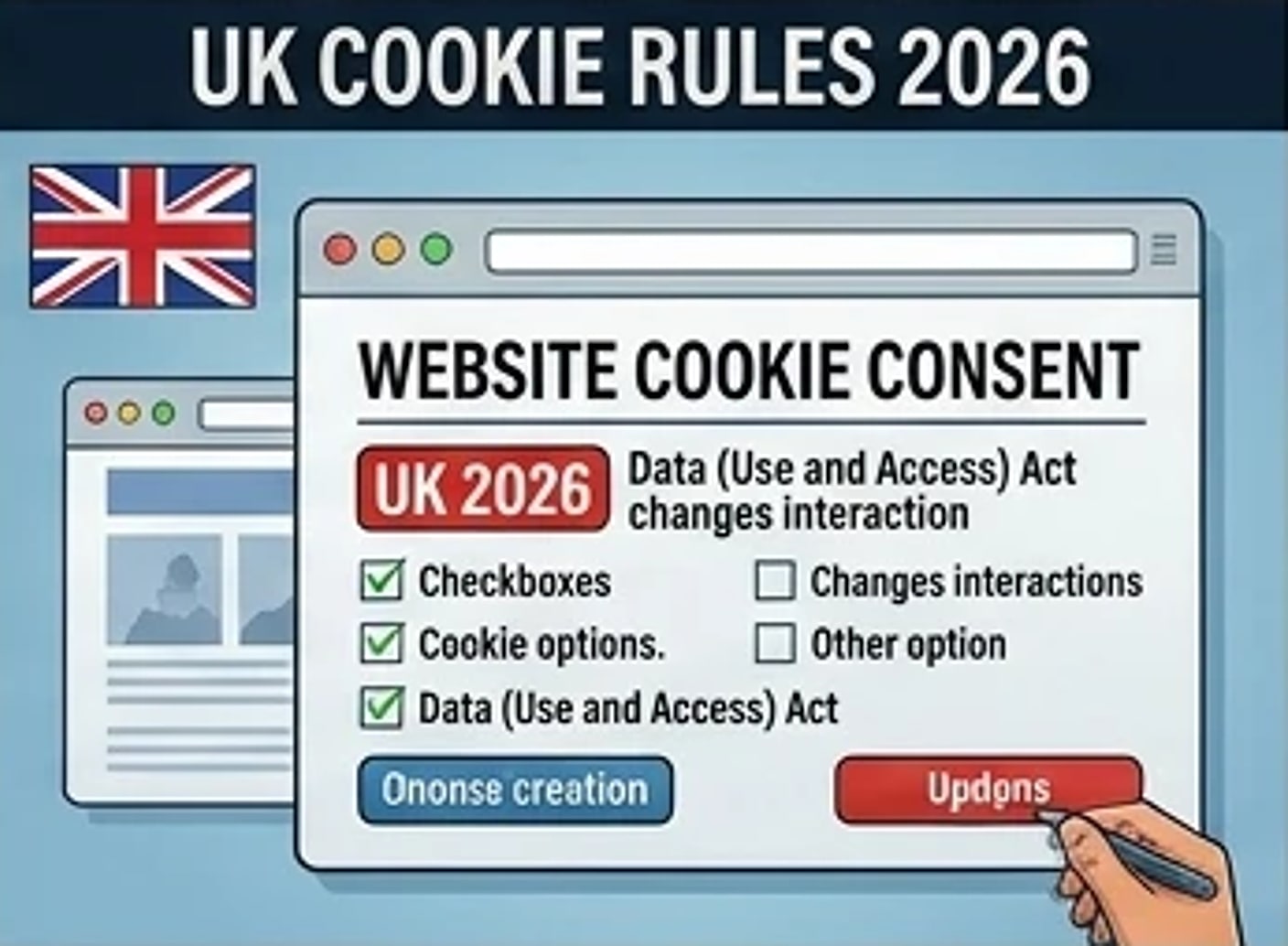
Cookie consent UK 2026 is a bit different from a year ago, and a lot of cookie banners haven’t caught up. The Data (Use and Access) Act 2025 amended the Privacy and Electronic Communications Regulations, and the main changes came into force in early 2026. The headline for most website owners is a new exemption: some low-risk analytics cookies no longer need prior consent. It isn’t a free-for-all, and the rest of the rules still apply.
If you run a site with UK visitors, including an Indian business that sells to the UK, here is what changed, what hasn’t, how to tell which of your cookies are covered, and what to do next. Commencement dates and conditions are reported slightly differently by different sources, so check the legislation and the ICO’s current guidance before you change a banner. Cookie consent UK 2026 is different from a year ago, and the Data (Use and Access) Act cookies PECR changes explain why.
What the act changed
PECR, the Privacy and Electronic Communications Regulations 2003, require consent before storing or accessing information on a user’s device, with exceptions for strictly necessary use. The Data (Use and Access) Act cookies PECR amendments widen the exceptions and raise penalties. Commencement regulations brought the bulk of the Act into force on 5 February 2026, according to several law firm summaries, and some data protection provisions followed in June 2026. Cookie consent UK 2026 changes came from amendments to PECR.
Two changes matter most. First, new exceptions allow some uses of cookies and similar technologies without consent, including certain analytics, and some functionality and security uses. Second, the Act brings PECR penalties into line with the UK GDPR, so the maximum fine for a PECR breach is now far higher than the old £500,000 cap. PECR fines increased as part of the Act, and reports say they now reach £17.5 million or 4% of worldwide turnover.
ICO guidance, you’d think, would settle the detail. Sources disagree on whether final ICO guidance on storage and access technologies has been published, with one placing it at the end of April 2026 and others still describing it as expected. Check the ICO site. In the meantime, the law itself is the safest starting point. Check ICO guidance storage and access technologies before changing a banner. Cookie consent UK 2026 rules are partly in guidance.
The analytics exemption and its limits
From 5 February 2026, consent is no longer required for cookies and similar technologies used solely for statistical purposes to improve the service, where the data is used only by the website operator and certain conditions are met. The statistical analytics cookies exemption is the one most websites care about, since analytics tools were a large part of the banner fatigue. The analytics exemption is the main cookie consent UK 2026 relief.
The conditions are tight. The purpose must be limited to producing aggregate statistics about how the site is used, so that it can be improved. Users must be given clear information about the analytics and an easy way to object. The exemption is lost if the tool shares data with third parties for their own purposes, or is used for advertising targeting, A/B testing on audiences, or conversion tracking tied to ad campaigns.
In practice, a basic first-party analytics set-up with data staying in your own account may be able to use the exemption. A tool that also feeds a marketing platform probably can’t. Read your analytics provider’s configuration, because default settings often share data. And note that the exemption removes the need for prior consent, not the duty to give information. A basic first-party set-up may meet the cookie consent UK 2026 exemption.
What still needs consent
Advertising, retargeting and social media cookies still need consent. So do cookies used for cross-site tracking, profiling and most third-party marketing tools. If your site uses a social share button that sets a tracking cookie, or an ad pixel that identifies visitors, you need valid consent before it fires, and a clear way for people to refuse. Advertising still needs cookie consent UK 2026 rules call for.
| Cookie type | Consent needed? | Note |
|---|---|---|
| Strictly necessary | No | Examples in the Act |
| First-party statistical analytics | Not if conditions are met | Information and easy objection |
| Advertising and retargeting | Yes | UK GDPR standard |
| Social media and cross-site tracking | Yes | Third-party tools |
The strictly necessary exception remains, now with clearer examples. The Act gives examples such as cookies that authenticate a user, help to detect or prevent fraud, or detect technical faults. A shopping basket cookie or a login session cookie is typically strictly necessary. A cookie that remembers a language preference may fall under the new functionality exception, but not if it also tracks the user.
Consent has to meet the UK GDPR standard: clear, specific, informed and freely given by a positive action. Pre-ticked boxes, banners that make rejection harder than acceptance, or walls that force consent are risky. The strictly necessary cookies examples in the Act help with classification, but they don’t relax the standard for everything else. Consent must be valid for cookie consent UK 2026 purposes.
A checklist for website owners
Start with a cookie audit. List every cookie and tracker on your site, including those set by third parties and by scripts, with the purpose, the provider, the lifetime and whether it feeds any other system. Tools can scan, but a human should review. Classify each as strictly necessary, analytics within the new exemption, functionality, or needing consent. Audit first for cookie consent UK 2026 compliance.
Then update the banner and policy. If some analytics can run without consent, adjust the banner so it doesn’t ask for consent for things that no longer need it, and make sure your privacy information describes them accurately and tells users how to object. Keep consent logs for the cookies that still need consent. Don’t remove the banner altogether unless you have no consent-based cookies.
Finally, review third parties. Ask your analytics, advertising and chat providers for details of what they set and how data flows. For an Indian company selling to the UK, include UK visitors in your cookie settings even though your servers and team are in India. Take UK advice if the site is a material part of your business. Include UK visitors in cookie consent UK 2026 settings, even from India.
Questions people ask
A cookie banner isn’t a legal strategy. The better approach is to cut down what you collect, so fewer things need consent in the first place. Cookie consent UK 2026 is easier if you collect less.
Related reading: the DPDP Act for UK businesses, UK GDPR and outsourcing to India, Online Safety Act age checks for Indian apps, consent managers under the DPDP Rules, dark patterns and the CCPA guidelines and DPDP marketing checklist.
Quick answers
Do I still need cookie consent UK 2026 for analytics?
Not always. From 5 February 2026 some analytics cookies used solely for aggregate statistics, with clear information and an easy way to object, can run without prior consent. Analytics that share data for advertising or other purposes still need consent.
What cookies still need consent in the UK?
Advertising, social media, tracking and most third-party marketing cookies still need consent that meets the UK GDPR standard. Strictly necessary cookies and some functionality and security uses are exempt.
What are the penalties for breaching PECR cookie rules?
The Data (Use and Access) Act aligned PECR fines with the UK GDPR, with reports of maximum fines of £17.5 million or 4% of worldwide turnover. Check the legislation for the current figures.
Do I still need a cookie banner?
Yes if you use any cookies that need consent, such as advertising cookies.
Final word
Halverton & Co. is an Indian law firm advising UK companies, founders, investors and law firms on Indian law, including Indian-law and cross-border data protection support for Indian businesses with UK visitors and customers, alongside UK advisers. We practise in Jharkhand, Maharashtra and before the Supreme Court of India, and work alongside your UK solicitors, who advise on English law. Halverton & Co.: Where tech needs law! If you have a question about Indian law, write to us at office@halvertonandco.com, or get in touch.
This article reflects developments reported up to 31 October 2026. It is for general information only, is not legal advice, and does not create a solicitor-client relationship. Halverton & Co. is an Indian law firm, is not authorised or regulated by the Solicitors Regulation Authority, and does not advise on English law; UK-law points should be confirmed with UK advisers.
Sources
Related practice area
Technology & AI Law
Contracts, data protection and AI policies for products that handle other people’s data.
View the practice areaComments
No account needed. Comments are reviewed before they appear, so yours will show here once approved. Please do not share confidential details or describe your own legal matter: replies are general discussion, not legal advice, and do not create an advocate-client relationship. For your own situation, write to office@halvertonandco.com.