Key takeaways
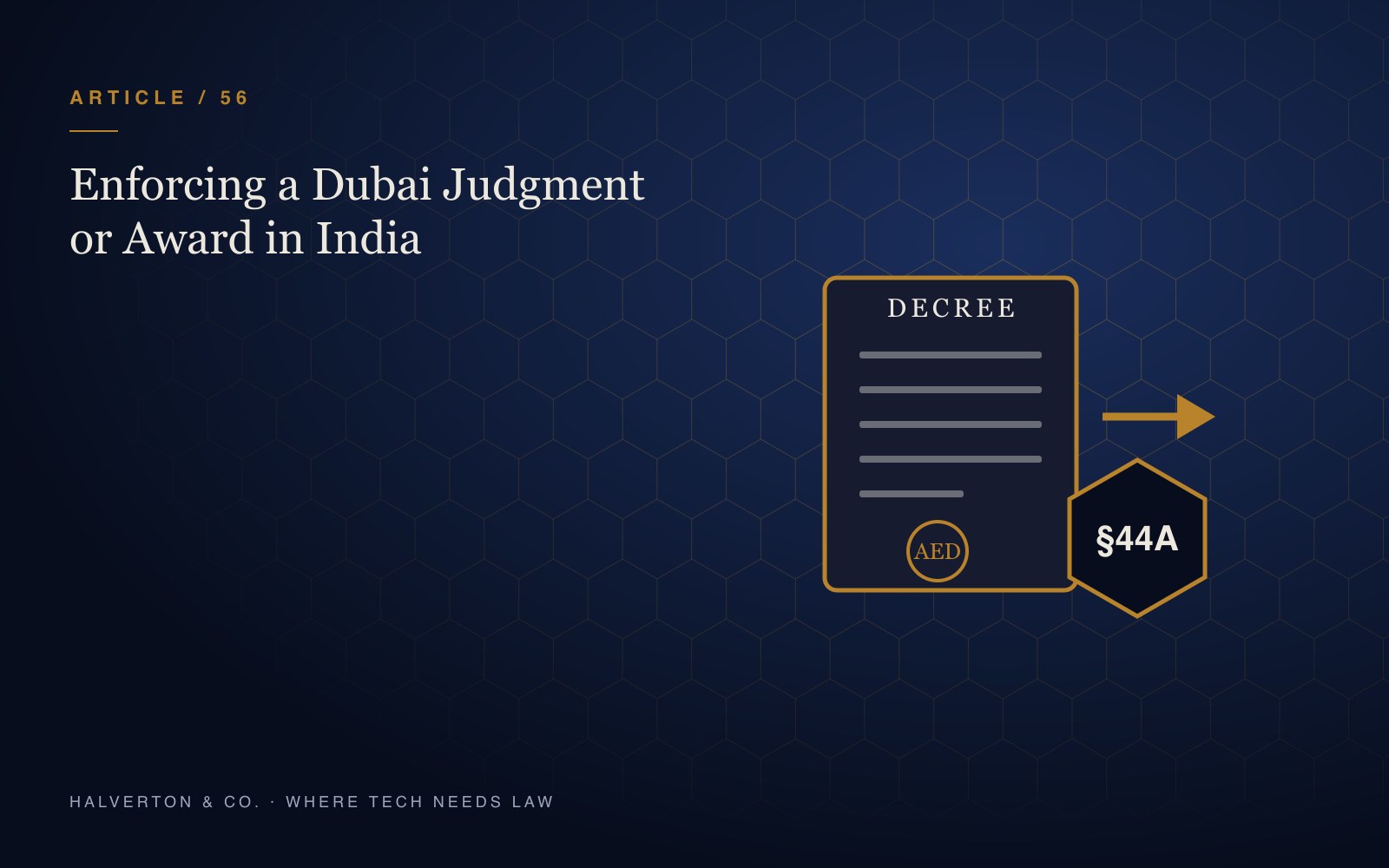
- Since January 2020, money judgments of notified UAE courts, including the Dubai, DIFC and ADGM Courts, can be executed in India under Section 44A.
- UAE-seated arbitration awards are not directly enforceable under India’s New York Convention framework, because India has not notified the UAE.
- An Indian debtor can raise only the defences in Section 13 of the Code of Civil Procedure.
- If the counterparty’s assets are likely to be in India, choose the forum with enforcement in India in mind.
Crypto disputes between Dubai and India are increasingly common: an exchange chasing a defaulting OTC counterparty, an investor suing a project’s Indian founders, a broker owed money by an Indian trading firm. Winning in Dubai is only half the battle when the losing party’s assets are in India.
The good news is that India has a direct route for enforcing many UAE court judgments. The surprising news is that UAE-seated arbitration awards don’t enjoy the same easy path. This guide explains how to enforce a Dubai judgment in India, the gap for UAE arbitration awards, the defences Indian debtors can raise, and practical steps for crypto disputes.
UAE judgments: a reciprocating territory since 2020
On 17 January 2020, India’s Ministry of Law and Justice declared the United Arab Emirates a “reciprocating territory” for enforcing foreign civil decrees under Section 44A of the Code of Civil Procedure, 1908 (Mondaq). The notified superior courts include the Dubai Courts, the ADGM Courts and the DIFC Courts (Lexology).
Before the notification, UAE judgment creditors had to file fresh civil proceedings in India to convert a UAE judgment into an Indian one (Lexology). Now, decrees from the notified UAE courts can be executed directly before the appropriate Indian courts as if they were Indian decrees (Lexology). Since 2020, Indian courts have enforced UAE civil and commercial judgments, including DIFC and ADGM judgments, under this framework without re-litigating the merits (The Oath).
Section 44A applies to money decrees, meaning judgments for a sum of money, excluding taxes, fines and penalties. Non-money relief, such as an injunction, can’t be executed directly and needs a fresh suit in India.
The gap: UAE-seated arbitration awards
Many crypto contracts choose arbitration rather than courts, often seated in Dubai or the DIFC. Here there’s a surprising gap. Although India and the UAE are both parties to the New York Convention, Indian law limits enforcement of foreign arbitral awards to awards from countries notified as reciprocating territories under the Arbitration and Conciliation Act (Bar & Bench). The UAE has not been notified under Section 44 of the Arbitration Act (Bar & Bench).
As a result, an award made in a UAE-seated arbitration, including DIFC and ADGM seats, isn’t currently enforceable in India under the New York Convention framework (The Oath). The January 2020 notification for judgments doesn’t fix this, because its scope is limited to decrees covered by Section 44A (Mondaq).
One workaround is to have the award ratified by a UAE court, converting it into a court judgment, and then execute that judgment in India under Section 44A (Wolters Kluwer Arbitration Blog). But doubt has been cast on this route, because Section 44A excludes an arbitral award even if it’s enforceable as a decree or judgment (Chambers). Commentators have also suggested exploring the India-UAE bilateral judicial cooperation treaty as an alternative route (Chambers). Parties who expect to enforce in India should think carefully before choosing a UAE seat.
| Route | Basis | Position |
|---|---|---|
| Money judgment of the Dubai, DIFC or ADGM courts | Section 44A of the Code of Civil Procedure; the UAE was declared a reciprocating territory on 17 January 2020 | Executable directly in the Indian court as if it were an Indian decree |
| Non-money relief such as an injunction | Outside Section 44A | Needs a fresh suit in India |
| UAE-seated arbitration award, including DIFC and ADGM seats | New York Convention route needs a notification under Section 44 of the Arbitration and Conciliation Act; the UAE has not been notified | Not currently enforceable on that route |
| Award ratified by a UAE court, then executed under Section 44A | Converts the award into a court judgment | Doubtful, because Section 44A excludes an arbitral award even if it is enforceable as a decree |
| Award from a seat India has notified, such as London or Singapore | New York Convention framework | Enforceable under the Arbitration Act route |
How execution of a Dubai judgment works, and the defences
To enforce a Dubai judgment in India, the creditor files an execution petition in the Indian court with jurisdiction over the debtor or its assets, with a certified copy of the decree and a certificate from the UAE court on the extent to which it has been satisfied. The Indian court issues notice to the debtor and, if objections fail, executes the decree through attachment and sale of property, garnishee orders on bank accounts and other tools.
The debtor can resist only on the grounds in Section 13 of the Code of Civil Procedure: that the judgment wasn’t given by a court of competent jurisdiction, wasn’t on the merits, was based on an incorrect view of international law or a refusal to recognise Indian law, was contrary to natural justice, was obtained by fraud, or sustains a claim founded on a breach of Indian law.
Two grounds matter most in crypto disputes. Default judgments, given without examining the evidence, may be challenged as “not on the merits”. And the “breach of Indian law” ground may be raised where the underlying transaction involved activity that Indian law restricts, for example unregistered crypto services to Indian users. Claimants should make sure the Dubai judgment records the evidence considered and reflects a legitimate underlying claim.
Practical steps for crypto disputes
Many crypto contracts are signed through click-through terms on a platform. Make sure those terms clearly identify the contracting entity, the governing law and the forum, because Indian courts will look at whether the Indian party genuinely submitted to the Dubai court’s jurisdiction. Start at the contract. If your counterparty’s assets are likely to be in India, consider choosing the Dubai Courts or DIFC Courts rather than a UAE-seated arbitration, or an arbitration seat that India has notified for New York Convention purposes, such as London or Singapore. Make sure the Indian party clearly submits to the chosen forum.
During the dispute, look at asset preservation. Indian courts can grant interim measures to protect assets, and early identification of the counterparty’s Indian bank accounts, property, shareholdings and exchange accounts makes later execution far more effective. Crypto assets held on Indian exchanges may be reachable through court orders directed at the exchange.
After judgment, move quickly: obtain certified copies and certificates from the Dubai court, identify assets in India, and file in the court where those assets are located. Delay gives debtors time to move assets, including crypto, beyond reach.
Remedies and limitation
Execution of foreign decrees in India is subject to limitation rules, so don’t wait. If a debtor raises Section 13 objections, the Indian court decides them in the execution proceedings, and appeals are possible on limited grounds. For UAE-seated awards, until India notifies the UAE under the Arbitration Act, award holders should take advice on the ratification route and its risks, or consider suing on the award in India. For crypto businesses, the most important lesson is to plan enforcement when drafting the contract: the ability to enforce a Dubai judgment in India directly is a real advantage, but only if the dispute ends in the right kind of decision.
Related reading: crypto fraud between Dubai and India, why Dubai exchanges also need FIU-IND registration, enforcing a UK judgment or arbitration award in India, when a crypto exchange is hacked, tokenized real estate in Dubai and setting up a Dubai holding company as an Indian founder; also using an Indian exchange’s Dubai entity; also smart contract liability for Indian developers.
Quick answers
Can a Dubai court judgment be enforced in India?
Yes. Money judgments of notified UAE courts, including Dubai, DIFC and ADGM Courts, can be executed in India under Section 44A since January 2020.
Are Dubai or DIFC arbitration awards enforceable in India?
Not directly under the New York Convention framework, because India hasn’t notified the UAE under Section 44 of the Arbitration Act.
What defences can an Indian debtor raise?
Only those in Section 13 of the Code of Civil Procedure, such as lack of jurisdiction, a judgment not on the merits, fraud or breach of natural justice.
Which UAE courts’ judgments can be executed in India?
The notified superior courts include the Dubai Courts, the ADGM Courts and the DIFC Courts.
Should a crypto contract choose a UAE arbitration seat?
If the counterparty’s assets are likely to be in India, consider the Dubai Courts or DIFC Courts instead, or an arbitration seat India has notified for New York Convention purposes, such as London or Singapore, and make sure the Indian party clearly submits to the chosen forum.
Final word
Halverton & Co. is an Indian law firm advising Indian founders, investors, NRIs and crypto businesses in Dubai and across the UAE on Indian law, including execution of UAE judgments, award enforcement strategy, asset tracing and interim relief in India. We practise in Jharkhand, Maharashtra and before the Supreme Court of India, and work alongside UAE-licensed counsel, who advise on UAE law. Halverton & Co.: Where tech needs law! If you have a question about Indian law, write to us at office@halvertonandco.com, or get in touch.
This article reflects developments reported up to early October 2026. It is for general information only, is not legal advice, and does not create an advocate-client relationship. Halverton & Co. is an Indian law firm and does not advise on UAE law; UAE-law points should be confirmed with UAE-licensed counsel.
Related practice area
Disputes & Litigation
Courts and tribunals in Jharkhand and Maharashtra, and the Supreme Court. IP and technology first.
View the practice areaComments
No account needed. Comments are reviewed before they appear, so yours will show here once approved. Please do not share confidential details or describe your own legal matter: replies are general discussion, not legal advice, and do not create an advocate-client relationship. For your own situation, write to office@halvertonandco.com.