Indian crypto brands have expanded into the Gulf, and many Indian users now trade through a brand’s Dubai, Singapore or other offshore entity rather than its Indian company. Often users don’t notice the switch at all: same app, same logo, slightly different terms of service.
But the entity you contract with decides your legal rights, especially if something goes wrong. This guide explains why it matters which entity you use, what happens to your rights if an exchange restructures or fails, where you can bring claims, and the lessons Indian users learned from the WazirX hack.
Why the contracting entity matters
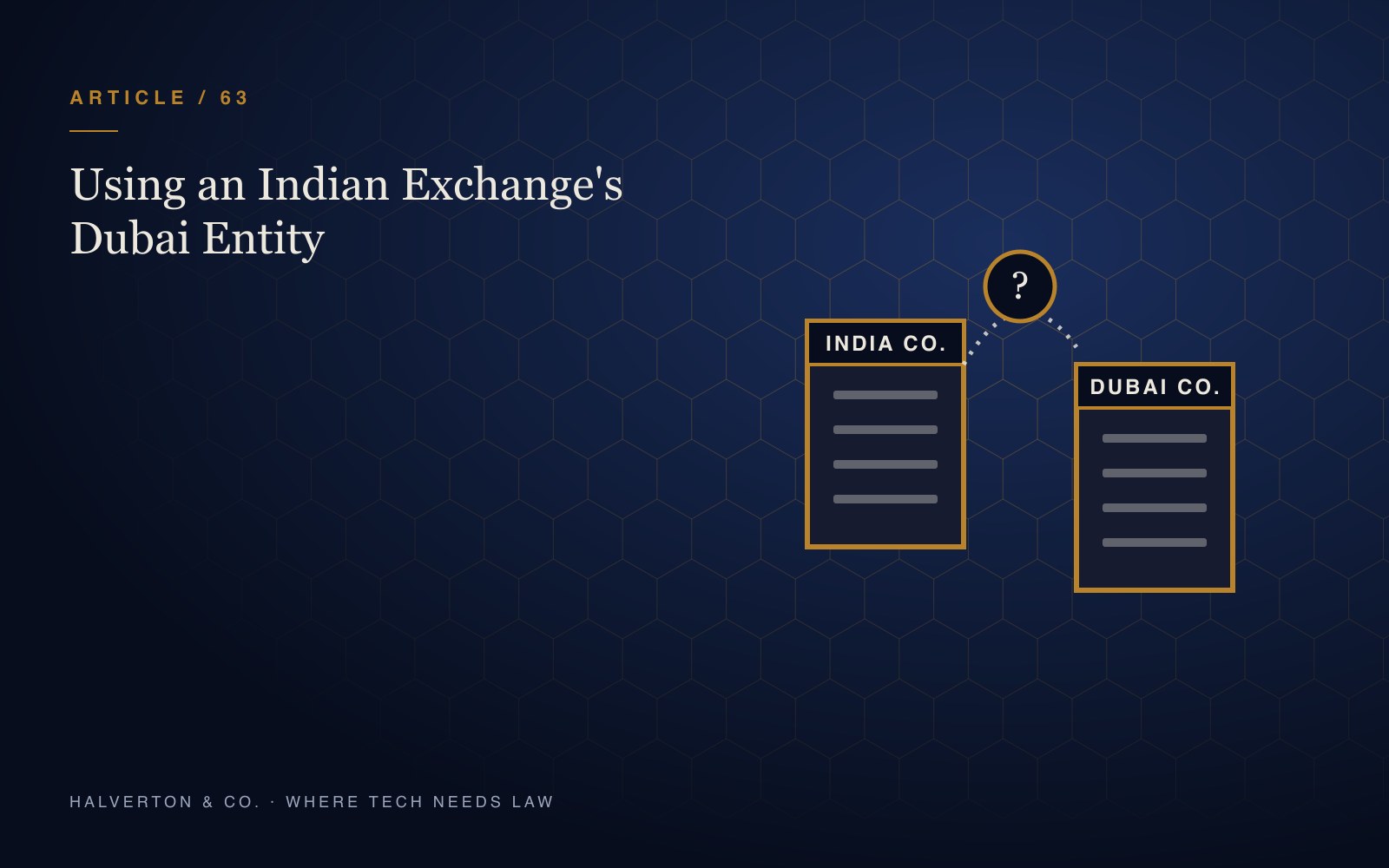
Every crypto platform’s terms of service name the legal entity you contract with, the law that governs the contract, and how disputes are resolved. Two users of the same brand can have very different rights if one contracts with an Indian company and the other with a Dubai or Singapore entity.
The entity determines which regulator supervises the service. A Dubai entity licensed by VARA is subject to Dubai’s rules on custody, segregation of client assets, disclosures and complaints, while an Indian entity is registered with FIU-IND under India’s anti-money laundering law but isn’t licensed by any Indian financial regulator. It also determines where your assets are legally held, which insolvency regime applies if the business fails, and which courts or arbitration forum will hear your claims.
| Question | Indian entity | Dubai entity |
|---|---|---|
| Regulator | Registered with FIU-IND under the PMLA, but not licensed by any Indian financial regulator | VARA licence, if licensed, with rules on custody, segregation of client assets, disclosures and complaints |
| Where assets are held | As the terms state; check the contracting entity | As the terms state; may differ from the Indian entity |
| If the business fails | Indian insolvency regime | UAE insolvency or restructuring processes may apply |
| Disputes | Courts or arbitration as the terms provide | Often Dubai, DIFC or foreign arbitration, or the Dubai or DIFC Courts |
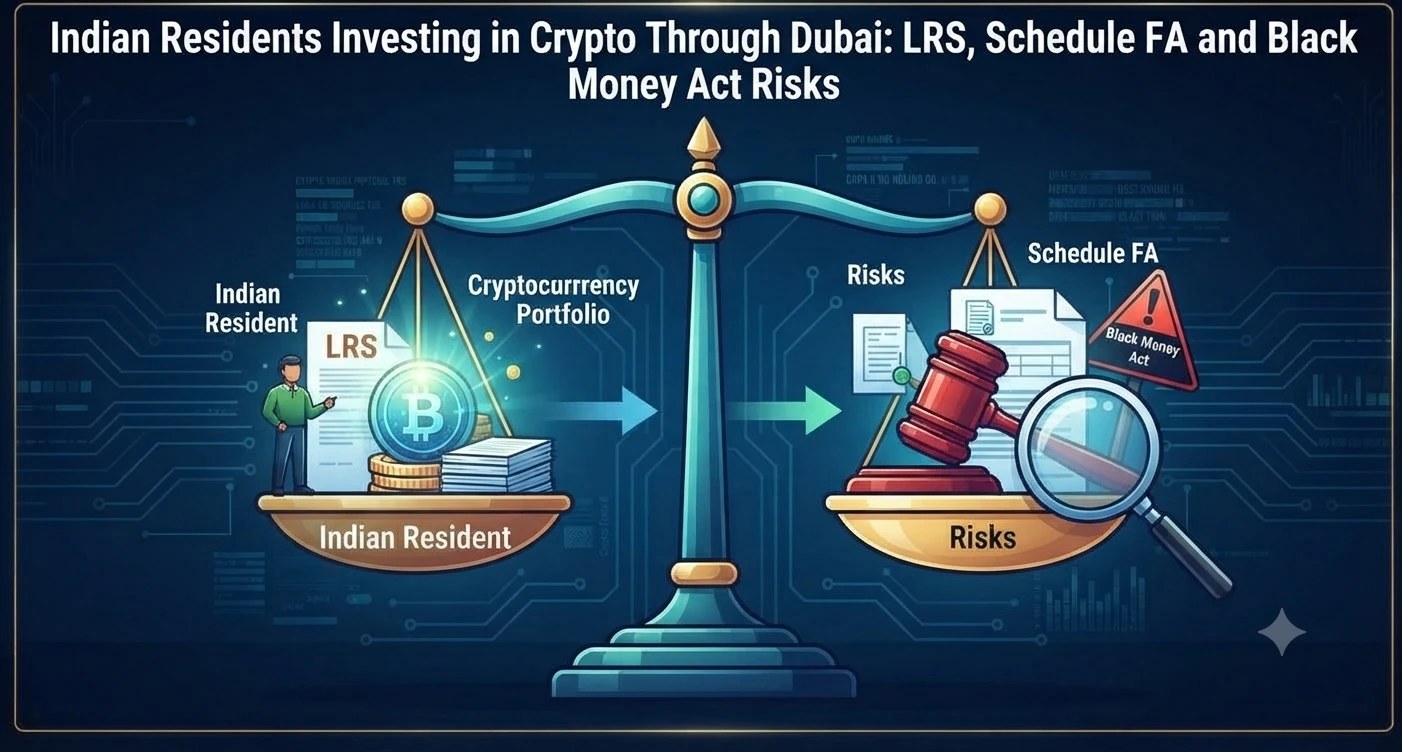
| Your tax filing | Indian exchange account | Tokens on a foreign platform are foreign assets for Schedule FA if you are resident and ordinarily resident |
Users can check whether a Dubai entity holds a VARA licence on VARA’s public register, which also shows the activities it’s licensed for. Before moving funds, read the first page of the terms: which entity, which law, which forum. If you’re an Indian resident using an offshore entity, also consider your Indian obligations: tokens held with a foreign platform are foreign assets to be disclosed in Schedule FA if you’re resident and ordinarily resident.
What WazirX taught Indian users
The WazirX hack of July 2024 is the clearest lesson. After around $230 million was lost from one of the exchange’s wallets, its Singapore parent, Zettai Pte Ltd, sought protection in the Singapore courts and proposed a scheme of arrangement that spread the loss across all users. After a long process, users received around 85% of their balances, with recovery tokens for the rest, and the exchange restarted in October 2025.
For Indian users, the key legal battles turned on the questions above: which entity held their assets, and whether Indian courts could intervene. In October 2025, the Madras High Court held at an interim stage that cryptocurrency is property capable of being held in trust, restrained the Indian entity from reallocating a user’s XRP, and rejected the argument that the foreign scheme and arbitration clause shut out Indian courts, because the user funded her account from an Indian bank and used the platform in India.
The lesson for users of any Indian brand’s Dubai entity is that offshore structures can move disputes, and insolvency processes, to foreign courts, but Indian courts may still offer interim protection where there’s a strong Indian connection.
Your rights if a Dubai entity restructures or fails
VARA has shown that it actively supervises the Dubai market, including by fining unlicensed operators in 2026, so a licensed Dubai entity is generally a safer counterparty than an unlicensed offshore one. If a Dubai-licensed entity faces financial difficulty, UAE law and VARA’s rules govern what happens to client assets, and UAE insolvency or restructuring processes may apply. VARA’s framework places significant emphasis on custody and segregation of client assets, which can help users, but the details are matters for UAE counsel.
If the Dubai entity is part of a group with an Indian company, users may have claims in both places, depending on how assets were actually held and which entity owed them obligations. Keeping records of your account, deposits, balances and communications is essential for any claim.
Watch the Dubai entity’s own announcements too. Licence changes, new activities or regulatory actions involving a Dubai entity are often published by VARA, and they can signal changes in how your assets are handled. Watch for restructuring notices. Exchanges sometimes migrate users from one entity to another, or change their terms, with notice by email. Moving to a new entity can change your rights significantly, so read migration notices carefully and decide whether to stay or withdraw.
Where you can bring claims
Your contract usually decides the forum. Many offshore entities specify arbitration in Dubai, Singapore or elsewhere. Indian users can still sometimes seek interim protection in India under Section 9 of the Arbitration and Conciliation Act, even where the arbitration is seated abroad, as the Madras High Court decision illustrates.
Where a Dubai entity’s terms choose the Dubai Courts or the DIFC Courts rather than arbitration, a money judgment obtained there can be executed against assets in India, which can be an advantage for Indian users in a dispute. Enforcement in India depends on the forum. Judgments of notified UAE courts, including the Dubai Courts and the DIFC Courts, can be executed in India under Section 44A of the Code of Civil Procedure since January 2020. But UAE-seated arbitral awards face a gap, because India hasn’t notified the UAE under its arbitration law for New York Convention enforcement.
Users should keep in mind that a Dubai entity’s complaints procedure is usually the first step regulators expect a user to take. Regulators are another route. A complaint to VARA about a VARA-licensed entity’s conduct, or to FIU-IND about a platform serving Indian users without registration, won’t recover your money directly, but it can put pressure on a platform and support other claims.
Protecting yourself and remedies
Before a large deposit, it’s worth asking the platform in writing which Dubai entity or other entity will hold your assets and under which licence. A clear answer, and a record of it, can be valuable later. To protect yourself when using an Indian exchange’s Dubai entity, check which entity you’re contracting with and whether it’s licensed by VARA, read the custody and asset-segregation terms, keep records, avoid concentrating all your holdings on one platform, and consider self-custody for long-term holdings. Indian residents should also report holdings correctly in their tax returns. If problems arise, act quickly: file claims in any restructuring, preserve evidence, consider interim relief in India where you have a strong Indian connection, and coordinate with lawyers in both countries.
Related reading: why Dubai exchanges also need FIU-IND registration, enforcing a Dubai judgment or award in India, what to do when a crypto exchange is hacked, crypto inheritance for NRIs in Dubai, launching a token from Dubai with Indian investors, Dubai vs GIFT City for crypto and Web3 businesses and crypto fraud between Dubai and India; also the UAE FIU and VARA crypto agreement and DMCC and VARA licences compared; also the crypto travel rule between the UAE and India.
Quick answers
Does it matter which entity of an exchange I use?
Yes. The entity decides the regulator, how your assets are held, which insolvency regime applies, and where disputes are resolved.
Can Indian courts help if an exchange’s Dubai entity fails?
Possibly, with interim relief where there’s a strong Indian connection, as the Madras High Court showed in the WazirX dispute.
Are UAE arbitration awards enforceable in India?
Not directly under the New York Convention framework, because India hasn’t notified the UAE under its arbitration law.
How can I check whether a Dubai entity is licensed?
On VARA’s public register, which also shows the activities the entity is licensed for. Read the first page of the platform’s terms too: which entity, which law and which forum.
What did the Madras High Court decide in the WazirX dispute?
In October 2025, at an interim stage, it held that cryptocurrency is property capable of being held in trust, restrained the Indian entity from reallocating a user’s XRP, and rejected the argument that the foreign scheme and arbitration clause shut out Indian courts.
Final word
Halverton & Co. is an Indian law firm advising NRIs, founders, investors and businesses in Dubai and across the UAE on Indian law, including crypto exchange disputes, investor recovery, interim relief and cross-border enforcement. We practise in Jharkhand, Maharashtra and before the Supreme Court of India, and work alongside UAE-licensed counsel, who advise on UAE law. Halverton & Co.: Where tech needs law! If you have a question about Indian law, write to us at office@halvertonandco.com, or get in touch.
This article reflects developments reported up to early October 2026. It is for general information only, is not legal advice, and does not create an advocate-client relationship. Halverton & Co. is an Indian law firm and does not advise on UAE law; UAE-law points should be confirmed with UAE-licensed counsel.
Related practice area
Crypto, Web3 & Digital Assets
Advice for virtual digital asset businesses on registration, reporting and structure.
View the practice areaComments
No account needed. Comments are reviewed before they appear, so yours will show here once approved. Please do not share confidential details or describe your own legal matter: replies are general discussion, not legal advice, and do not create an advocate-client relationship. For your own situation, write to office@halvertonandco.com.