Key takeaways
- Accounts are frozen when a P2P buyer pays with money from a fraud victim, and the complaint is traced through every account the money touched.
- Courts increasingly hold that only a lien on the disputed amount is lawful without a Magistrate’s order under Section 107 BNSS.
- NRIs in Dubai can act through a lawyer or a power of attorney holder in India, with the power of attorney properly attested.
- Gather P2P order details, chats, the buyer’s KYC name, payment references and proof of where your crypto came from.
It starts as an ordinary trade. You sell USDT on a P2P platform, the buyer’s payment arrives in your Indian bank account, and you release the crypto. The buyer says they’re in Dubai, or the payment comes from an account linked to someone overseas. A few weeks later, your bank tells you the account has been frozen on the instructions of a cyber police station you’ve never heard of.
This is one of the most common legal problems facing crypto traders in India, and cross-border P2P trades make it more likely. This guide explains why a bank account gets frozen after a P2P crypto trade, what Indian courts have said, and the step-by-step remedies for getting it released.
Why cross-border P2P trades lead to freezes
Fraud networks often use P2P crypto markets to launder money. A victim somewhere in India is cheated, the money passes through “mule” accounts, and the fraudster uses it to buy crypto from P2P sellers, who then release USDT to a wallet controlled by the network, often offshore, including in Dubai. When the victim complains on the National Cyber Crime Reporting Portal or the 1930 helpline, investigators trace the money through every account it touched, including the seller’s.
Cross-border trades add complications. A buyer who claims to be in Dubai may be using an Indian mule account to pay, or funds may arrive from accounts linked to overseas fraud. The seller usually has no way of knowing, and is often entirely innocent. But the freeze lands on their account all the same.
Whatever the route, a bank account frozen after a P2P trade can cause immediate hardship, from bounced EMIs to blocked salaries. Sometimes the problem runs the other way: an NRI in Dubai sells crypto and receives rupees into an Indian NRO account, which is then frozen because the payment came from a fraud. NRIs often find these freezes especially hard to resolve from abroad.
What Indian courts have said about freezes
Since 1 July 2024, criminal procedure is governed by the Bharatiya Nagarik Suraksha Sanhita, 2023 (BNSS). Section 106 lets police seize property connected with an offence, while Section 107 allows attachment of proceeds of crime only by order of a Magistrate, with notice.
Courts have used these provisions to limit blanket freezes. The Bombay High Court held that an investigating agency has no power to debit-freeze an account under Section 106, and that banks may only place a lien on the disputed amount (SCC Online). The Kerala High Court held that police must approach the Magistrate under Section 107 to attach property believed to be proceeds of crime, and the Supreme Court declined to interfere (24Law). A Division Bench of the Allahabad High Court held that seizure is limited to the suspected amount and that banks must promptly tell account holders about any freeze or lien and the reasons (24Law).
| Court | What it held |
|---|---|
| Bombay High Court | An investigating agency has no power to debit-freeze an account under Section 106 BNSS; banks may only place a lien on the disputed amount |
| Kerala High Court | Police must approach the Magistrate under Section 107 to attach property believed to be proceeds of crime; the Supreme Court declined to interfere |
| Allahabad High Court (Division Bench) | Seizure is limited to the suspected amount, and banks must promptly tell account holders about any freeze or lien and the reasons |
These decisions give a powerful argument to anyone whose bank account is frozen in full for a small disputed amount. The direction is clear: a lien on the disputed amount may be lawful, but a blanket freeze of an entire account without a Magistrate’s order is very likely not.
Step by step: getting your account released
First, find out who froze the account and why. Write to your bank asking for the police station or cyber cell, the complaint or acknowledgement number, the date and the amount involved. Banks should tell you.
Second, gather your evidence: P2P platform order details, chat logs with the buyer, the buyer’s KYC name as shown on the platform, UPI or bank references, your exchange statements, and proof of where your crypto came from. If the buyer said they were in Dubai, keep any messages showing that.
Third, send a written representation to the investigating officer, explaining the trade, attaching the evidence, offering to cooperate and asking for the freeze to be lifted or limited to a lien on the disputed amount. Ask the bank in writing to restrict only the disputed amount, citing the court decisions above. If the police don’t act, apply to the jurisdictional Magistrate for release of the account or the amount. Where the whole account is frozen without legal authority, or the freeze drags on without action, a writ petition under Article 226 before the High Court is an effective remedy.
| Step | Action |
|---|---|
| 1 | Write to the bank for the police station or cyber cell, complaint number, date and amount |
| 2 | Gather P2P order details, chats, the buyer’s KYC name, UPI or bank references and proof of your crypto’s source |
| 3 | Send a written representation to the investigating officer and ask the bank in writing to restrict only the disputed amount |
| 4 | If the police do not act, apply to the jurisdictional Magistrate for release |
| 5 | Where the whole account is frozen without authority, file a writ petition under Article 226 before the High Court |
Special issues for NRIs and Dubai-based traders
NRIs face practical hurdles: they may not be able to visit the police station, and NRO accounts often hold rental income or savings that families depend on. A power of attorney holder or lawyer in India can make representations and court applications on their behalf. Remember that a power of attorney executed in Dubai needs attestation before it can be used in India, so prepare it early.
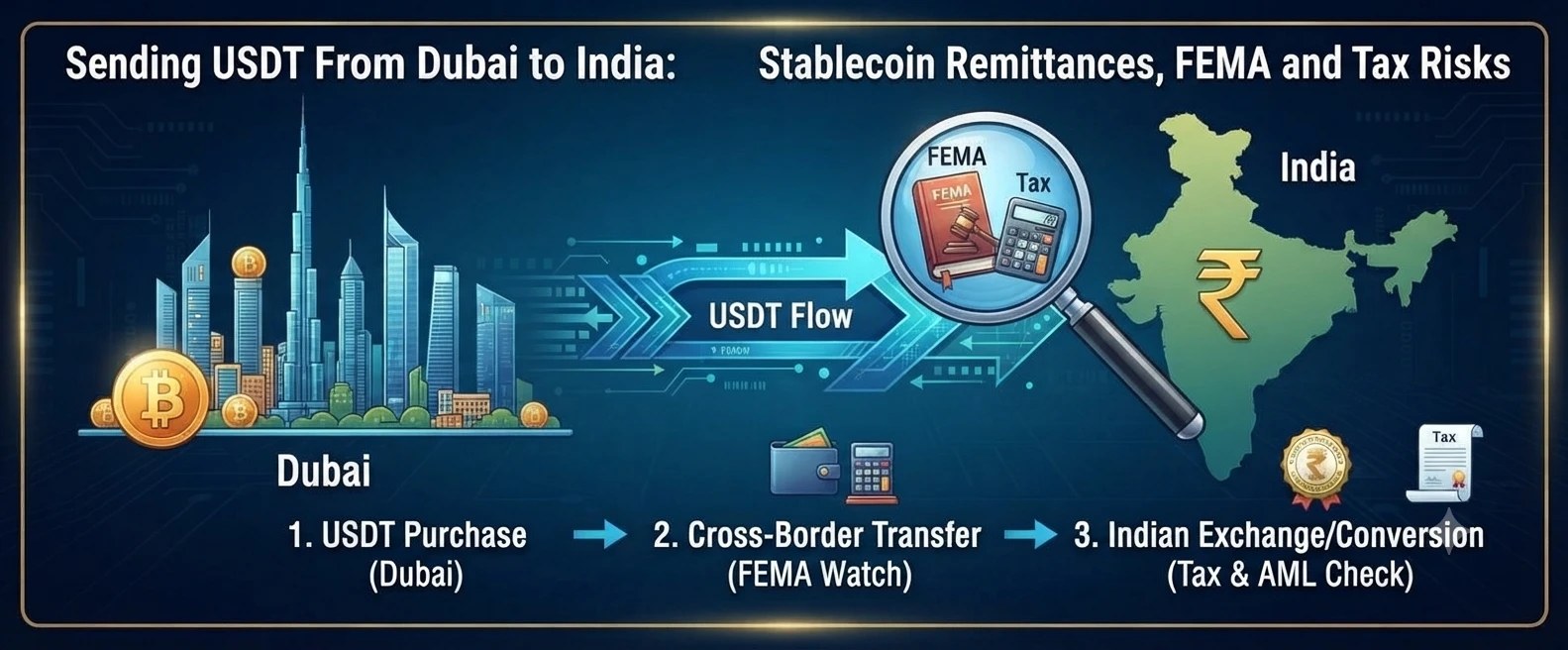
Dubai-based traders who sell crypto for rupees should also think about tax and foreign exchange rules. Gains on crypto sold for rupees are likely to be Indian-source income and taxed at 30%, and India’s 1% TDS should be deducted by the buyer in P2P trades. Receiving rupees for crypto trades into NRE accounts can raise foreign exchange questions.
Dubai-based traders should also keep their UAE records, such as exchange statements from VARA-licensed platforms, because they show the legitimate source of the crypto and help explain the trade to Indian investigators. If you’re named as an accused rather than just an account holder, take legal advice before responding to notices, and consider anticipatory bail where there’s a real risk of arrest.
Prevention and remedies
Prevention is far easier than cure. Trade on FIU-registered platforms, accept payment only from the counterparty’s own KYC-verified account, never from third parties, use a separate bank account for crypto trading, and keep records of every trade. Be particularly wary of buyers who claim to be overseas but pay from Indian accounts in other people’s names. If your bank account is frozen despite these precautions, act quickly: the sooner you identify the complaint and make a documented representation, the faster the account is usually released. Wrongful freezes that cause loss can also be raised with the bank’s grievance officer and the RBI Integrated Ombudsman.
Related reading: a bank account frozen over a crypto or UPI transaction, crypto fraud between Dubai and India, sending USDT from Dubai to India, a power of attorney from Dubai for Indian property, FIU-IND registration for crypto exchanges, whether a bank can close your account for crypto and using an Indian exchange’s Dubai entity; also the UAE FIU and VARA crypto agreement; also whether P2P crypto is legal in India.
Quick answers
Can police freeze my whole bank account for a P2P crypto trade?
Increasingly, courts say no. A lien on the disputed amount may be lawful, but attaching the whole account requires a Magistrate’s order under Section 107 BNSS.
How do I unfreeze my account?
Identify the cyber cell, send a documented representation, ask the bank to limit the restriction to a lien, then apply to the Magistrate or file a writ petition if needed.
Can an NRI in Dubai handle this from abroad?
Yes, through a lawyer or a power of attorney holder in India, with the power of attorney properly attested.
What evidence should I gather after a freeze?
P2P platform order details, chat logs with the buyer, the buyer’s KYC name as shown on the platform, UPI or bank references, your exchange statements and proof of where your crypto came from.
Can I complain about a wrongful freeze to the bank or the RBI?
Yes. Wrongful freezes that cause loss can be raised with the bank’s grievance officer and the RBI Integrated Ombudsman.
Final word
Halverton & Co. is an Indian law firm advising NRIs, founders, investors and businesses in Dubai and across the UAE on Indian law, including frozen bank accounts, cyber crime complaints, writ petitions and crypto trading disputes for NRIs and traders. We practise in Jharkhand, Maharashtra and before the Supreme Court of India, and work alongside UAE-licensed counsel, who advise on UAE law. Halverton & Co.: Where tech needs law! If you have a question about Indian law, write to us at office@halvertonandco.com, or get in touch.
This article reflects developments reported up to early October 2026. It is for general information only, is not legal advice, and does not create an advocate-client relationship. Halverton & Co. is an Indian law firm and does not advise on UAE law; UAE-law points should be confirmed with UAE-licensed counsel.
Related practice area
Crypto, Web3 & Digital Assets
Advice for virtual digital asset businesses on registration, reporting and structure.
View the practice areaComments
No account needed. Comments are reviewed before they appear, so yours will show here once approved. Please do not share confidential details or describe your own legal matter: replies are general discussion, not legal advice, and do not create an advocate-client relationship. For your own situation, write to office@halvertonandco.com.