Key takeaways
- An NDA is a contract under the Indian Contract Act, 1872, and courts also protect confidential information in equity even where the contract is weak.
- Section 27 makes post-employment restraints void, so an NDA must not operate as a disguised non-compete.
- Define the information specifically, set a purpose and a term, and stamp and sign the agreement properly.
- Unstamped agreements are inadmissible until duty and penalty are paid, although the Supreme Court has held the defect curable.
Every founder signs non-disclosure agreements, and most of them are copied from a template written for another country. When a leak happens, the first question a lawyer asks is about NDA enforceability India: will an Indian court enforce this document, in what form and against whom? The answer depends less on the length of the agreement than on how it is drafted, signed and stamped.
This guide explains NDA enforceability India from the point of view of a court: what makes a confidentiality agreement valid, which clauses carry weight, what Section 27 of the Indian Contract Act, 1872 does to over-broad restraints, why stamp duty matters, and what remedies are available when confidential information is misused. It applies to NDAs with employees, contractors, investors, vendors and overseas counterparties.
What makes an NDA enforceable in India
An NDA is a contract, so the ordinary rules of the Indian Contract Act, 1872 apply. There must be an offer and acceptance, lawful consideration, competent parties and a lawful object. In a mutual NDA, each side’s promise to protect the other’s information is the consideration. In a one-way NDA signed before a business discussion, the disclosure itself and the opportunity to evaluate a deal normally supply it. A confidentiality agreement is not a restraint of trade, so it is treated differently from a non-compete.
Indian courts also protect confidential information in equity, even where the contract is weak. The Delhi High Court in Burlington Home Shopping v. Rajnish Chibber (1995) protected a compiled customer database, and the Bombay High Court in Zee Telefilms v. Sundial Communications (2003) recognised that a developed idea shared in confidence can be protected. These decisions mean that NDA enforceability India does not depend only on the paper: the circumstances of disclosure and the quality of the information matter.
The practical lesson is to treat the NDA as evidence of the confidential relationship. A clear document makes it easier to prove that the recipient knew the information was secret, and to define exactly what was protected. Courts expect a claimant to identify the information specifically, so a vague promise to keep “everything” secret is much weaker than a defined schedule of what was shared.
Mutual and one-way NDAs deserve different drafting. In a one-way NDA the discloser carries the risk, so the definition, return and remedies clauses should be tight. In a mutual NDA each side’s obligations should be symmetrical, and neither should be able to use the other’s information to build a competing product. Whatever the form, NDA enforceability India improves when the document records the purpose, the people who may see the information and the way it is shared, such as a data room with access logs.
The clauses courts look for
Definition of confidential information. State what is covered, in categories and, where possible, by a schedule: source code, model weights, customer lists, pricing, roadmaps, financial data. Say whether oral disclosures are covered and whether marking is required. Over-reliance on marking can backfire, so many NDAs protect information that a reasonable person would understand to be confidential.
Purpose, exclusions and duration. Limit use to a stated purpose, such as evaluating an investment, and list the usual exclusions: information already public, independently developed, lawfully received from a third party or required by law to be disclosed. Set a fixed term for the confidentiality duty, with longer protection for trade secrets. An NDA India founders can rely on should say plainly what happens to source code and algorithms, since the Law Commission of India’s 289th Report in March 2024 noted that India has no dedicated trade secrets statute.
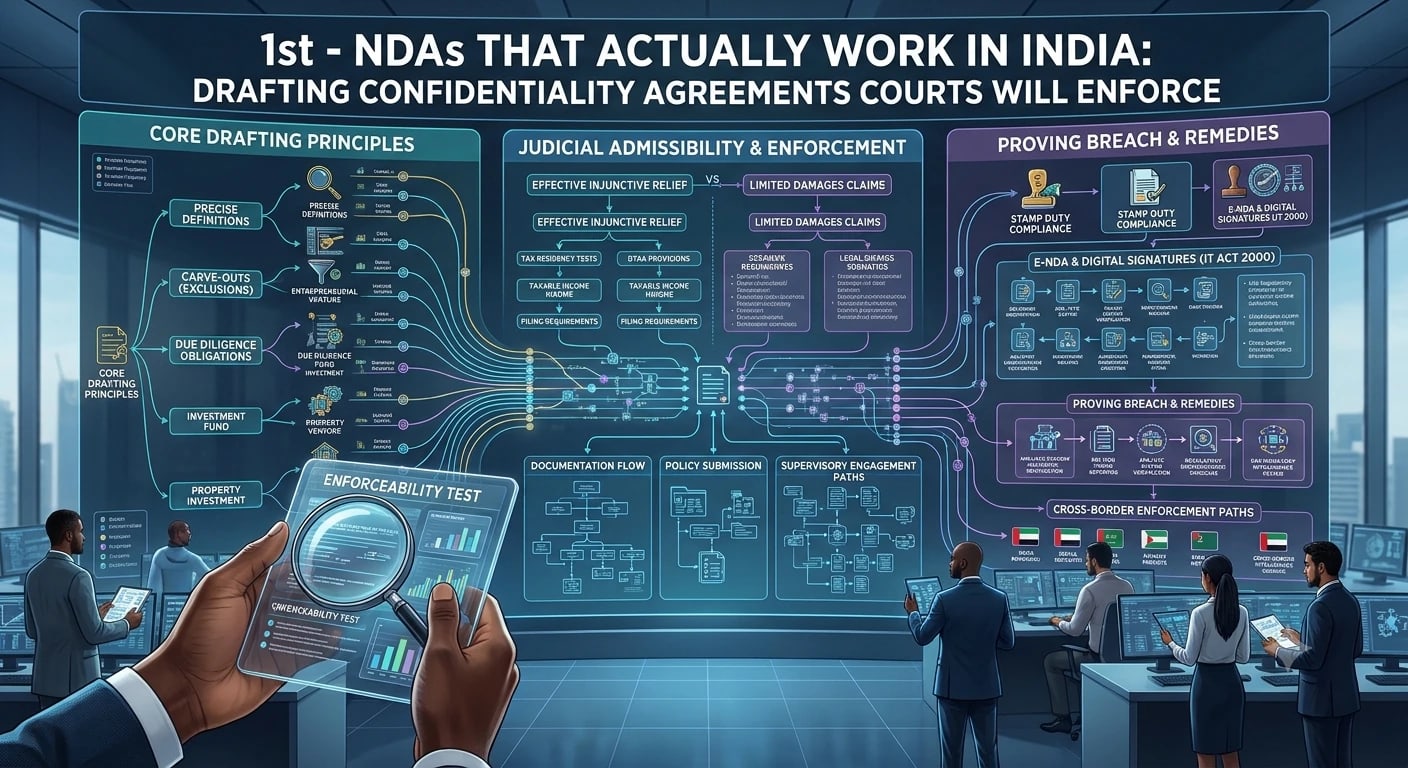
Return, remedies and forum. Require return or deletion on request, with a certificate. Record that damages may not be adequate and that the discloser may seek an injunction. Choose governing law, courts or arbitration, and a seat. An arbitration clause under the Arbitration and Conciliation Act, 1996 can allow urgent interim relief from a court, so the clause should not exclude it. A good confidentiality agreement enforceability India checklist therefore covers definition, purpose, exclusions, term, return, remedies and forum.
| Clause | What to include | Why it matters |
|---|---|---|
| Definition | Categories and, where possible, a schedule of what is confidential | Courts expect the claimant to identify the information specifically |
| Purpose and exclusions | A stated purpose and the usual exclusions for public, independently developed or lawfully received information | Limits disputes about what the recipient could use |
| Term | A fixed term, with longer protection for trade secrets | Perpetual duties over general know-how risk being read down |
| Return and remedies | Return or deletion on request, and a right to seek an injunction | Supports urgent relief when information leaks |
| Forum | Governing law, courts or arbitration, and seat | Avoids a fight over where to sue; keep interim relief available |
What courts will not enforce
Section 27 of the Contract Act makes any agreement in restraint of trade void, with a narrow exception for the sale of goodwill. The Supreme Court held in Niranjan Shankar Golikari v. Century Spinning (1967) that restrictions during employment can be valid, but in Superintendence Company of India v. Krishan Murgai (1980) that a post-termination restraint is void. An NDA that is really a disguised non-compete, for example one that bars a former employee from working in the industry, risks being struck down.
Perpetual and over-broad confidentiality terms are also vulnerable. A clause that treats all information the employee learned, including general skills and industry knowledge, as secret forever is likely to be read down. Courts distinguish between specific trade secrets, which can be protected without a time limit, and general know-how, which a person is free to use in a new job.
Liquidated damages must also be handled carefully. Section 74 of the Contract Act allows only reasonable compensation up to the amount named, not a penalty, and the Supreme Court in Kailash Nath Associates v. DDA (2015) required the court to assess reasonableness. A fixed sum that is clearly out of proportion to likely loss may be reduced. It is safer to combine a realistic genuine pre-estimate with a right to seek injunctive relief and actual damages.
Stamping, signing and evidence
Stamp duty is a state subject in India, so the amount depends on the state where the NDA is executed or brought into the state. An unstamped or under-stamped agreement is inadmissible in evidence until the deficiency and penalty are paid. In 2023, a seven-judge Bench of the Supreme Court in the reference on the interplay between arbitration agreements and stamp duty held that an unstamped agreement is not void but inadmissible, and that the defect is curable. The simple course is to stamp the NDA at signing, using e-stamping where available.
Signatures need care. E-signatures are valid under the Information Technology Act, 2000 where the method meets the Act’s conditions, and many NDAs are signed by Aadhaar eSign or other approved methods. For overseas parties signing by a click-through or PDF, keep the audit trail. Authority matters too: confirm the signatory can bind the company, because a signature by someone without authority invites a challenge.
Evidence is the next test. In a dispute, you will need to show what was disclosed, when and to whom. Keep a disclosure log, the emails that carried the information and access records. Electronic records are admitted with a certificate under Section 63 of the Bharatiya Sakshya Adhiniyam, 2023, so collect the certificate details early. A strong NDA enforceability India case combines a clear contract with a clean evidence file.
Employee and contractor NDAs need extra care. Keep confidentiality terms separate from IP assignment and from any restraint, so that a challenge to one does not take down the others. Include a carve-out for disclosures required by law and for reporting suspected offences, because a clause that stops a person reporting wrongdoing may be unenforceable as contrary to public policy. A well-structured NDA enforceability India position also depends on keeping the signed copy and the stamp paper in a place you can find in two years.
Remedies, next steps and quick answers
When a leak happens, act fast. Preserve evidence, send a notice demanding that use stops, and consider an urgent application to the High Court. Courts can grant interim injunctions under Order 39 of the Code of Civil Procedure, 1908, and in appropriate cases appoint a local commissioner to seize or image devices. The final relief can include a permanent injunction, damages or an account of profits, and in serious cases criminal remedies may be explored. Delay can count against you, so seek advice within days, not months. To improve NDA enforceability India before any dispute, review your templates: define the information, set the purpose and term, avoid disguised non-competes, stamp and sign properly and keep evidence. For NDAs with overseas parties, add a clear forum and consider arbitration, because an award can be enforced in many countries under the New York Convention.
Related reading: trade secrets in India: protecting source code and algorithms, founders’ agreements in India, who owns code written by Indian developers, using AI tools at work: confidentiality and data leaks, software copyright protection in India and due diligence for Indian startups; also trade secret remedies when former employees take code; also hiring a freelance developer from India and outsourcing to India under UK GDPR: five clauses; also freelancing from Dubai for Indian clients and who owns influencer content made for a brand.
Quick answers
Is an NDA enforceable in India?
Yes, if it is a valid contract with a lawful object and is properly stamped. Courts also protect confidential information in equity. The NDA must not operate as a post-employment non-compete, which Section 27 makes void.
How long can a confidentiality obligation last in India?
There is no fixed legal limit. A reasonable fixed term is safer for general business information, while trade secrets can be protected for as long as they remain secret. A perpetual duty over general know-how is likely to be read down.
Does an NDA need stamp duty in India?
Yes. Stamp duty depends on the state. An unstamped NDA is inadmissible until the duty and penalty are paid, although the Supreme Court has held that the defect is curable and does not make the agreement void.
Can I use an NDA to stop an employee joining a competitor?
Generally no. Section 27 of the Contract Act makes post-employment restraints void, so an NDA that works as a disguised non-compete is likely to fail. Protect specific confidential information instead.
What should I do first if an NDA is breached?
Preserve evidence, send a notice demanding that use stops and take advice within days about an urgent High Court application. Delay can count against you.
Final word
Halverton & Co. is an Indian law firm advising founders, startups, technology companies and investors on Indian law, including NDAs, confidentiality and trade secret protection, employment and contractor agreements, and technology contracts for startups and founders. We practise in Jharkhand, Maharashtra and before the Supreme Court of India, and act as fractional legal counsel for technology-driven businesses. Halverton & Co.: Where tech needs law! If you have a question about Indian law, write to us at office@halvertonandco.com, or get in touch.
This article reflects developments reported up to late October 2026. It is for general information only, is not legal advice, and does not create an advocate-client relationship. Halverton & Co. is an Indian law firm.
Sources
Related practice area
Intellectual Property
Trade marks, copyright, patents and designs. Searched, filed, licensed and enforced under Indian law.
View the practice areaComments
No account needed. Comments are reviewed before they appear, so yours will show here once approved. Please do not share confidential details or describe your own legal matter: replies are general discussion, not legal advice, and do not create an advocate-client relationship. For your own situation, write to office@halvertonandco.com.