“Can we patent our software?” It’s one of the first questions a tech founder asks an IP lawyer, usually right after an investor asks, “What’s your moat?” And the answer most founders have heard from friends, forums and older blog posts is a flat “No, software can’t be patented in India.”
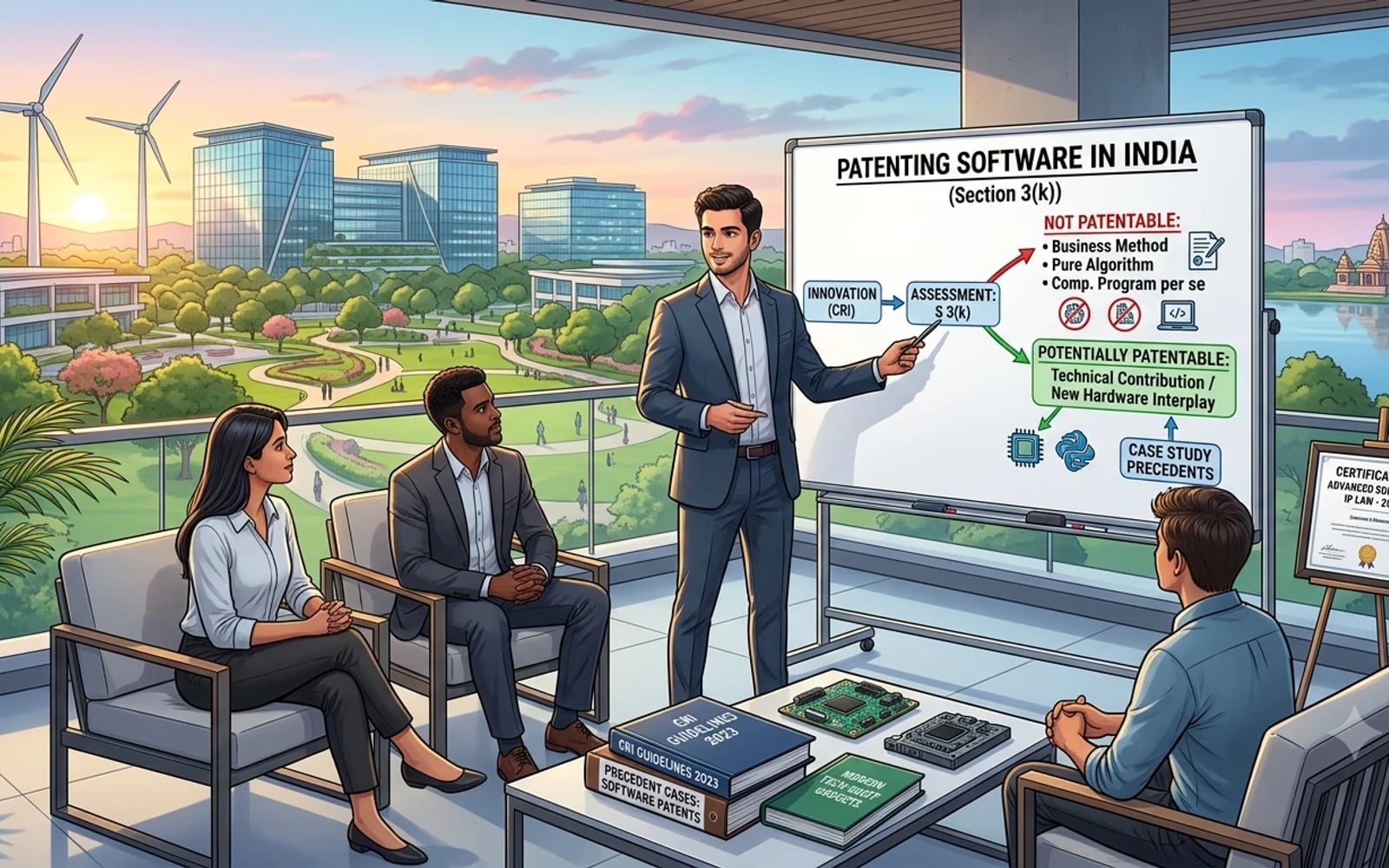
That answer is wrong, or at least badly incomplete. Indian patent law does not ban software patents. Section 3(k) of the Patents Act, 1970 excludes a “computer programme per se”, which is a much narrower thing. Over the past seven years, the Delhi and Madras High Courts have built a clear test, and in July 2025 the Indian Patent Office rewrote its rules for examining computer-related inventions around that test.
This guide explains, in plain language, when a software patent is possible in India, how Section 3(k) and the CRI Guidelines 2025 work, what filing costs a startup and how long it takes, and the legal remedies available both when your patent application is refused and when someone copies your patented invention.
What Section 3(k) says, and why the words “per se” matter so much
Section 3 of the Patents Act, 1970 lists things that are “not inventions” and therefore cannot be patented, however new or clever they are. Clause (k) is the one that troubles software founders. It excludes four things: “a mathematical or business method or a computer programme per se or algorithms”.
Read it slowly, because the drafting matters. The phrase “per se”, meaning “by itself” or “as such”, attaches only to computer programmes. It does not qualify business methods, mathematical methods or algorithms. So the law treats these four categories differently:
- A computer programme per se (code, instructions or a programme product claimed on its own) is excluded. But an invention that uses software to produce a technical result is not a computer programme per se.
- Business methods are excluded outright. There’s no “per se” to argue around.
- Mathematical methods and algorithms are excluded as abstract ideas. The way they are implemented in a technical system can still be patentable.
Where “per se” came from
Section 3(k) was added by the Patents (Amendment) Act, 2002. The Joint Parliamentary Committee that examined the Bill deliberately added “per se”, explaining that a computer programme may include things ancillary to it or developed on it, which should not be refused a patent if they are genuine inventions. In 2004, an ordinance tried to spell this out further by allowing software with a “technical application to industry or a combination with hardware”, but that wording was dropped when Parliament passed the 2005 amendment. Parliament, in effect, left it to the Patent Office and the courts to draw the line (SFLC.in).
Section 3(k) doesn’t work alone
A software patent application in India must also clear the basic tests of patentability under Section 2(1)(j): novelty, inventive step and industrial application. Indian law defines inventive step as a feature involving a “technical advance” or economic significance that is not obvious to a skilled person. Examiners often raise neighbouring exclusions too, such as Section 3(m) (mental acts and methods of playing games) and Section 3(n) (mere presentation of information), against apps whose only novelty is what appears on the screen.
So the honest answer to “can software be patented in India?” is this. You cannot patent code as code, and you cannot patent a business idea at all. But a computer-related invention that solves a technical problem in a technical way can be patented, even when software does all the work.
How courts and the CRI Guidelines 2025 decide whether software is patentable
For years, the Indian Patent Office rejected software patent applications almost by reflex, often insisting on “novel hardware”. The courts changed that, one judgment at a time. If you remember one idea from this article, make it this one: the test is technical effect or technical contribution.
The judgments that built the test
- Ferid Allani v. Union of India (Delhi High Court, 2019) is the turning point. The court held that an invention based on a computer programme can be patented if it shows a technical effect or technical contribution, and observed that almost every modern device runs on software (Lexology).
- OpenTV v. Controller (Delhi High Court, 2023) went the other way for business methods. Because “per se” doesn’t qualify business methods, the bar is absolute in India. A commercial scheme can’t be rescued by arguing it has a technical effect, even though that argument sometimes works in Europe (Treelife).
- Raytheon v. Controller General (Delhi High Court, 2023) removed the old demand for novel hardware. The court held that insisting on new hardware has no basis in law. What matters is the technical effect (Treelife).
- In the Microsoft cases (Delhi High Court, 2023 and 2024, and Madras High Court, 2024), the courts said the effect must be specific and credible and go beyond ordinary computing. They added that the mere presence of a mathematical formula in a claim doesn’t make it an unpatentable mathematical method.
- Ab Initio (Delhi High Court, 2024) gave technical effect a practical meaning: an input method that lets a processor compute faster or more efficiently produces a technical effect, even without any physical change.
- Blackberry (Delhi High Court, 2024) dealt with algorithms. A set of instructions that only directs data flow, with no real technical implementation, is excluded. Where the algorithm is implemented in a system that produces a technical effect, the inventive feature must lie in that implementation.
- In a 2025 database case, the Madras High Court confirmed that a computer-related invention is not excluded by Section 3(k) merely because it lacks novel hardware or doesn’t change a computer’s internal workings, as long as it makes a technical contribution (Law Street).
The CRI Guidelines 2025
On 29 July 2025, the Patent Office notified new Guidelines for Examination of Computer Related Inventions, replacing the 2017 version (Treelife). The CRI Guidelines 2025 bring the case law into examination practice and give examiners a step-by-step test for each limb of Section 3(k), with flowcharts and worked examples. Some points every founder should know:
- The claim is judged by its substance, not its label. Calling a business method a “system” won’t save it. Equally, software performing every step doesn’t sink a genuine technical invention.
- Claims to a computer programme product or a storage medium carrying instructions, standing alone, are excluded as a computer programme per se.
- Both method claims and system claims can be granted for the same computer-related invention.
- AI-assisted inventions, where AI is used as a tool, can be patented. AI-generated inventions made with minimal human input cannot, because an AI can’t be the “true and first inventor” under Section 6 (Lexology).
- AI, machine learning, blockchain and quantum computing inventions face much stricter disclosure requirements, and you must actually teach how the invention works.
What tends to pass, and what doesn’t
Software patents that succeed in India usually improve how a machine or network works: faster data processing, better compression, more efficient memory use, stronger encryption or authentication, smarter allocation of network or cloud resources, real-time control of robots or devices, or more efficient model training. Applications that fail usually claim the business outcome: a pricing engine, a recommendation feature, a dashboard, a booking workflow, or a manual process simply moved onto a computer.
A warning for AI startups
In Caleb Suresh Motupalli v. Controller of Patents (2025), the Madras High Court declined to interfere with the refusal of an AI-related application, which was also held not to be a maintainable appeal. The specification pulled together existing literature without teaching how to make the invention work, and lacked a technical effect sufficient to overcome Section 3(k) (24Law). For AI patents in India, describing your ambition is not enough. You have to disclose the method.
Filing a software patent in India: drafting, process, fees and timelines
In our view, whether a software patent application in India succeeds is decided more by drafting than by the invention itself. Two applications for the same technology can meet completely different fates depending on how the specification is written.
Draft around the technical problem, not the business result
Open the specification with the technical problem in its technical field, not the market opportunity. Explain the mechanism with flowcharts and show how the components work together. Include a clear passage on technical effect, ideally measured against a baseline, such as “reduces authorisation latency by X%” or “cuts memory use by Y%”. Claim both the method and the system, with dependent claims that narrow step by step to the specific implementation. This matters because after filing you can only amend within what the specification already discloses (Section 59). Avoid business words like “revenue”, “conversion” and “customer engagement” in your claims, and never rely on a “computer-readable medium” claim alone.
File before you tell the world
India has no general grace period for public disclosure. A demo day pitch, an open-source commit or a published paper before filing can destroy novelty. A provisional application is a cheap way to lock in your filing date while you finish the full specification, which must follow within 12 months.
The process, step by step
Step 1: Prior art search
For software, the prior art that defeats novelty is often a research paper, a GitHub repository or a product release note, not just another patent.
Step 2: File the application
File Form 1 with a provisional or complete specification online with the Indian Patent Office.
Step 3: Publication
Publication happens automatically after 18 months, or earlier if you request it on Form 9.
Step 4: Request examination
File Form 18. For applications filed on or after 15 March 2024, this is due within 31 months of the priority date, not the old 48 months. Miss it and the application is treated as withdrawn.
Step 5: Respond to the First Examination Report
You have six months, extendable by three. Expect a Section 3(k) objection in almost every software patent application.
Step 6: Hearing
If the examiner’s objections remain, you are heard before the Controller.
Step 7: Grant
The patent then lasts 20 years from the filing date, provided you pay annual renewal fees from the third year and file working statements (Form 27) once every three financial years.
What it costs a startup
Official fees depend on the type of applicant. Individuals and DPIIT-recognised startups pay the lowest rates: ₹1,600 for filing (Form 1) and ₹4,000 for the request for examination (Form 18). Small entities pay ₹4,000 and ₹10,000. Large entities pay ₹8,000 and ₹20,000 (Invntree fee schedule). Professional fees for drafting and prosecution come on top, and for a software patent they are worth spending on, because the drafting decides the outcome.
How long it takes
On the normal route, a software patent in India typically takes three to five years from filing to grant, and the examination queue is the main bottleneck. Startups can request expedited examination on Form 18A, at an official fee of ₹8,000 for individuals and startups, ₹25,000 for small entities and ₹60,000 for large entities (Invntree fee schedule). That can bring grant within roughly a year or so. For a startup preparing for a funding round, it is often worth the cost.
Two traps that catch Indian startups
- Filing abroad first. Under Section 39, a person resident in India must not file a patent application outside India without first filing in India (and waiting six weeks) or getting the Controller’s written permission on Form 25. This applies even if the US or Singapore parent company is the applicant: what matters is where the inventors live. Breach can lead to the Indian application being treated as abandoned (Section 40), revocation of the patent (Section 64(1)(n)), and imprisonment of up to two years, a fine, or both (Section 118).
- Not owning your own invention. Unlike copyright in code written by employees, Indian patent law has no rule that automatically gives the employer ownership of an employee’s invention. Your company owns an invention only through a written assignment (Section 68). Every employment, consultant and contractor agreement should include one, and assignments by founders should be recorded with the Patent Office. Our guide to founders’ agreements in India explains how to build this in from day one.
Objections, refusals and infringement: legal remedies for software patents
A software patent fight can happen at three stages: while the Patent Office examines your application, when a competitor challenges your patent, and when someone copies your invention. Indian patent law has a remedy at each stage.
Remedy 1: Answer the Section 3(k) objection properly
Treat the First Examination Report as the start of a negotiation, not a verdict. A strong reply identifies the essential technical features of the claim, states the technical problem, shows the technical effect (with numbers where possible), and maps the invention to the relevant test in the CRI Guidelines 2025. It also cites the matching High Court judgment, such as Raytheon if the examiner demands novel hardware, or Ferid Allani and Ab Initio on technical effect. It usually includes amended claims as well. What rarely works is pointing to a US or European patent on the same invention, or simply adding “a processor and a memory” to the claim.
Remedy 2: The hearing, review and appeal
If objections remain, you’re entitled to a hearing before the Controller, followed by written submissions. If the application is refused, you can seek review of the order under Section 77, or appeal to the High Court under Section 117A within three months of the decision. Note that the IPAB was abolished in 2021, and appeals now go to the High Courts, which have dedicated IP Divisions in Delhi and Madras. The High Courts have repeatedly set aside refusals where the Controller gave thin reasons or applied outdated tests. A well-run software patent appeal has a real chance of success.
Remedy 3: Oppositions, as shield and sword
Anyone can file a pre-grant opposition under Section 25(1) after your application is published and before it’s granted. Once the patent is granted, any person interested can file a post-grant opposition under Section 25(2) within one year of publication of the grant. Defend these vigorously, with technical evidence. The same tools work for you too: if a competitor files a weak software patent that could block your product, opposing it is far cheaper than defending an infringement suit later. A patent can also be revoked under Section 64, including on the ground that it isn’t an invention under Section 3(k), usually through a counter-claim in an infringement suit.
Remedy 4: Enforce your granted patent
A registered patent gives you the exclusive right to stop others from making, using, selling or importing your patented invention in India (Section 48). For patent infringement:
- File an infringement suit under Section 104 in a court no lower than a District Court. If the defendant counter-claims for revocation, the case moves to the High Court. Patent suits are commercial disputes, so pre-institution mediation applies unless you need urgent interim relief.
- Under Section 108, the court can grant an injunction (including an interim injunction), damages or an account of profits, and order infringing goods and the tools used to make them to be seized, forfeited or destroyed.
- Indian courts are now willing to award serious damages in technology patent cases. In Ericsson v. Lava (2024), the Delhi High Court awarded Ericsson around ₹244 crore for infringement of its telecom patents.
- Be careful with threats. Under Section 106, a person threatened with an infringement suit without justification can sue for a declaration and damages. Send a cease-and-desist only on solid grounds.
- Patent infringement in India is a civil wrong, not a crime. Copying your code, however, can be a criminal offence under copyright law (see the next section).
A practical point on enforcement. It’s hard to prove infringement of a software patent when the infringing mechanism runs on a competitor’s server out of sight. When drafting, try to include at least one claim whose infringement can be detected from outside the product, for example from its output, a network behaviour or the user’s device.
When a patent isn’t the answer, and a founder’s checklist
Here’s something IP lawyers don’t say often enough: for most software startups in India, a patent is not the first tool you need. A patent means publishing your method to the world in exchange for 20 years of exclusivity. Sometimes that’s a great deal. Often, copyright plus good contracts plus trade secrets protect you better, for less money.
Copyright protects your code automatically
Under the Copyright Act, 1957, a computer programme is a literary work. Copyright arises as soon as the code is written, without registration, and lasts for the author’s lifetime plus 60 years. Code written by employees in the course of employment belongs to the employer under Section 17(c), but code from freelancers and agencies needs a written assignment under Section 19. Registration is optional, but it gives you useful evidence in court. The remedies are strong: civil suits for injunction and damages under Section 55, and criminal prosecution under Section 63, punishable with six months to three years’ imprisonment and a fine of ₹50,000 to ₹2 lakh. Section 63B specifically punishes the knowing use of an infringing copy of a computer programme. The limit is that copyright protects the code as written, not the idea behind it. A competitor who rebuilds the same feature from scratch doesn’t infringe. (If AI writes part of your code, see our guide on who owns AI-generated content in India.)
Trade secrets protect what can’t be seen
India has no trade secrets statute, but courts protect confidential information through contract and the law of confidence, including by granting injunctions. Model weights, training data, ranking logic, pricing models and internal tools are usually better kept secret than patented, especially when infringement would be impossible to detect from outside. Use NDAs, confidentiality clauses, access controls and clean exit processes, and set rules for staff use of AI tools (see our guide to AI tools at work). Bear in mind that Section 27 of the Indian Contract Act limits post-employment non-competes, so confidentiality obligations do most of the work.
A trademark protects your brand
Your product name is often more valuable than any single patent. Register it early. Our guide to trademark registration for startups walks through how.
Founder’s checklist: should you file a software patent in India?
- Does the invention solve a technical problem, or a commercial one? If commercial, Section 3(k) will almost certainly block it.
- Is the inventive part the technical mechanism, or just the workflow it supports?
- Can you describe it in enough detail for a skilled engineer to build it without guesswork?
- Will this technology still matter to your business in five to ten years?
- Could you detect infringement from outside a competitor’s product?
- Have you filed in India first, and do written assignments from every inventor, employee and contractor sit with your company?
If you can answer “yes” to most of these, file. Use a provisional application to secure your date, and consider expedited examination. If not, put your money into copyright, contracts and trade secret discipline.
Quick answers
Can a mobile app be patented in India?
Not the app as such. A technical mechanism inside it, such as a new authentication or compression method, may be patentable if it produces a technical effect.
Can an algorithm be patented in India?
Not on its own. A specific technical implementation of an algorithm that produces a technical effect can be.
Can AI be named as an inventor in India?
No. Only a human can be the true and first inventor, though AI-assisted inventions can be patented.
Related reading: IP assignment in India and patent paralegal outsourcing; also software patents in India for US tech companies; also software patents in India for UK tech companies.
Final word
So, can you patent software in India? Yes, when the invention makes a genuine technical contribution and the application is drafted to show it. Section 3(k) is a filter, not a wall. After Ferid Allani, Raytheon and the CRI Guidelines 2025, the line is clearer than it has ever been. Business methods stay out, code by itself stays out, and technical innovation implemented in software can get through.
At Halverton & Co., we help tech founders, SaaS, fintech and AI startups protect their innovation, from deciding whether a software patent is worth filing to drafting strategy, Section 3(k) objections, oppositions, copyright and trade secret protection, and enforcement. We practise in Jharkhand, Maharashtra and before the Supreme Court of India, and work as fractional legal counsel for technology-driven businesses. Halverton & Co.: Where tech needs law!
Write to us at office@halvertonandco.com, or get in touch, to talk about protecting your technology. If your product handles customer data, our DPDP Act compliance checklist is a useful companion.
This article reflects the Patents Act, 1970, the CRI Guidelines 2025 and case law reported up to early October 2026. Official fees and timelines can change; check the current IP India schedule before filing.
Related practice area
Intellectual Property
Trade marks, copyright, patents and designs. Searched, filed, licensed and enforced under Indian law.
View the practice area