Every co-founder relationship starts with optimism. You’ve known each other for years, you finish each other’s sentences, and putting rules on paper feels almost insulting. Then, eighteen months in, one founder wants to leave, or stops pulling their weight, or turns out to own the domain name and the code repository personally. Without a founders agreement, that moment can sink the company.
A founders agreement is the cheapest insurance a startup will ever buy. This guide explains what an Indian founders agreement should contain, how to make vesting and IP assignment actually enforceable under Indian law, and what legal remedies exist when co-founders fall out.
Why every startup needs a founders agreement before the first cheque
Investors look at the founding team before anything else, and one of their first diligence questions is whether the founders are locked in and the company owns everything it uses. A founders agreement answers both. It sets out who owns what, who does what, what happens when someone leaves, and how disputes are resolved.
Signing it before the first external cheque matters for a practical reason. Once investors arrive, the shareholders’ agreement and articles of association take over, and renegotiating founder terms with money on the table is awkward and expensive. Sorting it out among yourselves, while everyone is still friends, is far easier. (When the money does arrive, see how early-stage instruments work in our guide to SAFE notes, iSAFEs and CCDs.)
A founders agreement also helps when the company hasn’t been incorporated yet. Founders often start building months before registering a company. Under Section 15 of the Specific Relief Act, 1963, a company can adopt contracts made on its behalf before incorporation, so a founders agreement signed early can be adopted by the company once it exists. Remember to pay the stamp duty that applies in your state, because an unstamped agreement can’t be relied on in court until the duty and any penalty are paid.
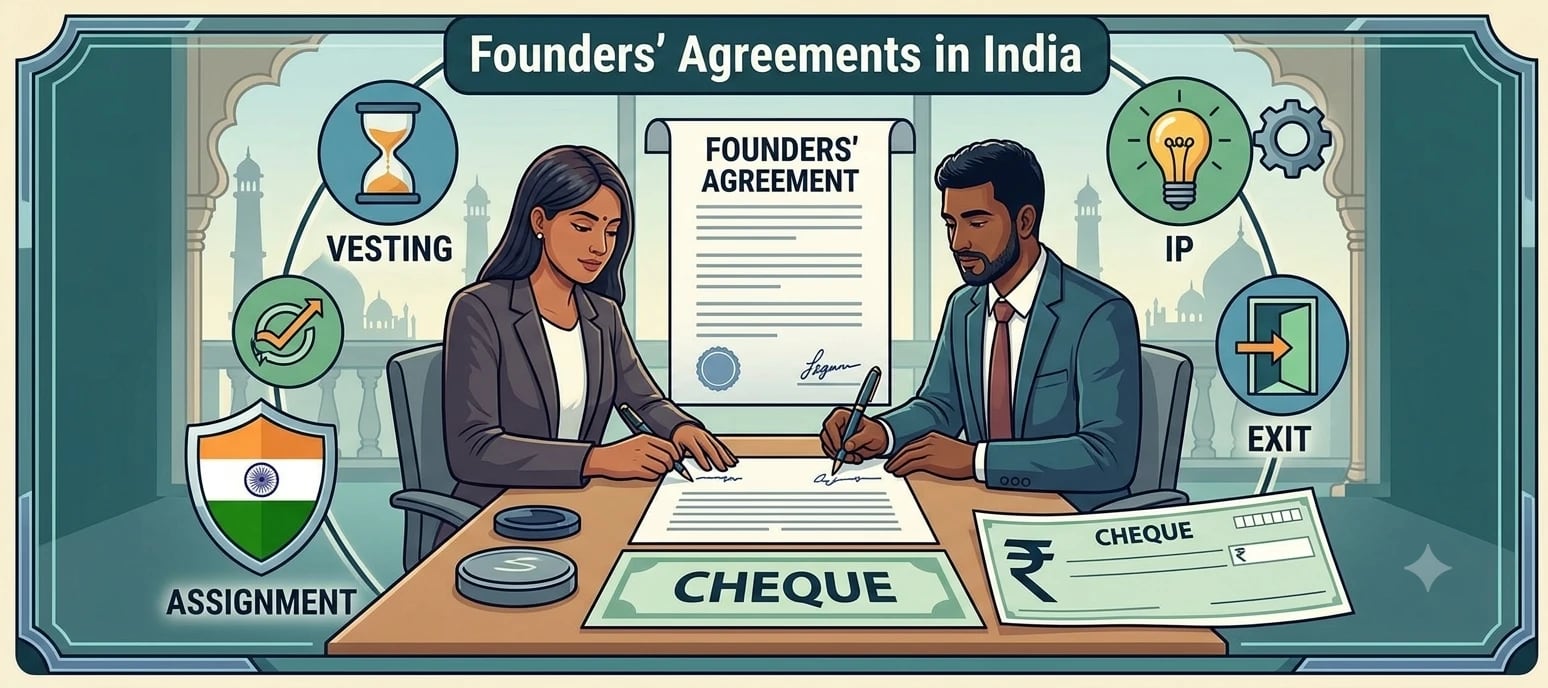
The key clauses: equity, roles, vesting, IP and exits
- Equity split and capital contributions. Who holds how many shares, and what each founder contributes: cash, time, IP or relationships.
- Roles and decision-making. Titles, responsibilities, reserved matters needing unanimous consent, and a deadlock mechanism.
- Founder vesting. Founders typically vest their shares over four years with a one-year cliff, so a founder who leaves early doesn’t walk away with a quarter of the company.
- IP assignment. Every founder assigns to the company all IP created for the business, including code, designs, brand names, domain names and social handles, and including work done before incorporation.
- Confidentiality and non-solicitation. Obligations to protect confidential information and not to poach employees or customers.
- Exit terms. Good leaver and bad leaver definitions, the price at which a leaver’s unvested (and sometimes vested) shares are bought back, and transfer restrictions such as a right of first refusal, tag-along and drag-along rights.
- Dispute resolution. Mediation first, then arbitration with a clear seat, such as Mumbai, Delhi or Ranchi.
Making vesting and IP assignment enforceable under Indian law
Indian law has a few quirks that catch founders who copy US templates.
Reverse vesting
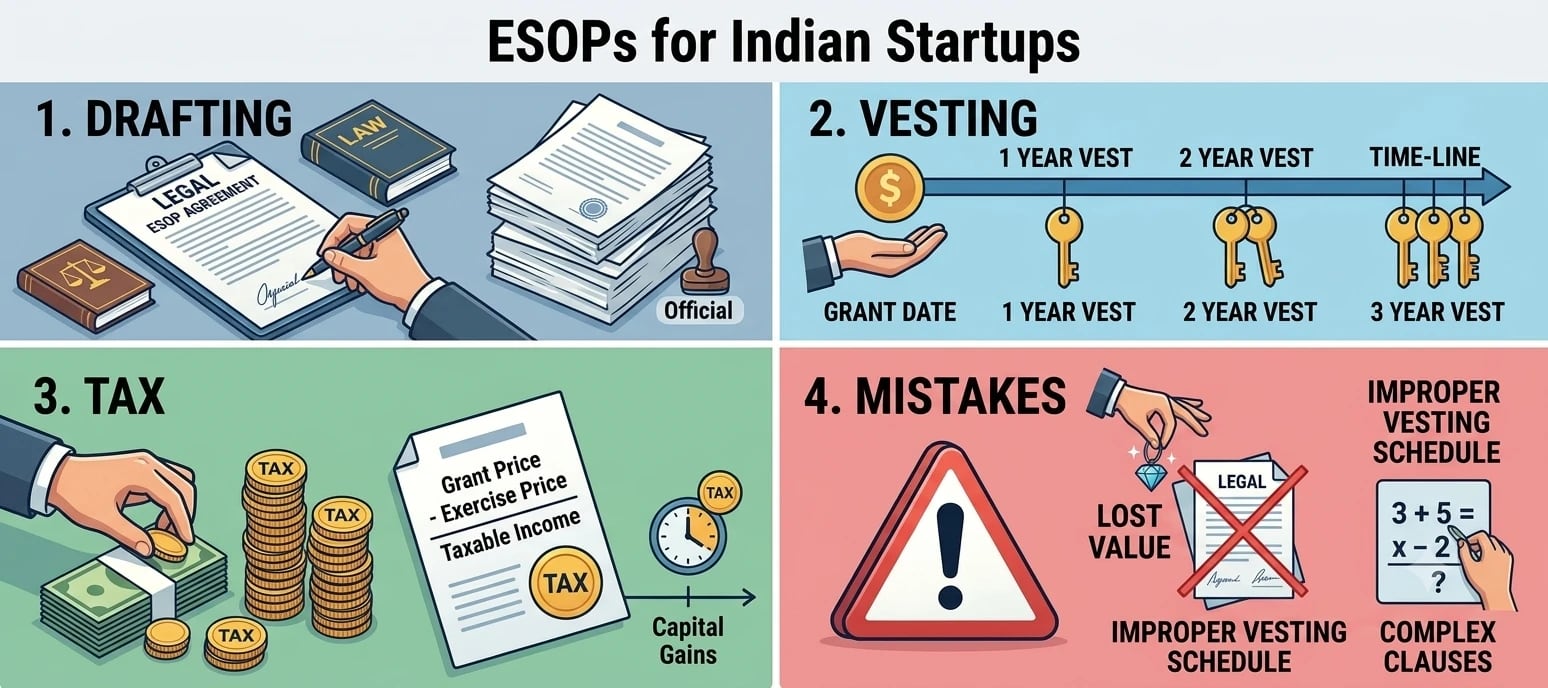
In India, founders usually receive all their shares upfront at incorporation, so true vesting is impossible. Instead, the agreement provides “reverse vesting”: if a founder leaves before fully vesting, they must transfer the unvested shares to the other founders, the company’s nominee or an ESOP trust at a nominal price. A company buying back its own shares is restricted by Section 68 of the Companies Act, so transfer to existing shareholders is usually the cleaner route. Employees’ options are a separate matter; see our guide to ESOPs for Indian startups.
Mirror it in the articles
Since the Supreme Court’s decision in V.B. Rangaraj v. V.B. Gopalakrishnan (1992), the safe course has been to write share transfer restrictions into the company’s articles of association, not just a private agreement. Founders’ transfer obligations should be reflected in the articles.
IP assignments must be in writing
Copyright in code written by an employee belongs to the employer under Section 17(c) of the Copyright Act, 1957, but founders are often not employees at the start. A copyright assignment must be in writing and signed (Section 19). Patents need a written assignment under Section 68 of the Patents Act (see our guide to patenting software in India), and trademarks can be assigned under Section 45 of the Trade Marks Act (see trademark registration for startups). Register the brand, domain names and social handles in the company’s name from day one; our guide on what to do when a brand name is taken as a domain or handle shows what happens when they aren’t. If AI tools write part of your code, also read who owns AI-generated content in India.
Non-competes have limits
Section 27 of the Indian Contract Act, 1872 makes agreements in restraint of trade void. In Superintendence Company of India v. Krishan Murgai (1980) and Percept D’Mark v. Zaheer Khan (2006), the Supreme Court made clear that post-termination non-competes are generally unenforceable. Restrictions during the relationship, confidentiality obligations and narrowly drawn non-solicitation clauses fare much better. When a founder sells their shares, a reasonable non-compete tied to the goodwill being sold may be upheld.
When co-founders fall out: legal remedies in India
A well-drafted founders agreement makes a falling-out manageable. When it comes to a dispute, these are the main remedies.
- Arbitration and interim relief. If the agreement has an arbitration clause, either side can seek urgent interim measures from the court under Section 9 of the Arbitration and Conciliation Act, 1996, or from the tribunal under Section 17. That can freeze a share transfer, protect IP or restrain misuse of confidential information.
- Oppression and mismanagement. A founder who meets the threshold in Section 244 (generally 10% of shareholding or one-tenth of members, which the NCLT can waive) can petition the NCLT under Sections 241 and 242 for relief against oppressive conduct, including orders regulating the company’s affairs or buying out a shareholder.
- Removing a founder as director. Shareholders can remove a director by ordinary resolution under Section 169, after special notice and with the director’s right to be heard. Removal as a director doesn’t take away their shares. That’s what the vesting and transfer clauses are for.
- Specific performance and injunctions. Courts can order a departing founder to transfer unvested shares as agreed, or restrain them from using the company’s IP, domain or social handles.
- Criminal law, as a last resort. Where a founder misappropriates company funds or property, criminal complaints such as criminal breach of trust under the Bharatiya Nyaya Sanhita, 2023 may be available, though they should be used carefully.
A founder’s checklist before the first cheque
- Sign a founders agreement covering equity, roles, vesting, IP, exits and disputes.
- Mirror transfer restrictions and reverse vesting in the articles of association.
- Get written IP assignments from every founder, including for pre-incorporation work.
- Move the domain names, trademarks, code repositories and social handles into the company’s name.
- Put employment or consultancy agreements in place for founders who work in the company.
- Keep board and shareholder minutes properly, because investors will ask.
Planning for a future move of the company’s home base? Read our guide to reverse flipping in India, where founder and IP terms are tested in diligence.
Quick answers
Is a founders agreement legally binding in India?
Yes. It’s a contract under the Indian Contract Act, but share transfer restrictions should also be in the articles of association to bind the company.
Are non-compete clauses enforceable against a co-founder?
Post-exit non-competes are generally void under Section 27, except in limited cases such as a sale of shares with goodwill. Confidentiality and non-solicitation clauses are more reliable.
What if my co-founder owns the domain or code personally?
Use the IP assignment clause to demand transfer. If they refuse, seek an injunction and specific performance, and sign assignments from the start next time.
Related reading: shutting down a startup legally, RSUs, SARs and phantom stock and the Income-tax Act 2025 for startups; also IP assignment for US startups with teams in India; also legal due diligence on Indian startups; also IP assignment for UK start-ups with Indian developers; also setting up a Dubai crypto holding company.
Final word
At Halverton & Co., we work as legal counsel for startups, founders and technology-driven businesses on founders agreements, shareholders agreements, IP assignment and co-founder disputes. We practise in Jharkhand, Maharashtra and before the Supreme Court of India, and act as fractional legal counsel for companies that need senior legal support without a full in-house team. Halverton & Co.: Where tech needs law!
Write to us at office@halvertonandco.com, or get in touch, to discuss your situation.
This article reflects the law and developments reported up to early October 2026. Rules in this area change often; please take advice on your specific facts before acting.
Related practice area
Startups & Venture
From incorporation to term sheet. The documents a company needs to be fundable.
View the practice area