
After more than a decade of on-and-off negotiations, the UK and India finally have a free trade agreement in force. For British companies that have watched India from a distance, waiting for the right moment, that moment has arrived. But a trade deal opens a door; it doesn’t walk you through it.
This guide explains what the UK-India trade deal changes and gives UK companies a practical legal checklist for entering India: choosing a structure, foreign investment rules, tariffs and rules of origin, intellectual property, data, people and dispute resolution. It is written from the Indian-law side; take English law and UK tax advice from UK advisers.
What the UK-India trade deal changes
The India-UK Comprehensive Economic and Trade Agreement (CETA) and the Double Contributions Convention (DCC) entered into force on 15 July 2026. The agreement was signed on 24 July 2025. India will remove tariffs immediately on a large share of goods by trade value, with more liberalised in phases, so check the schedule for your own product codes.
The headline tariff cuts benefit several UK sectors. Basic customs duty on Scotch whisky fell from 150% to 75% from 15 July 2026, and Indian tariffs on pharmaceuticals are being removed. The agreement also contains 30 chapters, including digital trade, government procurement, innovation and SMEs, and UK businesses gain access to parts of India’s government procurement market.
Mobility is another practical change. The agreement simplifies mobility provisions for business visitors, intra-company transferees, contractual service suppliers, independent professionals and investors, which helps UK companies sending staff to India to set up or manage operations. For services businesses, reports on the final text point to a commitment not to require businesses to establish or maintain a local presence to provide services, subject to the specific commitments made. That matters for UK consultancies, tech companies and professional services firms considering serving Indian clients from the UK.
Checklist part 1: structure and foreign investment
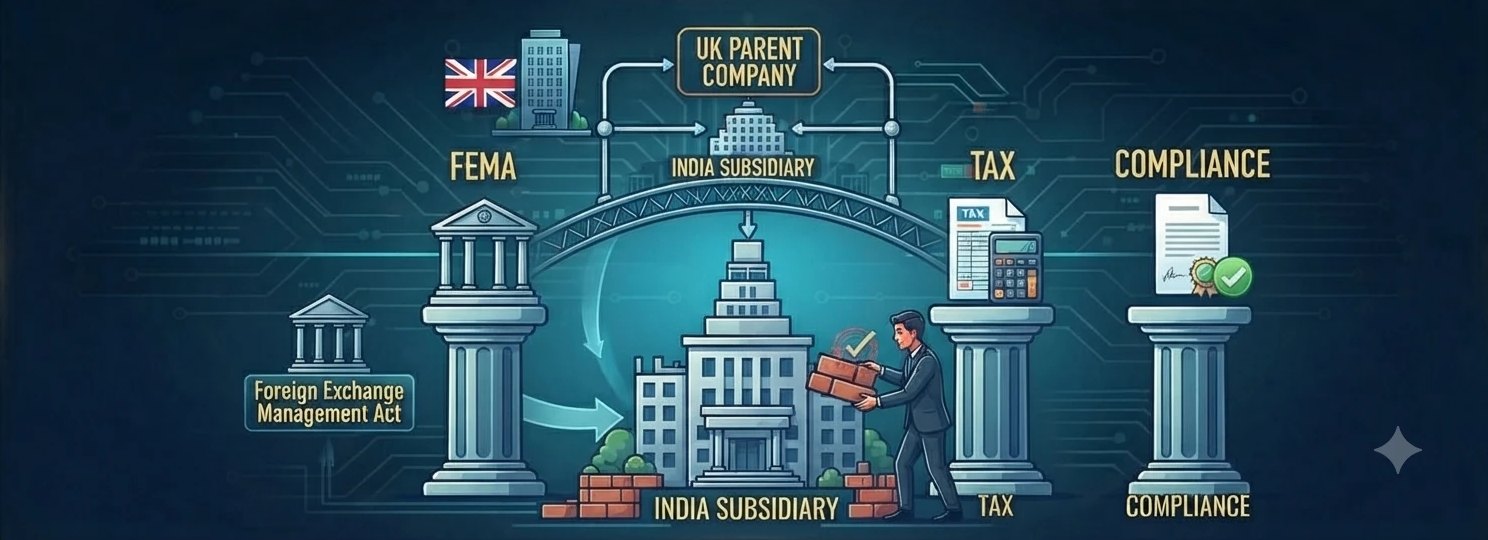
The first decision is how to be present in India. Options include selling from the UK without a local presence, appointing a distributor or agent, opening a liaison or branch office (which needs RBI approval and suits limited purposes), or incorporating a subsidiary, usually a private limited company. For most UK companies planning a long-term operating presence, a wholly owned subsidiary is the standard choice; see our guide to setting up a company in India from the UK.
Investment into an Indian company is foreign direct investment, governed by the Foreign Exchange Management Act, 1999. Most sectors allow 100% foreign investment under the automatic route, without prior government approval, but some sectors have caps or conditions. Shares must be issued at or above fair value, and the investment reported to the RBI on Form FC-GPR within 30 days of allotment.
Tax structuring also matters. The India-UK double taxation agreement governs how business profits, dividends, royalties and fees for technical services are taxed, and whether a UK company’s activities in India create a permanent establishment. Plan this before you start trading.
Checklist part 2: tariffs, origin and contracts
If you’re exporting goods, the trade deal’s tariff benefits aren’t automatic. Businesses must claim CETA preferential tariffs, which means satisfying the rules of origin and providing the right documentation. India has issued domestic instruments, including the CETA origin rules and tariff notifications, to give effect to the agreement. Map your supply chain against the origin rules before assuming a product qualifies.
Competition and consumer law in India also apply to distribution and pricing arrangements, so exclusive territories, resale price controls and online sales restrictions should be reviewed before signing. Contracts with Indian distributors, customers and suppliers should be drafted with Indian law in mind. Choose governing law and dispute resolution carefully. India enforces foreign arbitral awards from New York Convention countries, and the United Kingdom is also a “reciprocating territory” under Section 44A of India’s Code of Civil Procedure, which allows certain UK superior court judgments to be executed in India. That’s a significant advantage over some other jurisdictions.
Government procurement access is a new opportunity under the UK-India trade deal, particularly for UK firms in infrastructure, green energy and transport, but public procurement in India has its own eligibility, documentation and local-content rules, so tender documents need careful review. Watch for Indian-specific contract issues: stamp duty on agreements, restrictions on post-termination non-competes under Section 27 of the Indian Contract Act, GST on cross-border services, and withholding tax on payments to and from India.
Checklist part 3: IP, data and people
Register your intellectual property in India before you launch. UK trade mark registrations don’t protect you in India, and opportunistic filings by local parties are a well-known risk; see our guides to registering a US trademark in India (the Madrid and direct routes work the same way for UK owners) and trademark squatting in India. File through the Madrid Protocol or directly with the Indian Trade Marks Registry. Patents and designs need separate protection too.
Data is the next item. If your Indian operation processes personal data of people in India, India’s Digital Personal Data Protection Act, 2023 applies, with most obligations from 13 May 2027; see our guide to India’s DPDP Act for UK businesses. Transfers of UK personal data to your Indian entity also need a UK GDPR transfer mechanism, such as the IDTA, and a transfer risk assessment; see our guide to UK GDPR transfers to India.
On people, India’s four labour codes have applied since 21 November 2025, so Indian employment contracts and salary structures must comply with them; see our guide to the new labour codes for startups. Under the Double Contributions Convention, temporary workers sent between the two countries can be exempt from paying social security in the host country for a limited period. UK companies seconding staff to India should check how the DCC applies to them, including the period and conditions, with a payroll adviser. For developer teams, see our guide to hiring developers in India from the UK.
| Area | Check |
|---|---|
| Structure | Sell from the UK, distributor, liaison or branch office, or wholly owned subsidiary |
| Foreign investment | FEMA automatic route and sector caps; FC-GPR within 30 days; fair value pricing |
| Tax | India-UK double taxation agreement; permanent establishment; transfer pricing; GST and withholding |
| Tariffs | Claim CETA preferences with proof of origin; map supply chain to the rules |
| Contracts and disputes | Indian law and stamp duty; arbitration seat; Section 44A for UK judgments |
| IP and data | Register marks in India early; DPDP Act from 13 May 2027; UK GDPR transfer mechanism |
| People | Labour codes; Double Contributions Convention for secondments |
Disputes, remedies and quick answers
If things go wrong, your remedies depend on how you structured your entry. Commercial disputes are usually resolved through arbitration or the courts chosen in your contract, and both foreign arbitral awards and, in many cases, UK court judgments can be enforced in India. Confirm that the UK remains on India’s list of reciprocating territories under Section 44A when you draft. IP infringement can be pursued in the Indian courts, which can grant urgent injunctions. Investment-related disputes with the Indian state raise separate questions.
The best protection is preparation: a clear structure, compliant contracts, registered IP and documented origin compliance. The UK-India trade deal creates real opportunity, and UK companies that get the legal basics right early will be best placed to use it. If your business has an Indian counterparty, see also our guide to legal due diligence on Indian startups, written for US investors but useful for any foreign investor.
Quick answers
When did the UK-India trade deal come into force?
The CETA and the Double Contributions Convention entered into force on 15 July 2026.
Do UK exporters automatically get lower tariffs in India?
No. Preferential tariffs must be claimed, which requires meeting the rules of origin and providing the correct documentation.
Can UK court judgments be enforced in India?
In many cases, yes. The UK is a reciprocating territory under Section 44A of India’s Code of Civil Procedure, and foreign arbitral awards are also enforceable.
Related reading: protecting a UK trade mark in India, trade mark squatting in India, counterfeit goods and UK brands, selling SaaS to Indian customers from the UK, due diligence for UK investors in Indian start-ups and UK-based NRIs and Indian property; also seconding UK staff to India, UK law firms practising in India, opening a UK university campus in India, enforcing a UK judgment or award in India, selling a UK business to an Indian buyer and India’s Online Gaming Act for UK gaming companies.
Final word
Halverton & Co. is an Indian law firm that advises on Indian law, including India market entry, FEMA compliance, contracts, IP registration and employment structuring. We practise in Jharkhand, Maharashtra and before the Supreme Court of India, and we work alongside your UK solicitors, who advise on English law. Halverton & Co.: Where tech needs law! If you have a question about Indian law, write to us at office@halvertonandco.com, or get in touch.
This article reflects developments reported up to early October 2026. It is for general information only, is not legal advice, and does not create a solicitor-client relationship. Halverton & Co. is an Indian law firm, is not authorised or regulated by the Solicitors Regulation Authority, and does not advise on English law.
Related practice area
Startups & Venture
From incorporation to term sheet. The documents a company needs to be fundable.
View the practice area