India has one of the largest gaming audiences in the world, and UK gaming companies, from betting and gaming operators to studios, esports organisers and fantasy platforms, have long looked at it as a growth market. In August 2025, the rules changed dramatically.
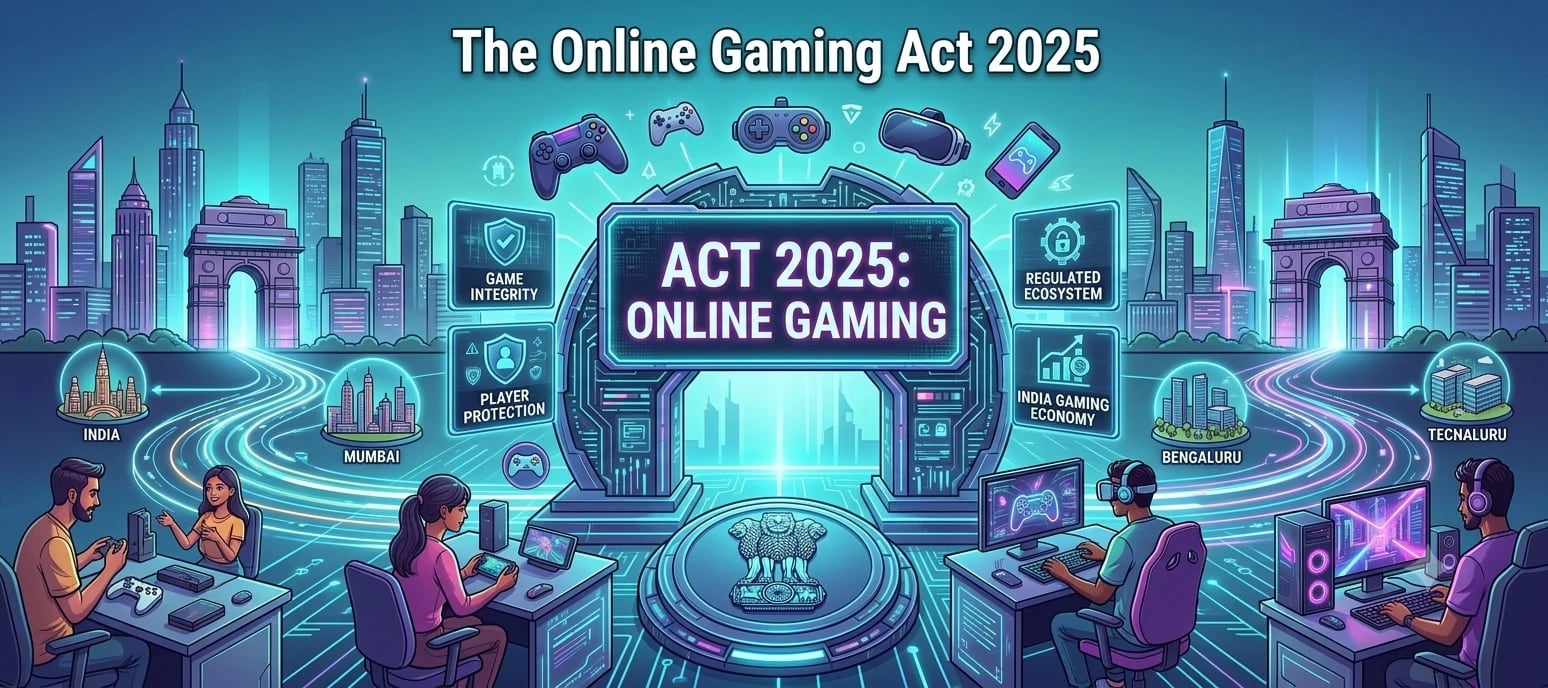
India’s Promotion and Regulation of Online Gaming Act, 2025 bans online money games outright while promoting esports and social games. This guide explains what the Online Gaming Act means for UK gaming companies: what’s banned, what’s still allowed, the advertising and payment restrictions, enforcement against offshore operators, and the constitutional challenge before India’s Supreme Court. UK gambling-licence and regulatory points should be checked with UK advisers. For the Indian-startup view, see our guide to the Online Gaming Act 2025.
What the Online Gaming Act does
The Promotion and Regulation of Online Gaming Bill, 2025 was introduced in Parliament on 20 August 2025, passed by both Houses within two days and received Presidential assent on 22 August 2025. The implementing Rules were notified on 22 April 2026, and the Act and Rules came into force on 1 May 2026.
The Online Gaming Act has two halves. It promotes esports and online social games as legitimate sectors, and it prohibits online money games and everything connected with them. The Rules set up a regulator, the Online Gaming Authority of India, and classify games into online money games, esports and online social games.
Crucially for UK operators, the ban doesn’t distinguish between games of skill and games of chance. Indian law had long treated skill games, such as rummy and fantasy sports, differently from gambling. The Online Gaming Act sets that distinction aside for online games played for money.
What’s banned and what’s still allowed
The Act bans offering, operating or facilitating an online money game, meaning a game in which a user deposits money or stakes in the expectation of winning money or other stakes. It also bans advertising and promoting online money games and prohibits banks, payment systems and financial institutions from processing transactions for them. The main offences carry criminal penalties, including imprisonment and substantial fines, and company officers can be held liable. Confirm penalty amounts against the Gazette text before quoting them.
What remains allowed, and promoted, is esports, played as organised competitive events, and online social games played for entertainment or skill development without stakes or winnings in money. Games monetised through advertising, subscriptions or cosmetic purchases, without a money-for-winnings loop, are generally outside the ban, though each structure needs checking.
Fantasy sports deserve a specific mention, because they were India’s biggest real-money gaming segment. Paid fantasy contests with cash prizes now fall within the ban on online money games, so UK companies with fantasy products should treat India as closed for paid contests. For UK gaming companies, the grey zone deserves the most attention: paid entry tournaments with prize pools funded by players, tokens or in-game currencies that can be converted to cash, and loyalty schemes that pay out money. These are the features most likely to bring a game within the definition of an online money game. The Online Gaming Authority can determine how a game is classified, and seeking that clarity is safer than assuming.
| Category | Position |
|---|---|
| Online money games (skill or chance), including paid fantasy contests with cash prizes | Banned |
| Advertising and promotion of online money games | Banned; marketing partners are exposed too |
| Payment processing for online money games | Banks and payment systems prohibited from processing |
| Esports and online social games without stakes or money winnings | Allowed and promoted |
| Paid-entry tournaments, cash-convertible tokens or currencies, cash-paying loyalty schemes | Grey area; likely to bring a game within the ban; seek classification |
Enforcement against offshore and UK operators
The Online Gaming Act applies to games offered to users in India, wherever the operator is based. A UK-licensed operator that accepts Indian players for real-money games is exposed under the Act, even if its servers, licences and company are in the UK or another jurisdiction. Enforcement has gone beyond prosecutions: banks withdrew payment services within days of the Act’s publication, and enforcement agencies have acted against operators.
India also uses blocking powers under Section 69A of the Information Technology Act, 2000 to restrict access to offshore betting and gaming websites and apps; see our guide to the Sahyog portal and content takedowns. Payment restrictions, combined with blocking and action against advertisers and influencers, make it very difficult for an offshore real-money operator to serve Indian users lawfully.
UK operators should also consider their UK regulatory position. Serving markets where a product is unlawful can raise questions with regulators and payment partners at home, so a documented India exclusion policy is sensible risk management. For UK companies, the practical consequence is clear: if you offer real-money games, geoblock India, block Indian payment methods, exclude Indian users in your terms, and make sure affiliates, influencers and marketing partners don’t target India. Advertising is itself an offence, so marketing partners are exposed too.
Opportunities for UK studios and esports businesses
The Online Gaming Act isn’t only a restriction. By promoting esports and social games, it creates opportunities for UK studios, publishers, tournament organisers and technology providers that don’t depend on stakes. India’s vast player base remains open to free-to-play, subscription and advertising-funded games, and to esports competitions funded by sponsors and organisers.
UK companies entering India in these segments should build compliance into product design: write a classification memo for each game explaining why it isn’t an online money game, keep payments separate from gameplay rewards, avoid cash-convertible currencies, and fund prize pools from sponsors rather than players’ entry fees. Contracts with Indian partners should address compliance with the Act and the Rules.
Partnerships with Indian esports organisers, streaming platforms and brands can be a practical way in, provided contracts set out who is responsible for compliance with the Online Gaming Act. Other Indian laws also apply: the Digital Personal Data Protection Act, 2023, which treats players under 18 as children requiring verifiable parental consent (see our guide to children’s data under the DPDP Act), consumer protection rules including the guidelines on dark patterns, the IT Rules on user content, and intellectual property protection for game brands and characters; see our guide to protecting a UK trade mark in India. If you will sell subscriptions to Indian users, see our guide to selling SaaS to Indian customers from the UK, and for the entity question, setting up a company in India from the UK.
The Supreme Court challenge, remedies and quick answers
The Online Gaming Act has been challenged. Operators filed petitions in several High Courts, and in September 2025 the Supreme Court transferred these challenges to itself. As of August 2026, the Court was moving towards final hearings; check the latest Supreme Court order before relying on this. The key questions are whether Parliament had power to legislate on what is traditionally a state subject (betting and gambling), and whether a blanket ban on skill-based games is a reasonable restriction on the right to carry on business.
Until the Court decides, the Act applies in full. UK gaming companies should treat India as closed to real-money gaming, open for esports and social games, and seek a classification decision from the Online Gaming Authority before launching anything with a payment element.
Quick answers
Can UK operators offer real-money games to Indian players?
No. The Online Gaming Act bans online money games, whether of skill or chance, from 1 May 2026, regardless of where the operator is based.
Are esports and social games allowed in India?
Yes. The Act promotes esports and online social games, provided they don’t involve stakes or money winnings.
Has the Online Gaming Act been challenged?
Yes. The Supreme Court took over the challenges in September 2025 and was moving towards final hearings as of August 2026.
Final word
Halverton & Co. is an Indian law firm that advises on Indian law, including online gaming regulation, esports and social gaming compliance, and market entry for UK gaming companies. We practise in Jharkhand, Maharashtra and before the Supreme Court of India, and we work alongside your UK solicitors, who advise on English law. Halverton & Co.: Where tech needs law! If you have a question about Indian law, write to us at office@halvertonandco.com, or get in touch.
This article reflects developments reported up to early October 2026. It is for general information only, is not legal advice, and does not create a solicitor-client relationship. Halverton & Co. is an Indian law firm, is not authorised or regulated by the Solicitors Regulation Authority, and does not advise on English law or UK tax.
Related practice area
Technology & AI Law
Contracts, data protection and AI policies for products that handle other people’s data.
View the practice areaComments
No account needed. Comments are reviewed before they appear, so yours will show here once approved. Please do not share confidential details or describe your own legal matter: replies are general discussion, not legal advice, and do not create an advocate-client relationship. For your own situation, write to office@halvertonandco.com.