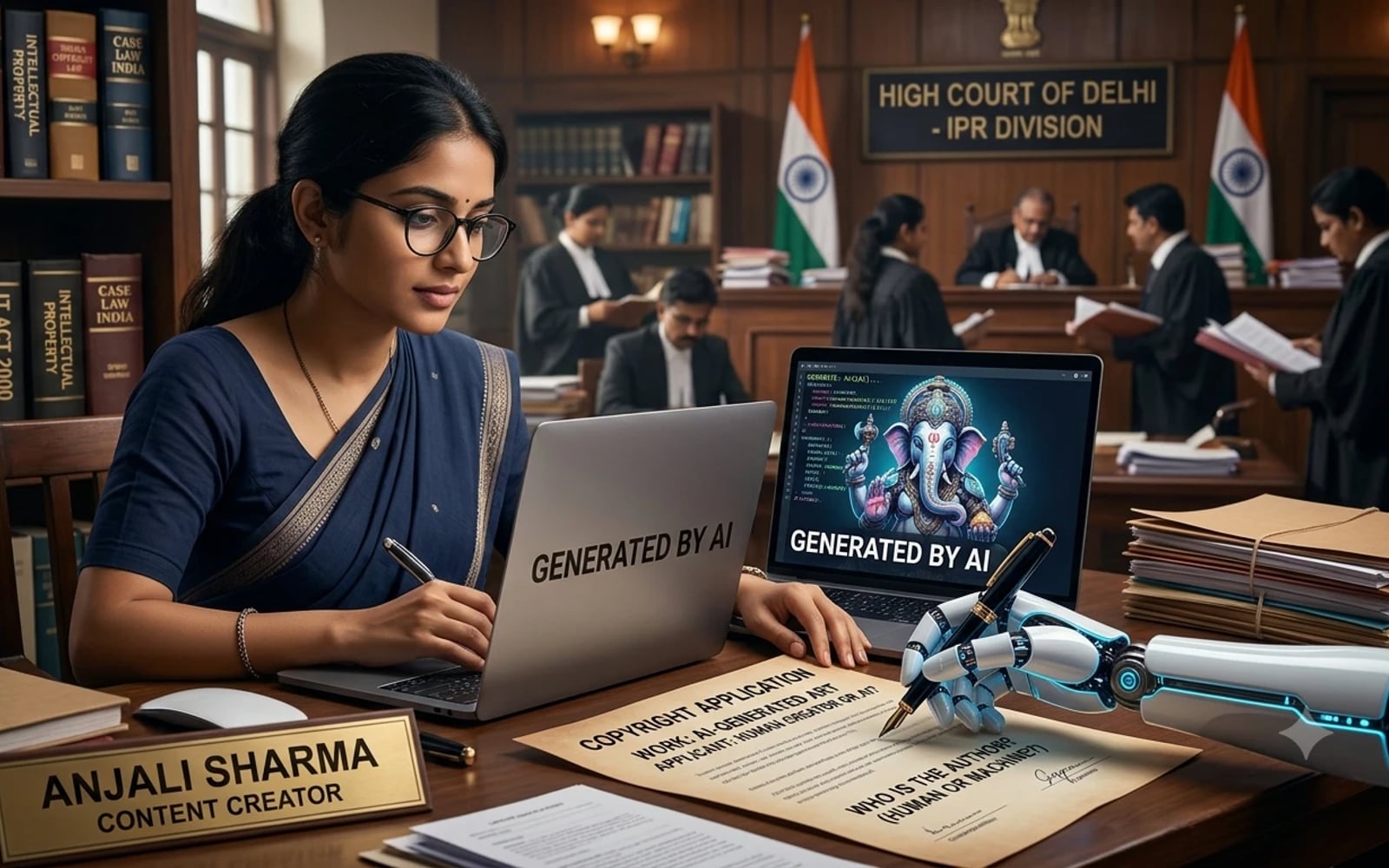

Every large language model is built on text that someone else wrote. News reports, books, blogs, court judgments: billions of words scraped from the open web and fed into a machine. For a long time, nobody in India could say for certain whether that was legal. Then, on 24 July 2026, the Delhi High Court gave us the first real answer.
In ANI v. OpenAI, the court refused to stop OpenAI from using ANI’s news content, and said that training AI on copyrighted data is, at least at first sight, fair dealing under the Copyright Act, 1957. It is a big moment for AI copyright in India. But it’s an interim order, ANI has already appealed, and the final word is still some way off.
We’ve read the coverage of the order closely and followed the appeal. Here is what the ANI v. OpenAI case actually decided, why the fair dealing question is far from settled, and what Indian publishers and AI developers should be doing right now. (For the wider question of who owns what AI produces, see our guide on who owns AI-generated content in India.)
The ANI v. OpenAI case so far: what ANI claimed and how the dispute unfolded
In November 2024, ANI Media, one of India’s biggest news agencies, sued OpenAI in the Delhi High Court. It was the first copyright lawsuit against ChatGPT in India, and it quickly became the test case for AI copyright in India.
ANI’s complaint had two parts, and it helps to keep them separate. The first was an input claim: OpenAI had copied and stored ANI’s news reports to train the models behind ChatGPT, without a licence. The second was an output claim: ChatGPT reproduced ANI’s content in its answers, sometimes close to verbatim, and sometimes attributed to ANI statements and news that the agency had never published (LiveLaw). ANI asked for a permanent injunction and damages, and in the meantime an interim injunction to stop OpenAI from storing, reproducing or using its works.
OpenAI pushed back on several fronts. It said Indian courts had no jurisdiction because its servers and training happen outside India. It also argued that news is largely factual and that facts are not protected by copyright. Other publishers, including the Digital News Publishers Association, joined the case on ANI’s side (Bar & Bench).
After more than eighteen months of hearings, Justice Amit Bansal dismissed ANI’s interim injunction application on 24 July 2026. ANI appealed to a Division Bench. On 15 September 2026, the bench issued notice to OpenAI, declined to give ANI immediate relief, and listed the appeal for 8 December 2026 (LiveLaw). The main suit continues alongside.
What the Delhi High Court decided on 24 July 2026
The July order is long and detailed. Broken down, it makes four findings that every publisher and AI developer in India should understand.
Indian courts can hear claims against foreign AI companies
OpenAI lost on jurisdiction. The court held it could hear the case because ANI’s principal place of business is in Delhi and OpenAI offers its services to users in India (Legal500). Keeping servers abroad does not put an AI company beyond the reach of Indian copyright law. This part of the ruling is good news for Indian rights holders.
Publicly available content is still protected by copyright
The court rejected the idea that publishing something openly on the web gives up copyright in it (Cyril Amarchand Mangaldas). Your articles being free to read does not make them free to copy.
AI training was treated as fair dealing, for now
This is the headline. Prima facie, the court held that OpenAI’s scraping and storage of ANI’s works to train its models falls within the fair dealing exception in Section 52(1)(a) of the Copyright Act, 1957, and that both the purpose test and the fairness test were met (Cyril Amarchand Mangaldas).
The outputs did not copy ANI
On the output claim, the court found ChatGPT’s answers were not substantially similar to ANI’s reports and saw no prima facie evidence that the model had memorised ANI’s articles. It thought the answers ANI obtained through adversarial prompts were probably produced by ChatGPT’s retrieval-augmented generation (RAG), which looks things up live, rather than from training data (Legal500). ANI had not pleaded a case based on RAG at all, which is a lesson in itself (Mondaq).
Harm and balance of convenience
The court then looked at harm and balance of convenience, and this part matters a great deal for future cases. ANI showed no loss of subscribers or advertising revenue. Its own offer to license its content to OpenAI for USD 7.5 million suggested that any loss could be compensated with money (Cyril Amarchand Mangaldas). ANI had also not used the opt-out tools that block web crawlers, and the court felt an injunction would hurt AI development and the wider public interest (Legal500).
One caution before anyone celebrates or panics. As is usual in India, the court made clear that its findings are only prima facie and will not decide the main suit, which still has to go through a full trial.
Is training AI on copyrighted data fair dealing? Section 52 under the microscope
To see why this question is still open, you need to know how fair dealing works in India, because it is not the same as American “fair use”.
The US has an open-ended fair use test with four factors, which judges can apply to almost any new technology. India’s Section 52 works differently. It is a list of specific permitted uses. Section 52(1)(a) covers fair dealing for private or personal use including research, for criticism or review, and for reporting current events. If a use doesn’t fit one of those purposes, the fair dealing defence generally fails. Within a permitted purpose, Indian courts ask whether the dealing was fair, looking at things like how much was taken, why, and whether it competes with the original. That is the exercise Justice Bansal carried out at the interim stage.
The case for treating AI training as fair dealing
OpenAI’s side of the argument goes roughly like this. A model doesn’t read an article to republish it; it learns statistical patterns of language from millions of texts. The copies made during training are intermediate and are not shown to anyone. Nothing in the evidence showed ChatGPT substituting for an ANI subscription. And blocking AI training through injunctions would slow down a technology with obvious public benefits. The interim order accepted much of this, at least for now.
The case against
ANI’s appeal attacks exactly these points. It argues that public access to news does not give anyone the right to scrape, store and commercially exploit it, and that stretching fair dealing to cover a commercial AI business under the label of research goes far beyond what Section 52 was meant to do (Adgully). ANI has also pointed out that OpenAI itself pays to license news content from publishers such as the Financial Times (Bar & Bench). That point has real force. If a licensing market for training data exists, taking the content for free arguably harms that market, which weighs against fairness.
Our view
In our reading, the fair dealing question in AI copyright is far from closed. The weakest link in the interim reasoning is the “research” or “personal use” label for a product that earns billions. The licensing market argument will be hard to ignore at trial. We also expect courts to keep training and outputs separate. Training may get more room, while outputs that reproduce or closely paraphrase protected content, including RAG outputs, will face much closer scrutiny.
Policy is moving in parallel
India has no specific text-and-data-mining exception, unlike the EU, which allows mining unless the rights holder opts out in machine-readable form. The Delhi court’s emphasis on ANI’s failure to use opt-out tools echoes that European approach. For how the EU’s AI rules reach Indian companies, see our guide to whether the EU AI Act applies to your Indian SaaS company. Meanwhile, the DPIIT committee’s December 2025 working paper proposes a hybrid model in which AI developers pay royalties once they commercialise their tools (Storyboard18). If that becomes law, the fair dealing debate could matter much less than a statutory licence.
What the ruling means for Indian publishers: rights and legal remedies
If you run a news site, a digital magazine, an edtech platform or a blog with valuable content, the ANI v. OpenAI order is a wake-up call. It isn’t a reason to give up. Read closely, it tells publishers exactly where ANI’s case was weak, and that is a roadmap for protecting your copyrighted content from AI scraping.
Opt out, in writing and in code
The court counted it against ANI that it had not used tools to block crawlers. Update your robots.txt to block the AI crawlers you don’t want, and put a clear clause in your website terms of use that prohibits scraping, text-and-data mining and AI training without a licence. Neither may be a complete legal shield in India yet, but both take away the argument that you consented or didn’t care.
Collect evidence of harm from day one
ANI’s interim case faltered partly because it could not show lost subscribers or revenue. Track subscriptions, traffic and licensing income, and record any drop that follows AI products answering questions with your content. Save AI outputs that copy or closely paraphrase your work, with the prompt, date and time, and preserve them in a form you can prove in court.
Plead both input and output claims, including RAG
One reported gap in ANI’s case was that it did not plead infringement through retrieval-augmented generation (Mondaq). A future plaint should deal with training, storage, live retrieval and outputs separately, each with its own evidence.
Know the remedies available under Indian law
Even after this order, the Copyright Act, 1957 gives publishers real tools:
- Civil suit (Section 55): an injunction, damages and an account of profits for copyright infringement. Under Section 62, you can file where you carry on business, and the jurisdiction ruling in ANI v. OpenAI confirms that foreign AI companies serving Indian users can be sued here.
- Commercial Courts Act, 2015: pre-institution mediation under Section 12A applies unless you seek urgent interim relief.
- Criminal remedy (Section 63): knowing infringement is punishable with imprisonment of six months to three years and a fine of ₹50,000 to ₹2,00,000.
- Paywall protection (Section 65A): circumventing an effective technological protection measure with the intention of infringing copyright is punishable with up to two years’ imprisonment and a fine. If a scraper breaks through your paywall, this provision may apply.
- Moral rights (Section 57) and your brand: where an AI tool attributes fabricated news to your publication, as ANI alleged, you can explore claims under moral rights, defamation and passing off, alongside copyright.
- Contract claims: breach of your website terms of use or of an existing content licence.
Consider licensing as a remedy too
Litigation is slow. Licensing deals are a commercial way to get paid for AI training data, and the market is growing. Get advice before signing one, so you keep control over scope, attribution, term and price.
What it means for AI developers and startups: a practical checklist
For Indian AI startups building on open models, fine-tuning on scraped data or offering RAG-based products, the July order is helpful but fragile. It is an interim ruling under appeal, and the next bench or the trial court could see things very differently. Treat it as breathing room, not a licence. Here’s the checklist we would give an AI developer today.
- Know where your training data comes from. Keep a record of sources, dates and the licence terms attached. If your data provenance is unclear, your fair dealing defence is weak.
- Respect opt-outs and paywalls. Honour robots.txt and terms that prohibit AI training. Never break through a paywall or other technical protection, which can attract criminal liability under Section 65A of the Copyright Act, 1957.
- Stay away from pirated datasets. A fair dealing argument is much harder to make when the material itself was obtained unlawfully.
- License where it matters. For high-value content such as news, textbooks or databases, a licence is often cheaper than litigation and gives you a cleaner product to sell.
- Control your outputs, especially RAG. Use filters against verbatim reproduction, keep quotations short, link to the source, and give rights holders a working complaint and takedown channel.
- Guard against false attribution. An AI that invents quotes and credits them to a real publisher invites claims well beyond copyright, including defamation and passing off.
- Check personal data too. If your training data contains personal data, the Digital Personal Data Protection Act, 2023 may also apply.
- Get your contracts right. Customer terms, indemnities and data licences should allocate copyright infringement risk clearly.
Quick answers
Is training AI on copyrighted data legal in India?
After ANI v. OpenAI, there is a prima facie judicial view that it can be fair dealing under Section 52(1)(a). That view is interim, under appeal and not final.
Can Indian publishers still sue AI companies?
Yes. The court confirmed it has jurisdiction over foreign AI companies serving Indian users, and all the remedies under the Copyright Act, 1957 remain available, especially for outputs that copy content.
What happens next in ANI v. OpenAI?
The Division Bench hears ANI’s appeal on 8 December 2026, the main suit continues, and DPIIT’s licensing proposal is still being worked on.
Related reading: the DPIIT AI copyright working paper and labelling AI-generated content; also AI copyright in India vs the US; also computer-generated works in India and the UK.
Final word
The ANI v. OpenAI case has given India its first judicial answer on AI training and fair dealing, but it is a first answer, not the last one. Publishers should tighten their opt-outs, build their evidence and know their remedies. AI developers should treat the ruling as room to build responsibly, not as permission to take everything.
At Halverton & Co., we advise publishers, creators, AI startups and tech-driven businesses on AI copyright in India, content licensing, data compliance and copyright infringement disputes. We practise in Jharkhand, Maharashtra and before the Supreme Court of India, and we work as fractional legal counsel for technology companies. Halverton & Co.: Where tech needs law!
Write to us at office@halvertonandco.com, or get in touch, to discuss how this ruling affects your business. If you are also building a brand, our guide to trademark registration for startups is a useful companion.
This article reflects developments up to early October 2026. Sources: Cyril Amarchand Mangaldas · Legal500 · Mondaq · Bar & Bench · Storyboard18
Related practice area
Technology & AI Law
Contracts, data protection and AI policies for products that handle other people’s data.
View the practice area