A British presenter discovers a video of herself promoting a crypto scheme she has never heard of. A UK skincare brand finds its founder’s cloned voice selling counterfeit products in Instagram adverts. A British Indian influencer’s face appears in fake endorsements circulating on WhatsApp groups in Mumbai and Birmingham. These aren’t hypothetical cases. Deepfake scams using familiar faces have become one of the fastest-growing forms of online fraud.
For UK creators and brands, the uncomfortable truth is that English law offers no direct right to control your own face and voice. India, by contrast, has spent the last few years building one of the world’s most active systems for protecting personality rights against AI misuse. This guide explains the gap in UK law, how Indian courts are protecting name, face and voice in 2026, when a UK person or brand can use Indian courts, the remedies available, and a practical deepfake response plan. The UK-law paragraphs should be reviewed by a UK solicitor. For the Indian-law background, see our guide to deepfakes and personality rights in India.
The UK gap: no personality right, and a consultation still awaited
Unlike the United States, where publicity rights are recognised at state level, or Germany, which has long recognised personality rights, UK law provides no standalone statutory protection for a person’s image or identity. Victims of a deepfake in the UK must fit their case into other laws. The current laws of passing off, defamation, online safety and UK GDPR have some potential to control digital replicas, but each has limits. Passing off, used successfully in false endorsement cases such as those involving Eddie Irvine and Rihanna, offers limited protection without an established commercial reputation. (Add citations for those cases before relying on them.)
Parliament has noticed. A House of Lords committee warned that the absence in UK law of a clear personality right or specific protection for digital likeness leaves creators and performers exposed. In its March 2026 report on copyright and AI, the government said it would consult on whether “a new personality right may be appropriate”, with options ranging from a narrow “digital replica right” targeting AI-generated outputs to a broader personality right; see our guide to computer-generated works in India and the UK.
That consultation was promised for summer 2026. The government’s formal response on 15 May 2026 largely repeated its March position, and at the time of writing the digital replica consultation has not been published; check whether it has appeared since early October 2026. In the meantime, some UK personalities have turned to trade mark law. Footballer Cole Palmer’s UK registrations of his face, name, nickname and goal celebration were granted, and darts player Luke Littler has applied to register his face. The government has legislated against sexually explicit deepfakes, but those measures address only a narrow part of the deepfake problem.
How Indian courts protect name, face and voice in 2026
India has no personality rights statute either, but its courts have built one through case law, rooted in the constitutional rights to privacy and dignity and in passing off and trade mark law. And they’re using it aggressively against deepfakes. In May 2026, the Delhi High Court granted Shashi Tharoor interim relief against unknown persons circulating deepfake videos, holding that personality rights are protected under Articles 19 and 21 of the Constitution. In July 2026, the Bombay High Court ordered removal of deepfake videos and morphed images of actor Preity Zinta, and considered how platforms could handle future complaints without repeated court visits. On 1 October 2026, the same court ordered removal of deepfakes, AI voice clips and AI chatbots exploiting actor Samantha Ruth Prabhu.
These orders build on a longer line of cases. The Bombay High Court protected singer Arijit Singh against AI voice cloning in 2024, and in the Sadhguru case in 2025, the Delhi High Court granted a “dynamic+” injunction that lets the claimant have new copies of infringing content taken down without filing a fresh suit each time.
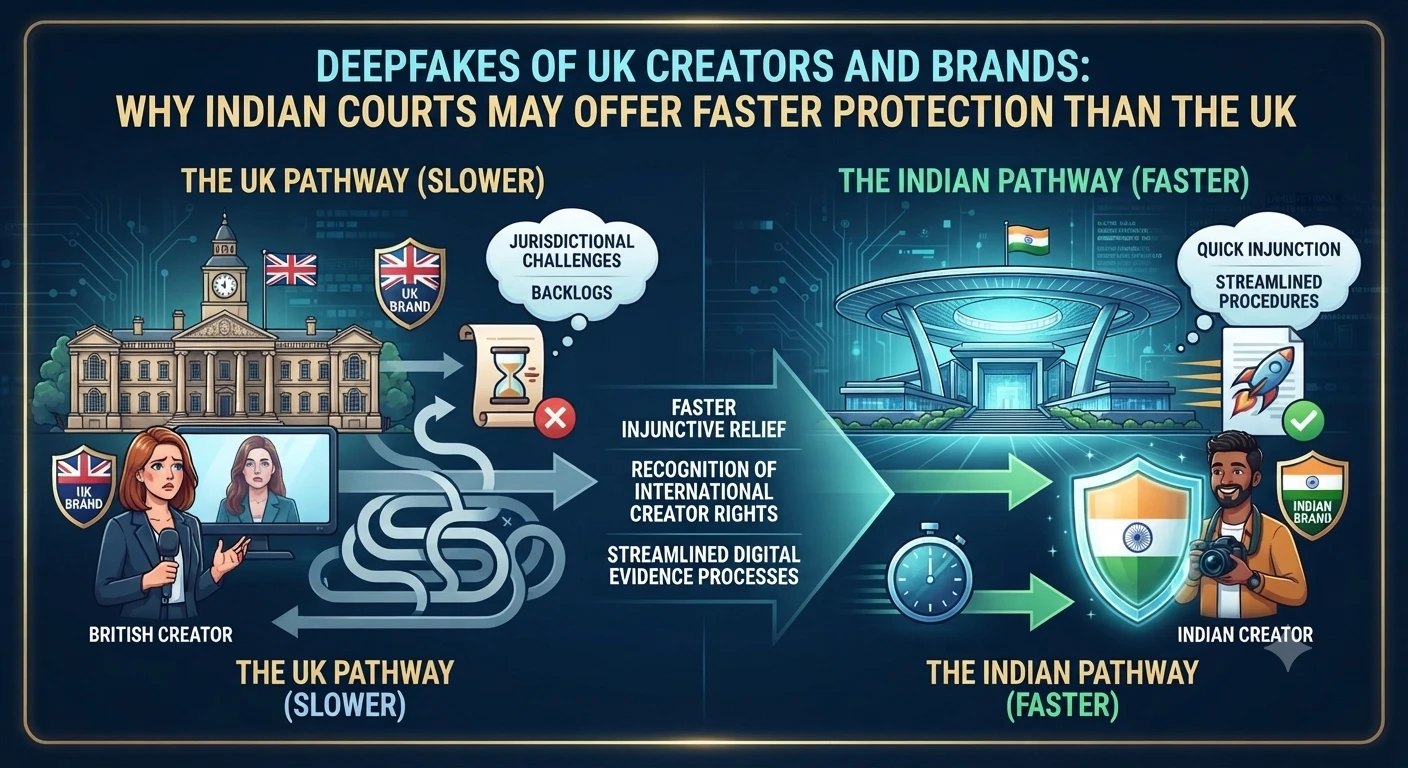
Indian courts aren’t granting everything. In August 2026, the Delhi High Court remarked that personality rights claims were acquiring “amoebic proportions”, and courts protect parody, criticism and news reporting as free speech. But for clear cases of deepfake impersonation, voice cloning and fake endorsements, Indian courts are among the fastest in the world to act.
| United Kingdom | India | |
|---|---|---|
| Personality right | No standalone right; consultation on a digital replica or personality right promised | No statute; built by courts from privacy, dignity, passing off and trade mark law |
| Main routes | Passing off, defamation, online safety, UK GDPR, trade marks | Personality rights suit, passing off, IT Rules and criminal law |
| Interim relief | Ordinary civil routes; limited protection without commercial reputation | Urgent interim injunctions, often at the first hearing in clear cases |
| Platform action | Online safety duties | Takedown within three hours of a government or court order; two hours for intimate deepfakes |
When a UK person or brand can use Indian courts
A UK creator or brand doesn’t need to be Indian to seek relief in India. What matters is whether the deepfake harm has a real connection to India. Indian courts can hear a civil suit where the cause of action arises wholly or partly within their jurisdiction. That will usually be satisfied where the deepfake content is hosted, uploaded, promoted or sold in India, where it targets Indian audiences, or where Indian platforms, sellers or payment channels are involved.
The strongest cases involve people and brands with a recognisable presence in India: British Indian influencers and creators with large Indian followings, UK actors, musicians, presenters and sportspeople known to Indian audiences, and UK brands that sell or advertise in India. Because personality rights in India rest partly on passing off principles, evidence of reputation among Indian audiences matters: follower data, Indian media coverage, sales or bookings in India, and examples of Indian users being deceived.
It’s also worth knowing that Indian courts have, in some cases, been willing to order platforms to restrict content globally rather than only in India, for example in the Delhi High Court’s 2019 decision involving Swami Ramdev and Facebook. Whether a global order is appropriate depends on the facts, but it means an Indian injunction can sometimes reach further than UK claimants expect.
Remedies in India: injunctions, takedowns, disclosure and criminal complaints
The core remedy is an urgent interim injunction, often granted at the first hearing in clear deepfake cases. Typical orders restrain named and unnamed (“John Doe”) defendants, direct platforms to remove listed links within a short period, require government agencies to block websites where necessary, and order platforms to disclose the identities of the people who uploaded the content, which is invaluable when deepfake scams are run anonymously. The same toolkit is used against fakes of goods; see our guide to counterfeit goods and UK brands in India.
India’s 2026 IT Rules add a fast regulatory track alongside court action. Amendments notified on 10 February 2026 bring “synthetically generated information” within platforms’ due diligence duties, require prominent labelling of AI-generated content, and require platforms to act on government or court takedown orders within three hours, down from 36. Complaints about non-consensual intimate imagery, including morphed or deepfake nudity, must be acted on within two hours. A UK victim can use platforms’ grievance processes in India and then escalate. See our guides to labelling AI-generated content and the Sahyog portal and content takedowns.
Where deepfakes are used in scams, such as fake endorsements, fraudulent investment schemes or cloned voices demanding money, Indian criminal law also applies. Cheating by personation using a computer resource is an offence under Section 66D of the IT Act, and identity theft under Section 66C, alongside cheating and forgery offences under the Bharatiya Nyaya Sanhita, 2023. Complaints can be lodged on India’s National Cyber Crime Reporting Portal. Criminal action is particularly useful against organised operations that keep reappearing under new names.
A deepfake response plan for UK creators, brands and agencies
Prepare before a deepfake appears. Register your name, logo and, where appropriate, distinctive personal marks as trade marks in both the UK and India, as some UK personalities are now doing; see our guides to protecting a UK trade mark in India and trade mark squatting in India. Keep evidence of your reputation in India. Write contracts with brands, agencies and platforms that prohibit AI replication of your face and voice without specific, paid consent. And set up monitoring for fake accounts, adverts and voice clips.
When a deepfake appears, act within hours: capture evidence (URLs, screenshots, upload dates and account details), report to the platforms in both countries, and decide quickly whether the content has an Indian connection that makes Indian court action worthwhile. For serious or repeated misuse, an Indian injunction with disclosure and dynamic takedown orders can stop a campaign at its source, while your UK solicitors pursue UK remedies such as passing off, defamation or data protection claims. Until the UK introduces its promised digital replica or personality right, combining UK and Indian remedies is often the fastest way to protect a face, a voice or a brand. If the deepfake involves personal data, see also our guide to India’s DPDP Act for UK businesses, and for the wider market context, our UK-India trade deal checklist.
Quick answers
Is there a personality right in UK law?
No standalone right exists. UK victims rely on passing off, defamation, data protection and online safety laws, and the government has promised a consultation on a digital replica or personality right.
Can a UK creator sue in India over a deepfake?
Yes, where the deepfake has a real connection to India, such as content uploaded, promoted or sold there, and especially where the creator has a reputation among Indian audiences.
How fast must Indian platforms remove deepfakes?
Within three hours of a government or court order under the 2026 IT Rules, and within two hours for complaints about intimate deepfakes.
Related reading: Indian scam call centres and UK victims.
Final word
Halverton & Co. is an Indian law firm that advises on Indian law, including personality rights, deepfake takedowns and urgent court action in India. We practise in Jharkhand, Maharashtra and before the Supreme Court of India, and we work alongside your UK solicitors, who advise on English law. Halverton & Co.: Where tech needs law! If you have a question about Indian law, write to us at office@halvertonandco.com, or get in touch.
This article reflects developments reported up to early October 2026. It is for general information only, is not legal advice, and does not create a solicitor-client relationship. Halverton & Co. is an Indian law firm, is not authorised or regulated by the Solicitors Regulation Authority, and does not advise on English law or UK tax.
Related practice area
Technology & AI Law
Contracts, data protection and AI policies for products that handle other people’s data.
View the practice area