Picture this. A small design studio makes a set of festival posters for a client using an AI image tool. A week later, the same posters turn up on a rival’s Instagram page with the logo swapped. The studio’s first question is simple: can we sue them? Do we even own these?
We hear some version of this almost every week now. Who owns AI-generated content in India? The honest answer is “it depends”, and that answer frustrates people. The Copyright Act, 1957 was written for typewriters and printing presses, not for ChatGPT or Midjourney. Still, the law is not silent. Read carefully, it already tells us a fair amount about AI copyright in India, and about what you can do when someone copies your work.
This piece walks through it the way we would explain it to a client across the table.
What counts as AI-generated content, and why ownership matters
Let’s get one distinction straight first, because almost everything turns on it.
When you type "a tiger in Madhubani style" into an image generator and post whatever comes out, that is AI-generated content. The machine did nearly all the creative work. When you write a blog post yourself and use AI to tighten a few paragraphs, or you generate twenty images and then pick, crop, recolour and combine them into one design, that is AI-assisted work. You did the creative heavy lifting, and AI was your tool.
It sounds like hair-splitting, but courts care about this line. It can decide whether copyright exists at all.
Why should a business owner care? Because without clear ownership you cannot license the work, sell it with confidence, or stop someone who copies it. And there is a risk running the other way too. AI tools learn from huge amounts of existing material, and sometimes their outputs sit uncomfortably close to someone else’s copyrighted work. If you publish that output, the copyright infringement claim lands on you, not on the AI.
What the Copyright Act, 1957 says about AI-generated works
You won’t find the words "artificial intelligence" anywhere in the Copyright Act, 1957. What you will find are three provisions that, read together, do most of the work.
The first is Section 13, which protects only "original" works. Originality in India has a specific meaning after the Supreme Court’s decision in Eastern Book Company v. D.B. Modak (2008). The Court said a work needs a "modicum of creativity", meaning some real skill and judgment from its maker. Hard work alone is not enough, and neither is mechanical output. That is a difficult test for content a machine produced on its own.
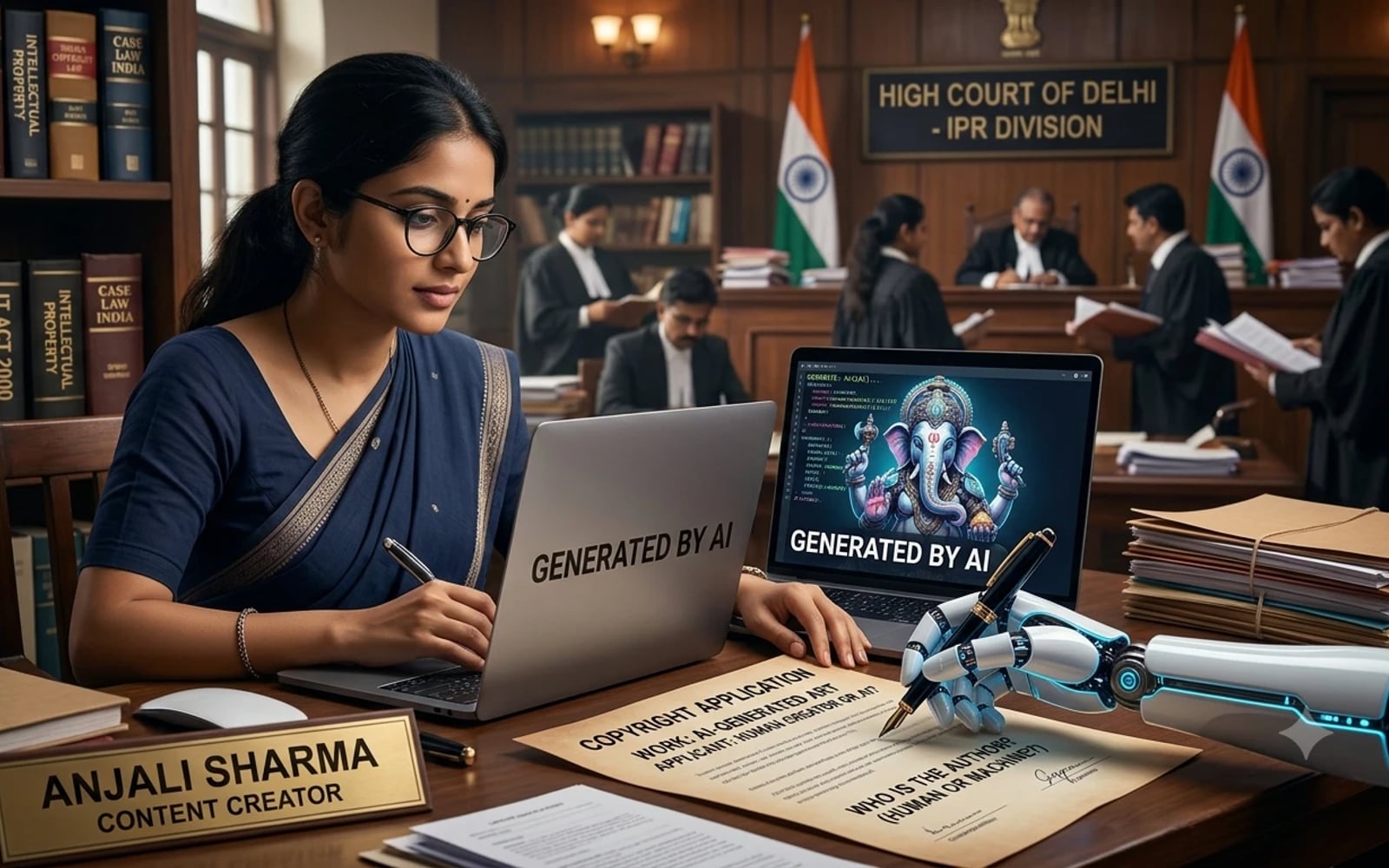
The second, and frankly the most interesting, is Section 2(d)(vi). In 1994 Parliament added a rule for computer-generated works: the author is "the person who causes the work to be created." Nobody in 1994 was imagining ChatGPT, but the wording fits surprisingly well. It points to a human being, the user, the programmer or the business behind them, and not the software. For anyone claiming copyright in AI-generated content in India, this is the strongest hook in the statute.
The third point is more basic. Indian law only recognises people and legal entities as authors and owners. An AI tool cannot hold copyright, sign an assignment or file a suit. Whatever rights exist have to sit with a human or a company.
The real fight, then, is over how much human input is enough. In our view, a one-line prompt will rarely pass the originality test on its own. But selecting, arranging, editing and reworking AI outputs looks a lot like the "skill and judgment" the Supreme Court described. That is where AI-assisted works stand on much firmer ground under Indian copyright law.
Cases and developments worth knowing
No Indian court has yet ruled squarely on who owns AI-generated works. But the signals are piling up.
SURYAST: the co-authorship experiment
In 2020, the Indian Copyright Office registered an artwork called "SURYAST" listing two co-authors: Ankit Sahni and an AI tool named RAGHAV. It made headlines worldwide. The Copyright Office later reportedly sent a withdrawal notice, which tells you how uneasy officials were with treating software as an author. Whatever its final status, the episode is still the go-to example whenever AI copyright in India comes up.
ANI v. OpenAI: the first real test
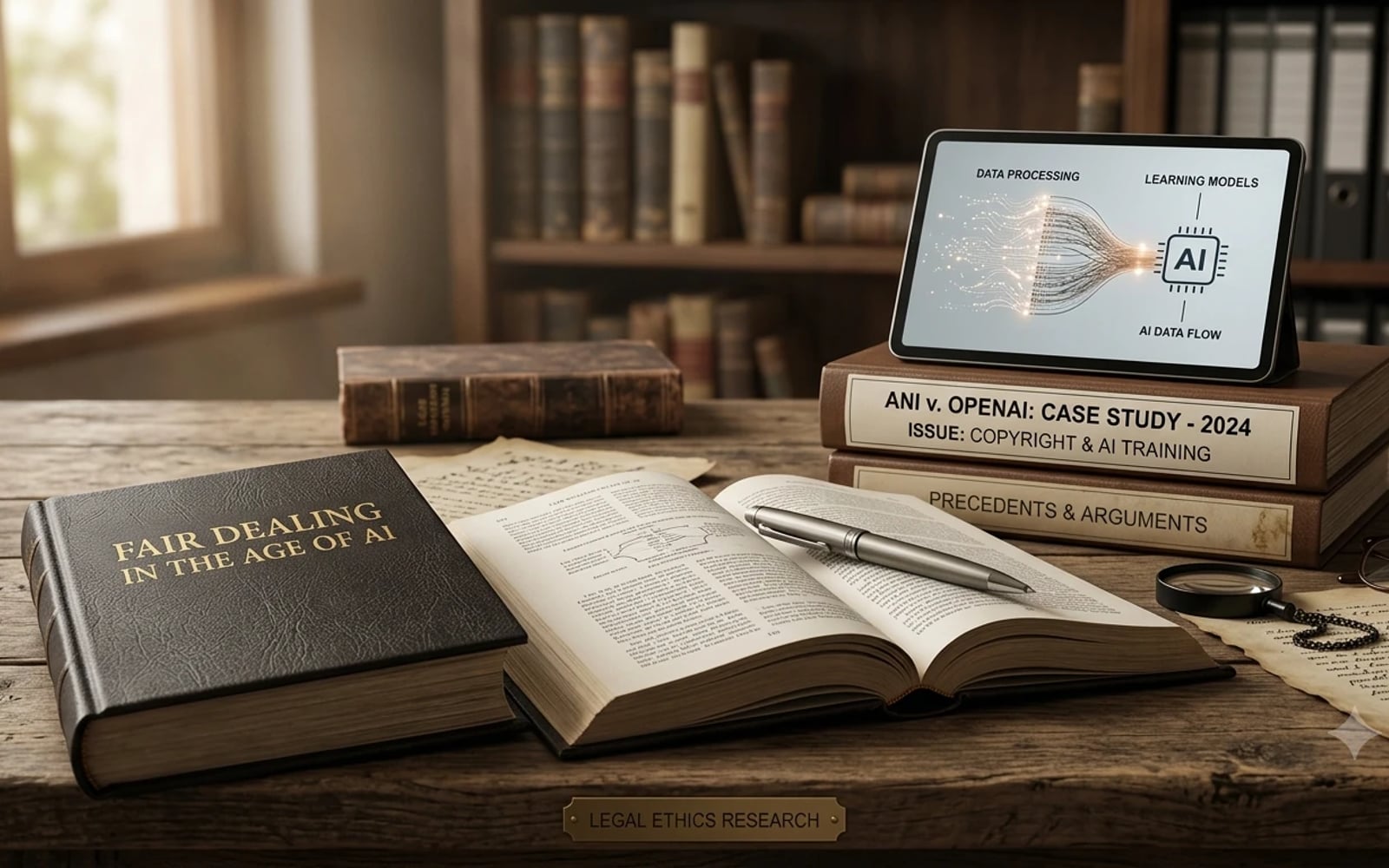
ANI Media’s suit against OpenAI, before the Delhi High Court, is the case to watch. ANI says OpenAI used its news articles without permission to train ChatGPT, and the court had to decide whether that training use counts as fair dealing under Section 52 of the Copyright Act.
On 24 July 2026, the Court handed down an interim order refusing ANI’s application to restrain OpenAI, finding "no infringement at first sight." It held, on a prima facie basis, that training an AI model on copyrighted news content was fair dealing, reasoning that the training data sat in a closed, non-public environment, that ChatGPT’s outputs were transformative rather than reproductions, and that copyright protects expression, not the underlying facts in a news report.
Two things matter for anyone reading this as precedent. First, the Court was explicit that the order "would have no bearing on the final outcome of the suit," which continues toward trial. Second, the reasoning was limited to news content, and the Court left open whether the same fair-dealing logic would extend to more expressive works such as music, film or literature. Treat this as an early, fact-specific signal, not a settled rule for training data in India. ANI has since appealed to a Division Bench, which will hear the matter next on 8 December 2026. We set out the order, the arguments on both sides and what publishers and AI developers should do in our full analysis, Is training AI on copyrighted data fair dealing? Lessons from ANI v. OpenAI.
The DPIIT committee on generative AI
The government is moving too. In April 2025, DPIIT set up an eight-member committee on generative AI and copyright. Its first working paper, released in December 2025, floats a hybrid licensing model in which AI developers pay royalties once they commercialise their tools. That paper deals with training data. A second part, expected to tackle whether AI outputs can be copyrighted at all, is the one creators should watch.
How other countries differ
Other countries are split. The United States has drawn a firm line: in Thaler v. Perlmutter, the courts confirmed that a work with no human author gets no copyright. The UK, like India, has a computer-generated works rule, Section 9(3) of its 1988 Act, giving authorship to whoever made the arrangements for the work, though it is now under review. The EU asks for the author’s "own intellectual creation" and, through the AI Act, adds labelling duties for AI-generated content. India sits somewhere between the UK and US positions, and that middle ground is worth using.
So who owns AI-generated content in India?
When a client asks us this, we usually go through the possible owners one by one.
You, the user
Section 2(d)(vi) gives you the best claim, especially if you shaped the result by choosing, editing and arranging outputs rather than accepting the first thing the tool spat out. The more of your own judgment shows in the final piece, the safer you are.
The AI company
It wrote the software, but that does not make it the owner of what you create with it. Most major AI platforms now say in their terms that output rights belong to the user. Read those terms anyway, because some free tiers and niche tools say otherwise.
Your employer
If you produced the content as part of your job, Section 17(c) generally hands the copyright to your employer, unless your contract says something different. This catches many in-house marketing and design teams by surprise.
The client who paid for it
Paying for work does not by itself transfer copyright. Under Sections 18 and 19, an assignment must be in writing and signed. We regularly see agencies and freelancers skip this step, and it causes real trouble later when ownership of AI-assisted content is disputed. Founders should also assign their own work to the company; see our guide to founders’ agreements in India. The same assignment rule decides what a buyer owns when they buy an NFT; see NFT ownership in India.
The AI itself
No. Indian law gives it no legal personality, so it cannot own anything.
The practical lesson is that ownership of AI-generated content is decided as much by your contracts and the tool’s terms of service as by the Copyright Act itself.
Legal remedies when your work is copied
Here is the good news. If your AI-assisted work clears the originality bar, you get the same protection as any other author. Indian copyright law has plenty of teeth. The same remedies also work in reverse: if someone’s AI-generated content copies your original work, you can go after them.
Start with a legal notice
In our experience, a well-drafted cease-and-desist notice resolves a large share of disputes before anyone sees a courtroom. It also builds your record if the matter escalates.
Get it taken down
Most copying today happens online. Under the IT Act, 2000 and the IT Rules, 2021, platforms must have a grievance officer who acknowledges complaints within 24 hours and resolves them within 15 days. Platforms that ignore valid complaints and court orders put their Section 79 safe-harbour protection at risk, so most of them act.
File a civil suit
Section 55 lets you ask for an injunction, damages and an account of the infringer’s profits. Courts can also grant urgent interim injunctions, Anton Piller orders (surprise search and seizure), and "John Doe" orders against infringers you cannot yet name. The Delhi High Court has gone further with dynamic injunctions that follow pirates to their mirror websites.
A practical point many people miss: under Section 62, you can sue where you live or do business. A creator in Ranchi does not have to chase an infringer to Mumbai or Delhi. Also keep in mind that copyright suits are commercial disputes, so Section 12A of the Commercial Courts Act, 2015 requires pre-institution mediation first, unless you need urgent interim relief.
Consider criminal action
Wilful copyright infringement is an offence under Section 63, punishable with imprisonment of six months to three years and a fine of ₹50,000 to ₹2,00,000. Under Section 64, a police officer of sub-inspector rank or above can seize infringing copies. We use this route selectively, usually for large-scale or commercial piracy.
Protect your moral rights
Section 57 lets an author insist on credit and object to distortion of their work. This is increasingly useful now that anyone can feed your work into an AI tool and twist it.
Use your contracts
If a freelancer, licensee or client breaks the agreement on ownership or use, you can claim damages under Section 73 of the Indian Contract Act, 1872.
Deepfakes are a separate fight
When AI is used to copy someone’s face or voice, the claim usually rests on personality and publicity rights rather than copyright. Indian High Courts, especially Delhi and Bombay, have been granting injunctions in these cases.
Don’t sit on it. The limitation period for a copyright infringement suit is generally three years, but delay can cost you an interim injunction much sooner than that.
What creators and businesses should do now
The law will take a few years to settle. You can’t wait that long, so here is what we tell clients to do today.
- Put real human work into anything you plan to own. Edit it, rearrange it, combine pieces, add your own text and design choices. That human layer is what turns AI-generated content into a protectable AI-assisted work.
- Keep your receipts. Save your prompts, drafts and version history. If ownership is ever challenged, that trail is the best evidence you have that a human did the creative work.
- Think about registering. Copyright registration under Section 45 is not compulsory, but under Section 48 the register is prima facie evidence of what it records, which helps a great deal in court. Be honest about AI use in the application. If you are also filing a trade mark for an AI-assisted brand, see our note on reading a trade mark examination report.
- Read the terms of the AI tool you use. Check who owns the output, whether commercial use is allowed, and whether the provider offers any indemnity against copyright infringement claims.
- Sort out your contracts. Employment agreements, freelancer contracts and client agreements should all say clearly who owns AI-assisted content, with a proper written assignment under Section 19.
If you run a business, add one more step
Write a short internal AI policy. List the tools your team may use, ban pasting confidential information into them, and require a human review before anything AI-generated goes public. Run a plagiarism or reverse-image check on outputs before commercial use, and keep an eye out for copies of your own work so you can act fast when you find one. For a fuller policy checklist, see our guide to AI tools at work.
Questions clients ask us
Can AI-generated content be copyrighted in India?
If the machine did all the work, probably not. If you added meaningful creative input of your own, there’s a good argument that it can be protected under the Copyright Act, 1957.
Who is the author of a computer-generated work?
Under Section 2(d)(vi), it’s the person who caused the work to be created. It is never the AI tool.
Can I sell AI-generated images or designs?
Usually yes, as long as the tool’s terms permit commercial use and the output doesn’t copy someone else’s copyright or trademark. Check both before you sell.
Is it legal to train AI on copyrighted material in India?
There is no settled answer yet. The Delhi High Court’s July 2026 interim order in ANI v. OpenAI found training on news content to be fair dealing on a prima facie basis, but called its own reasoning fact-specific, and the DPIIT working paper is addressing the same question from a policy angle.
Someone copied my AI-assisted work. What now?
Take screenshots and save links, send a legal notice, file a takedown with the platform, and talk to a lawyer about a civil suit under Section 55 or a criminal complaint under Section 63.
Related reading: the DPIIT AI copyright working paper and labelling AI-generated content under the IT Rules 2026; also AI copyright in India vs the US; also computer-generated works in India and the UK.
Final thoughts
So, who owns AI-generated content in India? For now, the answer is the person or business that put real creative effort into it and secured ownership on paper. It is not the AI, and often not the AI company either. The Copyright Act, 1957 already gives creators solid remedies, and the DPIIT process may soon add clearer rules. Until then, the creators who document their work, sign proper contracts and act quickly against copying will be the ones who come out ahead.
If you’re using AI in your creative or business work and aren’t sure where you stand, write to us about what you are building.
Sources: DPIIT working paper on generative AI and copyright · Storyboard18 on the hybrid licensing proposal · Mondaq on the ANI v. OpenAI ruling
Related practice area
Intellectual Property
Trade marks, copyright, patents and designs. Searched, filed, licensed and enforced under Indian law.
View the practice area