
Here is a story we see far too often. Two friends build an app, pick a catchy name, buy the domain, print merchandise and start getting traction. Eighteen months later, a legal notice arrives. Someone else filed for that brand name a year before they did. Now they face a rebrand, lost goodwill and a fight they never saw coming.
Most of that pain is avoidable. Trademark registration for startups is one of the cheapest and most valuable legal steps a founder can take, and in India the process is far more approachable than people think. The government even charges startups half the fee that companies pay.
At Halverton & Co., we work as legal counsel for startups and tech-driven businesses, and trademark registration in India is usually the first thing we sort out with a new founder. This guide walks you through the whole trademark registration process the way we explain it in our client meetings: from the first trademark search to the day your registration certificate arrives, and what to do if someone copies your brand.
Why trademark registration matters for startups (and the mistakes founders make)
Your brand name is often the only asset you own on day one. The code changes, the team changes, sometimes even the product changes. The name stays. Trademark registration is what turns that name into property you can defend, license, sell and show to investors.
Under the Trade Marks Act, 1999, registration gives you some real advantages:
- Exclusive rights. Section 28 gives the registered owner the exclusive right to use the trademark for the registered goods or services across India.
- A direct infringement action. You can sue for trademark infringement under Section 29 without first having to prove years of reputation, which you would need for a passing off claim.
- The ® symbol. Only a registered trademark can carry it. Using ® on an unregistered mark is an offence under Section 107, so use “TM” until your certificate arrives.
- Investor confidence. In any funding round, due diligence will ask, “Do you own your brand?” A trademark registration certificate answers that in one page.
We also see the same founder mistakes again and again:
- Assuming that registering a company with the MCA, or buying a domain, protects the brand name. It does not. A company name and a domain are not trademark registration.
- Filing in a founder’s personal name and forgetting about it. When the company raises money, the trademark has to be assigned to the company in writing under Section 45, and investors will want to see that done. Our guide to founders’ agreements in India covers how to document it.
- Choosing a purely descriptive name like “FastDelivery” or “BestCRM”. These are the names most likely to face a trademark objection, and they are the hardest to protect.
- Waiting until after launch. Indian law does protect genuine prior users (Section 34), but an early filing date puts you in a much stronger position, so file before you spend money on branding.
Before you file: trademark search and class selection
If founders skip one step, it’s usually this one. And it’s the step that decides whether your trademark application sails through or gets stuck for a year.
Run a proper trademark search
Start with the public search tool on the IP India website. Search the exact word, then phonetic variations, then spellings that sound alike. The Registry looks at deceptive similarity, and courts apply the test from Cadila Health Care v. Cadila Pharmaceuticals (2001): would an ordinary consumer with imperfect recollection be confused? “Zoomly” and “Zumly” can clash even though they are spelled differently. If you have a logo, search by its Vienna classification code as well. Then go beyond the Registry: check MCA company names, domain names, app stores and Instagram handles. A brand someone has been using without registering can still cause trouble under the prior user rule.
Pick a name that can actually be protected
Invented words such as “Kodak” are the strongest. Arbitrary words, like “Apple” for computers, come next. Suggestive names that hint at what you do are workable. Descriptive names that simply describe the product are weak and attract objections. Generic words cannot be registered at all.
Choose your trademark classes carefully
India follows the Nice Classification, with 45 classes in total: Classes 1 to 34 cover goods and Classes 35 to 45 cover services. You pay a separate fee for every class, so the goal is to cover what you do now plus what you will realistically do in the next two or three years, and nothing more.
| If your startup is… | Classes to consider |
|---|---|
| SaaS or mobile app | 9 (downloadable software, apps) and 42 (SaaS, software development) |
| E-commerce or marketplace | 35 (online retail, marketing) plus the class of the goods you sell |
| FinTech | 36 (financial services) and 9 or 42 for the platform |
| EdTech | 41 (education and training) and 9 |
| D2C clothing or beauty brand | 25 (clothing) or 3 (cosmetics), plus 35 |
| Food or cloud kitchen | 43 (restaurant services) and 30 or 29 for packaged food |
One more tip: file the word mark first. A word mark protects the name in any font or style, while a logo (device mark) protects only that design. If your budget allows, file both.
The trademark registration process in India, step by step
Once the trademark search is clean and your classes are chosen, the actual trademark registration process follows a fixed path. Here is the whole path in one picture.
Step 1: File Form TM-A
The trademark application is filed online on the IP India portal. You will need the applicant’s name and address, the brand name or logo, a description of goods and services in each class, and the date you first used the mark (or “proposed to be used” if you haven’t launched). If you claim earlier use, add a user affidavit with evidence such as invoices or screenshots. If a lawyer or trademark agent files for you, a power of attorney (Form TM-48) is needed.
The official fee is ₹4,500 per class for individuals, DPIIT-recognised startups and small enterprises, and ₹9,000 per class for other companies, when filed online. Keep your DPIIT recognition certificate or Udyam registration ready to claim the lower fee. You receive an application number the same day, and from then on you can use the “TM” symbol.
Step 2: Examination
A trademark examiner checks your application against the Trade Marks Act and the existing register, then issues an examination report. If there’s no problem, the mark is accepted. If there is, you get an objection (more on that in the next section).
Step 3: Publication in the Trade Marks Journal
An accepted mark is advertised in the Trade Marks Journal. For four months, anyone can oppose it under Section 21. This four-month window is fixed and cannot be extended.
Step 4: Registration certificate
If no one opposes, or you win the opposition, the mark is registered under Section 23 and the registration certificate is issued. Registration counts from your application date, and the mark stays valid for ten years. You can renew it every ten years indefinitely under Section 25.
How long does trademark registration take?
A clean application with no objection and no opposition can often be registered within roughly six months to a year. An objection or an opposition can stretch it to two or three years. If speed matters, for example before a funding round or a product launch, startups can request expedited examination for ₹20,000 per class online.
Trademark objections and oppositions: how to handle them
First, a word of reassurance. A trademark objection is not a rejection. A large share of trademark applications in India receive one, and most of them can be answered. What matters is how quickly and how well you respond. (For a closer look at reading an objection, see our note on what an examination report is really asking.)
Why trademark objections happen
Most objections come under one of two sections of the Trade Marks Act, 1999:
- Section 9 (absolute grounds). The mark is descriptive of the product’s kind, quality or purpose, lacks distinctiveness, is a common or generic term, could deceive the public, or uses protected emblems or names.
- Section 11 (relative grounds). The mark is identical or deceptively similar to an earlier trademark for the same or similar goods or services, so the public is likely to be confused.
How to reply to a trademark objection
You generally have one month from receiving the examination report to file your reply. Miss it, and the application can be treated as abandoned. This is the deadline we watch most closely for clients. A strong reply usually combines a few arguments. You can show the mark is distinctive when it is read as a whole. You can prove acquired distinctiveness through use, with sales figures, invoices and advertising, which the proviso to Section 9(1) allows. You can point out real differences in the goods, the market or the way the marks look and sound. Sometimes it helps to narrow the description of goods or services through Form TM-M, or to get a consent letter from the earlier owner. If the cited mark has not been used for five years or more, you can also seek its removal through rectification under Section 47.
If the examiner isn’t convinced by the written reply, you get a show cause hearing before the Registrar. If the application is refused after that, an appeal lies to the High Court under Section 91, since the IPAB was abolished in 2021.
Trademark opposition
This is a separate stage. Once your mark is published in the journal, a third party can file a notice of opposition (Form TM-O) within four months. When you receive that notice, the clock that matters is two months. You must file a counter-statement within two months under Section 21(2), or your trademark application is treated as abandoned. No extension is available. After that, both sides file evidence by affidavit, there’s a hearing, and the Registrar decides. Either side can appeal to the High Court.
The same tool works in your favour, too. If you spot a copycat brand in the Trade Marks Journal, you can oppose it before it ever gets registered. That’s why a trademark watch, a regular check of the journal for marks close to yours, is worth having once your brand starts to grow.
Protecting your brand after registration: legal remedies for trademark infringement
A trademark registration certificate is not a trophy for the wall. It’s a tool, and it matters most on the day someone copies your brand. Here is what Indian law lets you do.
Send a cease-and-desist notice
A firm, well-drafted legal notice ends a surprising number of disputes, especially with small copycats who didn’t check the register. One caution: Section 142 of the Trade Marks Act lets the other side sue you for groundless threats, so the notice should be based on real rights and sent by someone who knows the law.
File a civil suit for trademark infringement or passing off
With a registered trademark, you sue for infringement under Section 29. If your mark isn’t registered yet, you can still sue for passing off, which Section 27(2) preserves, though you’ll have to prove your reputation and goodwill. Under Section 135, the court can grant:
- an injunction, including an urgent ex parte interim injunction to stop the copying straight away;
- damages, or an account of the profits the infringer made;
- delivery up and destruction of infringing goods, labels and packaging;
- search-and-seizure (Anton Piller) orders and “John Doe” orders against unknown sellers.
Under Section 134, you can file where your business is based. A startup in Ranchi or Pune does not have to chase an infringer to another state. Trademark suits are commercial disputes, so pre-institution mediation under Section 12A of the Commercial Courts Act, 2015 applies, unless you need urgent interim relief, which is common in infringement cases. Don’t let things slide. In Midas Hygiene Industries v. Sudhir Bhatia (2004), the Supreme Court held that in clear infringement cases an injunction should normally follow, even if there was some delay. Still, acting quickly makes your case far stronger.
Take criminal action against counterfeiters
Applying a false trademark, or selling goods that carry one, is an offence under Sections 103 and 104. The punishment is imprisonment of six months to three years and a fine of ₹50,000 to ₹2,00,000. Police can search and seize under Section 115, after obtaining the Registrar’s opinion on the trademark. This route works best against counterfeit products.
Use the faster channels too
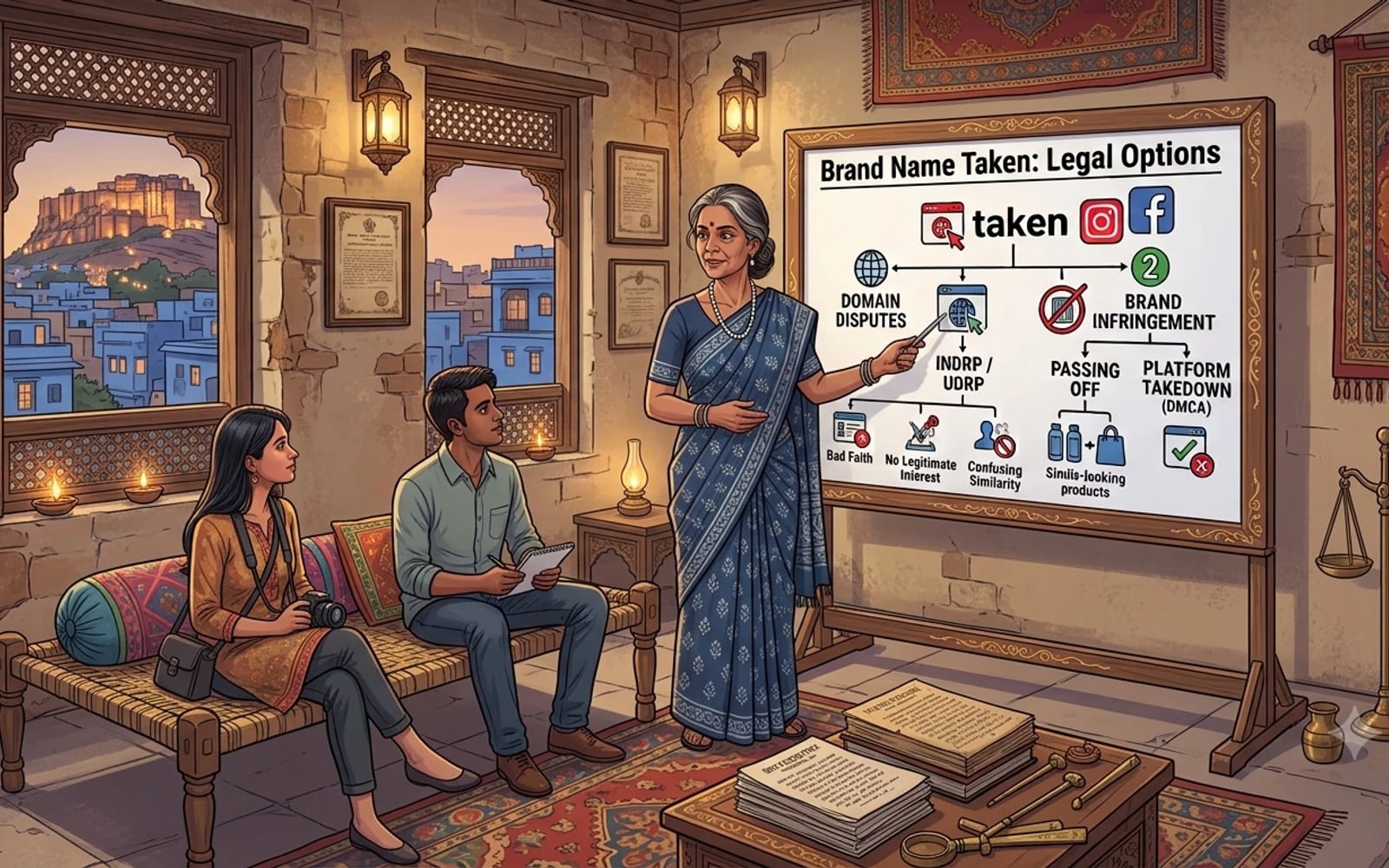
Most e-commerce marketplaces have brand protection and IP complaint systems for registered trademark owners. If someone grabs a .in domain with your brand name, the INDRP process can transfer it to you, and UDRP covers .com and other global domains. If counterfeit goods are being imported, you can record your trademark with Indian Customs under the IPR (Imported Goods) Enforcement Rules, 2007. And if a copycat has managed to register a similar mark, you can apply to cancel it through rectification under Sections 47 and 57.
Quick answers for founders
Can I use my brand before trademark registration?
Yes. Use “TM” after you file, and switch to ® only after the registration certificate is issued.
Should the trademark be in my name or the company’s?
In the company’s name, ideally. If it’s already in a founder’s name, assign it to the company in writing.
Does a startup get any discount on trademark registration?
Yes. DPIIT-recognised startups and small enterprises pay ₹4,500 per class online instead of ₹9,000.
What if I get a trademark objection?
Reply within one month, with arguments and evidence. Most objections can be overcome with a well-drafted reply.
Related reading: trademark docketing outsourcing and USPTO deadlines; also registering a US trademark in India and trademark squatting in India; also trade mark renewals and watching for UK IP firms; also protecting a UK trade mark in India.
Final word
Trademark registration for startups is not paperwork for later. It’s the cheapest form of insurance your brand will ever have. Do the trademark search, choose your classes wisely, file early, and respond to every deadline on time.
At Halverton & Co., we help founders and tech-driven businesses with trademark registration in India, from the first search and class strategy to objections, oppositions and enforcement against infringers. We practise in Jharkhand, Maharashtra and before the Supreme Court of India, and we act as fractional legal counsel for startups across the country. Halverton & Co.: Where tech needs law!
Write to us at office@halvertonandco.com to talk through your brand, or get in touch. If your product also uses AI-generated content, our guide on who owns AI-generated content in India covers the copyright side.
Fees and timelines are indicative and may change; check the latest schedule on the IP India website before filing. Sources: Trade Marks Act, 1999 on India Code · IP India e-filing portal
Related practice area
Startups & Venture
From incorporation to term sheet. The documents a company needs to be fundable.
View the practice area