Key takeaways
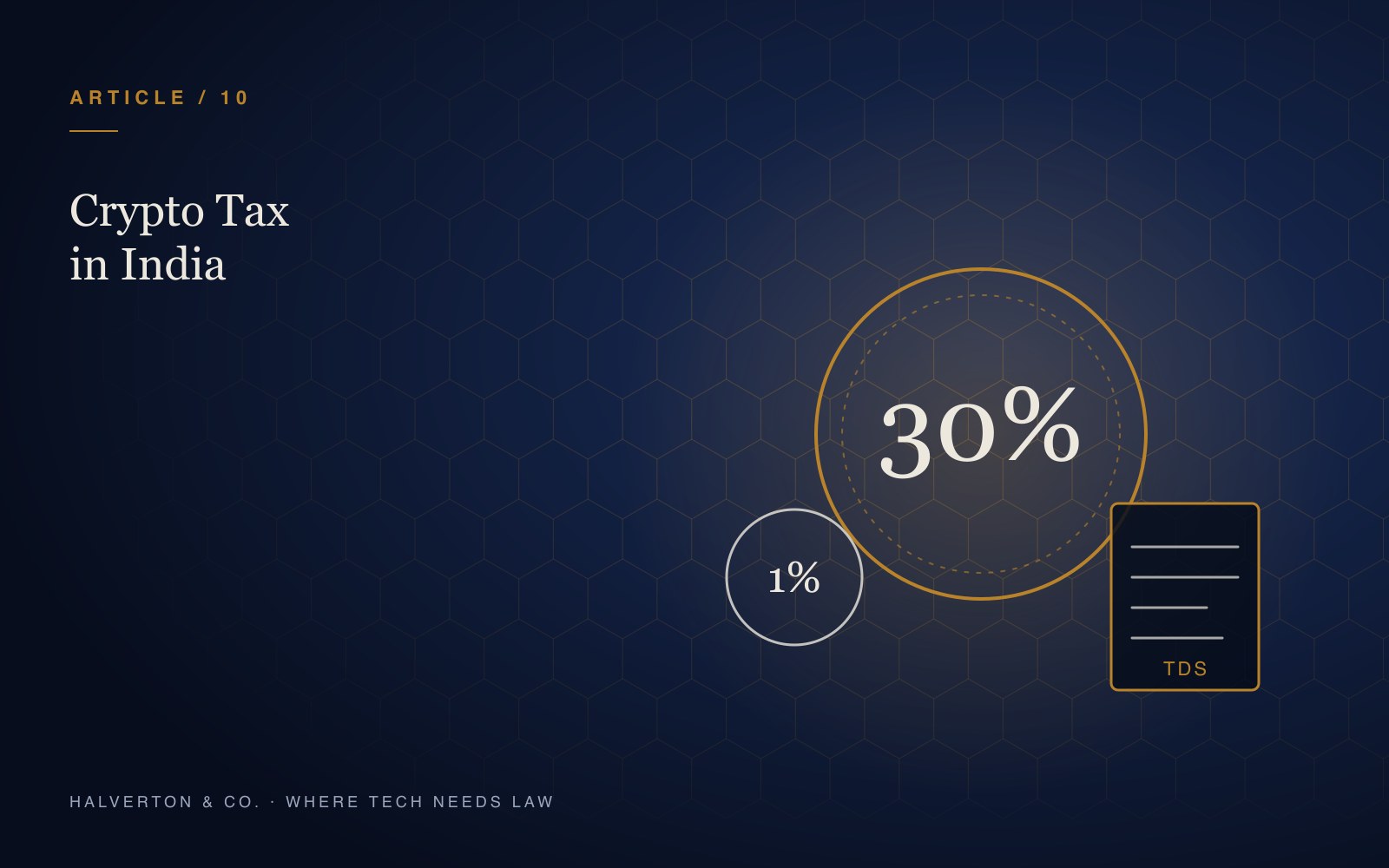
- Income from transferring virtual digital assets is taxed at a flat 30% plus 4% cess, whatever your slab or holding period.
- Crypto losses cannot be set off against any income or carried forward.
- A 1% TDS has applied to crypto transfers since 1 July 2022 and continues under the Income-tax Act, 2025.
- Exchanges now report crypto transactions under Section 509, so mismatches with your return are likely to be detected.
Every crypto investor in India eventually has the same moment. You’ve made a profit on one coin, lost more on another, and you assume the two cancel out. Then someone tells you India doesn’t work that way. The profit is taxed at 30%, and the loss is simply gone.
India has one of the world’s strictest crypto tax regimes, and from 1 April 2026 it also has a new Income-tax Act and a new exchange reporting framework. This guide explains how crypto tax in India works now: the 30% tax, the 1% TDS, what counts as a virtual digital asset, how to report crypto correctly in your return, and the remedies if you receive a tax notice.
The basics: how crypto is taxed in India
The Finance Act, 2022 introduced a separate regime for “virtual digital assets” (VDAs), a term that covers cryptocurrencies, tokens and most NFTs. The core rules are:
- A flat 30% tax on income from transferring a VDA, plus 4% cess, whatever your income slab and however long you held the asset. This was Section 115BBH of the 1961 Act (Legal Service India).
- No deductions except the cost of acquisition. Exchange fees, internet costs, advisory fees and interest on borrowed money can’t be deducted.
- No set-off of losses. A loss on one VDA can’t be set off against a gain on another VDA or against any other income, and it can’t be carried forward.
- Crypto-to-crypto trades are taxable. Swapping Bitcoin for Ethereum is a transfer of Bitcoin, so any gain is taxed.
- Gifts. VDAs received as a gift above ₹50,000 in a year can be taxed in the recipient’s hands, unless they come from a relative or fall within other exemptions.
What changed in 2026? The Income-tax Act, 2025 replaced the 1961 Act from 1 April 2026. It keeps the 30% tax, the 1% TDS, the bar on deductions and the loss restrictions unchanged in substance, but renumbers the sections and expressly adds “crypto-asset” to the VDA definition (Patron Accounting; Analytics Insight). Transactions up to 31 March 2026 are still governed by the old Act. NFTs are VDAs too; see our guide to NFT ownership and IP rights in India.
1% TDS on crypto: who deducts and when
Since 1 July 2022, a 1% tax deducted at source (TDS) has applied to payments for transferring a VDA. It was Section 194S of the 1961 Act and continues under the new Act. Key points:
- Thresholds. TDS applies where the consideration exceeds ₹50,000 in a financial year for “specified persons” (broadly, individuals and HUFs without business income above audit limits) and ₹10,000 for others.
- On Indian exchanges, the exchange usually deducts the TDS and deposits it with the government. You’ll see it in your Form 26AS and Annual Information Statement.
- In peer-to-peer (P2P) trades, the buyer is responsible for deducting TDS. Many P2P traders don’t know this, and that creates both tax exposure and mismatches. P2P records also matter if an account is frozen; see our guide to bank accounts frozen over a crypto or UPI transaction.
- TDS is not the final tax. It’s an advance credit. Your actual liability is 30% of your gains, and you claim the TDS as a credit when you file.
New in 2026: exchange reporting and the end of “they won’t know”
If any part of your crypto strategy relied on the tax department not finding out, that assumption is now finished. Section 509 of the Income-tax Act, 2025 requires prescribed reporting entities, including crypto exchanges, to furnish crypto-asset transaction statements to the tax department, with penalties for delayed or inaccurate reports (Candour Legal). The Finance Act, 2025 had introduced this reporting obligation in the 1961 Act as Section 285BAA (PipPenguin). Exchanges also carry anti-money-laundering duties; see our guide to FIU-IND registration for crypto businesses.
Internationally, India has committed to adopting the OECD’s Crypto-Asset Reporting Framework (CARF), with adoption expected from 2027, under which information about Indian residents’ holdings on foreign exchanges is to be shared automatically with Indian authorities (TaxGuru). Add the existing TDS trail in Form 26AS and the AIS, and the tax department can now match most crypto activity against your return.
How to report crypto correctly in your income tax return
- Use the right form. Individuals with crypto gains generally file ITR-2, or ITR-3 if crypto is treated as business income. ITR-1 and ITR-4 aren’t suitable.
- Fill in Schedule VDA transaction by transaction, with the date of acquisition, date of transfer, cost of acquisition and sale consideration.
- Report foreign holdings. Crypto held on foreign exchanges or in foreign accounts may need to be disclosed in Schedule FA (foreign assets).
- Reconcile TDS. Match the TDS in your Form 26AS and AIS with your exchange statements, and claim the full credit.
- Keep records of every trade, deposit, withdrawal, wallet transfer and P2P counterparty for at least the period the tax department can reopen assessments.
- Get advice on special income. Mining, staking rewards, airdrops and income from crypto as a business raise extra questions about timing and characterisation.
A worked example helps. Suppose you bought Bitcoin for ₹2,00,000 and sold it for ₹3,00,000, and separately lost ₹80,000 on an altcoin. Your crypto tax in India is 30% of ₹1,00,000, the Bitcoin gain, which is ₹30,000 plus cess. The ₹80,000 altcoin loss doesn’t reduce it at all. The TDS deducted on your sales is credited against the ₹30,000, and you pay or get refunded the difference when you file your return.
Missed something in an earlier year? File an updated return (ITR-U). The window was extended to 48 months by the Finance Act, 2025, but additional tax is payable, and the longer you wait, the higher it is. It’s far cheaper than a penalty after a notice.
Tax notices, penalties and legal remedies
The tax department now routinely sends notices to crypto investors whose AIS shows VDA transactions or TDS that aren’t reflected in their returns.
- Penalties. Under-reporting of income attracts a penalty of 50% of the tax on the under-reported amount, and misreporting up to 200%, in addition to the tax and interest. Wilful evasion can lead to prosecution.
- Respond to every notice on time. Ignoring a notice almost always leads to a best-judgement assessment against you. Reply through the e-filing portal with your exchange statements and calculations.
- Correct genuine mistakes early. An updated return, or a revised return within the time allowed, can avoid penalties for honest errors.
- Challenge wrong assessments. If an assessment is wrong, for example because it treats deposits as income or ignores your cost of acquisition, appeal to the Commissioner (Appeals) and then to the Income Tax Appellate Tribunal. Seek a stay of demand while the appeal is pending.
- Fix TDS mismatches. Where an exchange or P2P buyer deducted TDS but didn’t deposit or report it correctly, ask them to correct their TDS return so the credit reflects in your Form 26AS.
Losses from an exchange failure get no tax relief either; see our guide to what investors can do when a crypto exchange is hacked.
Quick answers
What is the crypto tax rate in India?
30% on income from the transfer of virtual digital assets, plus 4% cess, regardless of your slab or holding period.
Can I set off crypto losses in India?
No. VDA losses can’t be set off against VDA gains or any other income, and they can’t be carried forward.
Did the Income-tax Act, 2025 change crypto tax?
The rates and rules stay the same, but the sections are renumbered and exchanges now have formal transaction-reporting duties under Section 509.
Related reading: the crypto nudge email, stablecoins in India and crypto inheritance; also crypto tax in India vs the US and building a Web3 startup with an Indian team; also crypto tax in India vs the UK; also Indian tax on crypto after moving to Dubai, Indians investing in crypto through Dubai: LRS and Schedule FA and tokenized real estate in Dubai; also gifting crypto from Dubai to family in India, returning to India from Dubai with crypto, paid in crypto in Dubai: Indian tax for professionals and sending USDT from Dubai to India; also how to check a crypto firm’s licence in the UAE and the crypto travel rule between the UAE and India; also whether crypto is legal in India in 2026, what Budget 2026 changed for crypto tax, whether P2P crypto is legal in India, whether WazirX and CoinDCX are legal and NRI crypto tax notices and seven common mistakes.
Final word
At Halverton & Co., we advise investors, crypto and Web3 businesses and digital-asset holders on crypto taxation, VDA reporting, tax notices and appeals. We practise in Jharkhand, Maharashtra and before the Supreme Court of India, and act as fractional legal counsel for crypto, Web3 and fintech companies. Halverton & Co.: Where tech needs law!
Write to us at office@halvertonandco.com, or get in touch, to discuss your situation.
This article reflects the law and developments reported up to early October 2026. It is for general information only and is not legal, tax or investment advice. Crypto rules change quickly; please take advice on your specific facts before acting.
Related practice area
Crypto, Web3 & Digital Assets
Advice for virtual digital asset businesses on registration, reporting and structure.
View the practice areaComments
No account needed. Comments are reviewed before they appear, so yours will show here once approved. Please do not share confidential details or describe your own legal matter: replies are general discussion, not legal advice, and do not create an advocate-client relationship. For your own situation, write to office@halvertonandco.com.