You’ve traded crypto for a few years, paid your 30% tax, filed Schedule VDA every year. Then a letter arrives from your bank: your account will be closed in 30 days “due to transactions not in line with the bank’s policy”. There’s no explanation, no hearing, and no mention of crypto, but you know why.
Indian crypto traders report this kind of experience regularly, and it may become more common if the RBI’s 2026 push to restrict banks’ crypto exposure goes ahead. This guide explains whether a bank can close your bank account for crypto trading, what the Supreme Court and the RBI have said, your rights as a customer, and your remedies.
The history: the 2018 circular and the Supreme Court
On 6 April 2018, the RBI issued a circular directing regulated entities not to deal in virtual currencies or provide services to anyone dealing in or settling them. Banks cut off crypto exchanges, and many investors lost access to banking for crypto.
On 4 March 2020, the Supreme Court set the circular aside in Internet and Mobile Association of India v. Reserve Bank of India (IAMAI v. RBI). The Court found the restriction disproportionate, while recognising the RBI’s power to regulate crypto-related risks.
Even after the judgment, some banks kept citing the old circular. In May 2021, HDFC Bank and SBI warned customers against dealing in virtual currencies by referring to it, prompting the RBI to step in.
What the RBI said in 2021, and what banks can still do
On 31 May 2021, the RBI issued a circular on customer due diligence for transactions in virtual currencies. It said that references by banks to the 2018 circular were “not in order”, because the circular had been set aside by the Supreme Court and could no longer be cited or quoted. HDFC Bank then asked customers to ignore its earlier communication.
But the same circular preserved banks’ risk management powers. Banks may continue customer due diligence in line with KYC, anti-money laundering and counter-terrorist financing standards, their obligations under the PMLA, and FEMA for overseas remittances. That is the basis on which banks today scrutinise, restrict and sometimes close accounts linked to crypto activity.
So the legal position is nuanced. A bank can’t refuse service merely because you trade crypto, citing a struck-down circular. But a bank can act on genuine KYC, AML or fraud concerns, for example a sudden flood of P2P credits from unknown third parties, which is a classic pattern in mule-account fraud.
| A bank cannot | A bank can |
|---|---|
| Cite the struck-down 2018 circular as the reason | Run customer due diligence under KYC, AML and PMLA norms |
| Close an account arbitrarily or without reasonable notice | Close an account on notice under its terms, if it acts fairly |
| Ignore RBI customer service and grievance rules | Restrict accounts showing genuine fraud or mule-account patterns |
Can a bank simply close your account?
The relationship between a bank and a customer is contractual, and account terms usually allow the bank to close an account by giving notice. Banks generally don’t have to keep a customer they consider high-risk, provided they act in accordance with their terms, RBI directions on customer service and fair treatment, and not arbitrarily. Closures should come with reasonable notice so the customer can move their money, not a sudden freeze. Check the current RBI customer-service directions for the notice period that applies to you.
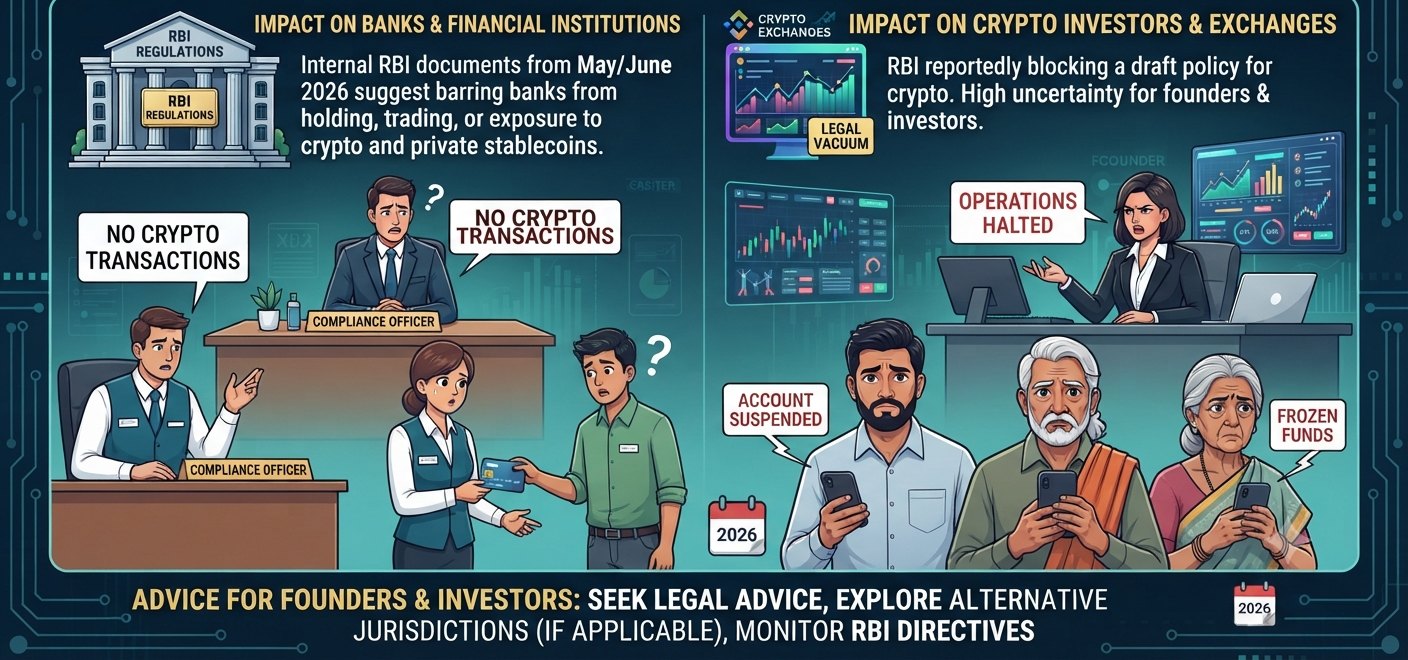
The risk could grow. Internal RBI documents reported in July 2026 suggest barring banks and financial institutions from any exposure to crypto assets and privately issued stablecoins. If that becomes formal policy, the impact on individual customers would depend on how it’s drafted, and whether it targets banks’ own exposure or customers’ transactions. Any such restriction would have to pass the proportionality test the Supreme Court applied in 2020. See our guide to the RBI’s push towards a crypto ban.
Account closure is also different from a freeze by cyber police. If your account is frozen after a P2P trade because a complainant’s money reached it, the legal framework and remedies are different, and High Courts have not taken a uniform view on how far a freeze can go. Many have held that the police may freeze only the disputed amount unless a Magistrate orders attachment. Our guide to frozen bank accounts over crypto or UPI covers this in detail.
How to reduce the risk of losing your bank account
Most bank account problems for crypto traders come from transaction patterns, not crypto itself. Trade on FIU-registered exchanges using bank transfers to and from your own verified exchange account; see our guide to FIU-IND registration. If you use P2P, accept payment only from the counterparty’s own KYC-verified account, never from third parties, and keep each trade’s records.
Keep your bank informed where it makes sense. If your bank asks about transactions, answer promptly with evidence: exchange statements, trade records and tax filings showing that you report your crypto income. A customer who can show a transparent, tax-compliant trail is much less likely to be closed down. Our guides to crypto tax and the crypto nudge email explain how to keep that trail clean.
If your bank account receives an unexpected credit from someone you don’t know, especially after you’ve posted a P2P offer, don’t release crypto or spend the money until you’ve confirmed it’s genuine. Fraudsters often send money first to make a bank account look like the recipient of stolen funds. Finally, separate your finances. Using a dedicated bank account for crypto activity, separate from your salary and business accounts, limits the damage if a bank restricts or closes it.
Remedies against banks, and quick answers
If the bank is restricting your account because of a cyber complaint rather than its own policy, ask for the complaint reference and the amount involved, because that changes which remedy applies. Act quickly, too: the sooner you raise a grievance, the stronger your position. Keep copies of every letter and email from the bank, the dates of each communication, and evidence that your crypto activity is lawful and tax-compliant.
If your bank closes your account or refuses service, start by writing to the bank’s grievance redressal officer, asking for the reasons and pointing to the RBI’s 31 May 2021 circular if the bank relies on the old 2018 restrictions. If you don’t get a satisfactory reply within 30 days, file a complaint under the RBI’s Integrated Ombudsman Scheme, which handles complaints about deficiencies in banking services. Where the closure caused financial loss, a consumer complaint for deficiency in service may be possible. Writ petitions are generally available against public sector banks performing public functions, though less readily against private banks. And if a future RBI restriction targets crypto users broadly, a constitutional challenge similar to IAMAI v. RBI would be the route.
Related reading: Indians investing in crypto through Dubai: LRS and Schedule FA; also a bank account frozen after a P2P crypto trade.
Quick answers
Can a bank refuse service because I trade crypto?
Not by citing the RBI’s 2018 circular, which the Supreme Court set aside in 2020. But banks can still act on genuine KYC, AML and fraud concerns.
Can my bank close my account without notice?
Banks should give reasonable notice under account terms and RBI customer service norms. Sudden closures can be challenged through the bank’s grievance process and the RBI Ombudsman.
What if my account is frozen by cyber police after a P2P trade?
That’s different from a bank closure. Seek a lien limited to the disputed amount, and approach the Magistrate or High Court if needed.
Final word
At Halverton & Co., we advise founders, technology companies, investors and individuals on banking disputes, crypto compliance, RBI Ombudsman complaints and writ petitions. We practise in Jharkhand, Maharashtra and before the Supreme Court of India, and act as fractional legal counsel for technology-driven businesses that need senior legal support without a full in-house legal team. Halverton & Co. is built on a simple idea: Where tech needs law! If this issue affects you or your business, write to us at office@halvertonandco.com, or get in touch, and we’ll help you work out where you stand.
This article reflects the law and developments reported up to early October 2026. It is for general information only and is not legal advice. Please take advice on your specific facts before acting.
Related practice area
Crypto, Web3 & Digital Assets
Advice for virtual digital asset businesses on registration, reporting and structure.
View the practice area