Key takeaways
- There is no clear legal framework approving USDT remittances. FEMA expects cross-border transfers through authorised banking channels.
- Stablecoins are virtual digital assets in India, so gains are taxed at 30% with 1% TDS on transfers above thresholds.
- The biggest practical risk is the recipient’s Indian bank account being frozen after a P2P sale paid with fraud proceeds.
- Bank transfers, licensed exchange houses and regulated remittance apps are the safer route.
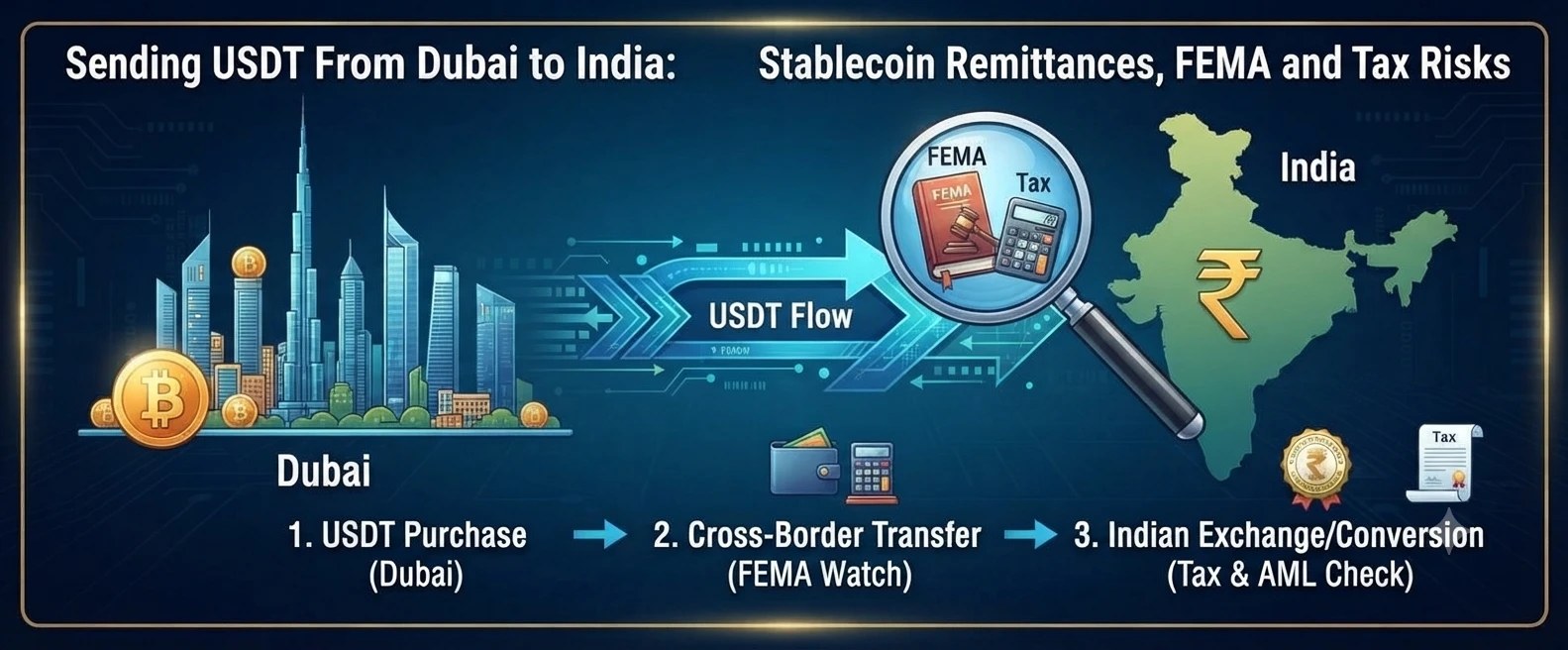
Ask around in Dubai and you’ll meet people who send money home to India in USDT rather than through a bank or exchange house. Buy USDT in Dubai, send it to a wallet in India, sell it on a P2P platform, and the rupees land in a family member’s account within minutes. It feels faster and cheaper than a wire transfer.
But sending USDT from Dubai to India sits in a legal grey zone on both sides, and it carries real risks for the sender and, especially, for the person in India who receives and converts it. This guide explains how the UAE treats stablecoins, how India treats USDT remittances under foreign exchange and tax law, the risk of bank account freezes, and the safer alternatives.
How the UAE treats stablecoins like USDT
The UAE regulates stablecoins through the Central Bank’s Payment Token Services Regulation, issued under Circular 2/2024. It distinguishes “Dirham Payment Tokens”, which reference the dirham, from “Foreign Payment Tokens” such as USDT and USDC, which reference the US dollar (The Fintech Times). The rules are restrictive about how foreign stablecoins can be used. UAE merchants can only accept Dirham Payment Tokens from licensed issuers, while Foreign Payment Tokens from registered issuers can only be accepted for purchasing virtual assets and virtual asset derivatives (The Fintech Times).
In January 2026, Abu Dhabi-based Universal Digital Intl secured registration of USDU as the UAE’s first registered foreign payment token, making it the only registered foreign payment token then permitted for compliant digital-asset settlement in the UAE (Enterprise). Payment token services carried out in or directed to the UAE also require CBUAE licensing (Hadef & Partners).
For someone sending USDT from Dubai to India, the practical point is that the UAE’s framework doesn’t treat USDT as a general-purpose payment rail for remittances. Buying it from a VARA-licensed platform is lawful, but using it as a substitute for a regulated remittance service isn’t what the framework is designed for. UAE counsel should confirm the position for any particular arrangement.
How India treats a USDT remittance
On the Indian side, two bodies of law matter: foreign exchange law and tax law. India’s Foreign Exchange Management Act, 1999 expects cross-border transfers of value to go through authorised banking channels. Using USDT to move money from Dubai to India bypasses those channels, and the recipient converting USDT into rupees through P2P markets isn’t receiving an inward remittance in the way FEMA contemplates. India has no clear framework approving crypto as a remittance route, and the RBI has repeatedly expressed concern about stablecoins.
Tax is the second issue. Since 1 April 2026, India’s VDA regime under the Income-tax Act, 2025 expressly includes crypto-assets, which covers stablecoins. When the person in India sells USDT for rupees, that’s a transfer of a virtual digital asset: any gain, even a small one caused by exchange-rate movements against the rupee, is taxed at 30%, and 1% TDS can apply to the transfer. Losses can’t be set off.
If the USDT is received as a gift from a relative, the receipt itself is generally not taxable for the recipient, but the later sale is. If it’s received from a non-relative above the exemption limit, the receipt can be taxable as income. Either way, the recipient needs records showing where the USDT came from and what it was worth when received.
The biggest practical risk: bank account freezes
The most serious risk in sending USDT from Dubai to India usually falls on the person in India. To turn USDT into rupees, they often sell it on a P2P platform, where the buyer pays by UPI or bank transfer. If that buyer is using money from a fraud victim, which is common in P2P markets, the victim’s complaint can lead police to freeze the seller’s bank account.
Indian courts have pushed back against blanket freezes. The Bombay High Court has held that investigating agencies can’t debit-freeze entire accounts under Section 106 of the Bharatiya Nagarik Suraksha Sanhita, and that banks may only mark a lien on the disputed amount, and other High Courts have taken similar views. But even a limited freeze can take months to resolve, and the account holder may face questions from the police about the source of funds.
Families who rely on USDT remittances often discover this risk only when a parent’s pension account or a sibling’s salary account is frozen. Keeping separate accounts, trading only with verified counterparties, and keeping records of the Dubai purchase and transfer all reduce the risk, but none of them eliminate it.
Safer alternatives for sending money home
For most people, regulated channels remain the safest way to send money from Dubai to India: bank transfers, licensed exchange houses, and regulated remittance apps. They’re fully compliant with FEMA, the funds arrive as inward remittances into NRE or NRO accounts or relatives’ accounts, and there’s no risk of the recipient being caught up in a P2P fraud investigation.
For NRIs, the account used matters. Money received in an NRE account from abroad is freely repatriable and, for non-residents, interest on NRE deposits is tax-free in India. Money sent to relatives as gifts is generally not taxable for them if they qualify as relatives under Indian tax law.
If you hold crypto in Dubai and want the value in India, the cleaner route is usually to sell the crypto on a VARA-licensed platform in Dubai, receive dirhams in your UAE bank account, and remit the money to India through a bank or exchange house. That keeps the crypto transaction in Dubai and the remittance in regulated channels.
| Question | USDT route | Bank, exchange house or remittance app |
|---|---|---|
| FEMA position | No clear framework approving crypto as a remittance route; bypasses authorised banking channels | Fully compliant; funds arrive as inward remittances |
| Tax in India | Sale of USDT is a transfer of a virtual digital asset: 30% on any gain, 1% TDS, no set-off of losses | No crypto tax event |
| Freeze risk | The recipient can be caught up if a P2P buyer paid with fraud proceeds | No P2P counterparty, so no such risk |
| UAE position | Foreign payment tokens such as USDT are restricted as a payment rail | Regulated remittance services |
| Records needed | Dubai purchase, transfer and sale records | Ordinary bank and exchange house records |
Remedies and compliance
If you’ve already used USDT remittances, assess the position on both sides: whether the recipients in India have reported the sales for tax, whether any accounts have been flagged, and whether records exist to explain the funds. Unreported gains can be corrected through an updated return within 48 months of the end of the relevant assessment year. If an account has been frozen, the recipient should find out which police station or cyber cell gave the instruction, send a documented representation, ask the bank to limit the restriction to a lien on the disputed amount, and, if needed, apply to the Magistrate or file a writ petition. Sending USDT from Dubai to India may look efficient, but for most families the hidden costs outweigh the savings.
Related reading: gifting crypto from Dubai to family in India, a bank account frozen after a P2P crypto trade, Indian residents investing in crypto through Dubai, crypto fraud between Dubai and India, stablecoins in India, a bank account frozen over a crypto or UPI transaction and crypto tax in India; also the crypto travel rule between the UAE and India; also buying Dubai property with crypto.
Quick answers
Is it legal to send USDT from Dubai to India?
There’s no clear legal framework approving it. India expects remittances through authorised banking channels, and the UAE restricts how foreign stablecoins are used.
Is USDT taxed in India?
Yes. Stablecoins are virtual digital assets, so gains on sale are taxed at 30%, with 1% TDS on transfers above thresholds.
What is the biggest risk of USDT remittances?
The recipient’s bank account in India being frozen if a P2P buyer paid with funds from a fraud.
Is USDT a payment token in the UAE?
The Central Bank’s Payment Token Services Regulation (Circular 2/2024) distinguishes Dirham Payment Tokens from Foreign Payment Tokens such as USDT and USDC. Foreign Payment Tokens from registered issuers can only be accepted for purchasing virtual assets and virtual asset derivatives.
What is the safer way to send money from Dubai to India?
Bank transfers, licensed exchange houses and regulated remittance apps. They comply with FEMA, the money arrives as an inward remittance, and the recipient is not exposed to a P2P fraud investigation.
Final word
Halverton & Co. is an Indian law firm advising NRIs, founders, investors and businesses in Dubai and across the UAE on Indian law, including crypto remittances, FEMA compliance, VDA tax and frozen bank accounts. We practise in Jharkhand, Maharashtra and before the Supreme Court of India, and work alongside UAE-licensed counsel, who advise on UAE law. Halverton & Co.: Where tech needs law! If you have a question about Indian law, write to us at office@halvertonandco.com, or get in touch.
This article reflects developments reported up to early October 2026. It is for general information only, is not legal advice, and does not create an advocate-client relationship. Halverton & Co. is an Indian law firm and does not advise on UAE law; UAE-law points should be confirmed with UAE-licensed counsel.
Related practice area
Crypto, Web3 & Digital Assets
Advice for virtual digital asset businesses on registration, reporting and structure.
View the practice areaComments
No account needed. Comments are reviewed before they appear, so yours will show here once approved. Please do not share confidential details or describe your own legal matter: replies are general discussion, not legal advice, and do not create an advocate-client relationship. For your own situation, write to office@halvertonandco.com.