Key takeaways
- IP India’s public trade mark search and WIPO’s Global Brand Database are free and show registered and pending marks.
- Search the exact name, variants, phonetic versions and Hindi script, in your classes and related ones, and check logos with the image tools.
- A free search does not show unregistered rights, does not judge similarity and may lag behind new filings.
- If the register is clear, file early in your own name; if there are conflicts, take advice before you proceed.
You can check a trademark in India for free. IP India publishes a public search of the Trade Marks Registry, and the World Intellectual Property Organization’s free Global Brand Database shows Madrid designations that cover India. For a UK business planning to enter India, checking whether your brand, or a similar one, is already registered is the first practical step, and it costs nothing but time.
This guide gives the steps to check trademark India free, explains how to read the results and the status of each application, shows how to search for similar marks and Madrid designations, and sets out what a free search cannot tell you. It is written by an Indian law firm for UK businesses. A free search is a screening tool, not a legal opinion.
Why check before you enter India
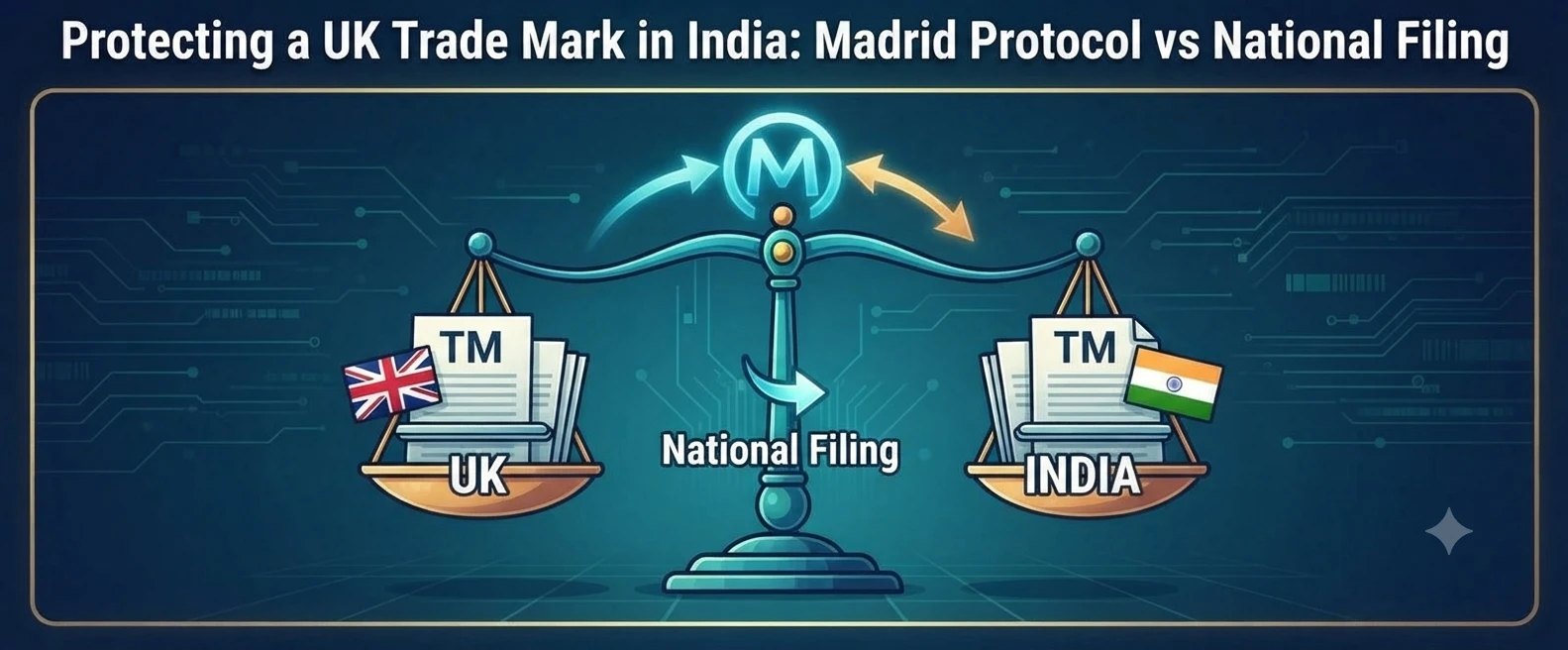
Trade mark rights are territorial. A UK registration does not protect your name in India. Someone else may have registered the same or a similar mark, or may be using it without registration, and the law of passing off protects them. If you launch first and search later, you risk an objection, an opposition or a claim, and a costly change of name. The simplest way to check trademark India free is to start with the public register.
A quick search also reveals squatters. Brands from abroad are sometimes registered in India by local filers who hope to sell the mark back or to block the owner. Seeing that your mark is already on the register, in someone else’s name, tells you early whether you can file freely, need to oppose, or should look for another route.
The check also helps you decide how to file. If the register is clear, you can apply directly or through the Madrid Protocol, designating India. If there are conflicts, you can adjust the mark or the goods, or prepare for a dispute. A free check is not enough on its own, but it tells you whether to commission a full professional search.
Step by step: search the Indian register
Step one: go to the Trade Marks public search on the IP India website. The page lets you search by wordmark, by application number or by proprietor name, and you can choose the class and the type of match. Menu labels change from time to time, so follow the on-screen options. Choose the “wordmark” search first and enter your brand name exactly. Each step helps you check trademark India free without paying for a report.
Step two: repeat the search with variations. Try spelling changes, plurals, a space or hyphen, phonetic versions, and the name written in Hindi or another Indian script. Search the proprietor’s name too, in case your company has been filed under a different mark. Search in the classes you care about, and in related classes, since the Registry compares similar goods and services across classes.
Step three: use the image tools for logos. IP India introduced AI and machine learning based trademark search in September 2024, with image-based and voice-enabled search, and a revamped website was reported in March 2026. Upload your logo, check the results and note anything that looks similar. Treat the tool as a screening aid, because the Registry’s examiners and the courts judge similarity themselves.
Reading status and spotting similar marks
Each record shows a status, such as registered, objected, accepted and advertised, opposed, refused, abandoned or withdrawn. A registered mark is the biggest obstacle. An objected or pending mark may still become registered. An abandoned or refused mark is less of a risk, but it can be revived or re-filed, and the owner may still use the name. Always note the filing date, because earlier applicants usually have priority. Reading results correctly is half the task when you check trademark India free.
| Status | Meaning | Risk to your brand |
|---|---|---|
| Registered | The mark is on the register | Highest; consider opposition or rectification options |
| Accepted and advertised | Published for opposition for four months | You can oppose within the period |
| Objected | Examiner has raised grounds; reply pending | May still proceed to registration |
| Opposed | A third party has challenged it | Outcome uncertain |
| Abandoned, refused or withdrawn | Application is not proceeding | Lower, but it can be re-filed |
Check the class and the description of goods and services. A similar mark in a different class may not be a conflict, but the Registry compares goods across classes, and a well-known mark may be protected widely. Note the owner and their other marks, which can show a pattern of filings, such as a squatter with many foreign brands. Also check for marks that include your name with a small difference.
For UK brands, check Madrid designations as well. If a UK or other owner has designated India under the Madrid Protocol, the mark may appear in WIPO’s Global Brand Database before or alongside the Indian record. Search there by name and look at the countries designated. This helps you see whether a rival group has already targeted India, and whether your own UK international registration covers it.
What a free search misses
A free register search does not show unregistered rights. A business that has used a similar name in India for years may be able to stop you through passing off, even if it never registered, and the register will not show it. Search the web, marketplaces, app stores, social media and company names for local users, and ask your Indian partners whether the name is known. Know these limits before you rely on a result when you check trademark India free.
A free search also does not judge similarity. The Registry and courts consider sound, appearance, meaning, the goods, the customers and the overall impression, and decisions turn on facts. Two marks that look different on a screen may be confusingly similar to Indian consumers, particularly across languages. A trade mark professional can give an opinion on the risk, and that opinion is what you rely on for a decision.
Data can be out of date. Applications take time to appear, and statuses change. A search that is a week old may miss a new filing. The Trade Marks Journal, which publishes accepted applications for opposition, is another source. If your launch is close, repeat the search shortly before you file, and consider a watch service that alerts you to new similar marks.
Next steps and quick answers
Run the searches above, save screenshots with dates, and list any conflicts. If the register looks clear, file as soon as you can, in the right classes and in your own name. If there are conflicts, take advice on whether to change the mark, negotiate, or oppose. A paid professional search and opinion is worth the cost before a launch. This is general information, not legal advice. Repeat the process to check trademark India free again before filing.
Related reading: UK trade marks in India: Madrid or national filing, trade mark squatting in India for UK companies, IP India’s AI trade mark search, Indian trade mark classes for UK businesses, spotting Indian trade mark squatters early, defending a UK brand against an Indian opposition and selling on Amazon India from the UK; also trade mark clearance in India for UK brands and trademark status meanings in India.
Quick answers
Can I check trademark India free?
Yes. IP India’s public search of the Trade Marks Registry is free, and WIPO’s Global Brand Database is free for Madrid designations. A free search is a screening step, not a legal opinion.
Does my UK trade mark protect me in India?
No. Trade mark rights are territorial. You need an Indian registration or a Madrid designation covering India, or proof of reputation in India, to rely on rights there.
What if someone has already registered my brand in India?
Take advice quickly. Options include opposition if it is still pending, a rectification petition if it is registered, evidence of bad faith or prior rights, negotiation, or a different mark.
Is IP India’s search really free?
Yes. IP India’s public search of the Trade Marks Registry is free, and WIPO’s Global Brand Database is free for Madrid designations.
How often should I repeat the search?
Search again shortly before you file and set up a watch, because new applications appear daily and statuses change.
Final word
Halverton & Co. is an Indian law firm advising UK companies, founders, investors and law firms on Indian law, including trade mark search, filing and enforcement in India, brand protection for foreign companies, and market entry advice for UK businesses. We practise in Jharkhand, Maharashtra and before the Supreme Court of India, and work alongside your UK solicitors, who advise on English law. Halverton & Co.: Where tech needs law! If you have a question about Indian law, write to us at office@halvertonandco.com, or get in touch.
This article reflects developments reported up to 31 October 2026. It is for general information only, is not legal advice, and does not create a solicitor-client relationship. Halverton & Co. is an Indian law firm, is not authorised or regulated by the Solicitors Regulation Authority, and does not advise on English law; UK-law points should be confirmed with UK advisers.
Sources
Related practice area
Intellectual Property
Trade marks, copyright, patents and designs. Searched, filed, licensed and enforced under Indian law.
View the practice areaComments
No account needed. Comments are reviewed before they appear, so yours will show here once approved. Please do not share confidential details or describe your own legal matter: replies are general discussion, not legal advice, and do not create an advocate-client relationship. For your own situation, write to office@halvertonandco.com.