Key takeaways
- A UK trade mark does not protect a brand in India. You need an Indian registration through Madrid or a national filing.
- A Madrid application designating India is filed through the UKIPO and forwarded by WIPO.
- A national filing allows a tailored specification and independence from the UK mark, and needs an address for service in India.
- Indian courts require reputation among Indian consumers for passing off, so register early.
A UK trade mark registration protects your brand in the United Kingdom, and nowhere else. Trade mark rights are territorial, so if you sell into India, have an app downloaded there, take on Indian distributors, or plan to build a team or raise money there, your UK registration gives you no protection in the Indian market.
With the UK-India trade deal in force since 15 July 2026, more British brands are entering India, and protecting a UK trade mark in India has become an urgent item on many launch plans; see our legal checklist for the UK-India trade deal. This guide compares the two routes, the Madrid Protocol and a national filing in India, and explains examination, objections, oppositions, costs and timelines.
Why a UK trade mark needs separate protection in India
India’s Trade Marks Act, 1999 gives the registered owner the exclusive right to use the mark across India for the registered goods and services, and a statutory action for infringement. Without registration, a UK brand has to rely on passing off, which requires proof of goodwill among Indian consumers. Indian courts have made clear that international reputation alone isn’t enough; the brand must show a reputation in India.
There’s a practical urgency too. Indian law protects prior users, but a local party that files your brand first can cause years of delay and cost through oppositions, rectification and litigation. Distributors, franchisees and former partners are a common source of such filings. Registering your UK trade mark in India before you launch, appoint a distributor or announce your plans is the cheapest protection available.
Indian registration also speeds up enforcement online. Indian marketplaces, app stores and social platforms act much faster on takedown requests backed by an Indian registration certificate than on those relying only on a UK registration. See our guides to counterfeit goods in India and what to do if someone has registered your brand in India.
Route one: the Madrid Protocol
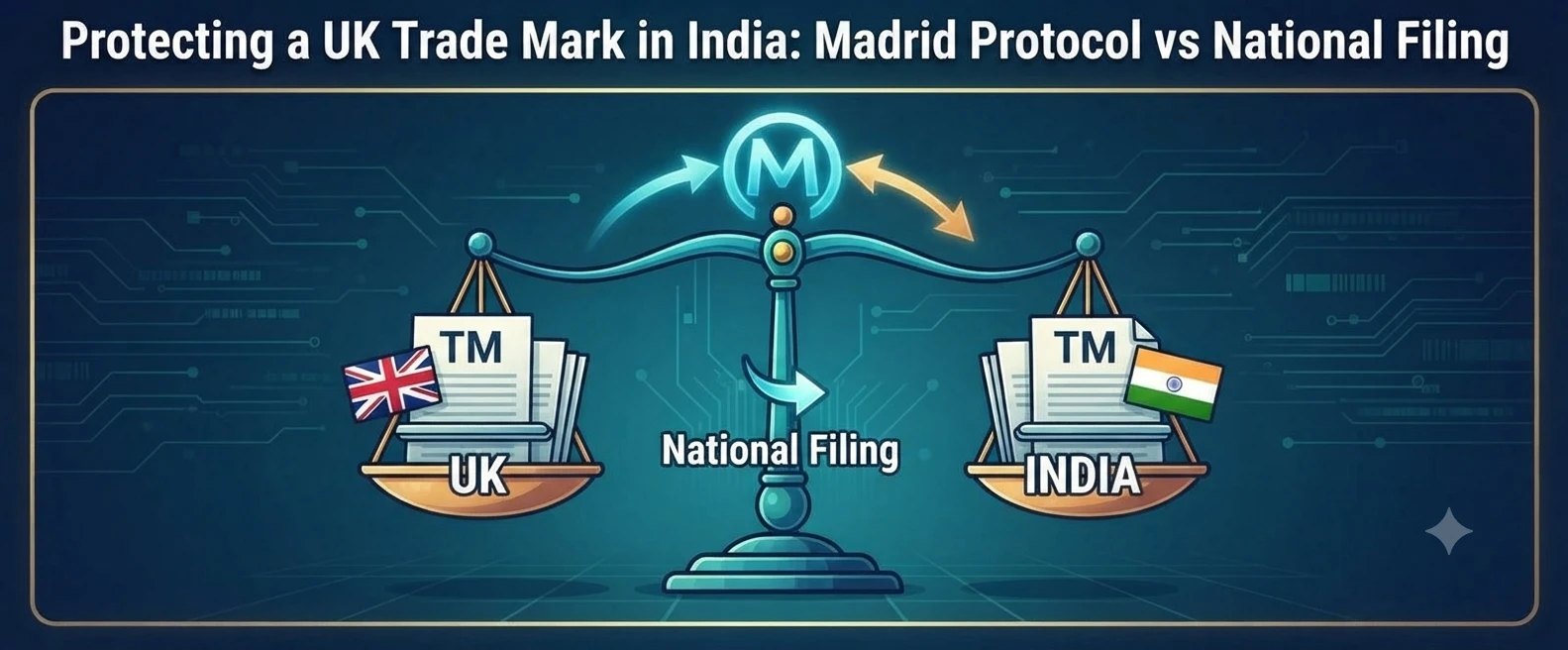
India joined the Madrid Protocol in 2013, so a UK applicant can designate India in an international application based on its UK application or registration. The international application is filed through the UKIPO, which forwards it to the World Intellectual Property Organization, which then notifies India. One application in English, with fees paid in Swiss francs, can cover India and many other countries together.
The main benefits are simplicity and central management: one filing, one renewal date and one place to record changes of ownership or address across your international portfolio. For a UK company protecting its brand in several countries at once, this is often the most efficient way to protect a UK trade mark in India.
There are drawbacks. For five years, the international registration depends on the UK base mark, so if the UK mark is narrowed or cancelled in that time, the Indian designation can fall with it, a risk known as “central attack”. The specification can’t be broader than the UK base, which may be drafted narrowly for UK purposes. And if India issues a provisional refusal, you’ll still need an Indian trade mark professional to respond, which reduces the cost saving.
Route two: a national filing in India
A national application is filed directly with the Indian Trade Marks Registry, usually through an Indian trade mark attorney, because applicants without a place of business in India must give an address for service in India. One application can cover multiple classes, with a fee per class. The official e-filing fee has been ₹9,000 per class for applicants that don’t qualify as individuals, start-ups or small enterprises, which is roughly £80 per class at recent exchange rates; check the current fee and rate before you budget.
A national filing gives flexibility. You can draft the specification of goods and services for your Indian business plans rather than copying a UK specification, the Indian registration stands independently of the UK mark, and it can be filed quickly if you need to get ahead of a suspected squatter.
The trade-off is administration: a separate renewal date every ten years and a separate file to manage; see our guide to trade mark renewals and watching for UK IP firms. For UK companies whose main overseas market is India, or whose Indian business differs from their UK business, a national filing is often the better way to protect a UK trade mark in India.
| Madrid Protocol | National filing | |
|---|---|---|
| How filed | International application through the UKIPO designating India | Application to the Indian Trade Marks Registry, usually via an Indian attorney |
| Dependence on UK mark | Five-year dependence on the UK base mark | Stands alone |
| Specification | Cannot be broader than the UK base | Drafted for Indian plans |
| Management | One renewal date and one record for many countries | Own renewal date every ten years |
| Best for | India as one of several countries in a coordinated programme | India as a priority market, or when speed matters |
Examination, objections, oppositions and timelines
Whichever route you choose, the mark is examined under Indian law. Objections usually arise under Section 9 (absolute grounds, for example descriptive or non-distinctive marks) or Section 11 (relative grounds, such as conflicts with earlier Indian marks). Under a national filing, you respond to an examination report and may attend a hearing. Under Madrid, an objection arrives as a provisional refusal that must be answered within the time set by the Registry; confirm that period for your case. Our guide to what a trade mark examination report is asking explains a typical objection.
Once accepted, the mark is advertised in the Trade Marks Journal, and anyone can oppose it within four months. If an opposition is filed, you must file a counter-statement within two months of receiving it, or the application is treated as abandoned. That deadline is easy to miss if notices go to an outdated address, so keep your Indian representative’s details current.
Use in India matters after registration too. An Indian registration can be removed for non-use if there’s no bona fide use for a continuous five-year period, so UK brands should keep evidence of Indian sales, marketing and online activity once they’ve protected a UK trade mark in India. A straightforward application may be registered within roughly a year, while objections or oppositions can take considerably longer. Indian registrations last ten years and can be renewed indefinitely. UK brand owners should also note that India uses the Nice Classification, like the UK, so classes map across easily, although Indian practice on specifications can differ. For the Indian filing steps in detail, see our guide to trademark registration for startups in India; the Madrid and national routes work the same way for US owners, as we explain in registering a US trademark in India.
Choosing a route, remedies and quick answers
As a rule of thumb, use Madrid when India is one of several countries in a coordinated international programme and your UK specification fits your Indian business. Use a national filing when India is a priority market, when you need a broader or different specification, when independence from the UK mark matters, or when speed is important. Many UK companies combine both: Madrid for most countries and a national Indian filing for their core brand.
If someone has already filed your brand in India, the remedies include opposing their application within the four-month window, applying to rectify a registration on grounds such as bad faith or non-use, and suing for passing off if you can show reputation in India; see our guide to trade mark squatting in India.
Related reading: recovering a .in domain: an INDRP guide for UK brands and Web3 trade marks in India and the UAE; also defending a UK brand against a trade mark opposition in India, protecting UK food and drink names in India and licensing a UK brand to Indian franchisees; also how to check a UK brand in India for free, Indian trade mark classes for UK businesses, selling on Amazon India from the UK and spotting Indian trade mark squatters early.
Quick answers
Does a UK trade mark protect my brand in India?
No. Trade marks are territorial, so you need an Indian registration through the Madrid Protocol or a national filing.
Is the Madrid Protocol or a national filing better for India?
Madrid suits coordinated international filings; a national filing offers flexibility and independence from the UK mark. Many brands use both.
How long does it take to register a trade mark in India?
A clean application may register within about a year; objections or oppositions can take longer.
Final word
Halverton & Co. is an Indian law firm that advises on Indian law, including trade mark clearance, filing and enforcement in India for UK brands. We practise in Jharkhand, Maharashtra and before the Supreme Court of India, and we work alongside your UK solicitors, who advise on English law. Halverton & Co.: Where tech needs law! If you have a question about Indian law, write to us at office@halvertonandco.com, or get in touch.
This article reflects developments reported up to early October 2026. It is for general information only, is not legal advice, and does not create a solicitor-client relationship. Halverton & Co. is an Indian law firm, is not authorised or regulated by the Solicitors Regulation Authority, and does not advise on English law or UK tax.
Sources
Related practice area
Intellectual Property
Trade marks, copyright, patents and designs. Searched, filed, licensed and enforced under Indian law.
View the practice areaComments
No account needed. Comments are reviewed before they appear, so yours will show here once approved. Please do not share confidential details or describe your own legal matter: replies are general discussion, not legal advice, and do not create an advocate-client relationship. For your own situation, write to office@halvertonandco.com.