Key takeaways
- Register the mark in India before franchising, so a franchisee or third party cannot register the brand first.
- Use of a mark by a permitted user under a written licence is treated as use by the proprietor, which also helps against removal for non-use.
- Real quality control, with a brand manual, audits and corrective action, protects the mark and your goodwill.
- Section 27 makes post-termination restraints void, and royalties are taxed, so plan the terms, withholding and treaty relief with advisers.
India is a large franchise market, and many UK restaurant, retail, education and fitness brands look for partners there. A franchise is only as safe as the brand licence behind it. If the mark is poorly licensed or the franchisee controls quality as it likes, the brand can lose value, and in the worst case, the mark itself can be put at risk. This guide explains trademark licensing India franchise UK brand owners need to understand: registration, permitted use, quality control, contract terms, money and exit.
It covers the legal framework in the Trade Marks Act, 1999, how to structure a master or unit franchise, what quality and control provisions to include, how royalties and tax work, and how to end a relationship without losing goodwill. It is written by an Indian law firm for UK brand owners. English law and UK franchise-code questions should be checked with your UK advisers.
Start with registered rights
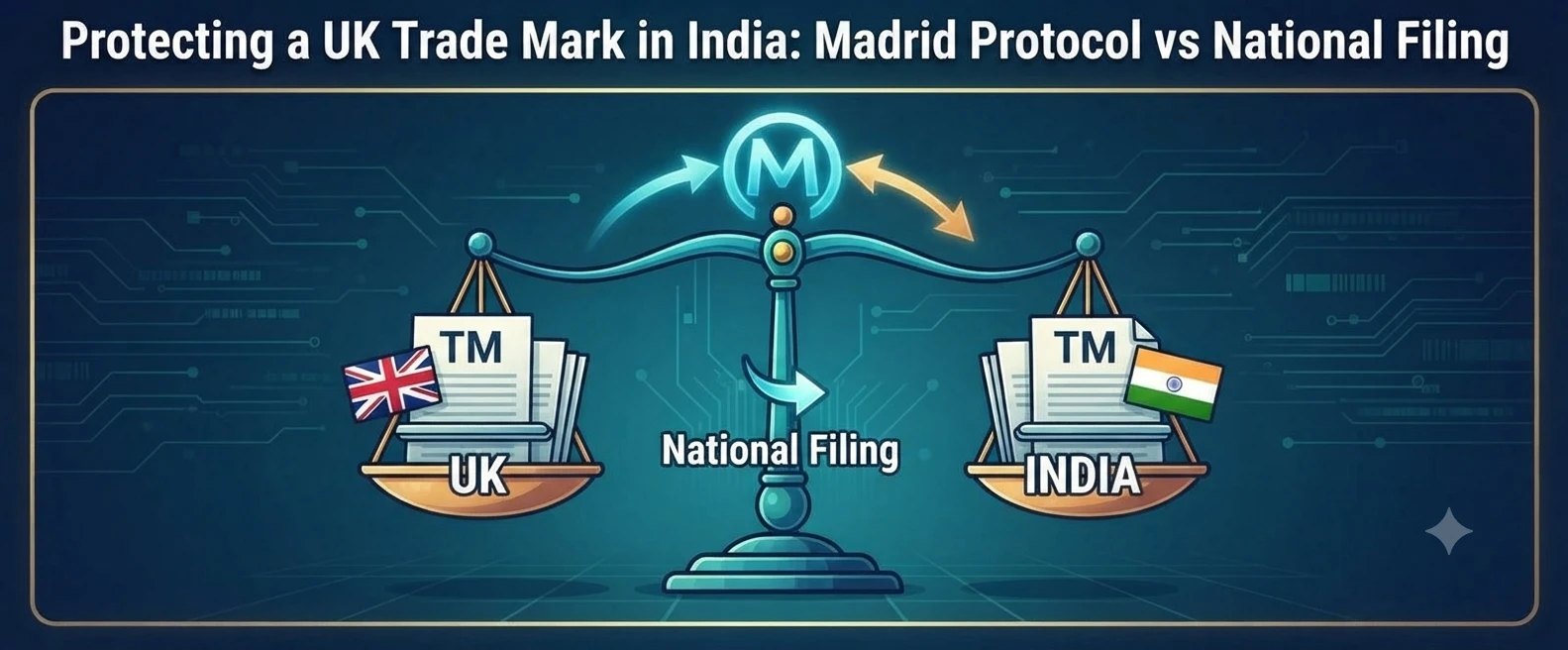
Before you license, secure the mark in India. File the word mark and logo in the relevant classes, directly or through the Madrid Protocol designating India, and check for conflicts first. A licensor that does not own an Indian registration is weak: the franchisee may register the brand in its own name, or a third party may block you. Give the franchisee only the rights you have, and record who owns the goodwill.
India does not have a single franchise statute. Franchising rests on general law: the Indian Contract Act, 1872, the Trade Marks Act, 1999, competition law, consumer protection law, and sector laws such as food safety. There is no mandatory franchise disclosure document as in some countries, but good practice is to give a clear information pack. For food brands, an FSSAI licence is needed, and for education or health brands, sector rules apply.
The Trade Marks Act contemplates licensing through the concept of permitted use. Under Section 48, use of a mark by a permitted user, with the proprietor’s consent and under a written agreement, is treated as use by the proprietor. This matters because a mark that is not used by its owner or a licensee for five years and three months can be vulnerable to removal for non-use under Section 47. Trademark licensing India franchise UK programmes must therefore be properly documented.
Permitted use and quality control
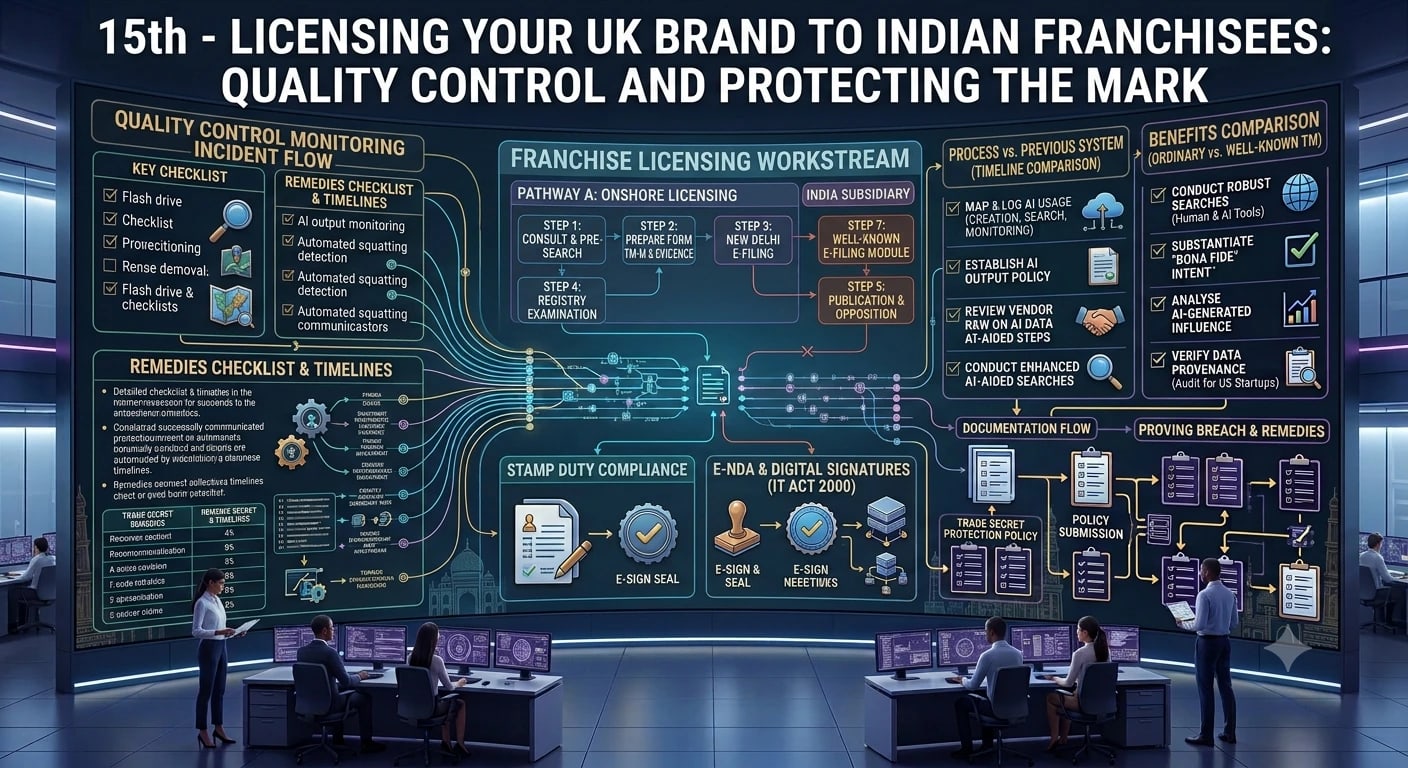
Control of quality is the legal and commercial centre of a trade mark licence. The licence should require the franchisee to meet defined standards for products, services, premises, uniforms, training and customer care, set out in a brand manual that can be updated. The licensor should have the right to inspect, to audit, to require corrective action and to stop use of the mark where standards fall. Without real control, a licence risks being seen as a naked licence that weakens the mark. Control is the feature that courts and the Registry look for in trademark licensing India franchise UK arrangements.
Use clear mark-use rules. Say how the mark can appear, require the correct symbols and a notice that the mark is licensed, ban modifications and combinations with other marks, and control domain names and social media accounts, which should be registered in the brand owner’s name. Make the franchisee agree that all goodwill from use belongs to the licensor and that it will not challenge the mark or register similar marks.
| Provision | What to include | Why it matters |
|---|---|---|
| Brand manual | Standards for products, services, premises, uniforms, training and customer care | Defines what quality means |
| Inspection and audit | Right to inspect, audit and require corrective action | Shows control is real |
| Mark-use rules | Correct form of the mark, symbols and licence notice; no modifications | Protects the registration |
| Digital assets | Domain names and social accounts registered to the brand owner | Prevents loss of online identity |
| Goodwill | All goodwill belongs to the licensor; no challenge to the mark | Keeps ownership clear |
Consider recording the arrangement. The Act provides for recording a registered user with the Registry, and although recording is not compulsory for permitted use, doing so can help as evidence in a dispute and show the proprietor’s consent. Ask your Indian counsel whether to record each franchisee or a master licence. Keep copies of audits, inspection reports and training records, because they show that control was real, which helps if you must defend the mark.
Franchise agreement terms that matter
Define the grant. Decide whether the licence is exclusive, sole or non-exclusive, what territory it covers, and whether sub-licensing is allowed. In a master franchise, the master franchisee appoints sub-franchisees, so your contract should control the terms it can offer, require your approval, and give you step-in rights if the master fails. Set development schedules for opening outlets, with termination if targets are missed.
Deal with restrictive covenants carefully. Section 27 of the Indian Contract Act makes post-termination restraints of trade void, so a clause stopping a former franchisee from running a similar business after exit may not be enforceable, though in-term exclusivity and confidentiality are valid. Draft for enforceable protections: confidentiality, de-identification, return of manuals, no use of the brand’s trade dress and no use of confidential know-how. Competition law can also affect territorial and pricing terms.
Provide for disputes. Choose governing law and forum, with arbitration under a recognised institution and a seat that suits both sides, such as London or Singapore, while keeping the right to seek urgent injunctions from Indian courts. Plan termination events, the effect on stock, signage, domain names and customer data, and an exit process that lets you step in or appoint a replacement quickly. Insurance and indemnity clauses should cover product and service claims. Clear exit terms complete a trademark licensing India franchise UK agreement.
Royalties, tax and foreign exchange
Royalties and fees paid from India to a UK licensor are generally permitted through authorised dealer banks under India’s foreign exchange rules, and the automatic route usually allows royalty payments for trade mark and brand use without prior approval, subject to documentation. Check current rules and the category of payment, since the position can change, and keep contracts and invoices to support each remittance.
Tax needs planning. Royalties paid to a non-resident are subject to withholding tax in India, which the payer deducts, at the domestic rate or a lower rate under the India-UK double tax treaty, if the licensor provides a tax residency certificate and meets the treaty conditions. Check the treaty rate, which is commonly in a band between 10 and 15%, and how the Income-tax Act, 2025 carries the withholding rules. The UK licensor should also check relief for foreign tax credit.
Indirect tax and pricing also matter. Import of services such as brand licensing may attract GST under reverse charge, which the Indian franchisee pays. Transfer pricing rules apply if the parties are related. Set fees, such as an upfront fee, a royalty on sales and a marketing contribution, so that they work after tax, and allow for currency movements. Model the numbers with tax advisers before you sign. Model these costs before launching trademark licensing India franchise UK deals.
Next steps and quick answers
Before you sign a franchise deal, confirm your Indian registrations and watch for squatters, prepare a brand manual and a licence that creates genuine control, decide on the structure (master or unit), obtain tax and foreign exchange advice, and choose the dispute process. Pilot with one or two outlets where possible. Review the programme each year, recording audits and any changes to the standards. Take advice from both Indian and UK lawyers. Strong registered rights are the base of any trademark licensing India franchise UK programme.
Related reading: licensing UK technology to Indian companies: royalties, FEMA and tax, UK trade marks in India: Madrid or national filing, setting up a company in India from the UK, the UK-India trade deal: a legal checklist, selling SaaS in India from the UK, exclusive and non-exclusive copyright licences, counterfeit goods in India: remedies for UK brands and enforcing a UK judgment or arbitration award in India; also Indian trade mark classes for UK businesses and selling on Amazon India from the UK.
Quick answers
Do I need to register my mark in India before franchising?
Yes, ideally. File in India first so that a franchisee or third party cannot register the brand, and so that you can license rights you actually hold.
How do I keep control of quality in an Indian franchise?
Use a brand manual, inspection and audit rights, corrective action and termination rights, and keep records. Real control protects the mark and your goodwill.
Are royalties from India to the UK taxed?
Yes, withholding tax applies at the domestic or treaty rate if conditions are met. Check the India-UK treaty and the current rules on remittance, and get tax advice.
Is there an Indian franchise law?
India has no single franchise statute. Franchising rests on contract law, trade mark law, competition law, consumer law and sector rules such as food safety.
Does the licence need to be recorded with the Trade Marks Registry?
Recording a registered user is not compulsory for permitted use, but it can help as evidence of consent. Ask Indian counsel whether to record each franchisee or a master licence.
Final word
Halverton & Co. is an Indian law firm advising UK companies, founders, investors and law firms on Indian law, including franchise and brand licensing agreements, trade mark registration and enforcement in India, and cross-border tax and foreign exchange structuring. We practise in Jharkhand, Maharashtra and before the Supreme Court of India, and work alongside your UK solicitors, who advise on English law. Halverton & Co.: Where tech needs law! If you have a question about Indian law, write to us at office@halvertonandco.com, or get in touch.
This article reflects developments reported up to late October 2026. It is for general information only, is not legal advice, and does not create a solicitor-client relationship. Halverton & Co. is an Indian law firm, is not authorised or regulated by the Solicitors Regulation Authority, and does not advise on English law; UK-law points should be confirmed with UK advisers.
Sources
Related practice area
Intellectual Property
Trade marks, copyright, patents and designs. Searched, filed, licensed and enforced under Indian law.
View the practice areaComments
No account needed. Comments are reviewed before they appear, so yours will show here once approved. Please do not share confidential details or describe your own legal matter: replies are general discussion, not legal advice, and do not create an advocate-client relationship. For your own situation, write to office@halvertonandco.com.