Key takeaways
- A marketplace can claim safe harbour under Section 79 of the IT Act only if it is a passive intermediary that follows due diligence and acts after notice.
- The Delhi High Court in Christian Louboutin v Nakul Bajaj held that a platform playing an active role may lose safe harbour.
- The Consumer Protection (E-Commerce) Rules, 2020 add duties on marketplaces and give consumers redress routes.
- Brand owners should register marks, keep test-purchase evidence, send notices and consider court orders.
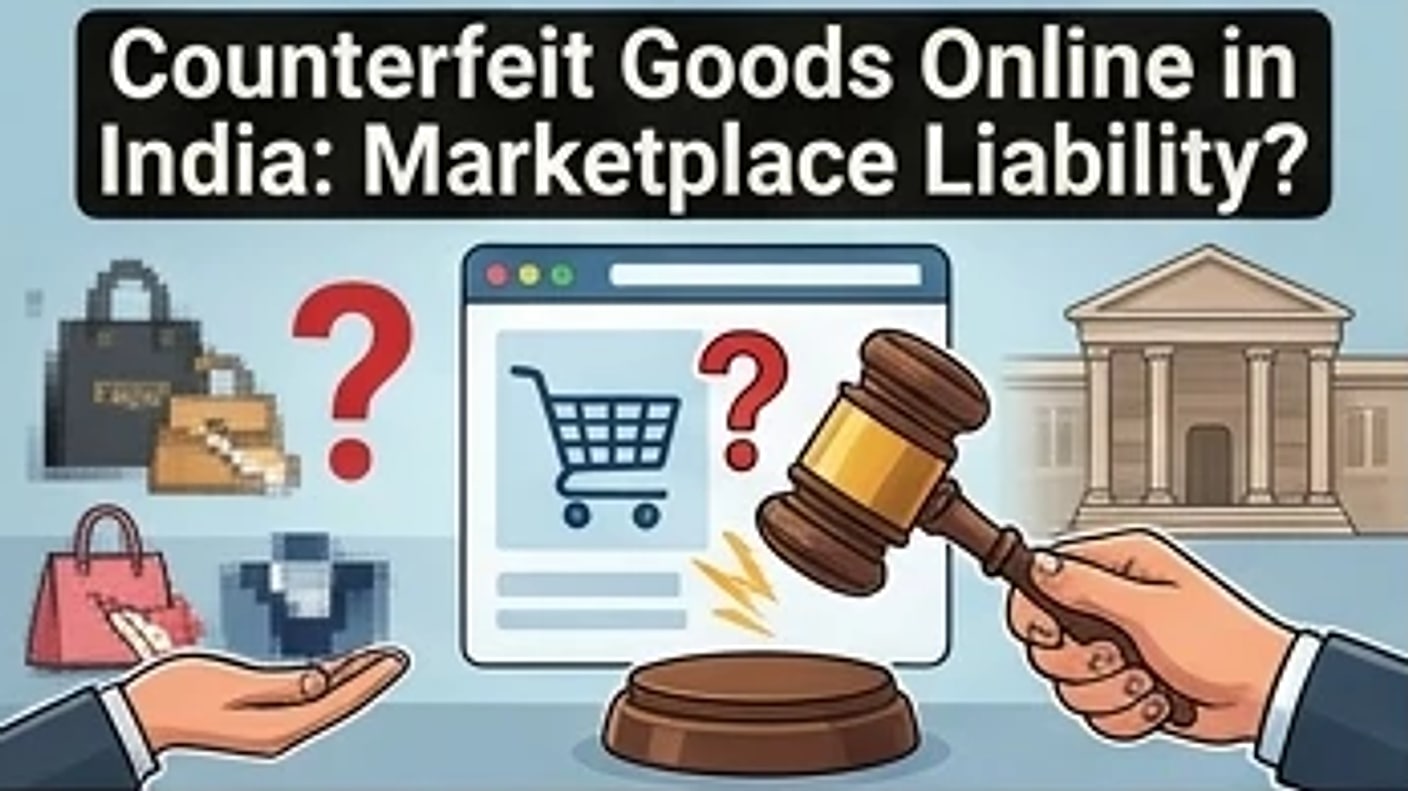
Counterfeit goods India online sales are a daily problem for brand owners and a safety risk for buyers. A fake cosmetic, spare part or electronic item bought on a marketplace raises the same question each time: is the platform responsible, or only the seller? The answer depends on whether the marketplace acts as a neutral intermediary or plays an active role in the sale, and on what it does after it is told about the problem.
This guide explains marketplace liability counterfeit India law in plain terms: the safe harbour in Section 79 of the IT Act, what Indian courts have said about active marketplaces, the duties in the Consumer Protection (E-Commerce) Rules, 2020, and a practical enforcement route for brand owners and a complaint route for consumers. It is general information, not legal advice. Court decisions turn on their facts, so read the orders before relying on them.
The legal framework
Selling a counterfeit under another’s registered mark is infringement under Section 29 of the Trade Marks Act, 1999, and can be a criminal offence under Sections 103 and 104 for applying a false trade mark or selling goods bearing one. Civil remedies under Section 135 include injunctions, damages or an account of profits, and delivery up. The seller is plainly liable. The harder question is the marketplace that hosted the listing. Counterfeit goods India online sellers ship are often listed in bulk under copied brand names.
Marketplaces argue they are intermediaries protected by Section 79 of the IT Act, 2000. Section 79 gives safe harbour if the platform only provides access, does not initiate the transmission, select the receiver or modify the content, observes due diligence and removes unlawful content after actual knowledge or a government or court notice. The Section 79 safe harbour e-commerce platforms claim is conditional, not automatic.
The IT Intermediary Guidelines and Digital Media Ethics Code Rules, 2021 add due diligence duties such as publishing rules, appointing a grievance officer and acting on complaints within set times. Platforms that fail these duties risk losing protection. Brand owners should therefore document every notice and the response, because that record decides whether the platform can claim safe harbour. A brand owner facing counterfeit goods India online should keep every notice and every platform reply.
When a marketplace can lose safe harbour
The leading decision is Christian Louboutin SAS v Nakul Bajaj, decided by the Delhi High Court in 2018 on a luxury e-commerce site. The court held that where a platform plays an active role, such as authenticating products, storing and packaging them, providing quality assurance and promoting sellers, it goes beyond a passive intermediary and may not claim safe harbour. The Christian Louboutin v Nakul Bajaj reasoning is often cited against marketplaces that curate and fulfil orders.
Other Delhi High Court decisions, including Amazon Seller Services v Modicut India and later cases involving large marketplaces, have examined intermediary status, knowledge and notice. The outcomes vary with the platform’s model, so there is no single rule. Courts look at whether the platform controls pricing, logistics, branding and customer service, and whether it acted promptly after notice.
The practical lesson is that a marketplace which is merely a listing board is better placed than one which stocks, ships and guarantees goods. Both can be ordered to take down listings and to disclose seller details. Whether damages can be recovered from the platform depends on the facts and is not settled across all models, so avoid assuming that a platform will always pay.
E-Commerce Rules and consumer remedies
The Consumer Protection (E-Commerce) Rules, 2020 apply to marketplace and inventory e-commerce entities. They require disclosure of seller details, a grievance officer, acknowledgment of complaints and redress within set periods, and they prohibit unfair practices. The Consumer Protection E-Commerce Rules 2020 also require marketplaces to provide information on return and refund, and not to misrepresent goods.
A consumer who receives a fake product can complain to the seller and platform, request a refund and, if not satisfied, approach the National Consumer Helpline or the District Consumer Commission under the Consumer Protection Act, 2019. Product liability provisions may apply where a counterfeit causes harm. Keep the order, invoice, listing screenshots and photographs of the item.
Regulators also act. The Central Consumer Protection Authority can order recalls and penalise misleading practices, and the Legal Metrology and BIS rules apply to labelling and standards. A counterfeit that claims a safety certification it does not hold raises additional issues. Report such cases to the relevant authority as well. Regulators also treat counterfeit goods India online as a consumer safety issue when labels or certifications are false.
An enforcement route for brand owners
Start by securing the registration. A registered trade mark gives the strongest basis for action, and a copyright or design registration may add support. Then collect evidence: screenshots of listings, test purchases with invoices and photographs, seller names, addresses and contact details. A test purchase is often the best proof, because it links the seller, the product and the platform. Every action against counterfeit goods India online starts with a registered right and clean evidence.
| Step | Action | Evidence |
|---|---|---|
| Secure rights | Registered trade mark, copyright or design | Registration certificates |
| Collect evidence | Listings, test purchases, seller details | Invoices and photos |
| Notice | Platform grievance officer and seller | Dated notices and replies |
| Court | Injunction, local commissioner, disclosure of sellers | Plaint and affidavits |
| Customs | Record the mark for imported fakes | Recordal |
Next send a takedown notice counterfeit seller India platforms will recognise. Use the marketplace’s brand protection programme, if there is one, and a formal notice to its grievance officer, giving the registration details, the infringing listings and the reasons. In parallel, send a cease and desist to the seller. If the platform does not act, the notice supports a later argument that it had actual knowledge.
If listings return or sellers ignore notices, consider a suit in the High Court. Courts have granted interim injunctions, orders to take down listings, orders to disclose seller details, appointment of local commissioners to inspect and seize goods, and orders against unknown sellers. Add customs recordal for imported fakes. Plan for monitoring, since enforcement is continuous.
Next steps and quick answers
Gather evidence, send notices, record your marks, consider a High Court action and monitor. Consumers should keep proof and complain through the platform and consumer channels. This is general information, not legal advice. Treat counterfeit goods India online as a continuing monitoring task, not a one-time cleanup.
Related reading: counterfeit goods in India: remedies for UK brands, selling on Amazon India: brand registry and fakes, fake domains and brand scams, customs recordal in India for trade marks, Indian courts blocking pirate sites and AI intermediaries and safe harbour; also trademark infringement damages in India.
Quick answers
Can a marketplace be liable for counterfeit goods in India?
It can lose Section 79 safe harbour if it plays an active role or ignores notice, as the Delhi High Court has discussed in Christian Louboutin. Outcomes depend on facts.
What should I do if I bought a fake product online?
Keep the evidence, complain to the seller and platform, ask for a refund and escalate to the consumer helpline or Consumer Commission if needed.
How do brand owners remove fake listings?
Use the platform’s brand protection tools, send a formal notice, collect test-purchase evidence and, if needed, seek a court order.
Can I get money back for a fake product bought online?
Complain to the seller and platform, keep the evidence and escalate to the consumer helpline or Consumer Commission if needed.
Final word
Halverton & Co. is an Indian law firm advising founders, startups, technology companies and investors on Indian law, including brand protection, trade mark enforcement and e-commerce compliance in India. We practise in Jharkhand, Maharashtra and before the Supreme Court of India, and act as fractional legal counsel for technology-driven businesses. Halverton & Co.: Where tech needs law! If you have a question about Indian law, write to us at office@halvertonandco.com, or get in touch.
This article reflects developments reported up to 31 October 2026. It is for general information only, is not legal advice, and does not create an advocate-client relationship. Halverton & Co. is an Indian law firm.
Sources
Related practice area
Intellectual Property
Trade marks, copyright, patents and designs. Searched, filed, licensed and enforced under Indian law.
View the practice areaComments
No account needed. Comments are reviewed before they appear, so yours will show here once approved. Please do not share confidential details or describe your own legal matter: replies are general discussion, not legal advice, and do not create an advocate-client relationship. For your own situation, write to office@halvertonandco.com.