Key takeaways
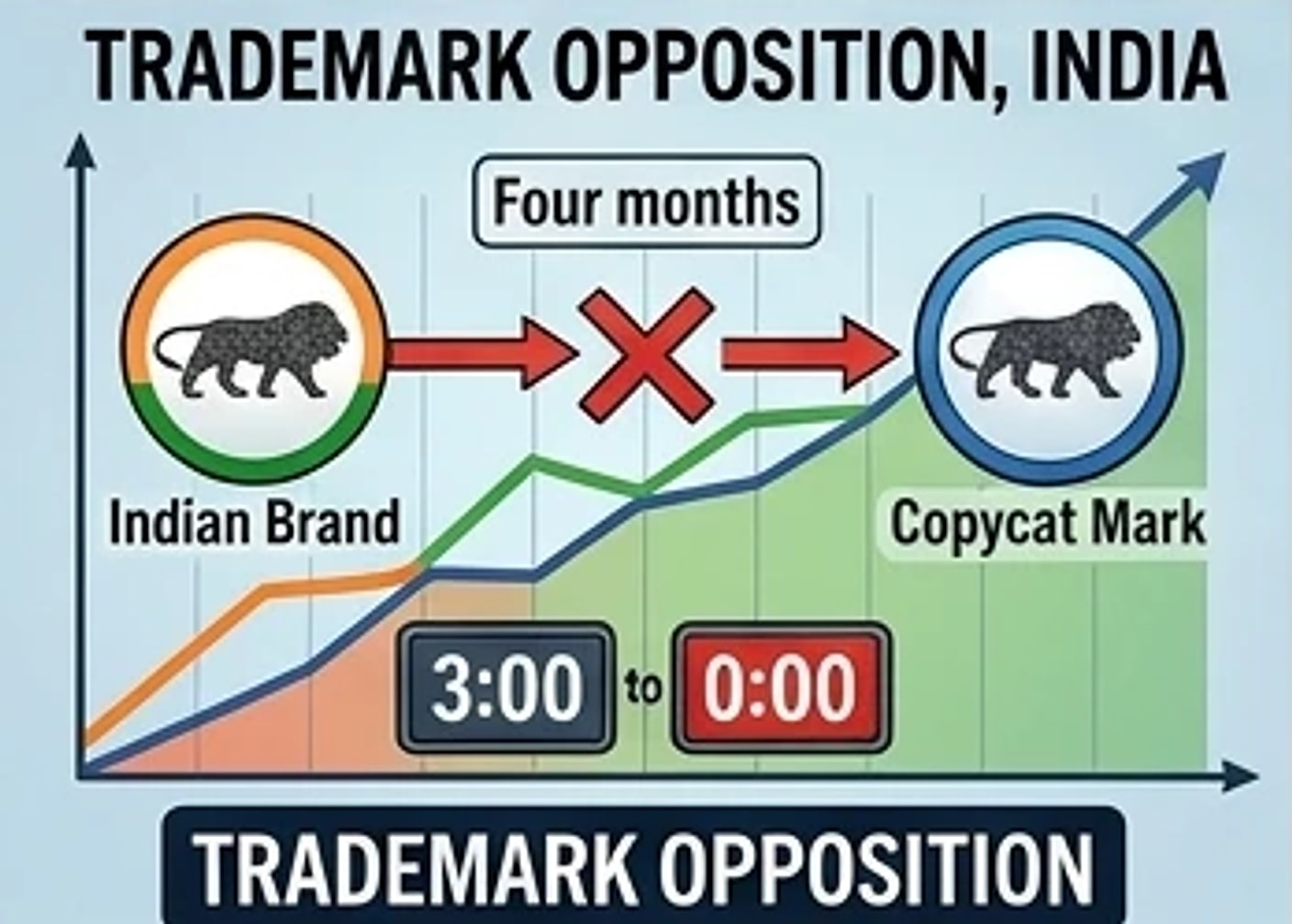
- You can oppose a trademark within four months of its advertisement in the Trade Marks Journal, extendable by one month on application and fee.
- File a notice of opposition on Form TM-O with clear grounds, and the applicant must file a counter-statement within two months.
- Evidence of use, reputation and sales decides most oppositions.
- A watch on the Journal is the best way to catch a copycat in time.
Trademark opposition India is the cheapest moment to stop a copycat. Once a mark is registered, you need a rectification petition or a full lawsuit. Before it is registered, in the window after it is advertised, you can file one form and force the applicant to defend its claim. The window is four months, and it doesn’t wait for anybody.
That is the step after the examination report and the hearing, and most brand owners only discover it when a competitor’s logo shows up on a shelf. This post walks through how to learn about the advertisement, what goes into the notice, how the counter-statement and evidence rounds work, and what usually goes wrong. Fees and forms change, so check the current schedule on the IP India site. Trademark opposition India is the cheapest moment to stop a copycat, and it only needs one form.
Finding out about the application
A mark is advertised in the Trade Marks Journal once the examiner accepts it, or accepts it subject to conditions. The Journal is published weekly and is online. Watching it for marks similar to yours is the standard defence, and most brand owners pay a watch service or an attorney to do it. If you only search occasionally, you can miss an advertisement that is open for just four months. Trademark opposition India starts with watching the Journal.
There is an earlier chance. A third party can file a letter of protest while an application is still being examined, pointing out its prior rights to the examiner. A letter of protest trademark India users file has no right to be heard and doesn’t bind the Registrar, but it can lead to an objection that you’d otherwise have to fight later.
Set up a watch in the classes that matter and include phonetic and visual variants, including Hindi transliterations and spelling changes. Copycats seldom use your exact name. They change a letter, add a word or flip the design.
Filing the notice within four months
Section 21 of the Trade Marks Act, 1999 allows any person to oppose within four months of the advertisement, extendable by one month on application and fee. The four months from advertisement Trade Marks Journal date is a hard stop in practice. Don’t plan on the extension. File early. For trademark opposition India applicants file within four months, so diarise the day of advertisement.
You oppose by filing a notice of opposition, using Form TM-O, with the grounds and fee. The notice must say why the mark shouldn’t be registered: it conflicts with your earlier mark, it is similar to your well-known mark, it is deceptive, it was applied for in bad faith, it would amount to passing off, or one of the absolute grounds applies. Notice of opposition Form TM-O drafting is where most of the value is. A vague notice is a weak start.
Cite your own rights clearly: registration numbers, dates of first use, the territories and goods or services. Attach what you can. If you have no registration yet, you may still rely on prior use and passing off, though it is harder to prove. Serve nothing yourself: the Registry sends the notice to the applicant. A weak notice undermines trademark opposition India brand owners hope to win.
Counter-statement, evidence and hearing
The applicant must file a counter-statement within two months of receiving a copy of the notice. If it doesn’t, it is treated as abandoning the application. That is a common result when the applicant is a small trader who ignores the post. A counter-statement trademark opposition filing sets out the applicant’s case in reply. A trademark opposition India case moves in rounds.
| Stage | Time limit | Note |
|---|---|---|
| Notice of opposition (Form TM-O) | Four months from advertisement, extendable by one month | Section 21 |
| Counter-statement | Two months from the notice | Failure means abandonment |
| Evidence rounds | Periods set by the Rules | Use affidavits and exhibits |
| Hearing and decision | Before the Registrar | Appeal to High Court |
Next come the evidence rounds. The opponent files evidence in support, usually an affidavit with exhibits showing use, sales, advertising and reputation. The applicant then files evidence in answer, and the opponent may file evidence in reply. Each round has a time limit in the Rules, so check the current periods. Evidence in trademark opposition India is decisive, because the Registrar relies on it.
A hearing follows before the Registrar. Both sides argue on the documents, and a decision is issued later. Either side can appeal to the High Court. The process can take a year or more, and some oppositions settle with a coexistence agreement or a withdrawal along the way. A hearing closes the trademark opposition India process before the Registrar.
What makes an opposition strong
Evidence of use is everything. Invoices, advertising spend, press, awards, website traffic and testimonials, dated and linked to your mark, carry more weight than the argument that the marks look alike. If your brand is well known, say so with proof. The Registrar often weighs the strength of reputation more than minor differences in design. Strong trademark opposition India cases rest on use evidence.
Choose grounds with care. Pleading every ground in the Act dilutes the case. Lead with your strongest: confusing similarity with an earlier mark, passing off, or bad faith if you can show the applicant knew about you. Bad faith can be shown by a history of dealings with the applicant, copying of your packaging or an obvious attempt to ride on your name.
Keep an eye on the cost and the point. An opposition costs less than a suit but more than many founders expect. If the copycat is small and unlikely to threaten you, a warning letter might do. If it is a serious competitor or a squatter in your category, an opposition is the right move. Our posts on squatting and examination reports sit alongside this one. If the copycat is small, weigh trademark opposition India costs against a warning letter.
Questions people ask
The main message is about timing. Everything else is workable if you are inside the four months, and much harder if you aren’t.
Related reading: defending a trademark opposition in India, what a trade mark examination report is asking, trademark status meanings in India, spotting trademark squatters in India, well-known trademarks in India and trademark renewal in India; also replying to a trademark infringement notice and well-known trademark status in India.
Quick answers
How long do I have for trademark opposition India applicants can use?
Four months from the date of advertisement in the Trade Marks Journal, extendable by one month on application and fee under Section 21 of the Trade Marks Act, 1999.
What is Form TM-O?
It is the notice of opposition filed with the Registrar to oppose a trademark application, stating the grounds. The applicant then files a counter-statement within two months.
What happens if the applicant doesn’t file a counter-statement?
The application is treated as abandoned, so the opposition succeeds by default. Check the Registry record for the status and dates.
What happens if the applicant does not reply?
The application is treated as abandoned, so the opposition succeeds by default.
Final word
Halverton & Co. is an Indian law firm advising founders, startups, technology companies and investors on Indian law, including trade mark opposition, watch services and brand enforcement in India for startups and foreign brand owners. We practise in Jharkhand, Maharashtra and before the Supreme Court of India, and act as fractional legal counsel for technology-driven businesses. Halverton & Co.: Where tech needs law! If you have a question about Indian law, write to us at office@halvertonandco.com, or get in touch.
This article reflects developments reported up to 31 October 2026. It is for general information only, is not legal advice, and does not create an advocate-client relationship. Halverton & Co. is an Indian law firm.
Sources
Related practice area
Intellectual Property
Trade marks, copyright, patents and designs. Searched, filed, licensed and enforced under Indian law.
View the practice areaComments
No account needed. Comments are reviewed before they appear, so yours will show here once approved. Please do not share confidential details or describe your own legal matter: replies are general discussion, not legal advice, and do not create an advocate-client relationship. For your own situation, write to office@halvertonandco.com.