Key takeaways
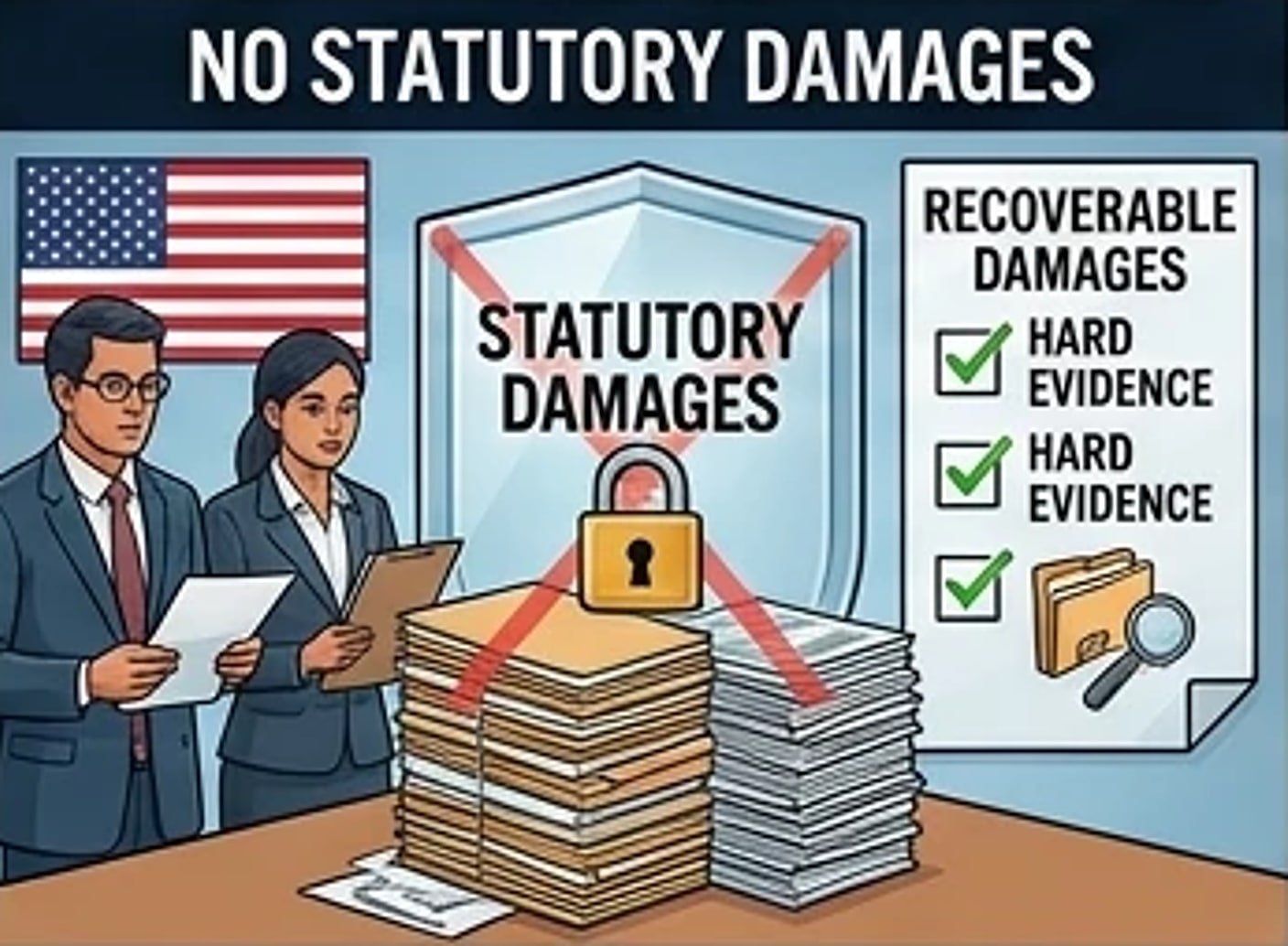
- Indian trademark law has no statutory damages scheme, so recovery depends on proof of loss or the defendant’s profits.
- Section 135 allows injunctions, damages or an account of profits and delivery up of infringing goods.
- Delhi High Court judges have awarded punitive damages in clear counterfeiting cases, and the Commercial Courts Act allows actual costs.
- Collection from small sellers can be hard, so brands often aim for the injunction and destruction of stock.
A US brand owner used to the Lanham Act expects a number. In the US, statutory damages for counterfeiting can run from $1,000 to $200,000 per mark per type of goods, and more for willful cases, without proving a cent of loss. The question of trademark infringement damages India courts award starts with a disappointing answer: there is no statutory damages scheme in Indian trademark law.
That doesn’t mean there’s nothing to win. Indian courts, especially the Delhi High Court’s IP Division, regularly grant injunctions, order delivery up of fakes, award damages or an account of profits and, in the right case, punitive damages and full legal costs. The practical message for a US brand: you will recover less than a US jury might give, but the interim and enforcement tools are strong. Here is how it works in practice. On trademark infringement damages India courts give, expect orders and costs more than a headline number.
What Indian law gives you
Section 135 of the Trade Marks Act, 1999 sets out the civil remedies for infringement and passing off. A court may grant an injunction, and, at the claimant’s option, damages or an account of profits, together with an order for delivery up of the infringing labels and marks for destruction or erasure. That is the whole list. There is no schedule of fixed sums, so statutory damages trademark India lawyers can point to simply don’t exist. For trademark infringement damages India has no schedule of sums, so proof decides everything.
Everything is therefore about proof. Damages need evidence of loss, an account of profits needs evidence of what the defendant earned, and the court decides the sum. A brand that has been careful with evidence from the start has a much better outcome than one that relies on the label “counterfeit”.
Compared with the US, two things stand out. Remedies come mostly in the form of orders, not awards. And the volume of cases that end by consent decree or default judgment is high, because defendants who don’t appear lose by default. For a brand fighting counterfeiters, an injunction plus destruction of stock can be worth more than a damages figure that is hard to collect. Overall, trademark infringement damages India courts award depend on evidence and conduct.
Damages, profits and punitive awards
In many counterfeiting cases the defendant doesn’t show up or doesn’t produce accounts. Delhi High Court judges, faced with that, have awarded punitive or exemplary damages to deter repeat offenders, along with compensatory damages. Cases involving well-known brands often end with decrees of several lakh to a few crore rupees. Outcomes vary a great deal by judge and facts, and published awards are only a guide. Trademark infringement damages India judges award in counterfeiting cases are sometimes punitive.
| Remedy | Available? | Note |
|---|---|---|
| Injunction | Yes | Interim and final |
| Damages or account of profits | Yes, at your option | Needs evidence |
| Delivery up of infringing goods | Yes | Destruction or erasure |
| Statutory damages | No | Not in Indian law |
| Actual costs | Often, under the Commercial Courts Act | Keep fee records |
Courts have said that punitive damages punish deliberate and flagrant infringement. They may also be given when the infringer’s profits can’t be measured. The punitive damages Delhi High Court trademark decisions reflect a sense that an injunction alone is too weak against organised sellers of fakes.
An account of profits is the other route. The defendant must disclose sales and profits from the infringing goods, and the claimant gets those profits. It needs a defendant who engages, and it takes time. Brands usually choose damages when they can show a clear loss, and an account of profits when the defendant clearly made money. The account of profits trademark India route is slower but can be more accurate. The account of profits trademark India route depends on the defendant disclosing sales.
Costs and the Commercial Courts Act
Trademark suits above the specified value are commercial disputes under the Commercial Courts Act, 2015. Section 35 of that Act, as amended, lets the court award actual costs to the winner, including lawyers’ fees and the cost of witnesses, and take account of conduct such as delaying tactics. That gives you a real chance of recovering what you spent, which is not usual in the US. Trademark infringement damages India can be topped up with costs under the Commercial Courts Act actual costs principle, which is rare elsewhere.
The Commercial Courts Act actual costs principle has changed behaviour. The Delhi High Court has awarded costs running to substantial sums in clear counterfeiting cases and in cases where the defendant behaved badly. If you can document your fees and expenses, you can ask for them. Keep invoices by task. Courts can order costs Commercial Courts Act actual costs allow, which helps a winning brand.
The Act also allows summary judgment in suitable cases, where the defendant has no real prospect of success, and case management that speeds trial. Those features help a brand that has a clean case and wants a decision within a reasonable time. Summary judgment can speed trademark infringement damages India claims against defendants with no defence.
How to build a recovery case
Start before you sue. Gather test purchases with invoices, photographs, packaging, seller details, sales data from marketplaces and evidence of your own sales and margins in the area. A court is more likely to award damages when you can show the infringer sold at scale. Ask your Indian lawyer whether to seek a local commissioner to inspect and seize goods, which also produces sales records. To build trademark infringement damages India claims, keep evidence organised from day one.
Plan the order of steps. An interim injunction and a John Doe or ashok kumar order, which lets the claim extend to unknown sellers, can stop the sales quickly. Delivery up counterfeit goods India courts order removes stock from the market. Then pursue damages or an account if the defendant is solvent and worth pursuing.
Be realistic about collection. A judgment against an individual seller in a small town may be easy to win and hard to collect. Brands should weigh cost against likely return and use the injunction, the destruction and the deterrent effect. Often the aim is stopping the supply chain, not the award. Our posts on counterfeit goods and customs recordal cover the wider toolkit. Collection is the practical limit on trademark infringement damages India brands actually receive.
Questions people ask
In short, the system rewards brands that arrive with proof and Indian counsel who know the bench. Fixed numbers are not on offer, but credible numbers can be won. Brands should expect orders more than numbers when pursuing trademark infringement damages India courts handle.
Related reading: counterfeit goods sold online in India, counterfeit goods in India: remedies for UK brands, customs recordal in India for UK brands, what a US company pays for an Indian trade mark, Indian courts blocking pirate sites and trademark squatting in India for US companies; also passing off in the UK and India; also replying to a trademark infringement notice and well-known trademark status in India.
Quick answers
Are there statutory damages for trademark infringement in India?
No. Indian law has no fixed statutory damages scheme. A court can award damages or an account of profits under Section 135 of the Trade Marks Act, order delivery up, and in some cases punitive damages and costs.
Can a US brand recover legal costs in India?
Often yes. Under the Commercial Courts Act, the court can award actual costs to the winner, taking account of the other side’s conduct. Keep detailed fee records.
How much can I recover for trademark infringement in India?
It depends on your proof of loss, the defendant’s profits, the court and the case. Awards vary widely, and collecting from small sellers can be difficult.
Can a US brand recover legal costs in India?
Often yes. The Commercial Courts Act allows actual costs to the winner, so keep detailed fee records.
Final word
Halverton & Co. is an Indian law firm advising US companies, founders, investors and law firms on Indian law, including trade mark enforcement and anti-counterfeiting litigation in India for US and other foreign brand owners, working alongside US counsel. We practise in Jharkhand, Maharashtra and before the Supreme Court of India, and work alongside US counsel, who advise on US law. Halverton & Co.: Where tech needs law! If you have a question about Indian law, write to us at office@halvertonandco.com, or get in touch.
This article reflects developments reported up to 31 October 2026. It is for general information only, is not legal advice, and does not create an attorney-client relationship. Halverton & Co. is an Indian law firm and does not advise on US law; US-law points should be confirmed with US counsel.
Sources
Related practice area
Intellectual Property
Trade marks, copyright, patents and designs. Searched, filed, licensed and enforced under Indian law.
View the practice areaComments
No account needed. Comments are reviewed before they appear, so yours will show here once approved. Please do not share confidential details or describe your own legal matter: replies are general discussion, not legal advice, and do not create an advocate-client relationship. For your own situation, write to office@halvertonandco.com.