Key takeaways
- Preserve forensic images, access logs and git history before locking accounts or wiping devices.
- A civil suit can seek an interim injunction for breach of confidence and copyright, and a local commissioner can inspect devices.
- Section 43 and 66 of the IT Act and BNS provisions give civil and criminal routes, but use them carefully.
- A post-employment non-compete is generally void in India, so rely on confidentiality and IP terms.
You find out on a Monday. A senior developer resigned on Friday, and the logs show a full repository clone to a personal laptop the night before. Whatever you do in the next 48 hours decides whether source code theft India legal action is straightforward or a mess. Most startups lose time because nobody has a plan. They send an angry email, lock the account, wipe the laptop, and in doing so destroy the evidence they will need.
This post is about the first days and the choices after: how to preserve proof, which civil and criminal routes exist in India, what a court can order quickly, and what you can’t do. Indian law has no stand-alone trade secrets statute, so the claim runs through contract, confidence, copyright and the IT Act. That makes evidence and speed even more important. Our post on trade secret theft by former employees for US companies covers a related cross-border view. Source code theft India legal action goes better with a plan. If an employee copied source code remedies exist, but evidence comes first.
The first 48 hours
Don’t wipe, reset or reissue the employee’s laptop and accounts. Image them. A forensic copy of the device, the cloud drives, the code hosting service and the email account, made by someone who can later testify, is the core of any case. Export the access logs, git history, download records, VPN logs and badge records, and preserve them with a note of who took them and when. Source code theft India legal action starts with evidence, not with an angry email.
Next, freeze further access without destroying records. Disable credentials, rotate secrets and API keys in the code that was copied, and check whether production systems were touched. Look at what was taken: the repository, which branches, which modules, and whether customer data was included, because that affects other legal duties including data breach reporting.
Write down the timeline now while people remember it. Collect the employment contract, the confidentiality and IP assignment clauses, the acceptable use policy and any exit paperwork. If the employee signed something at joining about company property, that signed copy is what you will rely on. A source code theft India legal action rarely succeeds without a signed document and a clean log. A signed contract and a clean log make source code theft India legal action much stronger.
What a civil claim looks like
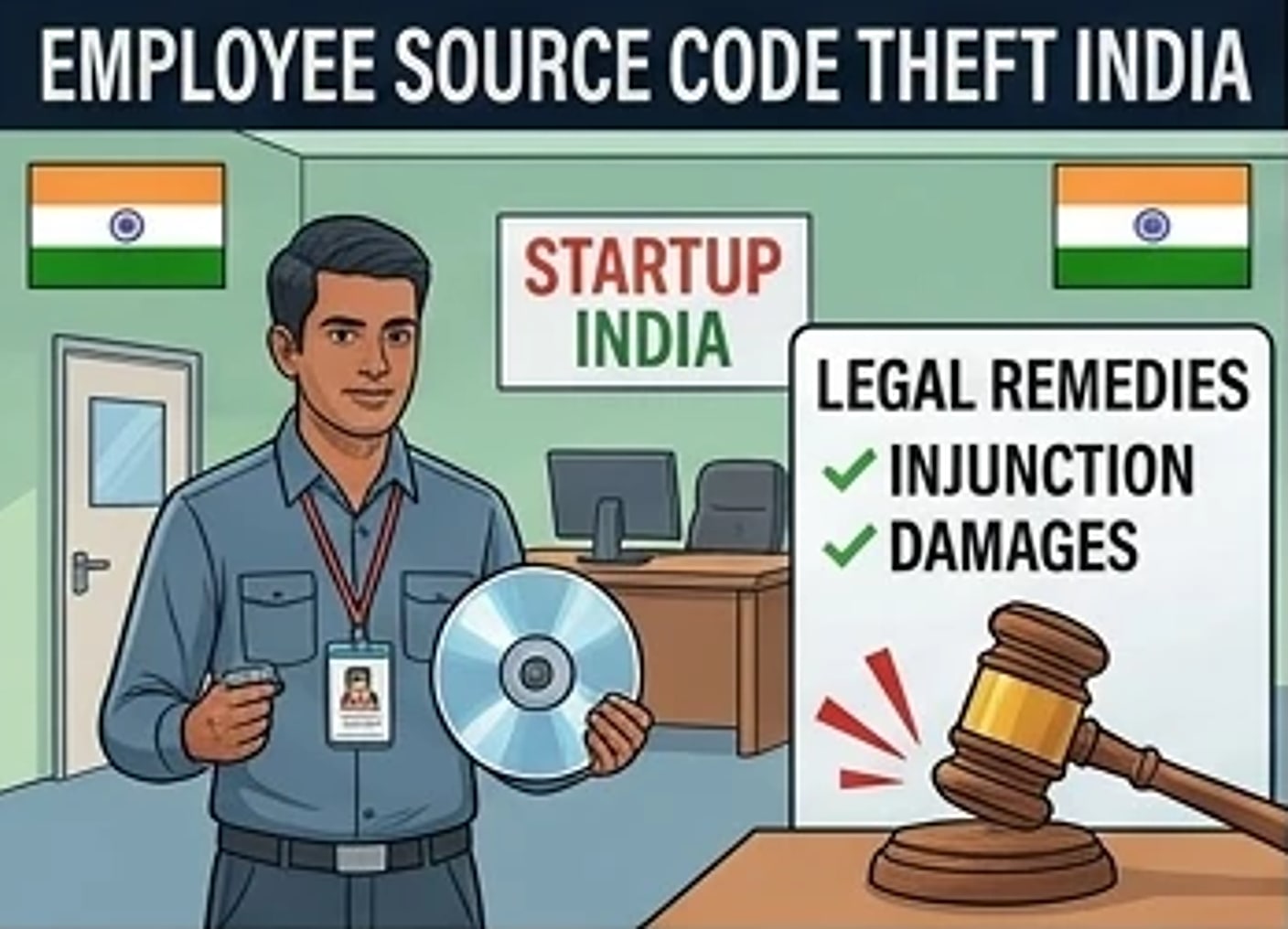
A civil suit is usually the first formal step. The claims commonly pleaded are breach of the confidentiality terms in the employment contract, breach of confidence in equity, copyright infringement under the Copyright Act, and, if the code is being used in a rival product, passing off or unfair competition. The reliefs sought are an injunction, delivery up of the code and devices, damages or an account of profits. In civil source code theft India legal action, the main claims are breach of confidence and copyright.
| Route | What it can give | Note |
|---|---|---|
| Civil suit | Injunction, delivery up, damages | Needs evidence and speed |
| Local commissioner | Inspection and seizure of devices | Strong evidence required |
| IT Act Section 43 and 66 | Compensation and offence | Unauthorised access and copying |
| BNS and Copyright Act | Criminal breach of trust, infringement | Use carefully |
An interim breach of confidence injunction India courts grant can stop the former employee from using or disclosing the code while the suit goes on. Courts look at three things: a prima facie case, balance of convenience and irreparable harm. Evidence that the code is confidential, that you took reasonable steps to protect it and that the employee had it is what persuades.
In urgent cases the High Court can appoint a local commissioner to attend the defendant’s premises, inspect devices and make copies, which is the Indian counterpart of an Anton Piller order. A local commissioner seizure Delhi High Court judges grant is a strong tool, but it needs strong evidence and clear drafting of what is to be searched. Expect to give an undertaking to pay damages if you are wrong. Be ready for a hard look at your own security in any source code theft India legal action.
Criminal and IT Act routes
Several provisions can apply. Section 43 of the IT Act gives a civil remedy of compensation for unauthorised access to, or copying of, data from a computer system. Section 66 makes it an offence to do those acts dishonestly or fraudulently. The Section 43 IT Act unauthorised copying provision is often pleaded together with the criminal one, because compensation claims go before an adjudicating officer. A criminal complaint is an option in source code theft India legal action, not the first step.
The Copyright Act has criminal provisions for knowing infringement of software, and the Bharatiya Nyaya Sanhita covers offences such as criminal breach of trust, cheating and, in some cases, theft of property. A criminal breach of trust Bharatiya Nyaya Sanhita complaint can be made to the police, who can investigate and, if there is a cognisable offence, register an FIR. Police can seize devices.
Use criminal routes carefully. A police complaint adds pressure and can lead to seizure, but it also takes control out of your hands, may be slow, and can backfire if it looks like harassment of a former employee. Many startups pursue the civil route first and keep the criminal complaint as an option. Take advice on the order.
Limits and what not to do
Don’t rely on a non-compete. Section 27 of the Contract Act makes post-employment restraints on trade void in India, so a clause that says the employee can’t work for a competitor is usually unenforceable. Confidentiality and IP assignment clauses are enforceable, and they are the ones to rely on. So a claim should be framed around the copying of code, not the new job. In source code theft India legal action, the non-compete isn’t the claim to run.
Don’t threaten criminal action to extract a settlement, which can itself raise legal problems. Don’t contact the new employer with accusations before you have evidence, because a defamation claim is possible. Do send a measured cease and desist letter once you have the facts, through a lawyer, demanding return and deletion and an undertaking.
Prevention is cheaper. Control who can clone repositories, use data loss prevention tools, log downloads, require signed IP and confidentiality terms at joining, run exit checks and remind leavers of their duties in writing. Courts give more weight to companies that took reasonable steps to keep code secret.
Questions people ask
The pattern is the same in most cases: quick evidence, a clear contract and a lawyer who has done it before. Source code theft India legal action depends on quick evidence and a clear contract.
Related reading: trade secret theft in India: remedies for US companies, trade secret protection for source code in India, IP assignment for Indian developers and US startups, trade secrets: UK and India, AI tools at work and confidentiality in India and NDA enforceability in India; also the DTSA and foreign trade secret theft.
Quick answers
What can I do about source code theft India companies face from ex-employees?
Preserve forensic evidence, send a measured legal notice, and seek an interim injunction and, if needed, a local commissioner in a civil suit for breach of confidence and copyright infringement. Criminal complaints under the IT Act and BNS are also available.
Can I stop an employee joining a competitor in India?
Usually not by a post-employment non-compete, because Section 27 of the Contract Act makes such restraints void. You can enforce confidentiality, IP assignment and non-solicitation in some cases.
Is copying source code an offence under the IT Act?
Dishonest or fraudulent unauthorised access and copying can be an offence under Section 66 and a civil wrong under Section 43. Take legal advice on the right provisions.
Can I stop an employee joining a competitor?
Usually not by a non-compete, because Section 27 of the Contract Act makes such restraints void.
Final word
Halverton & Co. is an Indian law firm advising founders, startups, technology companies and investors on Indian law, including technology and IP disputes for Indian startups, including employee code theft and confidentiality breaches. We practise in Jharkhand, Maharashtra and before the Supreme Court of India, and act as fractional legal counsel for technology-driven businesses. Halverton & Co.: Where tech needs law! If you have a question about Indian law, write to us at office@halvertonandco.com, or get in touch.
This article reflects developments reported up to 31 October 2026. It is for general information only, is not legal advice, and does not create an advocate-client relationship. Halverton & Co. is an Indian law firm.
Sources
Related practice area
Intellectual Property
Trade marks, copyright, patents and designs. Searched, filed, licensed and enforced under Indian law.
View the practice areaComments
No account needed. Comments are reviewed before they appear, so yours will show here once approved. Please do not share confidential details or describe your own legal matter: replies are general discussion, not legal advice, and do not create an advocate-client relationship. For your own situation, write to office@halvertonandco.com.