It usually arrives without warning: an email from the Income Tax Department saying that its records show crypto transactions that don’t seem to be reflected in your income tax return, and inviting you to review and update it. It’s polite, not threatening, but it’s also very clear that the department knows something.
If you’ve received a crypto nudge email, don’t panic and don’t ignore it. This guide explains what the NUDGE campaign is, how the department knows about your crypto, how to check the email is genuine, how to respond, and the remedies and risks if you don’t. For the underlying rules, see our guide to crypto tax in India.
What the NUDGE campaign is
NUDGE stands for “Non-intrusive Usage of Data to Guide and Enable”. It’s a campaign run by the Income Tax Department and the CBDT on a “trust taxpayers first” philosophy, sending emails to people who have undertaken crypto transactions but don’t appear to have reflected the income properly in their returns, nudging them to file an updated return. The 2025 campaign covered assessment years 2023-24 and 2024-25 and was the third in the NUDGE series, after campaigns on foreign assets and bogus political donation deductions.
The scale is substantial. The Finance Ministry told the Rajya Sabha that 44,057 emails and messages had been sent to taxpayers who invested and traded in VDAs but didn’t report them in Schedule VDA of their returns, and that undisclosed VDA income of about ₹630 crore had been detected in search and survey operations. Later secondary reports put the undisclosed VDA income identified at a higher figure, so treat figures beyond the parliamentary answer with caution.
How the department knows about your crypto
Since 1 July 2022, the 1% TDS on crypto transfers has acted as a direct report to the Income Tax Department. The department matches income tax returns against the TDS returns filed by virtual asset service providers, such as crypto exchanges, to find discrepancies.
Its data analytics flag several patterns: taxpayers who didn’t file Schedule VDA at all, and those who declared crypto income incorrectly, for example by claiming lower tax rates or disallowed deductions such as indexation. Many crypto nudge emails are triggered simply because someone reported crypto gains as capital gains at a lower rate, rather than at the flat 30%.
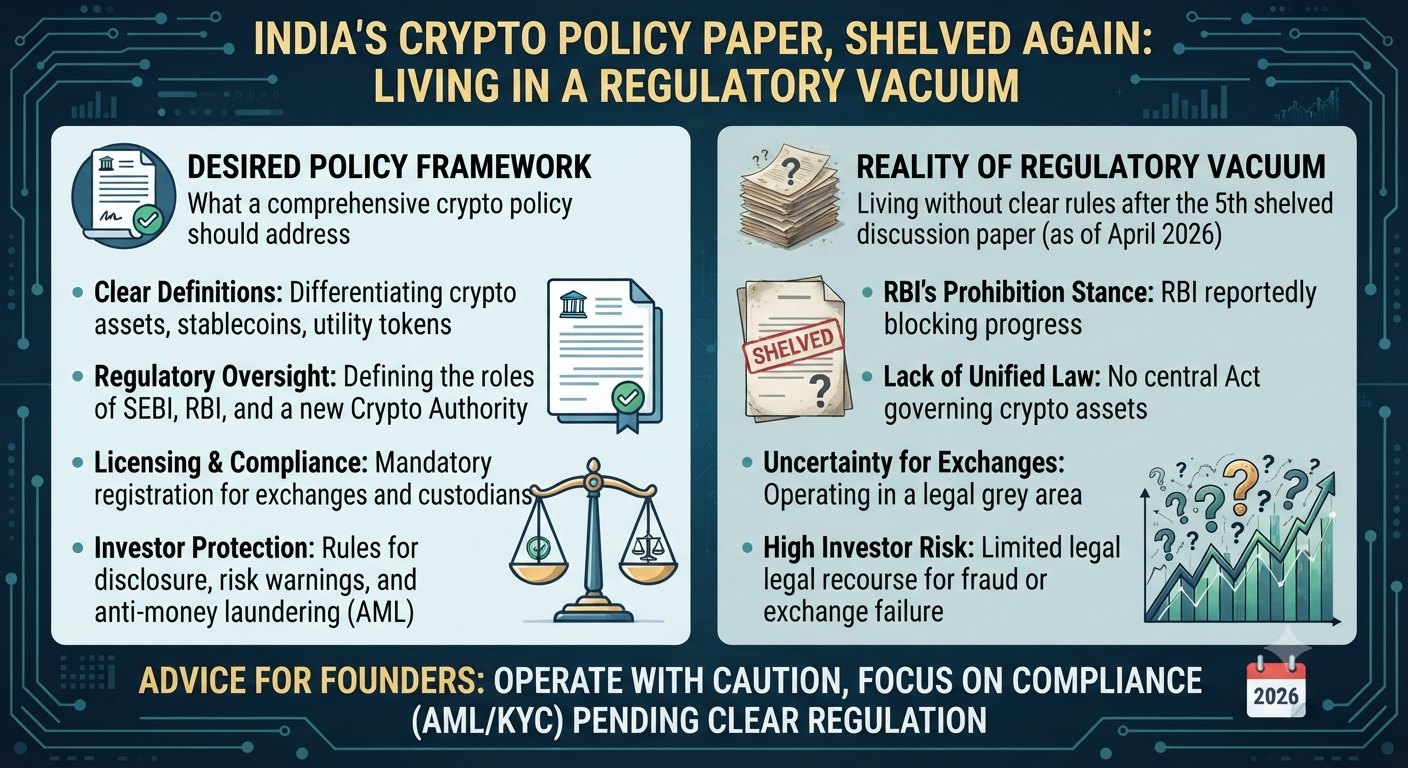
The reporting net has since tightened further. Under the Income-tax Act, 2025, which came into force on 1 April 2026, exchanges have formal obligations to report crypto transactions to the department, and reporting entities must disclose crypto transactions in the prescribed statements. See our guide to the Income-tax Act 2025 for startups for how the renumbered provisions work. The wider policy backdrop is covered in our guide to India’s shelved crypto policy paper.
How to respond to a crypto nudge email
Step one is to check the email is genuine. Scammers copy official emails to steal data or money. Genuine emails from the department typically come from domains such as @incometax.gov.in or @gov.in. Never click links asking for passwords or payments. Log in to the income tax portal directly and check your Annual Information Statement (AIS) and any communications there.
Step two is to reconstruct your crypto activity. Download transaction histories from every exchange and wallet for the years in question, match them with the TDS entries in your Form 26AS and AIS, and calculate your gains correctly: 30% on each profitable transfer, no deduction except the cost of acquisition, and no set-off of losses.
Don’t forget smaller details. Crypto received as payment for freelance work, airdrops, staking rewards and NFT sales may also need to be reported, and gifts of crypto from non-relatives above the exemption limit can be taxable. See our guides on stablecoins in India and NFT ownership. A crypto nudge email is a good moment to review everything, not just the transactions the department flagged.
Step three is to correct your return if it was wrong. If the original due date for revising has passed, you can file an updated return (ITR-U) within 48 months from the end of the relevant assessment year (the tax year under the new Act), with additional tax. Report crypto transaction-wise in Schedule VDA of ITR-2 or ITR-3. If you believe your original return was correct, respond through the portal with your explanation and supporting documents.
| Step | What to do |
|---|---|
| 1. Check it is genuine | Look for @incometax.gov.in or @gov.in, avoid links, log in to the portal directly |
| 2. Reconstruct activity | Download exchange and wallet histories, match with Form 26AS and AIS |
| 3. Compute correctly | 30% on gains, cost of acquisition only, no loss set-off, 1% TDS credit |
| 4. Correct or explain | File an updated return in time, or reply on the portal with evidence |
What happens if you ignore it
A crypto nudge email is the department’s soft step. When it detects evasion, its escalating actions include nudging taxpayers, e-verification, reassessment, surveys, and search and seizure operations. Ignoring a nudge makes those later steps more likely and removes your chance to correct the position cheaply.
The costs of waiting are significant. Under-reported income attracts a penalty of 50% of the tax, and misreporting up to 200%, on top of the tax and interest. An updated return filed voluntarily avoids most of those penalties, though it carries additional tax that rises the longer you wait. Where crypto is held on foreign exchanges or abroad and isn’t disclosed, the Black Money (Undisclosed Foreign Income and Assets) and Imposition of Tax Act, 2015 can apply, with far harsher consequences.
Professional help is worth considering where several years, foreign exchanges or large amounts are involved. A chartered accountant or tax lawyer can reconstruct the transactions, calculate the correct tax and draft a response that closes the issue rather than opening new questions. If you get a crypto nudge email but are confident your return was right, say so clearly and back it up. A short, well-documented reply through the portal often closes the matter, while silence leaves the department to draw its own conclusions.
There’s also a wider enforcement context. The Enforcement Directorate has been running parallel investigations into VDA-related money laundering, with large sums in linked proceeds reported as attached. Most nudge recipients are ordinary investors who made mistakes, not launderers, but correcting the record quickly keeps you firmly in the first category. Platforms must also stay registered; see our guide to FIU-IND registration.
Remedies, disputes and quick answers
If the department’s data is wrong, for example because TDS was wrongly attributed to you, an exchange reported a transaction twice, or a P2P counterparty used your PAN, ask the deductor to correct its TDS return and explain the mismatch through the portal with evidence. If you later receive a formal notice or assessment you disagree with, respond within the deadline, seek a stay of demand where needed, and appeal to the Commissioner (Appeals) and then the Income Tax Appellate Tribunal. Keep every record, because in crypto tax disputes the party with the better data usually wins. If a bank account is frozen as part of a wider inquiry, see our guide to frozen bank accounts.
Quick answers
Is a crypto nudge email a tax notice?
Not formally. It’s a non-intrusive reminder to review and update your return, but ignoring it can lead to formal notices and reassessment.
How long do I have to file an updated return for crypto income?
Up to 48 months from the end of the relevant assessment year, with additional tax that increases over time.
How do I know the email is real?
Genuine emails come from official domains such as @incometax.gov.in. Log in to the portal directly rather than clicking links.
Related reading: crypto tax in India vs the US; also Indian tax on crypto after moving to Dubai and Indians investing in crypto through Dubai: LRS and Schedule FA; also gifting crypto from Dubai to family in India and returning to India from Dubai with crypto.
Final word
At Halverton & Co., we advise founders, technology companies, investors and individuals on crypto tax compliance, updated returns, tax notices and appeals. We practise in Jharkhand, Maharashtra and before the Supreme Court of India, and act as fractional legal counsel for technology-driven businesses that need senior legal support without a full in-house legal team. Halverton & Co. is built on a simple idea: Where tech needs law! If this issue affects you or your business, write to us at office@halvertonandco.com, or get in touch, and we’ll help you work out where you stand.
This article reflects the law and developments reported up to early October 2026. It is for general information only and is not legal advice. Please take advice on your specific facts before acting.
Related practice area
Crypto, Web3 & Digital Assets
Advice for virtual digital asset businesses on registration, reporting and structure.
View the practice area