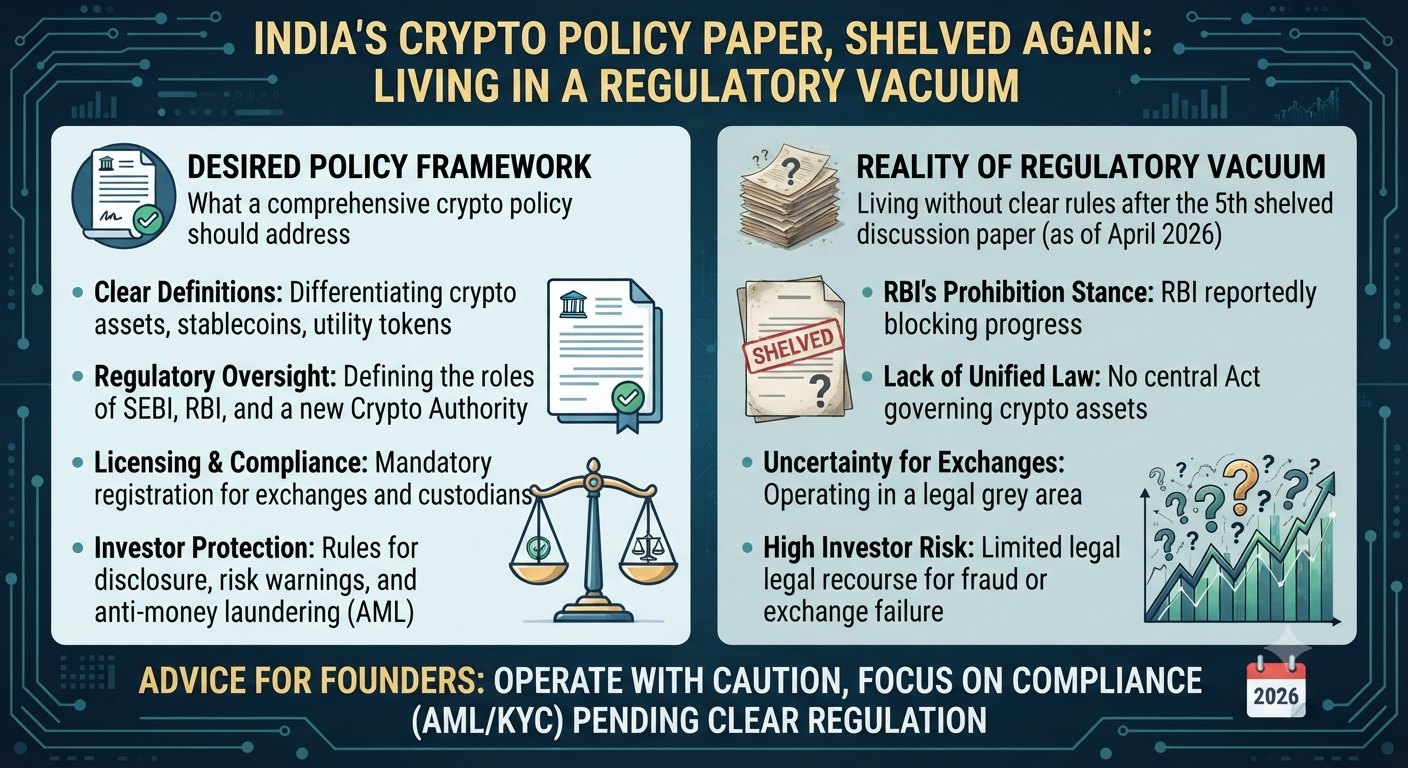
For more than two years, India’s crypto industry has been waiting for one document: the government’s crypto policy discussion paper, meant to set out how India would approach regulation using global frameworks. It has been promised repeatedly. And as of April 2026, it was reportedly shelved again, for the fifth time.
This guide explains what happened to the discussion paper, what “regulatory vacuum” really means in practice, which rules already apply to crypto businesses and investors, and what founders can and can’t rely on while crypto policy in India remains unsettled.
What happened to the crypto policy discussion paper
India’s crypto policy paper, intended to outline regulation using global frameworks, has been repeatedly delayed since 2024 due to RBI opposition, and in April 2026 it was reportedly shelved again. One tracker records that the RBI blocked a draft said to have been in “final stages” since May 2025, citing the risk that regulation would give crypto legitimacy, and describes a continuing impasse between the Finance Ministry and the RBI.
International observers have noticed. The TRM Labs Global Crypto Policy Review observed that broader regulatory clarity in India continues to prove elusive, as another year passed without the long-awaited discussion paper. Meanwhile, internal RBI documents reported in July 2026 suggest the central bank’s preferred direction is restriction, not regulation; see our guide to the RBI’s push towards a crypto ban.
What “regulatory vacuum” really means
The phrase “regulatory vacuum” is popular but misleading. India has no dedicated crypto statute, no licensing regime for exchanges, no investor protection framework, and no rules on custody, disclosures or market abuse. In that sense, there is a vacuum. But crypto isn’t unregulated. It’s governed piecemeal by laws designed for other purposes.
The practical consequences are real. There’s no regulator to approve a crypto business model in advance, no deposit insurance or compensation scheme when an exchange fails, and no clear rules on whether particular tokens are securities. Founders can’t get a licence that tells banks, investors and customers “this business is approved”, which makes banking relationships, fundraising and partnerships harder.
For investors, the absence of an investor protection regime means that when things go wrong, as in the WazirX hack, remedies depend on general contract, property and insolvency law, and on courts willing to apply them to crypto. See our guide to what to do when a crypto exchange is hacked.
The rules that already apply to crypto in India
Despite the missing crypto policy, a significant compliance framework already exists. Tax is the most developed part: a flat 30% tax on gains from virtual digital assets and 1% TDS on transfers; see our guide to crypto tax in India. The Finance Act, 2025 expanded the VDA definition to explicitly include crypto-assets from 1 April 2026, with new exchange reporting obligations under Section 509(1) of the Income-tax Act, 2025. Reporting entities face daily penalties for late statements and further penalties for incorrect reporting, so check the current amounts in the Act before relying on any figure.
Anti-money laundering is the second pillar. Since March 2023, virtual digital asset service providers have been reporting entities under the PMLA, must register with FIU-IND, and must follow its AML/CFT guidelines, updated in January 2026. FIU-IND has blocked and penalised offshore exchanges that failed to register. Our guide to FIU-IND registration explains the process.
Then there are the general laws: CERT-In’s cyber security directions, which include KYC and record-keeping duties for virtual asset service providers; FEMA for cross-border flows; consumer protection law; the DPDP Act for user data; and the criminal law for fraud. A crypto startup in India faces more compliance obligations than the phrase “regulatory vacuum” suggests.
| Area | What applies today |
|---|---|
| Tax | 30% on gains from virtual digital assets, 1% TDS, exchange reporting under Section 509(1) of the Income-tax Act, 2025 |
| Anti-money laundering | PMLA reporting entity status, FIU-IND registration and AML/CFT guidelines |
| Cyber security | CERT-In directions, including KYC and record-keeping for virtual asset service providers |
| Other | FEMA, consumer protection law, DPDP Act and criminal law on fraud |
What crypto founders can and can’t rely on
Founders can rely on the fact that operating a compliant, FIU-registered crypto business with proper tax reporting is lawful today. The Supreme Court’s 2020 decision in IAMAI v. RBI, which set aside the RBI’s 2018 banking restrictions on proportionality grounds, means that sudden, sweeping restrictions face real legal hurdles.
What founders can’t rely on is stability. There’s no guarantee of a licensing regime, no protection against future restrictions on banking access, and no certainty about the treatment of stablecoins, DeFi, token offerings or staking. Business models that depend on banks, offer yield products or issue tokens to the public carry the most regulatory risk. Token and NFT projects face extra ownership questions; see our guide to NFT ownership and IP rights.
There’s a cost to the uncertainty too: talent, capital and companies have moved abroad to clearer regimes, and every year without a coherent crypto policy makes that trend harder to reverse. Investors and founders should also watch for signals that crypto policy is moving. A published discussion paper, a draft Bill, new RBI circulars, changes to FIU-IND guidelines or tax amendments in a Budget would each show which direction India is taking. Until then, crypto policy in India is being made in pieces, through tax rules, anti-money laundering registration and court judgments, rather than through one coherent framework. The practical answer is to build for the strictest plausible future: strong KYC and AML, transparent tax reporting, segregation of customer assets, clear disclosures, sound cyber security, and contracts and corporate structures that would adapt if India introduces a licensing regime, or restrictions.
Remedies in a policy vacuum, and quick answers
Individual investors should be equally realistic. Without a dedicated crypto policy, there’s no compensation fund if an exchange collapses, no regulator to complain to about mis-selling, and no rules on how platforms must hold customer assets. Choosing reputable, FIU-registered platforms, keeping records and not holding more on any one exchange than you can afford to lose are the practical substitutes for missing regulation.
The vacuum also affects how founders raise money. Investors performing due diligence on Indian crypto startups now ask detailed questions about FIU-IND registration, tax reporting, banking relationships and contingency plans for a restrictive crypto policy. A startup that can answer those questions with documents, not promises, raises money more easily; see our guides to founders’ agreements and SAFE and convertible notes.
When there’s no crypto-specific regulator, disputes go to general forums. Investors can use contract and property law, which the Madras High Court strengthened in 2025 by treating crypto as property capable of being held in trust; consumer forums; arbitration under platform terms; and criminal complaints for fraud. Businesses facing arbitrary action, such as blocking orders, bank account closures or regulatory directions without a legal basis, can seek judicial review. For crypto policy in India to settle, the industry will also need to make its case in public consultations when the discussion paper finally appears.
Related reading: Dubai vs GIFT City for crypto and Web3 businesses and VARA licences and FIU-IND registration for Dubai exchanges.
Quick answers
Has India released its crypto discussion paper?
No. As of April 2026, it was reportedly shelved for the fifth time, with the RBI reportedly blocking a draft.
Is crypto unregulated in India?
Not entirely. It’s taxed at 30% with 1% TDS, exchanges must register with FIU-IND under the PMLA, and exchanges must report transactions under Section 509.
Is it legal to run a crypto startup in India?
Yes, provided it complies with tax, PMLA, CERT-In, FEMA and other applicable laws.
Final word
At Halverton & Co., we advise founders, technology companies, investors and individuals on crypto regulatory strategy, PMLA compliance, tax reporting and Web3 structuring. We practise in Jharkhand, Maharashtra and before the Supreme Court of India, and act as fractional legal counsel for technology-driven businesses that need senior legal support without a full in-house legal team. Halverton & Co. is built on a simple idea: Where tech needs law! If this issue affects you or your business, write to us at office@halvertonandco.com, or get in touch, and we’ll help you work out where you stand.
This article reflects the law and developments reported up to early October 2026. It is for general information only and is not legal advice. Please take advice on your specific facts before acting.
Related practice area
Crypto, Web3 & Digital Assets
Advice for virtual digital asset businesses on registration, reporting and structure.
View the practice area