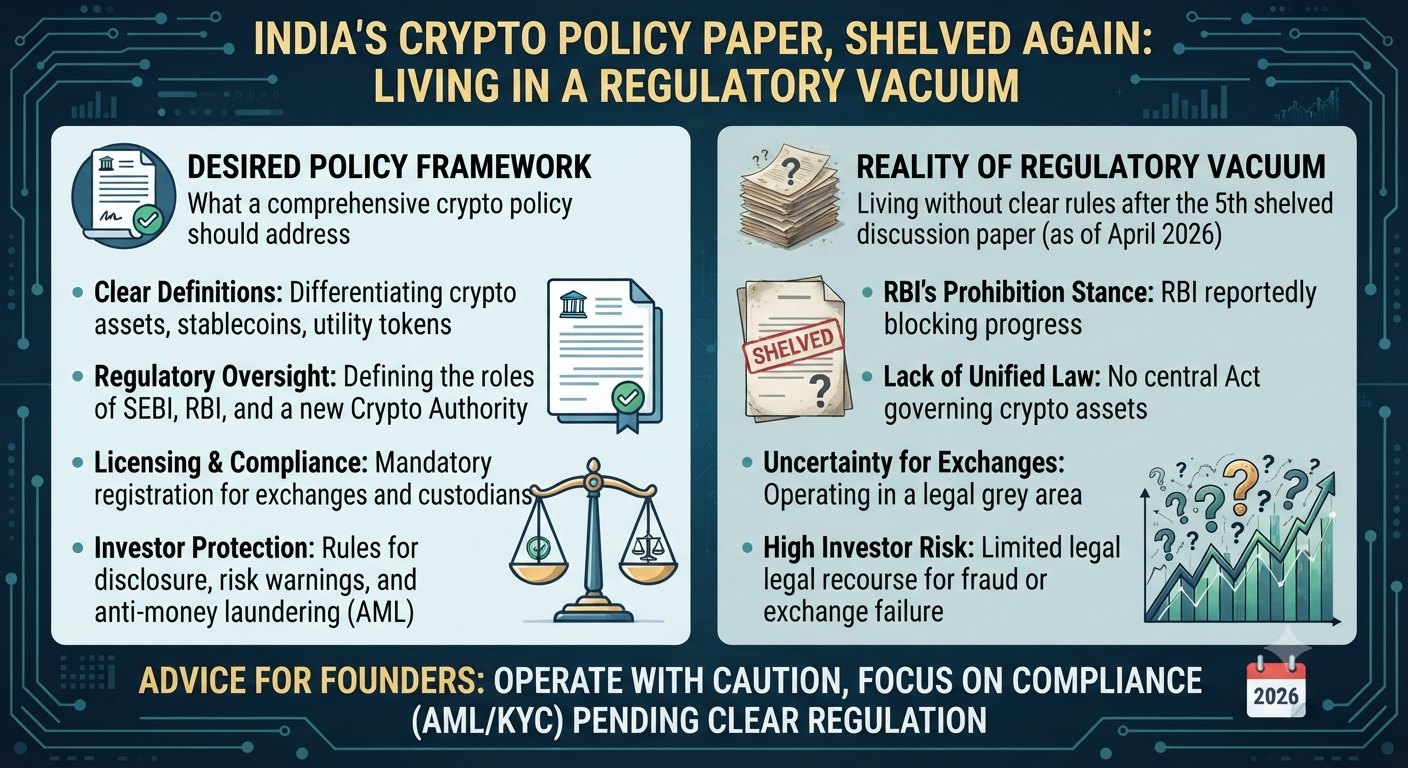

India’s 39 million or so crypto investors, on the figure reported, have lived with uncertainty for a decade: taxed heavily, regulated for money laundering, but never formally legalised or banned. In July 2026, a Reuters report suggested the uncertainty might be ending in the direction many feared. Internal documents showed the Reserve Bank of India pushing for policies “leaning towards prohibition”.
This guide explains what the RBI is reportedly proposing, why, what it would mean for investors and exchanges, the legal limits on any crypto ban, and the remedies available if restrictions arrive. The figures below are reported from those documents and should be read as reported, not as official statistics.
What the RBI is reportedly proposing
According to internal documents seen by Reuters, dating from May and June 2026, the RBI is recommending policies that lean towards a crypto ban, citing concerns about financial stability, monetary sovereignty and the difficulty of taxing crypto transactions. The documents suggest barring banks and financial institutions from holding, trading or gaining any exposure to crypto assets and privately issued stablecoins.
The RBI’s preference for restriction also extends to the use of crypto in payments and settlements, according to a background note to a parliamentary panel. RBI officials also warned that applying traditional regulation to crypto could give speculative assets a form of legitimacy.
It’s important to be precise about what this is. These are internal recommendations, not a law, a regulation or a binding RBI circular. Policy on crypto is ultimately for the government and Parliament, and the Finance Ministry has historically taken a more open view than the RBI. The policy paper that was meant to settle this has itself stalled; see our guide to India’s shelved crypto policy paper.
Why the RBI wants a crypto ban
The RBI’s concerns are long-standing, but the 2026 documents sharpen them. On stablecoins, the RBI views tokens backed by foreign currencies as a threat to rupee sovereignty, and it reportedly opposes both foreign-currency and rupee-pegged stablecoin models because of the risk of contagion. See our guide to stablecoins in India.
On tax, the documents point to an enforcement problem. India taxes crypto gains at 30%, but the tax department reportedly found that fewer than a quarter of those who made crypto transactions in the financial year ending March 2023 declared them, and estimates that India has nearly 39 million crypto traders. Indian investors were reported to hold about $2.1 billion in digital assets as of May 2026. That enforcement gap is why the department has been sending crypto nudge emails.
Underlying all of this is the RBI’s view that its own digital rupee (the CBDC) and India’s payment systems, such as UPI, meet the needs that crypto and stablecoins claim to serve.
The legal limits on any crypto ban
Indian crypto investors have been here before. In April 2018, the RBI barred regulated entities from dealing in virtual currencies or providing services to anyone dealing in them. On 4 March 2020, the Supreme Court set that circular aside in Internet and Mobile Association of India v. Reserve Bank of India (IAMAI v. RBI). The Court set it aside on proportionality grounds, while recognising the RBI’s power to regulate crypto-related risks.
That judgment shapes what the RBI can do now. A fresh restriction on banks would need a stronger factual basis and a proportionality analysis showing why lesser measures wouldn’t work. A complete ban on crypto ownership or trading would almost certainly need legislation by Parliament, rather than an RBI circular, and would face constitutional challenge under Article 19(1)(g), the right to carry on a trade or business.
The government also has to reconcile a ban with its own policy. It taxes crypto at 30% with 1% TDS, requires exchanges to register with FIU-IND under the PMLA, and since April 2026 requires them to report transactions to the tax department. Banning an activity that the state actively taxes and supervises would be a significant shift. See our guides on crypto tax and FIU-IND registration.
| Measure | Legal route | Main constraint |
|---|---|---|
| Barring banks from crypto exposure | RBI direction or circular | Proportionality test from IAMAI v. RBI (2020) |
| Banning ownership or trading | Act of Parliament | Article 19(1)(g) challenge; conflict with existing tax and PMLA regime |
| Restricting stablecoins in payments | RBI or government policy | Needs a clear legal basis and evidence of risk |
What it means for investors and exchanges right now
For investors, nothing has changed legally yet. Holding, buying and selling crypto through FIU-registered platforms remains lawful, subject to tax. The practical risk is a tightening of banking access. If banks are barred from crypto exposure, deposits to and withdrawals from exchanges could become harder, P2P trading could become riskier, and bank accounts used for crypto could face more scrutiny. See our guides on whether a bank can close your account for trading crypto and on frozen bank accounts.
Another consideration is international. Several major economies, including the United States, have moved towards regulating crypto and stablecoins rather than banning them, and India’s G20 work has emphasised coordinated global standards. Those developments don’t bind India, but they shape the arguments on both sides of the crypto ban debate. It’s also worth remembering how the 2018 episode played out. When banks withdrew services, exchanges moved to P2P models and some investors moved to offshore platforms, which made activity harder to monitor, not easier. Any new crypto ban debate will have to grapple with that experience, and with the reality that a ban on banks alone may push activity further outside the regulated system.
Sensible steps now include keeping full records of every transaction and reporting crypto correctly in your tax return, using FIU-registered platforms, avoiding over-reliance on any single exchange, and understanding how you would exit positions if banking rails narrowed. Investors should also be wary of panic. Selling everything on a headline about a crypto ban can crystallise losses and a 30% tax bill on any gains, while the policy itself may take years to arrive, if it arrives at all. Decisions are better made on actual legal changes than on reports of internal documents.
For exchanges and Web3 startups, the message is to build regulatory resilience: strong PMLA compliance, transparent tax reporting, diversified banking relationships, and active engagement in the policy process. Exchanges that can show they help the government track and tax crypto are in a stronger position to argue against prohibition.
Remedies if restrictions arrive, and quick answers
If the RBI issues new restrictions on banks, affected exchanges, businesses and industry bodies can challenge them in the High Courts or the Supreme Court, as IAMAI did in 2018, arguing disproportionality and the absence of a legislative basis. Individuals whose bank accounts are closed or restricted can use the bank’s grievance process, the RBI Integrated Ombudsman Scheme and, where appropriate, consumer forums. If Parliament legislates a ban, any law would likely provide a transition window, and investors would need advice on exiting positions lawfully and on the tax consequences. Until then, the best protection is compliance: investors and businesses with clean records are best placed whatever happens.
Related reading: Dubai vs GIFT City for crypto and Web3 businesses and Indians investing in crypto through Dubai: LRS and Schedule FA.
Quick answers
Has the RBI banned crypto in India?
No. Internal RBI documents reported in July 2026 recommend policies leaning towards prohibition, but no ban has been issued or enacted.
Can the RBI ban crypto on its own?
It can regulate banks’ exposure, but the Supreme Court struck down its 2018 restrictions as disproportionate. A full ban would likely need legislation.
Is it still legal to buy crypto in India?
Yes, through FIU-registered platforms, subject to 30% tax on gains and 1% TDS.
Final word
At Halverton & Co., we advise founders, technology companies, investors and individuals on crypto regulation, exchange compliance, banking restrictions and constitutional challenges. We practise in Jharkhand, Maharashtra and before the Supreme Court of India, and act as fractional legal counsel for technology-driven businesses that need senior legal support without a full in-house legal team. Halverton & Co. is built on a simple idea: Where tech needs law! If this issue affects you or your business, write to us at office@halvertonandco.com, or get in touch, and we’ll help you work out where you stand.
This article reflects the law and developments reported up to early October 2026. It is for general information only and is not legal advice. Please take advice on your specific facts before acting.
Related practice area
Crypto, Web3 & Digital Assets
Advice for virtual digital asset businesses on registration, reporting and structure.
View the practice area