Key takeaways
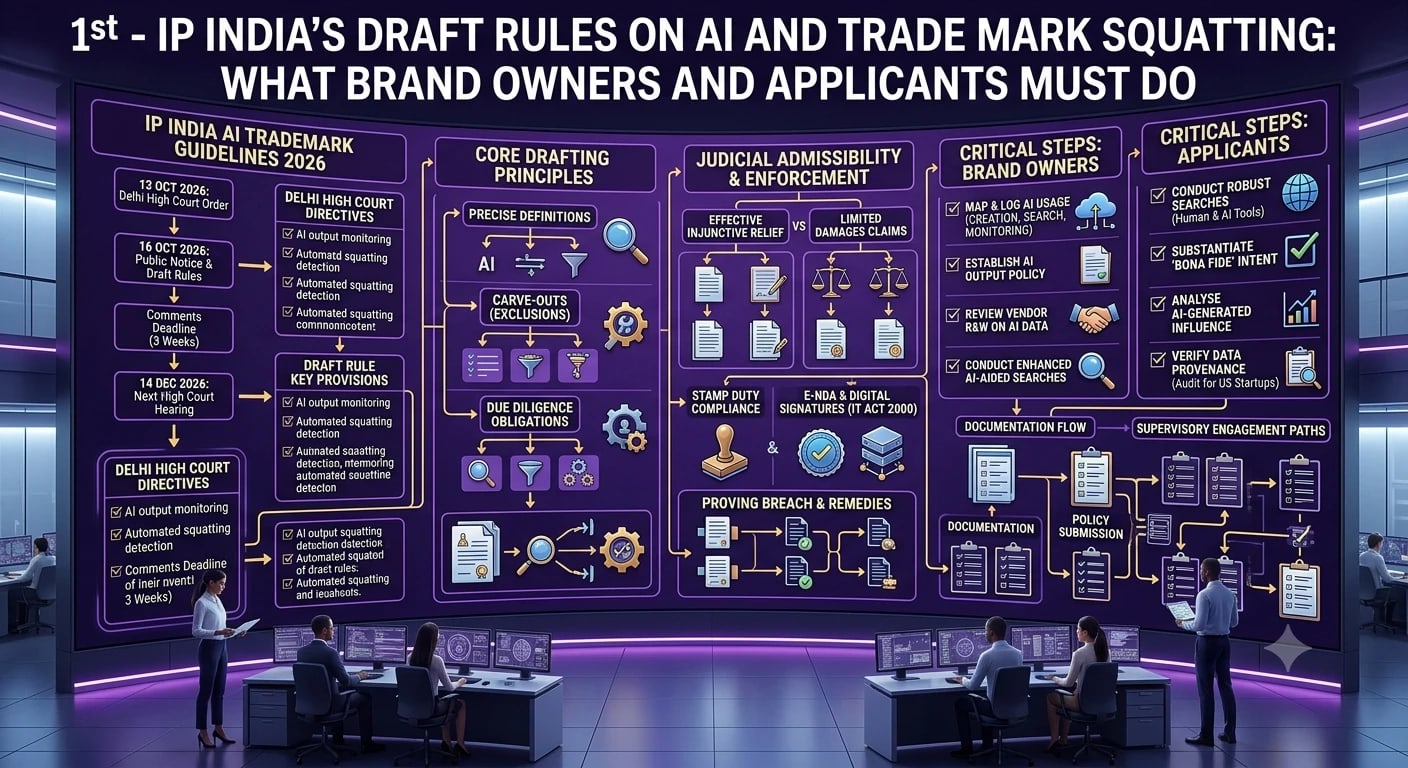
- A Delhi High Court order of 13 October 2026 pushed IP India to frame guidelines on AI misuse and trade mark squatting; a public notice of 16 October invited comments within three weeks.
- The draft is reported to ask for a declaration of AI use and for citations to be checked against a non-AI source, but it is not final.
- Squatting is dealt with through bad faith under Section 11(10), proprietor-only filing under Section 18, opposition under Section 21 and rectification under Section 57.
- Brand owners should file early, keep proof of use, set up a watch and adopt a written rule on AI-assisted filings now.
In October 2026, IP India opened a consultation that every brand owner and trade mark applicant should read. A Delhi High Court order of 13 October 2026 pushed the Trade Marks Registry to frame guidelines on two problems: the careless use of artificial intelligence in filings and hearings, and the squatting of other people’s marks. A public notice dated 16 October invited comments within three weeks. The IP India AI trademark guidelines 2026 are still in draft, but they show where the Registry is heading.
This guide explains what has been reported about the draft, how it connects to squatting and bad faith under the Trade Marks Act, 1999, what applicants and agents should change in their filing practice, and how to use the consultation. The next High Court hearing is reported for 14 December 2026, so the position may move quickly. Read the notice and the draft itself before relying on this summary.
What the draft covers and why now
The background is a writ petition before the Delhi High Court in which the court asked the Registrar to frame guidelines on malicious squatting and on the misuse of AI. Reports of the 13 October 2026 order say the court wanted the Registry to act on both problems together. A public notice from the Controller General of Patents, Designs and Trade Marks followed on 16 October 2026, inviting suggestions within three weeks. Check the notice for the exact closing date, because commentators have read the three-week period differently.
On AI, the reported draft asks parties and agents to declare when AI tools were used in preparing a filing or submission, and to check any case law or citation produced by AI against a reliable non-AI source. This follows a pattern seen in courts abroad, where lawyers have been criticised for filing citations that an AI tool invented. The draft is aimed at proceedings before the Registry, such as examination replies, oppositions and hearings, under the Trade Marks Act, 1999 and the Trade Marks Rules, 2017.
The IP India AI trademark guidelines 2026 are examination and procedure guidance, not a new statute. They will not change the grounds on which a mark can be refused or opposed. What they can change is the discipline expected of applicants, and the way the Registry treats filings that look automated, copied or made in bad faith. Treat the draft as an early warning about the standard of conduct the Registry will expect.
Squatting and bad faith under Indian law
Trade mark squatting means registering or applying for a mark that belongs in substance to someone else, usually a foreign brand that has not yet entered India, in order to block that owner or sell the mark back at a price. The Delhi High Court has described such conduct as bad faith in decisions such as BPI Sports v. Saurabh Gulati, where the court looked at filings made with no intention to use the mark. Verify the exact holding before you cite the case.
The Trade Marks Act gives several tools. Section 11 lets the Registrar refuse a mark that conflicts with an earlier mark or a well-known mark, and Section 11(10) requires the Registrar to consider bad faith at the time of application. Section 18 allows only the proprietor of a mark to apply, so an application by an agent or distributor without authority can be challenged. Section 9 covers marks that lack distinctiveness or are deceptive.
Squatting is not only a foreign brand problem. Indian start-ups find that a competitor, a former employee or a vendor filed their name first. A squatter’s filing can sit in the system for months and cause an objection to your own application. Understanding this background explains why the IP India AI trademark guidelines 2026 have been combined with squatting in the same consultation: both concern the integrity of what is filed.
What applicants and agents should change
Start with your own process. If you or your agent use AI tools to draft replies or research, put in place a short written rule: AI may help with drafting but a person must check every citation, statute reference and date against the original source before filing. Keep a note of which tools were used. If the declaration requirement is adopted, you will be able to answer it in minutes rather than reconstructing events later.
Next, review your filing hygiene. File your key marks early, in the classes you actually use and plan to use, and file the word mark and the logo separately. Record the date you first used each mark in India and keep invoices, advertising and website captures as proof. Authority matters too: where an agent, distributor or founder files in a personal name, record in writing that the company owns the mark, and assign it properly.
Finally, set up a watch. A watch service or regular search of the Trade Marks Journal will show new applications that resemble your mark, so that you can oppose within the four-month window under Section 21. Ask your agent to tell you quickly about any bad faith filing, because the evidence you gather in the first weeks, such as the squatter’s other filings and offers to sell, is often the strongest.
| Area | What to do | Why it matters |
|---|---|---|
| AI use | Allow AI for drafting only, and record which tools were used | A declaration may be required if the draft is adopted |
| Citations | Check every case, statute and date against the original source | AI tools can invent authorities |
| Filing early | File key marks in the classes you use and plan to use, word mark and logo separately | Reduces the room for a squatter |
| Proof of use | Keep dated invoices, adverts and website captures | Supports opposition and priority claims |
| Authority | Record in writing that the company owns each mark and assign it properly | Section 18 allows only the proprietor to apply |
| Watch | Search the Trade Marks Journal or use a watch service | Opposition must be filed within four months |
How to respond and protect your brand
A consultation is a chance to shape the final text. If you are a brand owner, an agent or an industry body, consider submitting practical points: how the AI declaration should work for small filers, whether a template is needed, how the Registry will treat non-compliance, and how squatters will be identified. Short, specific suggestions with examples are more useful than general support. Send them by the method set out in the notice and keep proof of submission.
If a squatter has already filed against you, choose the route that suits the facts. An opposition under Section 21 is the usual first step for a pending application. For a registered mark, a rectification petition can be filed before the High Court under Section 57. Where the squatter is also selling goods or services, a civil suit for passing off and infringement can follow, with an application for an interim injunction. Evidence of your own reputation is central in every route.
Foreign brands should treat India as a market that needs protection before entry. Filing early, directly or through the Madrid Protocol, is cheaper than fighting a squatter later. Use the period before a launch to clear the name, file in the right classes and record your first use. This work is the best defence, and it will also help you meet any new conduct standards that follow the IP India AI trademark guidelines 2026.
Next steps and quick answers
Over the next weeks, read the public notice and the draft, decide whether to submit comments, update your internal AI-use rule, and run a search for squatting against your key marks. Keep an eye on the 14 December 2026 hearing, since the court may give further directions. Treat everything here as general information and take advice on your own filings before the final guidelines are published.
Related reading: trade mark squatting in India for US companies, trade mark squatting in India for UK companies, trade mark registration for startups in India, what a trade mark examination report is asking, defending a UK brand against an Indian trade mark opposition, getting a well-known trade mark declared in India and clearing a brand name for India before a US launch; also IP India’s AI trade mark search and spotting Indian trade mark squatters early.
Quick answers
What are the IP India AI trademark guidelines 2026?
They are draft Registry guidelines, issued after a Delhi High Court order of 13 October 2026, on the use of AI in trade mark filings and hearings and on trade mark squatting. They are open for comments and not final.
Do I have to declare AI use in my trade mark filings now?
Not yet, if the position is as reported: the draft is open for comments. It is wise to adopt the practice now, checking every citation against a non-AI source and keeping a record of the tools used.
What can I do if someone squats my brand in India?
Oppose the application within four months of advertisement, or file a rectification petition against a registered mark, and consider a suit for passing off. Gather evidence of your use, reputation and the squatter’s bad faith early.
When does the comment window close?
A public notice dated 16 October 2026 invited comments within three weeks, but commentators read the closing date differently. Check the notice itself for the exact date.
Is the AI declaration mandatory?
Not yet, as far as reports show: the guidelines are in draft and open for comments. Check the final text before treating any requirement as binding.
Final word
Halverton & Co. is an Indian law firm advising founders, startups, technology companies and investors on Indian law, including trade mark filing, opposition and enforcement, brand protection strategy, technology and AI law, and startup compliance. We practise in Jharkhand, Maharashtra and before the Supreme Court of India, and act as fractional legal counsel for technology-driven businesses. Halverton & Co.: Where tech needs law! If you have a question about Indian law, write to us at office@halvertonandco.com, or get in touch.
This article reflects developments reported up to late October 2026. It is for general information only, is not legal advice, and does not create an advocate-client relationship. Halverton & Co. is an Indian law firm.
Sources
Related practice area
Intellectual Property
Trade marks, copyright, patents and designs. Searched, filed, licensed and enforced under Indian law.
View the practice areaComments
No account needed. Comments are reviewed before they appear, so yours will show here once approved. Please do not share confidential details or describe your own legal matter: replies are general discussion, not legal advice, and do not create an advocate-client relationship. For your own situation, write to office@halvertonandco.com.