A US trademark registration protects your brand in the United States, and only there. Trademark rights are territorial, so if your product is sold in India, your app is downloaded there, or you plan to build a team or raise money there, your US registration gives you no protection in the Indian market. India has a large and fast-growing consumer and developer base, and opportunistic trademark filings by local parties are a well-known risk for foreign brands.
If you want to register a US trademark in India, you have two main routes: extending your US application or registration through the Madrid Protocol, or filing directly with the Indian Trade Marks Registry. This guide compares the two, explains how Indian examination works, and covers costs, timelines, objections and practical tips for US brand owners. If someone has already filed your mark, see our guide to trademark squatting in India.
Why US brands need Indian trademark protection
India’s Trade Marks Act, 1999 gives a registered owner the exclusive right to use the mark for the registered goods and services across India, and a statutory action for infringement. Without registration, a US brand must rely on passing off, which requires proof of goodwill and reputation in India. Indian courts have made clear that reputation must exist among Indian consumers, not just abroad. That can be hard to prove for a young company, however well known it is in the US.
There’s also a practical reason to file early. India protects prior users of a mark, but a local party that files first can still cause years of delay and expense through oppositions, rectification proceedings and litigation. US companies entering India often discover that someone has already applied for their brand, sometimes a former distributor, partner or contractor. Filing before you launch, hire or announce in India is the cheapest protection available.
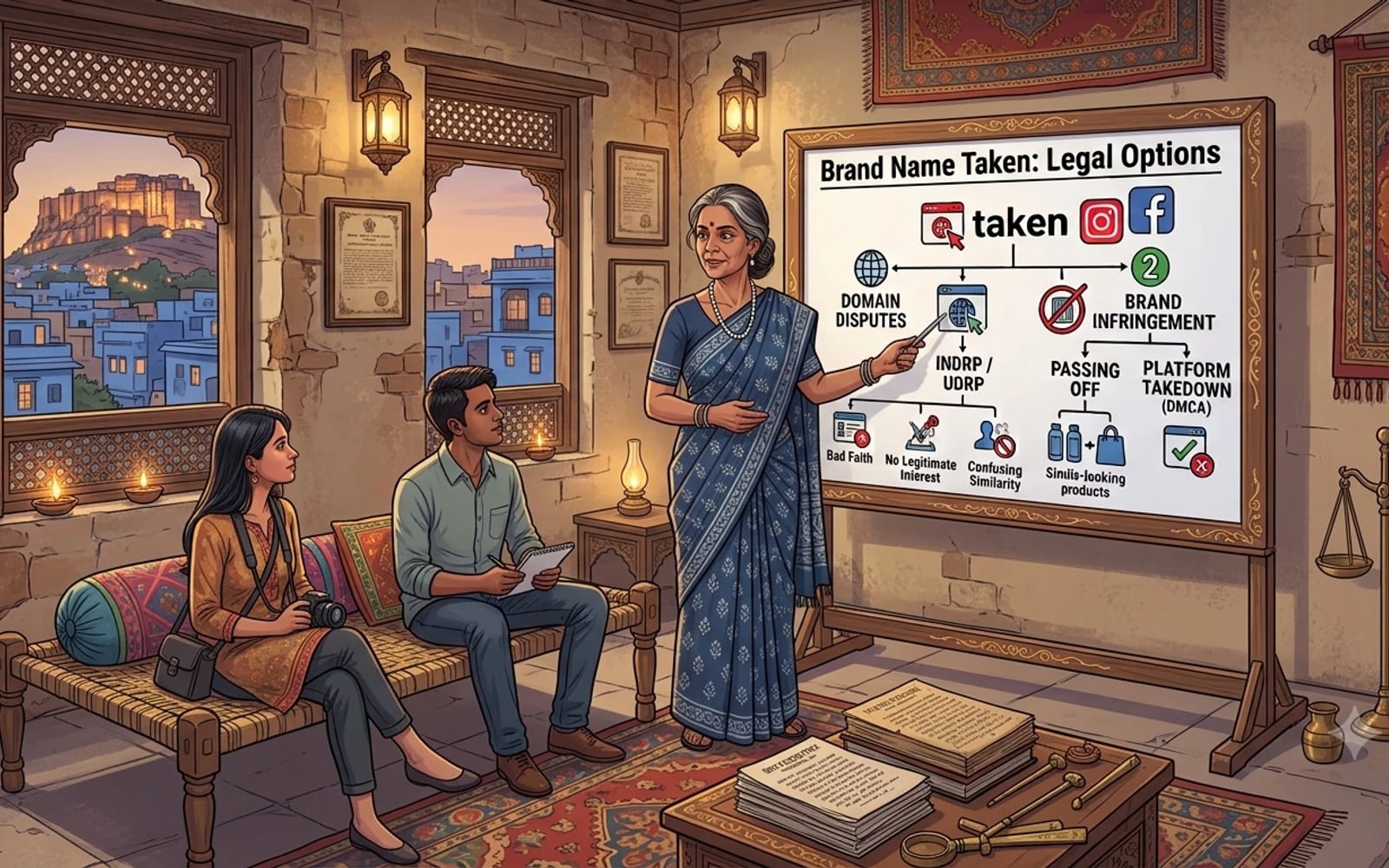
Indian registration also matters for online enforcement. Marketplaces, app stores and social platforms in India respond far faster to a takedown request backed by an Indian registration certificate than to one backed only by a US registration. Domain names and social handles raise related issues; see our guide to brand names, domains and social handles in India.
Route one: the Madrid Protocol
India has been a member of the Madrid Protocol since 2013, so a US applicant can designate India in an international application based on its US application or registration. The international application is filed through the USPTO, which certifies it and forwards it to the World Intellectual Property Organization, which then notifies India. One application, in English, with fees paid in Swiss francs, can cover India and many other countries at the same time.
The advantages are simplicity and central management: one filing, one renewal date and one place to record ownership changes for the whole international portfolio. For a US company protecting its brand in several countries at once, the Madrid route is often the most efficient way to register a US trademark in India.
The disadvantages matter too. For five years, the international registration depends on the US base application or registration, so if the US mark is narrowed or cancelled in that period, the Indian protection can fall with it (“central attack”). The goods and services can’t be broader than the US specification, which is often drafted narrowly to satisfy USPTO practice. And if India issues a provisional refusal, you’ll still need an Indian trademark professional to respond, which reduces the cost advantage.
Route two: direct filing in India
A direct national application is filed with the Indian Trade Marks Registry on Form TM-A, normally through an Indian trademark attorney or agent, because applicants without a place of business in India must give an address for service in India. A single application can cover multiple classes, with a fee for each class. The official e-filing fee has been ₹9,000 per class for companies that don’t qualify as individuals, startups or small enterprises, but check the Registry’s current fee schedule before you budget.
Direct filing gives you flexibility. The specification of goods and services can be drafted for Indian practice and your Indian business plans, rather than copying a narrow US description. The Indian registration stands on its own, with no dependency on the US mark. And it can be filed quickly, which matters if you need to beat a suspected squatter.
The trade-off is administration. A direct Indian registration has its own renewal date (every ten years) and must be managed separately from your international portfolio; see our guide to trademark docketing outsourcing and USPTO deadlines for how firms track those dates. For US companies whose main overseas market is India, or whose Indian business differs from their US business, direct filing is often the better way to register a US trademark in India.
| Madrid Protocol | Direct filing (Form TM-A) | |
|---|---|---|
| How filed | International application through the USPTO, designating India | National application with the Indian Trade Marks Registry, usually through an Indian agent |
| Dependence on US mark | Depends on the US base mark for five years | Stands alone |
| Specification | Cannot be broader than the US specification | Drafted for Indian practice and business plans |
| Management | One renewal date and one record for many countries | Own renewal date every ten years |
| Best for | India as one of several countries in a coordinated program | India as a priority market, or when speed matters |
Examination, objections and timelines in India
Whichever route you choose, the mark is examined under Indian law. Objections usually arise under Section 9 (absolute grounds, such as descriptive or non-distinctive marks) or Section 11 (relative grounds, such as conflicts with earlier Indian marks). Under the direct route, you respond to an examination report and may attend a hearing. Under Madrid, an objection takes the form of a provisional refusal, which must be answered within the time limit set by the Registry. Our guide to what a trade mark examination report is asking walks through a typical objection.
Once accepted, the mark is advertised in the Trade Marks Journal, and anyone can oppose it within four months. A US brand facing an opposition must file a counter-statement within two months of receiving the notice, or the application is treated as abandoned. That deadline is easy to miss if notices go to an outdated address, so make sure your Indian representative’s details are current.
Timelines vary. A clean application may be registered within roughly a year, while objections or oppositions can extend the process significantly. Indian registrations are valid for ten years and can be renewed indefinitely. For the Indian filing steps in detail, see our guide to trademark registration for startups in India.
Choosing a route, remedies and quick answers
As a rule of thumb, use Madrid when India is one of several countries in a coordinated international filing program and your US specification fits your Indian business. File directly when India is a priority market, when you need a broader or different specification, when you want independence from the US mark, or when speed matters because of a squatting risk. Many companies use both: Madrid for most countries and a direct Indian filing for their core brand.
If someone has already filed your mark in India, the remedies include opposing their application, applying for rectification of a registration on grounds such as bad faith or non-use, and suing for passing off if you have reputation in India. We cover each in our guide to trademark squatting in India. Companies planning a wider India entry should also read our guide to setting up an Indian subsidiary.
Quick answers
Can I register a US trademark in India through the Madrid Protocol?
Yes. India is a Madrid member, so a US applicant can designate India in an international application filed through the USPTO.
Is direct filing in India better than Madrid?
It depends. Direct filing offers flexibility and independence from the US mark; Madrid offers central management across many countries.
How long does it take to register a trademark in India?
A clean application may register within about a year, but objections or oppositions can take considerably longer.
Related reading: the UK-India trade deal checklist; also protecting a UK trade mark in India.
Final word
Halverton & Co. is an Indian law firm that advises on Indian law, including trademark clearance, filing and enforcement in India for US brands. We practice in Jharkhand, Maharashtra and before the Supreme Court of India, and we work alongside US counsel, who advise on US law. Halverton & Co.: Where tech needs law! If you have a question about Indian law, write to us at office@halvertonandco.com, or get in touch.
This article reflects developments reported up to early October 2026. It is for general information only, is not legal advice, and does not create an attorney-client relationship. Halverton & Co. is an Indian law firm and does not advise on US law.
Related practice area
Intellectual Property
Trade marks, copyright, patents and designs. Searched, filed, licensed and enforced under Indian law.
View the practice area