Key takeaways
- An objection is a notice that you must answer, not a rejection, and many applications proceed after a reasoned reply or hearing.
- The main grounds are Section 9 (distinctiveness and description) and Section 11 (conflicts with earlier marks).
- The ‘about 60% success’ figure comes from a commercial blog, not the Registry; a vendor estimates 30 to 40% receive an objection.
- A pre-filing search, a distinctive mark, the right classes and a precise specification prevent most problems.
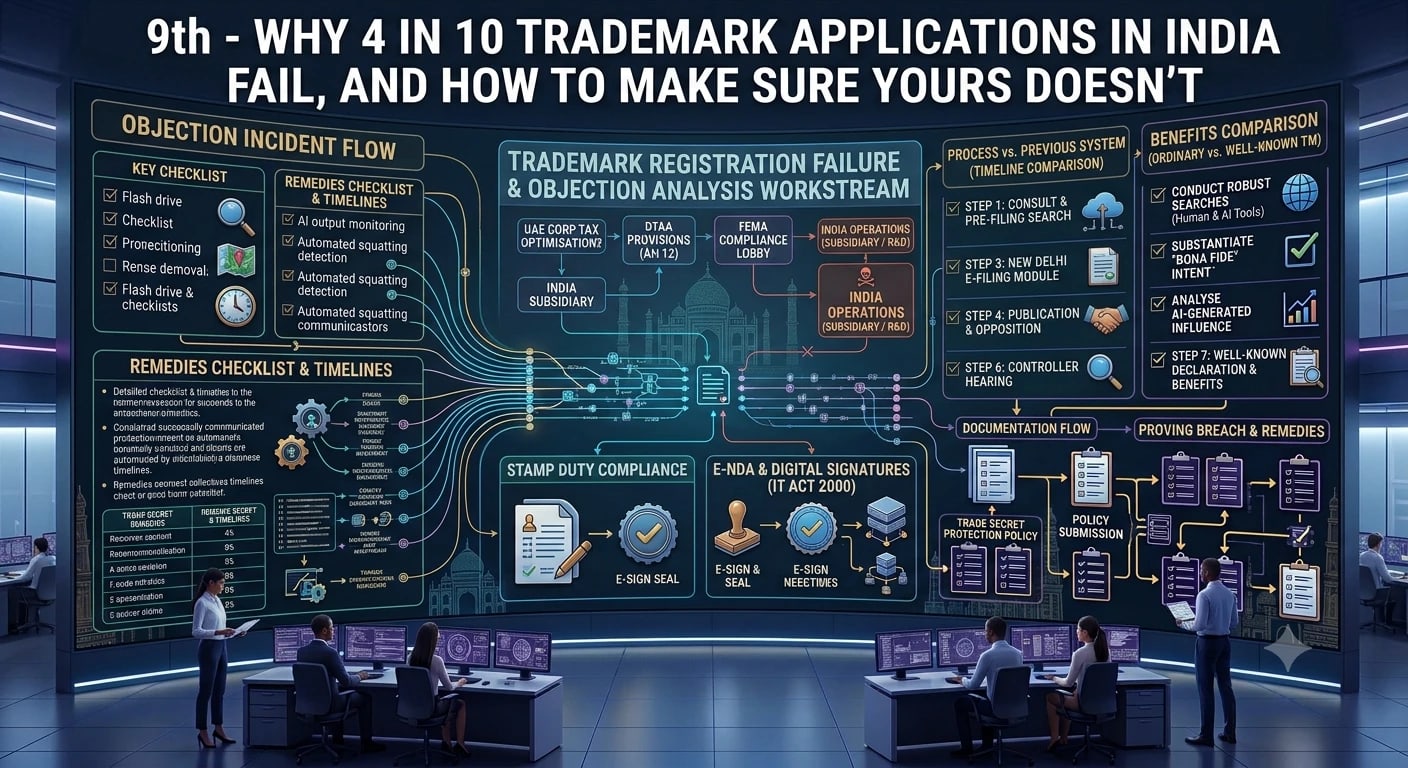
A frequently quoted estimate says that about four in ten trade mark applications in India do not make it to registration. The figure comes from commercial analyses of 2019 to 2023 filings, not from an official Registry statistic, so treat it as a rough guide. What is certain is that many applications receive an objection, and a good number are refused or abandoned. Understanding trademark objection India reasons is the best way to avoid being in that group.
This guide explains what an objection is, the main grounds under Sections 9 and 11 of the Trade Marks Act, 1999, the mistakes that most often lead to refusal or abandonment, the deadlines to meet and a checklist that raises your chances. It is general information for founders and brand owners, and a professional search and opinion before filing will always help.
What an objection is and what the numbers say
After you file, the Registry examines your application and issues an examination report. If it finds a problem, the report raises objections under the Act. An objection is not a rejection. It is a notice that you must respond to, with arguments, evidence or amendments, usually within a set time. Many applications that are objected eventually proceed to registration after a reasoned reply or a hearing. Knowing trademark objection India reasons early shortens the process.
The 60% figure that circulates, said to be India’s average success rate for 2019 to 2023, comes from a trade mark services blog and does not clearly cite its data. A vendor also estimates that 30 to 40% of applications receive at least one objection. These are not official numbers, and the true rates depend on how you count refused, abandoned and withdrawn applications. Treat them as indications of risk.
What is not in doubt is the pattern. Most problems arise from the same few causes, and most can be avoided before filing. If you understand the grounds and the process, you can design your mark and your application to meet them. That is the aim of this guide on trademark objection India reasons: to turn a vague worry into a checklist.
The main grounds for objection
Section 9 sets absolute grounds. A mark may be refused if it lacks distinctive character, if it consists only of signs that describe the kind, quality, quantity, purpose or origin of the goods, or if it has become customary in the trade. It may also be refused if it is likely to deceive the public or cause confusion, contains matter likely to hurt religious feelings, or is obscene. Common words and descriptive terms fall here.
Section 11 sets relative grounds. A mark may be refused because it is identical or similar to an earlier mark for identical or similar goods or services, with a likelihood of confusion, or because it is similar to a well-known mark. A mark may also be refused where use would be prevented by passing off or copyright. Most conflict objections arise because the applicant did not search the register before filing.
| Ground | Section | Typical example |
|---|---|---|
| Lack of distinctiveness | Section 9(1)(a) | A plain word for the goods |
| Descriptive of the goods | Section 9(1)(b) | A word naming quality, kind or purpose |
| Customary in the trade | Section 9(1)(c) | A sign everyone uses |
| Deceptive or offensive | Section 9(2) | Misleading or hurtful matter |
| Conflict with an earlier mark | Section 11 | A similar mark for similar goods |
| Applicant not the proprietor | Section 18 | An agent filing without authority |
Other objections are practical. The goods may be described in vague or incorrect terms, the class may be wrong, the claimed date of first use may lack proof, or the applicant’s details may be incomplete. Marks that contain protected emblems, national flags or names covered by special laws, or geographical names, can also attract objections. Each ground needs a different type of reply.
Mistakes that lead to refusal or abandonment
The first mistake is filing without a search. Applicants choose a name they like, file, and find that it is close to an existing mark. A pre-filing search of the register, the Journal and the market reveals most conflicts. The second mistake is choosing a weak mark. A name that describes the product, such as a plain word for the goods, is hard to register. A coined or arbitrary word is stronger. Most trademark objection India reasons trace back to a missing search.
The third mistake is missing deadlines. An examination report must be answered within the time set by the Rules, which is a short period from the date of the report, and failure to reply leads to the application being treated as abandoned. Similarly, an opposition notice must be answered with a counter-statement within two months. Check your email, the portal and your agent’s reminders, because notices are often sent electronically.
The fourth mistake is a poor reply. A reply that only repeats that the marks are different, without comparing them or giving evidence, often fails. Arguments about distinctiveness need proof of use, such as invoices, advertising and awards, to show that the mark has acquired distinctiveness. A reply about similarity should compare sound, appearance and meaning and the goods. The fifth mistake is filing through an unreliable intermediary who gives no copies of correspondence.
Replying to an objection
Read the report carefully and identify each ground. Many reports list several. Prepare a reply that deals with each point in turn, with legal arguments, case law where useful and evidence. If a conflicting mark is cited, check its status, its owner and its goods. You may argue that the marks are different, that the goods differ, or that the cited mark is vulnerable. You may also seek consent from the owner of the earlier mark. A reply tailored to the trademark objection India reasons cited is more likely to succeed.
If the Registrar is not satisfied by the reply, a hearing may be fixed, or a show-cause notice may be issued. Prepare a short note, the evidence and a comparison of the marks. Attend the hearing, either in person or by video, as the Registry allows. After the hearing, the Registrar may accept the mark, accept it with conditions, or refuse it. A refusal can be appealed to the High Court within the time allowed.
If the mark is accepted, it is advertised in the Trade Marks Journal, and third parties have four months to oppose. Many marks are registered after that period without opposition. If you receive an opposition, you must file a counter-statement. At every stage, keep copies of all documents, check the status regularly, and respond within time. Professional help is valuable at the reply and hearing stages.
Next steps and quick answers
Before you file, run a thorough search, pick a distinctive mark, choose the right classes and describe the goods precisely, collect proof of use if you claim prior use, and file in your own name. After you file, track the status and respond within time. Use a named advocate or registered agent, and ask for copies of everything. If you get an objection, treat it as a task with a deadline, not as a final answer. This is general information, not legal advice.
Related reading: what a trade mark examination report is asking, preparing for a trade mark show cause hearing, trade mark registration for startups in India, the fake filing sites warning, how to check a trade mark in India for free, Indian trade mark classes explained and the startup name checklist for 2026; also replying to a trademark examination report in India and Section 9 and Section 11 trademark objections; also trademark status meanings in India.
Quick answers
What are the most common trademark objection India reasons?
The most common are lack of distinctiveness or descriptiveness under Section 9, similarity to an earlier mark under Section 11, vague or wrong goods descriptions and classes, and missing proof of use. Most can be reduced by a search and careful drafting.
How many trademark applications fail in India?
There is no official figure in the sources we found. One commercial analysis puts the success rate at about 60% for 2019 to 2023, and vendors estimate that 30 to 40% receive an objection. Treat these as rough estimates.
What happens if I do not reply to an examination report?
The application is treated as abandoned. Reply within the time allowed, and take advice quickly if you have missed a date.
Is the 4 in 10 failure rate official?
No. It comes from commercial analyses of 2019 to 2023 filings and vendor estimates, not from an official Registry statistic. Treat it as a rough guide to risk.
What if I miss the reply deadline?
The application is treated as abandoned. Reply within the time allowed and take advice at once if you have missed a date.
Final word
Halverton & Co. is an Indian law firm advising founders, startups, technology companies and investors on Indian law, including trade mark filing, objection replies, hearings and oppositions, and brand protection for startups and businesses. We practise in Jharkhand, Maharashtra and before the Supreme Court of India, and act as fractional legal counsel for technology-driven businesses. Halverton & Co.: Where tech needs law! If you have a question about Indian law, write to us at office@halvertonandco.com, or get in touch.
This article reflects developments reported up to 31 October 2026. It is for general information only, is not legal advice, and does not create an advocate-client relationship. Halverton & Co. is an Indian law firm.
Sources
Related practice area
Intellectual Property
Trade marks, copyright, patents and designs. Searched, filed, licensed and enforced under Indian law.
View the practice areaComments
No account needed. Comments are reviewed before they appear, so yours will show here once approved. Please do not share confidential details or describe your own legal matter: replies are general discussion, not legal advice, and do not create an advocate-client relationship. For your own situation, write to office@halvertonandco.com.